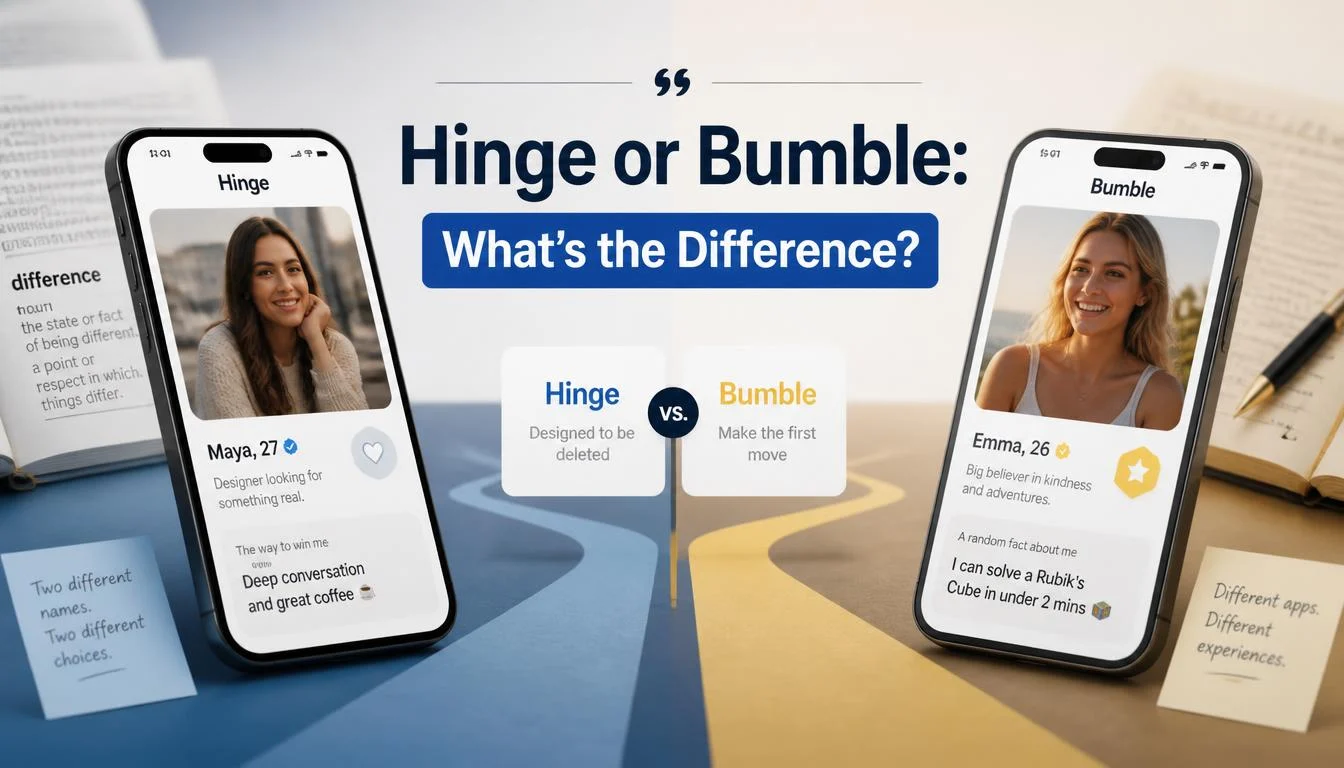
Quick Answer
Hinge and Bumble are both correct names, but they are different dating apps. Hinge focuses on profiles and prompts that encourage conversation, while Bumble offers a broader dating experience with its own matching and messaging features.
Choosing between Hinge or Bumble can be confusing because both apps are designed to help people meet potential matches, yet they approach online dating in different ways. Hinge is known for profiles that encourage users to share more about their personality through prompts, photos, and responses, while Bumble has built its identity around a different matching and messaging experience. Understanding these differences can make it easier to decide which platform fits the kind of dating experience you want.
The choice between Hinge or Bumble often comes down to more than the number of users or basic features. Profile design, matching tools, messaging rules, dating preferences, and overall app experience can all affect how you interact with potential matches. In this guide, we’ll compare Hinge and Bumble in clear, practical terms so you can understand how each app works and identify the differences that matter most for your own dating preferences.
Which One Is Correct?
Both Hinge and Bumble are correct when you are referring to the dating apps.
They are not alternative spellings of the same word. They are separate brand names with different identities and product features.
| Name | Correct? | What it refers to |
|---|---|---|
| Hinge | Yes | A dating app and brand |
| Bumble | Yes | A dating app and brand |
| hinge | Yes, as an ordinary English word | A mechanical joint or connection point |
| bumble | Yes, as an ordinary English word | To move, work, or speak awkwardly |
The capitalized forms Hinge and Bumble normally refer to the brands. The lowercase forms hinge and bumble can have ordinary dictionary meanings.
For example:
- “I met her on Hinge.” correct brand usage.
- “He found a loose hinge on the door.” correct ordinary-word usage.
- “They connected on Bumble.” correct brand usage.
- “I sometimes bumble through my explanation.” correct ordinary-word usage.
So, if you are asking “Hinge or Bumble?”, you are comparing two names, not choosing between a correct and incorrect spelling.
Meaning of the Correct Word: Hinge
Definition
The word hinge is an ordinary English noun referring to a device that connects two objects while allowing one to move relative to the other.
A door hinge is the classic example. It allows the door to swing open and closed.
As a verb, hinge means to depend on something or to be determined by it.
For example:
“The decision hinges on the final report.”
When capitalized as Hinge, the word refers to the dating brand.
Explanation
The everyday word hinge has a strong connection with the idea of a turning point or connection. A physical hinge allows movement between two connected parts.
The brand name Hinge uses this familiar word as its identity. In dating related writing, however, Hinge should normally be treated as a proper noun because it identifies a specific service.
Capitalization therefore matters in some contexts.
Compare these sentences:
- “The cabinet door needs a new hinge.”
- “She created a profile on Hinge.”
The first sentence uses a common noun. The second uses a brand name.
Usage
When writing about the dating app, use Hinge with a capital H.
Common expressions include:
- Hinge profile
- Hinge app
- Hinge match
- Hinge prompt
- Hinge date
- Hinge conversation
- Hinge profile picture
You may also see informal expressions such as “a Hinge match” or “met on Hinge.” These are natural in casual writing.
Real-World Examples
Here are several examples showing how Hinge works in context:
- “I downloaded Hinge after hearing about it from a friend.”
- “His Hinge profile has several interesting prompts.”
- “They matched on Hinge last month.”
- “She started a conversation with a response to his Hinge prompt.”
- “We met through Hinge and eventually went on a date.”
Notice that Hinge stays capitalized because it functions as the name of a brand.
Meaning of the Incorrect or Alternative Word
Neither word is actually incorrect. In this comparison, Bumble is better described as the alternative brand name, rather than an incorrect word.
Incorrect
Bumble is not an incorrect spelling of Hinge.
Likewise, Hinge is not an incorrect spelling of Bumble. They identify separate dating apps.
Writing “I met someone on Hinge” when you mean Bumble is not a spelling mistake. It is a mistake of reference because you have named the wrong service.
Typo
A typo can occur with either brand.
Examples might include:
- “Hignge” instead of “Hinge”
- “Bummble” instead of “Bumble”
- “Bumblee” instead of “Bumble”
These are typographical errors because they do not correctly reproduce the brand names.
However, typing hinge instead of Hinge is not necessarily a typo. In ordinary English, lowercase hinge is a valid word. The issue is capitalization when you intend to identify the brand.
Slang
Neither Hinge nor Bumble is simply slang for the other.
People may use informal expressions involving either app in casual conversations. For example, someone might say, “I found him on Hinge,” or “We matched on Bumble.”
Those expressions are informal, but the names themselves remain brand names.
Regional Variation
Hinge and Bumble are not regional spelling variants.
An American writer does not use Hinge while another English-speaking region uses Bumble to mean the same thing. The names refer to different services.
You should therefore avoid treating this comparison like color vs. colour or license vs. licence.
Rare but Valid Usage
The lowercase words have independent meanings outside dating.
Hinge can describe a mechanical joint:
“The gate swung on its hinge.”
Bumble can function as a verb meaning to move, speak, or act awkwardly:
“He began to bumble through his explanation.”
Bumble can also appear in expressions such as “bumble along,” describing slow or awkward progress.
These dictionary meanings remain valid even though Hinge and Bumble are also well-known brand names.
Key Differences Between the Two Words
The biggest difference is not grammar. It is reference.
| Feature | Hinge | Bumble |
|---|---|---|
| Spelling | Hinge | Bumble |
| Meaning as a brand | Dating app | Dating app |
| Ordinary English meaning | A joint that allows movement | To act or move awkwardly |
| Pronunciation | “hinj” | “BUM-buhl” |
| Grammar as a brand | Proper noun | Proper noun |
| Brand capitalization | Hinge | Bumble |
| Usage | Refers to the Hinge platform | Refers to the Bumble platform |
| Recognition | Widely recognized brand name | Widely recognized brand name |
| Is it a spelling variant? | No | No |
| Is it incorrect? | No | No |
Pronunciation Differences
Hinge is pronounced approximately “hinj.”
It has one syllable and rhymes closely with words such as fringe and singed in many varieties of American English.
Bumble is pronounced approximately “BUM-buhl.”
It has two syllables, with the first syllable receiving the main stress.
These pronunciations are completely different, just like the brands themselves.
Grammar Differences
When referring to the companies or apps, both names function as proper nouns.
That means capitalization is appropriate:
- “I downloaded Hinge.”
- “She uses Bumble.”
When referring to the ordinary dictionary words, they can have different grammatical roles.
Hinge can be a noun or verb:
- “The door has a broken hinge.” noun
- “The outcome hinges on timing.” verb
Bumble can function primarily as a verb:
- “He bumbled through the interview.”
- “She bumbled the instructions.”
The related noun bumble can also describe an awkward mistake or blunder in some contexts.
Common Mistakes People Make
Because Hinge and Bumble are both dating-app names, writers sometimes use them as if they were interchangeable. They are not.
Mistake 1: Treating Them as Spellings of One Word
Incorrect assumption:
“Hinge and Bumble are two ways to spell the same app.”
That is false. They are distinct brand names.
Mistake 2: Calling Bumble a Misspelling of Hinge
If someone writes “Bumble” when they mean Hinge, the problem is not spelling. They have identified a different platform.
The same applies in reverse.
Mistake 3: Forgetting Capitalization
When referring to the brands, write:
- Hinge
- Bumble
When referring to ordinary objects or actions, lowercase may be correct:
- a door hinge
- to bumble through something
Capitalization helps readers understand which meaning you intend.
Mistake 4: Assuming the Apps Work Exactly the Same Way
The names may appear together in dating-app discussions, but that does not make their features identical.
People should check the current features, policies, and availability of each platform rather than assuming that one app works exactly like the other.
Mistake 5: Using the Brand Name as a Generic Noun
A sentence such as “I downloaded a hinge” changes the meaning completely.
If you mean the dating app, write:
“I downloaded Hinge.”
The capital letter signals that you mean the brand.
Correct Usage Examples
Casual Examples
Casual conversations often use the brand names without additional explanation.
- “Are you on Hinge?”
- “I matched with someone on Bumble.”
- “We started talking on Hinge.”
- “She met her partner through Bumble.”
- “Have you tried Hinge or Bumble?”
- “I deleted Bumble for a while.”
These examples sound natural because the names clearly refer to dating platforms.
Professional Examples
Formal writing should capitalize both names when discussing the brands.
- “Hinge and Bumble are separate dating platforms.”
- “The article compares features offered by Hinge and Bumble.”
- “Users should review each platform’s current terms and privacy information.”
- “The report discusses how dating apps such as Hinge and Bumble facilitate online connections.”
Avoid treating either name as a generic term for all dating apps.
Educational Examples
Teachers and writers can use the names when explaining proper nouns or brand names.
- “Hinge is a proper noun when it refers to the dating app.”
- “Bumble is capitalized when it refers to the dating brand.”
- “The lowercase word hinge has a separate dictionary meaning.”
- “The verb bumble describes awkward or clumsy action.”
These examples make the capitalization distinction especially clear.
Literary/Metaphorical Examples
The ordinary meanings of the words can also appear in figurative writing.
For hinge:
“The entire plan hinged on one final decision.”
Here, hinged means depended on.
For bumble:
“He bumbled through the unfamiliar instructions.”
Here, bumbled suggests awkward or clumsy performance.
These meanings have nothing to do with the dating brands.
Word Origin / Etymology
Hinge
The ordinary English word hinge has a long history in the language. It developed from older Germanic forms associated with a joint or connection that permits movement.
Its physical meaning became firmly established around the idea of a movable connection between two parts.
The verb hinge later developed from this physical concept. Saying that something “hinges on” another thing creates a metaphor: just as a door depends on its hinge for movement, an outcome can depend on a particular condition.
The modern brand name Hinge draws on this familiar English word rather than representing an alternate spelling.
Bumble
The English word bumble has an older history as well. It has been used to describe buzzing or humming sounds and later developed senses involving awkward movement, confusion, or clumsy action.
The word can therefore suggest something noisy, busy, awkward, or uncoordinated depending on context.
The brand name Bumble uses this existing English word as its name. As with Hinge, the brand meaning is separate from the ordinary dictionary meaning.
Why the Incorrect Version Became Popular
There is no true “incorrect version” in hinge or bumble.
This is an important distinction because many word-comparison searches involve a genuine spelling mistake. For example, one form may be standard while the other is a typo. That is not the situation here.
The confusion comes from the fact that Hinge and Bumble belong to the same broad category: dating apps. People often encounter the names together when discussing online dating.
Searches may therefore resemble spelling questions even though they are really brand comparison questions.
Another source of confusion is the lowercase English vocabulary:
- hinge is a normal English word.
- bumble is also a normal English word.
This gives each name two possible contexts. The surrounding sentence usually reveals which meaning the writer intends.
For example:
“The hinge on my door is loose.”
Here, the sentence clearly concerns hardware.
Compare it with:
“I met my partner on Hinge.”
The capital letter and context identify the dating platform.
The same principle applies to Bumble:
“He tends to bumble when he gets nervous.”
versus:
“She created a Bumble profile.”
The words are therefore not competitors in spelling. They are different words that also serve as brand names.
Easy Memory Tricks
A simple way to remember the difference is to connect each name with its ordinary meaning.
Think of a Door for Hinge
A hinge connects two parts and allows movement.
Think:
Hinge = connection and movement.
When you see Hinge with a capital H in a dating conversation, remember that it is the brand name.
Think of Awkward Action for Bumble
To bumble means to act or move awkwardly.
Think:
Bumble = awkward action.
When you see Bumble with a capital B, it identifies the brand.
Remember: They Are Both Correct
The most useful memory trick is simple:
Hinge and Bumble are not spelling choices. They are two different names.
If someone asks, “Which spelling is correct, Hinge or Bumble?” the answer is that both spellings are correct, but they refer to different things.
FAQs
Is Hinge the same as Bumble?
No. Hinge and Bumble are separate dating apps with different brand identities and features.
Is Bumble a misspelling of Hinge?
No. Bumble is not a misspelling of Hinge. It is the name of a different dating brand.
How do you pronounce Hinge?
Hinge is pronounced approximately “hinj,” with one syllable.
How do you pronounce Bumble?
Bumble is pronounced approximately “BUM-buhl,” with two syllables.
Should Hinge be capitalized?
Yes, capitalize Hinge when you mean the dating brand. Use lowercase hinge for the ordinary English word.
Should Bumble be capitalized?
Yes, capitalize Bumble when referring to the dating brand. Lowercase bumble is used for the ordinary English word.
Are Hinge and Bumble grammar differences?
No. The main distinction is not grammar. They are separate brand names that also happen to be ordinary English words.
Which word is correct, Hinge or Bumble?
Both are correct. Hinge and Bumble refer to different dating apps, so the correct name depends on which platform you mean.
Conclusion
When comparing hinge or bumble, remember that both names are correct and refer to different dating apps.Hinge is also an ordinary word for a movable joint, while bumble describes awkward action or movement.Use capital letters when referring to the brands, and lowercase forms for their ordinary dictionary meanings.The easiest rule is simple: Hinge and Bumble are different names, not different spellings.
Read More Articles
- Combating or Combatting | Meaning, Spelling and Usage In 2026
- HDMI or DisplayPort | A Complete Guide to Choosing the Right Connection In 2026

Andrew Cooper is a blogger and writer at Gramscript.com, turning everyday ideas into clear, engaging stories. His writing blends curiosity, insight and a genuinely human perspective.