Quick Answer
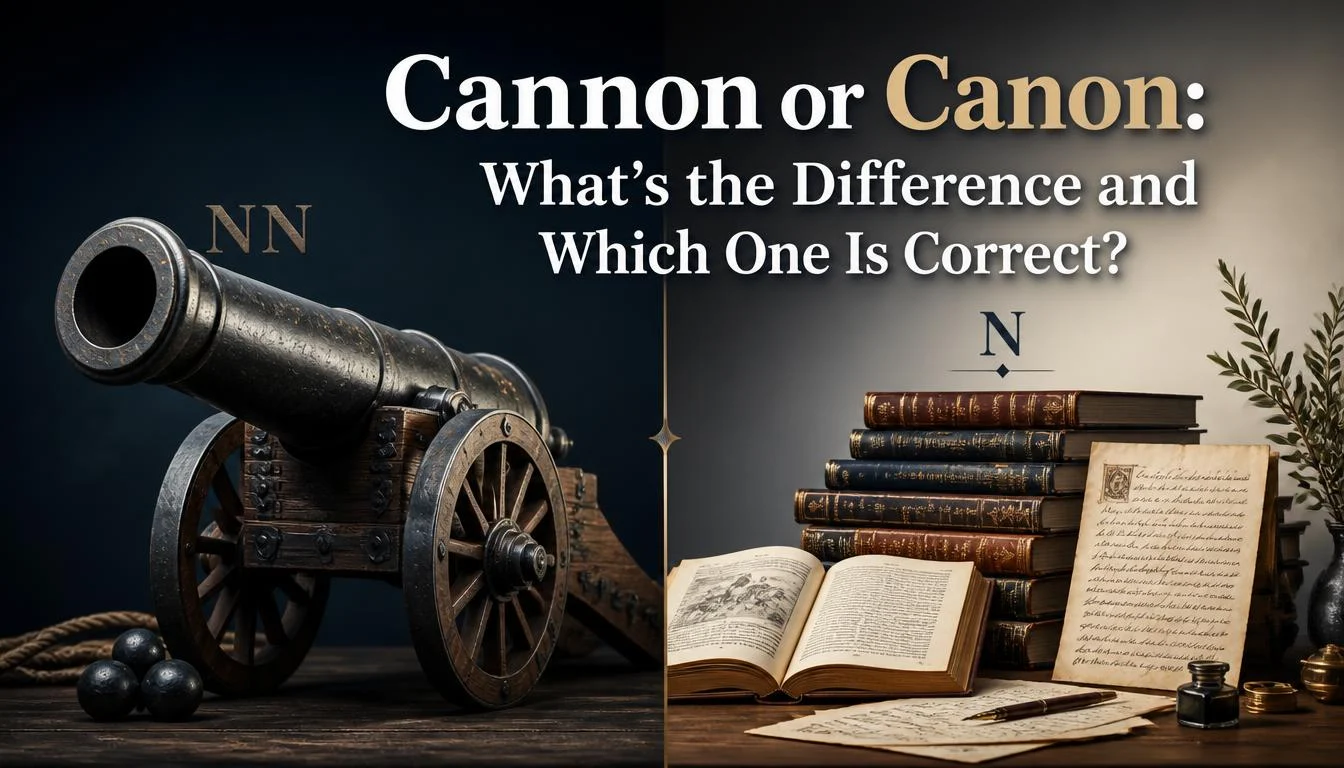
Cannon means a large gun or artillery weapon, while canon refers to an accepted set of works, rules, or principles.
Both words are correct, but they have completely different meanings and uses.
Cannon or canon may look almost identical, but these two words have completely different meanings. Cannon usually refers to a large gun designed to fire heavy projectiles, while canon has several meanings, including an accepted collection of works, an established rule or principle, or an official list of religious texts. Because they differ by only one letter, it is easy to confuse them when writing.
Knowing the difference between cannon or canon becomes especially useful when you are discussing literature, religion, history, or military subjects. For example, you might write about a medieval cannon in a history article, but refer to the literary canon when discussing widely recognized works of literature. This guide explains the meaning, spelling, pronunciation, and correct usage of both words, with clear examples to help you choose the right one confidently.
Which One Is Correct?
Both cannon and canon are correct English words. The right choice depends entirely on what you mean.
Cannon is a noun that usually means a large, heavy gun designed to fire projectiles. It can also refer to certain types of artillery.
Canon has several meanings. It can describe an accepted collection of literary or artistic works, an official set of religious texts, a rule or principle, or the established material considered authentic within a fictional universe.
The simplest distinction is:
- Cannon = a large gun
- Canon = an accepted collection, rule, or official body of work
For example:
The soldiers moved the cannon into position.
But:
Shakespeare is central to the English literary canon.
Both sentences are correct because the words serve different purposes.
Meaning of the Correct Word
Definition
Cannon is a noun meaning a large gun, especially one designed to fire a heavy projectile. Historically, cannons were important weapons used in warfare, fortifications, and naval battles.
The word can describe both historical artillery and certain modern weapons classified as cannons.
In contrast, canon is a noun with several established meanings. It can refer to an accepted collection of books or works, a recognized body of religious writings, or a set of rules and principles.
In fiction, canon also describes material officially accepted as part of a story’s established universe.
Explanation
The difference becomes clearer when you look at context.
If you are talking about a battlefield, artillery, a ship’s weapon, or a heavy gun, use cannon.
If you are talking about books, religious texts, accepted rules, artistic works, or official fictional events, use canon.
Consider these examples:
The museum displays a medieval cannon.
Here, cannon refers to a weapon.
The novel is considered part of the literary canon.
Here, canon refers to a recognized collection of important literature.
The meanings do not overlap in ordinary modern English.
Usage
Cannon is most commonly used as a noun.
It can appear in historical, military, nautical, and technical contexts.
Examples include:
- naval cannon
- artillery cannon
- bronze cannon
- cannon fire
- cannonball
- antique cannon
Canon is also primarily a noun, but its context varies widely.
You may see it in:
- literary criticism
- religious studies
- film discussions
- music
- art history
- philosophy
- academic writing
- fan communities
The phrase literary canon is especially common. It describes works widely recognized as significant within a particular literary tradition.
Real-World Examples
Here are several examples that show the difference naturally:
The old fortress still contains a restored cannon.
The professor discussed the works included in the American literary canon.
The ship carried several cannons during the naval battle.
The church established a canon of accepted religious writings.
Fans often debate whether a particular episode is part of the show’s official canon.
Notice how the subject determines the spelling.
Weapons take cannon. Collections, rules, and official bodies of work take canon.
Meaning of the Incorrect or Alternative Word
Incorrect
Neither word is inherently incorrect. Cannon and canon are both standard English words.
The mistake happens when someone uses the wrong word for the intended meaning.
For example:
Shakespeare belongs to the literary cannon.
This spelling is incorrect in context because Shakespeare belongs to a literary canon, not a weapon.
Likewise:
The soldiers loaded the canon.
This is incorrect if the writer means a large gun. The correct word is cannon.
Typo
A misspelling often occurs because the words are pronounced similarly.
Writers may accidentally leave out the second n in cannon. Others may add an unnecessary n when they mean canon.
Spell-checkers may not always catch this type of error because both words are legitimate English terms.
That makes context especially important.
Slang
Neither cannon nor canon is simply a slang spelling of the other.
However, cannon can appear informally in phrases or metaphors. For example, someone might describe a powerful athlete’s arm as a “cannon.”
Canon is also common in informal online discussions, especially when fans discuss whether a character, relationship, event, or storyline is officially part of a fictional universe.
Regional Variation
The distinction between cannon and canon is not primarily a regional spelling difference.
American English and British English use both words with the same basic distinction.
You should not choose cannon because you are writing for an American audience or canon because you are writing for a British audience. The intended meaning determines the spelling.
Rare but Valid Usage
Both words have specialized meanings beyond their most familiar definitions.
Cannon can refer to certain large firearms in historical and military terminology. It may also appear metaphorically when describing something powerful.
Canon has an especially broad range of specialized meanings. In religion, it can refer to officially accepted scriptures or laws. In literature, it can describe works recognized as important or influential. In fiction, it identifies material accepted as officially belonging to a story’s continuity.
So, while beginners often learn one meaning for each word, both have deeper uses.
Key Differences Between the Two Words
| Feature | Cannon | Canon |
|---|---|---|
| Spelling | C-A-N-N-O-N | C-A-N-O-N |
| Meaning | A large gun or artillery weapon | An accepted collection, rule, or body of work |
| Pronunciation | KAN-un | KAN-un |
| Grammar | Usually a noun | Usually a noun |
| Common usage | Military, historical, naval, metaphorical | Literature, religion, art, fiction, rules |
| Recognition | Commonly recognized as a weapon | Commonly recognized as a collection or standard |
| Example | The cannon fired across the field. | The novel entered the literary canon. |
Why Their Pronunciation Causes Confusion
In standard American English, cannon and canon are generally pronounced the same way: KAN-un.
This makes them homophones, meaning they sound alike but have different spellings and meanings.
Because listeners cannot see the spelling, the distinction becomes especially important in writing.
For example, if someone says:
“The book is part of the canon.”
You can understand the meaning from the context. But when writing the sentence, you must choose the correct spelling.
Why the Extra “N” Matters
The additional n in cannon is not decorative. It separates the word from canon and signals a completely different meaning.
A useful visual comparison is:
CANON → collection, rule, official story
CANNON → weapon
That single extra letter can change the entire meaning of a sentence.
Common Mistakes People Make
One of the most common errors is using cannon when discussing literature.
Incorrect:
Jane Austen is part of the English literary cannon.
Correct:
Jane Austen is part of the English literary canon.
Another common mistake appears in discussions about fictional universes.
Incorrect:
That event isn’t cannon.
Correct:
That event isn’t canon.
Here, canon means the material officially recognized as part of the fictional story.
The opposite mistake happens when discussing weapons.
Incorrect:
The museum restored an old canon.
Correct:
The museum restored an old cannon.
Writers also sometimes confuse canon with cannon because spell-check software accepts both. A grammar checker may recognize the spelling without understanding your intended meaning.
The best solution is to proofread according to context rather than spelling alone.
Mistake With Literary Canon
The phrase literary canon is standard.
Use it when referring to works regarded as important, influential, or traditionally studied within literature.
The course explores works from the Western literary canon.
Do not write literary cannon unless you are deliberately making a joke or wordplay.
Mistake With Fictional Canon
In fandom discussions, canon means officially established story material.
For example:
The character’s relationship is canon.
This means the relationship is officially part of the story.
A fan theory may be popular without being canon.
Mistake With Military Cannons
When describing artillery, use cannon.
The historical fort contains several iron cannons.
The plural is normally cannons when referring to weapons.
The plural of canon is usually canons.
These forms look similar, so checking the intended meaning remains essential.
Correct Usage Examples
Casual Examples
I thought that scene was canon, but apparently it was only a fan theory.
There is an old cannon outside the museum.
Is that character officially canon?
The movie showed a huge cannon on the ship.
These examples reflect everyday conversations about entertainment and historical objects.
Professional Examples
The historian examined the development of naval cannons during the period.
The researcher compared several works within the modern literary canon.
The museum’s collection includes a nineteenth-century field cannon.
Scholars continue to debate which works belong in the national literary canon.
In professional writing, precision matters because the two terms communicate completely different concepts.
Educational Examples
Students read several authors traditionally included in the literary canon.
The textbook explains how early cannons changed military tactics.
The professor asked whether the poem should be considered part of the established canon.
The class examined a diagram of an early naval cannon.
The surrounding subject usually makes the correct spelling obvious.
Literary/Metaphorical Examples
Cannon can be used metaphorically to suggest force or power.
His voice hit the room like a cannon.
She has a right arm like a cannon.
Meanwhile, canon often works metaphorically around accepted standards or bodies of knowledge.
The essay challenges assumptions within the traditional literary canon.
The artist’s early paintings are now considered part of the movement’s canon.
These uses demonstrate how both words can move beyond their basic dictionary definitions.
Word Origin / Etymology
The histories of cannon and canon are different, even though their modern pronunciations are similar.
Canon ultimately comes from an ancient Greek word meaning a rule, measuring rod, or standard. It passed through Latin and developed meanings connected with rules, standards, and officially recognized texts.
Over time, canon gained important religious and literary meanings. It came to describe authoritative collections of writings and, later, recognized bodies of literature and art.
The modern fictional meaning developed from this broader idea of an accepted or authoritative body of material. When fans call something “canon,” they mean it belongs to the officially established story.
Cannon has a different history. The English word is connected with terms used for large firearms and artillery. Its history is associated with words for tubes or large guns in other European languages.
The two words therefore look and sound similar today, but they do not share the same basic origin or meaning.
Why the Incorrect Version Became Popular
The “incorrect version” is popular mainly because cannon and canon are homophones.
When people hear the words rather than see them, there is no pronunciation clue telling them which spelling to use.
Digital communication adds another layer of confusion. Someone may type cannon when discussing a fictional storyline because the spelling feels familiar. Another person may type canon when talking about an old weapon.
Both spellings pass as legitimate words in many writing tools, so automatic correction may not flag the mistake.
The popularity of fictional discussions has also increased the visibility of canon. Online communities regularly use terms such as:
- official canon
- canon material
- canon character
- canon storyline
- non-canon
- canon event
At the same time, historical documentaries, museums, and military writing continue to use cannon.
The result is a pair of words that are easy to confuse but widely used in completely different contexts.
Easy Memory Tricks
A simple memory trick can help you remember the difference.
Think “Cannon Has Firepower”
CANNON has two N’s.
Imagine the two N’s as two heavy objects inside a cannon.
So:
CANNON = weapon
Think “Canon Has a Standard”
CANON has one N.
Think of a canon as a standard or accepted collection.
So:
CANON = accepted works, rules, or official story
Use the Topic Test
Ask yourself:
Am I talking about a gun?
Use cannon.
Am I talking about books, rules, religion, art, or fictional continuity?
Use canon.
Remember the Short Pair
Cannon fires. Canon defines.
This quick contrast works well when you need to choose the spelling quickly.
FAQs
Is cannon or canon correct?
Both are correct. Cannon means a large gun, while canon refers to an accepted collection, rule, or official body of work.
Are cannon and canon pronounced the same?
Yes. In standard American English, both are generally pronounced KAN-un.
What does canon mean in literature?
In literature, canon means a recognized collection of important or influential works within a particular tradition.
What does canon mean in movies and TV?
In movies and TV, canon refers to events, characters, and details officially accepted as part of the story’s continuity.
Is it literary cannon or literary canon?
The correct phrase is literary canon. It refers to recognized literary works, not weapons.
Is cannon related to a gun?
Yes. Cannon is a noun for a large gun or artillery weapon, especially in historical and military contexts.
What is the plural of cannon?
The usual plural is cannons when referring to multiple weapons.
What is the easiest way to remember cannon and canon?
Remember cannon = weapon and canon = accepted standard or collection. The extra n belongs to the weapon.
Conclusion
Understanding cannon or canon becomes easy once you connect each spelling with its meaning. Cannon refers to a large gun, while canon describes an accepted collection, standard, or official story. Their identical pronunciation makes them easy to confuse, but context reveals the correct choice. Remember the extra n in cannon as a visual cue for its heavy weapon meaning. When in doubt, think: cannon fires, canon defines.
Read More Articles
- Scrapping or Scraping | Correct Spelling, Meaning and Usage In 2026
- Combating or Combatting | Meaning, Spelling and Usage In 2026

Andrew Cooper is a blogger and writer at Gramscript.com, turning everyday ideas into clear, engaging stories. His writing blends curiosity, insight and a genuinely human perspective.
2 thoughts on “Cannon or Canon | Understanding the Difference Between These Commonly Confused Words In 2026”