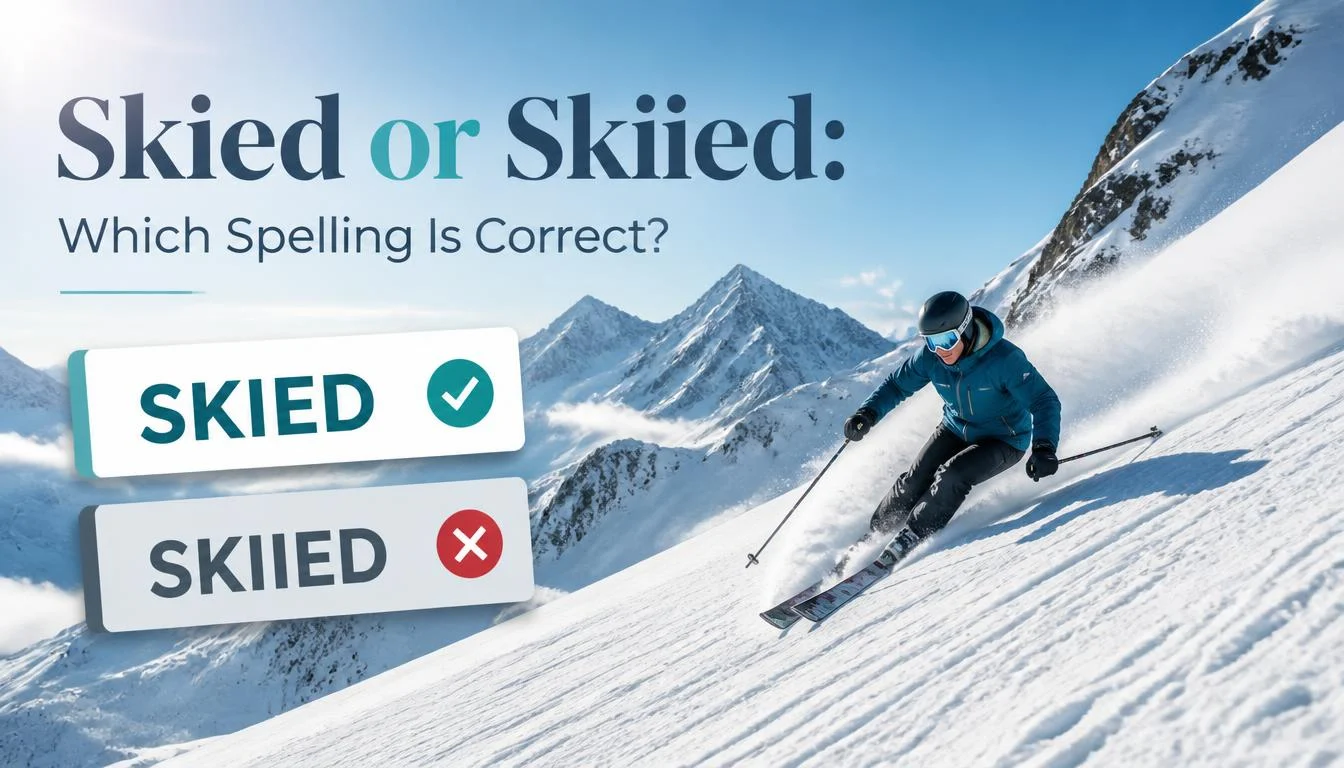
Quick Answer
Skied is the correct past tense and past participle of ski; skiied is a common spelling mistake.Use skied when describing someone who went skiing in the past, as in “We skied down the mountain.”
When talking about skiing in the past, many people hesitate between skied or skiied. The confusion is understandable because the verb ski ends in a vowel, and English spelling rules can make past-tense forms seem unpredictable. However, only one of these spellings is considered correct in standard English.
Skied is the correct past-tense and past-participle form of ski, while skiied is a common spelling mistake. Understanding why skied is correct can make your writing more accurate and help you avoid this easy-to-miss error. In this guide, we’ll explain the spelling rule, show how to use skied naturally in sentences, and clarify when this form should be used.
Which One Is Correct?
The correct spelling is skied.
Ski → skied
The form skiied is not the standard past tense or past participle of ski. If you are writing an essay, email, article, school assignment, report, or professional document, use skied.
The pattern is straightforward:
| Base verb | Past tense | Past participle |
|---|---|---|
| ski | skied | skied |
For example:
- We skied in Colorado last winter.
- She has skied since she was a teenager.
- They skied down the steep slope.
- I had never skied before that trip.
The word skied can describe the completed action of skiing. It works with both simple past constructions and perfect tenses.
Meaning of the Correct Word
Definition
Skied is the past tense and past participle of the verb ski.
The verb ski means to move over snow using skis, usually for recreation, sport, travel, or competition. Therefore, skied means that someone performed this activity in the past.
For example:
We skied all afternoon.
The sentence tells us that the skiing happened earlier.
Explanation
The spelling may look strange at first because ski ends in i. English does not normally turn this into skiied when forming the past tense.
Instead, the verb takes the regular -ed ending:
ski + ed = skied
The spelling changes visually, but the pronunciation remains easy to recognize. Skied is pronounced approximately skeed, with one syllable.
This pattern is worth remembering because adding an extra i creates the nonstandard form skiied.
Usage
Skied is used whenever the action of skiing occurred in the past.
It can appear in several common grammatical structures:
Simple past:
We skied in Utah last January.
Past perfect:
By noon, they had already skied several runs.
Present perfect:
She has skied in several countries.
Past perfect passive is not normally needed for the action itself, but the participle can appear in other constructions:
The resort has been skied by thousands of visitors.
The most natural uses, however, describe people skiing.
Real-World Examples
Here are some natural examples of skied:
- I skied for the first time when I was twelve.
- Marcus skied down the beginner’s slope.
- We skied through fresh powder after the storm.
- They skied at the resort for three days.
- She skied competitively during high school.
- The family skied together during their winter vacation.
- He had never skied on such a steep mountain.
- We skied until the lifts closed.
In each sentence, skied refers to an action that happened before the present moment.
Meaning of the Incorrect or Alternative Word
Incorrect
In standard modern English, skiied is considered an incorrect spelling of the past tense of ski.
If you see it in edited writing, it is usually a typographical or spelling error rather than a separate grammatical form.
The correct form is:
She skied yesterday.
Not:
She skiied yesterday.
Typo
Skiied often appears because writers try to preserve the two i letters from the base word and the past-tense ending.
A person may reason:
ski + ied = skiied
That looks logical at a glance, but English spelling does not form the past tense this way.
The correct construction is:
ski + ed = skied
The same issue can occur when people type quickly or rely on how the word visually appears rather than checking its established spelling.
Slang
Skiied is not recognized as a standard slang form of skied.
You may encounter unusual spellings in casual online communication, social media posts, messages, or user-generated content. However, that does not make the spelling grammatically standard.
For formal and edited writing, choose skied.
Regional Variation
There is no major American versus British spelling distinction between skied and skiied.
American English uses skied, and British English also uses skied.
Therefore, this is not a case where one spelling belongs to the United States and another belongs to the United Kingdom.
Rare but Valid Usage
Skied itself is the established form in standard English. There is no need to treat skiied as a rare alternative.
If you encounter skiied, the safest interpretation is that the writer intended skied.
The word skied can appear in different contexts, from casual conversation to sports journalism, travel writing, education, and professional reports.
Key Differences Between the Two Words
The difference between skied and skiied is mainly one of standard spelling and grammatical correctness.
| Feature | Skied | Skiied |
|---|---|---|
| Spelling | Correct | Incorrect in standard English |
| Meaning | Past action of skiing | Intended to mean the same thing |
| Pronunciation | Approximately “skeed” | Usually intended to sound like “skeed” |
| Grammar | Past tense and past participle | Not a standard grammatical form |
| Usage | Standard and widely accepted | Usually a spelling error |
| Recognition | Recognized in dictionaries and edited writing | Not the standard dictionary form |
| Suitable for formal writing | Yes | No |
| American English | Correct | Incorrect |
| British English | Correct | Incorrect |
The important point is that the two forms do not represent two different meanings. Someone who writes skiied almost certainly means skied.
Why Does “Skied” Look So Unusual?
The unusual appearance comes from the interaction between the letters i, e, and d.
The base word is:
ski
Add the regular past-tense ending:
ski + ed
The result is:
skied
This gives us the spelling s-k-i-e-d.
It may look as if something has been removed or rearranged, but nothing mysterious has happened. The word simply follows its established spelling pattern.
How Is “Skied” Pronounced?
Skied is pronounced approximately skeed.
It has one syllable.
The pronunciation is not normally divided into something like “ski-ed.” In natural speech, the word flows as a single syllable.
Compare:
- ski “skee”
- skied “skeed”
- skiing “SKEE-ing”
This pronunciation can help distinguish the past tense from the present participle skiing.
Common Mistakes People Make
Adding an Extra “i”
The most common mistake is writing:
skiied
instead of:
skied
Writers may assume that the final i in ski needs another i before the -ed ending. It does not.
Confusing “Skied” With “Skiing”
The forms skied and skiing serve different grammatical purposes.
Skied refers to a completed past action:
We skied yesterday.
Skiing describes an ongoing action or functions as a noun:
We are skiing today.
Skiing is my favorite winter sport.
The spelling patterns are therefore different.
Treating “Ski” Like a Verb With a Doubled Consonant
English learners sometimes apply rules from verbs such as stop → stopped or plan → planned.
Those verbs double their final consonant under particular spelling rules. Ski does not.
You do not write:
skiied
and you do not need to double any consonant.
The standard form is simply:
skied
Assuming Every Past-Tense Ending Looks the Same
The -ed ending can create several spelling and pronunciation patterns in English. That does not mean every verb takes it in exactly the same visual way.
For ski, the established past form is skied.
Learning common word forms is often more reliable than trying to create every past tense from a single spelling rule.
Using “Skiied” in Formal Writing
A casual typo may go unnoticed in a text message, but spelling matters more in professional or academic contexts.
Use skied in:
- School assignments
- Business writing
- Travel articles
- Sports reports
- Resumes
- News writing
- Academic papers
- Website content
- Formal emails
Assuming the Extra “i” Is More Correct
The appearance of skiied can make it seem more faithful to the base word ski. In reality, standard spelling determines the correct form.
English spelling is not always perfectly predictable from individual letters. Established usage matters.
Correct Usage Examples
Casual Examples
These examples sound natural in everyday conversation:
- We skied all day.
- I skied with my friends last weekend.
- She skied for the first time yesterday.
- They skied until sunset.
- He skied down the easiest trail.
You can also use skied in questions:
Did you ski or snowboard last winter?
Where did you ski?
Notice that after did, the base form ski is used. You do not say “Did you skied?”
Professional Examples
Professional writing may use skied when discussing travel, tourism, athletics, or outdoor recreation:
- The team skied at the resort during its winter training camp.
- The journalist skied with local instructors to evaluate the new trails.
- Guests skied across the northern section of the mountain.
- The athletes skied under challenging weather conditions.
These examples show how the word works naturally in reports and descriptive writing.
Educational Examples
Teachers and textbooks may use skied when explaining verb forms:
- The past tense of ski is skied.
- She skied during her winter vacation.
- We skied yesterday, so the action belongs in the simple past.
- They had skied several kilometers before taking a break.
A useful comparison is:
| Time or function | Example |
|---|---|
| Present | I ski every winter. |
| Simple past | I skied last winter. |
| Present participle | I am skiing now. |
| Present perfect | I have skied many times. |
| Past perfect | I had skied there before. |
Literary/Metaphorical Examples
Skied is usually literal, but creative writing can use skiing imagery in descriptive ways:
- The skier skied silently beneath the pale morning sky.
- She skied through the powder as the mountain disappeared into mist.
- They skied along the ridge while sunlight spread across the valley.
In these examples, the word remains literal. The surrounding description creates the literary effect.
Word Origin / Etymology
The word ski entered English from Norwegian. It is related to the Scandinavian language tradition and ultimately connects with an Old Norse word associated with a split piece of wood.
A ski was historically a long, narrow piece of wood used for traveling over snow. Over time, the noun ski became firmly established in English.
English later developed the verb to ski, meaning to travel or move on skis.
Once ski functions as a regular English verb, its past tense becomes skied.
The development can be represented simply:
ski → to ski → skied
The modern spelling reflects established English usage rather than a need to duplicate the final i.
The word also appears in related forms such as skier, skiing, skiable, and compounds involving skiing and ski equipment.
Why the Incorrect Version Became Popular
The spelling skiied is easy to understand as a mistake because the base word ends in i.
When people see:
ski
and want to add:
-ed
they may mentally combine the ending as though it begins with another i.
That produces:
skiied
The mistake is especially tempting because many English spelling patterns are based on visible letter changes. Learners may expect the original letters to remain untouched when an ending is added.
Another reason is that skied looks slightly unusual. The sequence -ied appears in other English words, such as tried and cried, where a final y changes to i before the ending. That pattern may make skied seem unfamiliar to someone who has not encountered it often.
There is also a useful distinction here: ski does not behave like a word ending in y.
Compare:
- try → tried
- cry → cried
- ski → skied
In try → tried, the final y changes to i. In ski → skied, the i is already part of the base spelling.
Despite that difference, the final result is still skied.
Easy Memory Tricks
Remember “Ski + ED”
The simplest trick is to think:
SKI + ED = SKIED
Do not add another i.
If you can remember the two parts, the spelling becomes much easier.
Think “One I, Then ED”
Look at the correct spelling:
skied
There is only one i.
A useful reminder is:
One I is enough: skied.
Compare “Ski” and “Skied”
Keep these forms together:
ski → skied
The word gains -ed rather than -ied.
Use a Sentence
Memorize one natural sentence:
We skied yesterday.
If you need the past tense later, this familiar sentence can help you recall the spelling.
Remember the Three Main Forms
A quick verb chart can make the distinction clear:
ski → skied → skied
The base form is ski. The past tense is skied. The past participle is also skied.
FAQs
Is “skied” the correct spelling?
Yes. Skied is the standard past tense and past participle of ski.
Is “skiied” a word?
Skiied is not the standard spelling of the past tense of ski. It is generally considered a spelling error.
Why is it “skied” instead of “skiied”?
The verb ski takes the regular -ed ending, giving skied. No second i is added.
How do you pronounce “skied”?
Skied is pronounced approximately skeed and normally has one syllable.
Is “skied” American or British?
Skied is standard in both American and British English. There is no major regional spelling difference here.
What is the past tense of “ski”?
The simple past tense is skied. For example, “We skied in Colorado last year.”
What is the past participle of “ski”?
The past participle is also skied. For example, “She has skied on several mountains.”
Is “skiing” the past tense of “ski”?
No. Skiing is the present participle or gerund. The simple past form is skied.
Conclusion
When choosing between skied or skiied, always use skied in standard English.The verb ski takes the regular -ed ending, producing skied, pronounced roughly “skeed.”Although skiied may look logical, it is a common spelling mistake rather than a standard alternative.Remember ski → skied, and you will never need the extra “i” again.
Read More Articles
- Cannon or Canon | Understanding the Difference Between These Commonly Confused Words In 2026
- Likeable or Likable | The Easy Way to Remember the Difference In 2026

Jessica Morgan is a blogger and writer at GramScript.com, where she turns everyday ideas into engaging, relatable stories. Her writing blends a natural voice with fresh perspectives that keep readers coming back.
1 thought on “Skied or Skiied | How to Spell the Past Tense of Ski In 2026”