Quick Answer
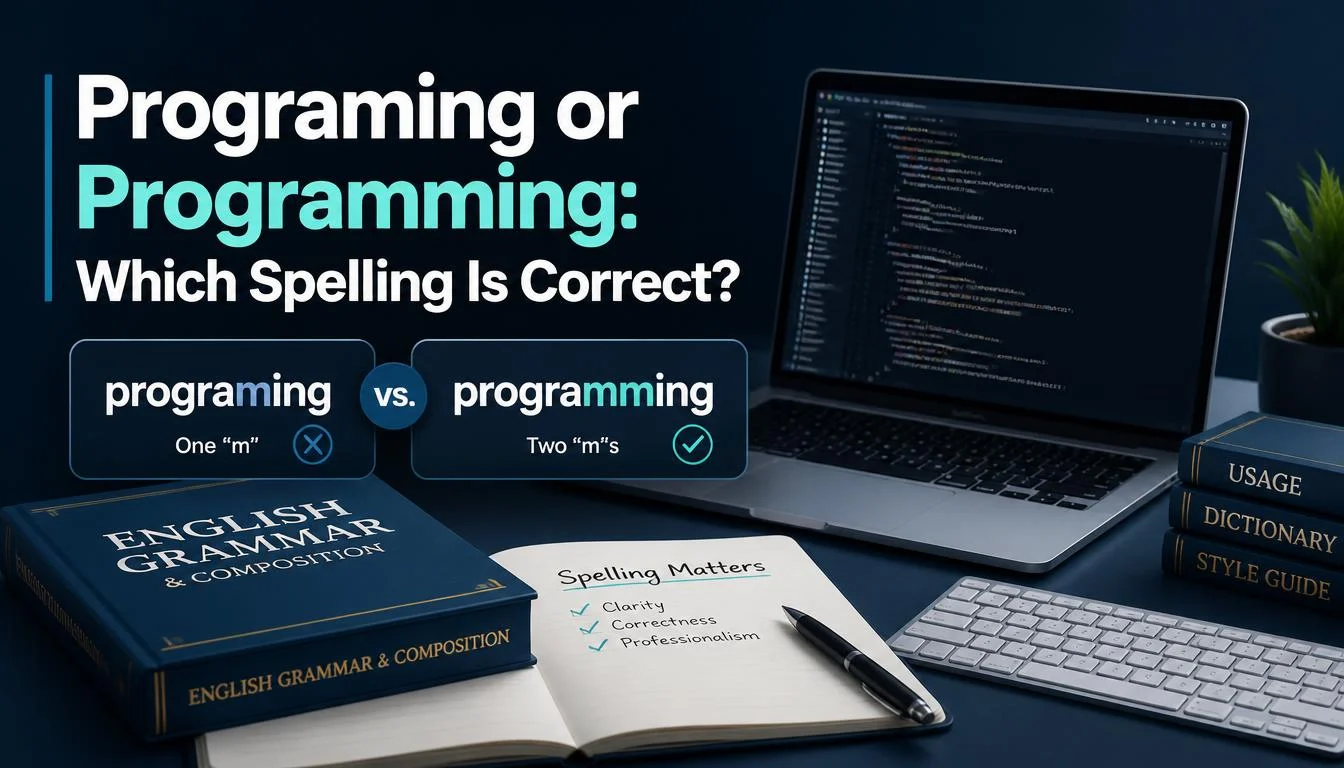
Programming is the standard and overwhelmingly preferred spelling, especially in American English and the technology industry.Programing is a less common variant that is technically valid in some dictionaries, but it can look like a spelling mistake.
If you have ever wondered whether programing or programming is the correct spelling, you are not alone. The two forms look almost identical, but only one is the standard spelling used in modern English. Programming is the correct form when referring to the process of writing, testing, and maintaining computer code. It is also the form you will normally see in technical writing, software development, education, and professional communication.
The confusion usually comes from the spelling pattern of words ending in -ing. When “program” becomes a noun or verb form ending in -ing, the final consonant is doubled, giving us programming. In this guide, we’ll explain why “programming” is correct, whether “programing” is ever acceptable, and how to use the word naturally in sentences. By the end, you’ll have a clear way to remember the correct spelling and avoid this common mistake.
Which One Is Correct?
Programming is the preferred spelling in standard American English.
It is the form readers are most likely to expect when discussing software, coding, computer science, or the general act of creating a program. For example, you would normally write, “She is learning programming at school.”
Programing can also be found as an accepted spelling variant, but it is far less common. Many readers may interpret it as a typo because programming is so firmly established.
For professional, academic, educational, and online writing, programming is the safest choice.
Meaning of the Correct Word
Definition
Programming is the act, process, or skill of creating instructions for a computer or other programmable device.
In a broader sense, programming can also mean arranging, planning, or organizing a series of activities or events. The exact meaning depends on the context.
For example:
- “He is studying computer programming.”
- “The festival’s programming includes live music.”
- “The television network changed its programming schedule.”
Explanation
In computing, programming involves writing and organizing instructions that tell software or a computer system what to do.
A programmer may use languages such as Python, JavaScript, Java, C++, or C# to create those instructions. Programming can involve solving problems, designing algorithms, testing code, fixing errors, and maintaining software.
The word can also have a nontechnical meaning. A museum may discuss its cultural programming, meaning the collection of events and activities it offers. A television channel’s programming refers to the shows and content it broadcasts.
So, programming does not always mean writing computer code. Its meaning depends on the surrounding words.
Usage
Programming is commonly used as:
- A noun: “Programming requires logical thinking.”
- A gerund: “Programming can be challenging at first.”
- A present participle: “She is programming a new application.”
- A modifier: “He joined a programming course.”
It frequently appears with terms such as computer programming, software programming, programming language, programming skills, programming course, and programming experience.
Real-World Examples
Here are several natural examples:
- “My brother started programming when he was twelve.”
- “The company needs someone with strong programming skills.”
- “Python is a popular language for programming.”
- “She is programming a small mobile application.”
- “The university offers several programming courses.”
- “The theater has an impressive cultural programming schedule.”
These examples show why programming is the spelling most readers will recognize immediately.
Meaning of the Incorrect or Alternative Word
Incorrect
Programing is not best described as completely incorrect. It is a recognized spelling variant of programming, but it is uncommon compared with the standard form.
That distinction matters. Calling programing an absolute spelling error would be too strong because the variant has historical and dictionary support.
Still, if your goal is clear modern English, programming is the better choice.
Typo
In everyday writing, programing is often treated as a typo.
This happens because people may type the base word program and simply add -ing. That produces programing mechanically:
program + ing = programing
The conventional spelling, however, is:
program + ming = programming
Because programming is so common, spell-checkers, editors, employers, teachers, and readers usually expect the double m.
Slang
Programing is not slang.
It does not represent an informal pronunciation or a special form used by a particular social group. It is simply a less common spelling variant.
Regional Variation
Unlike differences such as color/colour or center/centre, programing/programming is not a major American-versus-British spelling distinction.
Both forms can appear in American English, but programming is by far the more familiar choice. British English also overwhelmingly uses programming.
Therefore, you should not choose programing because you think it is the British form or programming because you think it is exclusively American. That distinction does not accurately describe their usage.
Rare but Valid Usage
Programing can be considered a rare or less-preferred variant rather than a completely invalid word.
You may encounter it in older publications, dictionary entries, or individual writing styles. However, its rarity creates a practical problem: readers may assume it is an error.
When a spelling is both less common and unnecessary, using the familiar form usually produces clearer communication. That is why programming is the better choice for most situations.
Key Differences Between the Two Words
| Feature | Programming | Programing |
|---|---|---|
| Spelling | Standard spelling with double m | Less common spelling with one m |
| Meaning | Creating computer instructions; also planning or organizing content | Same basic meaning |
| Pronunciation | “PROH-gram-ing” | Usually pronounced the same |
| Grammar | Noun, gerund, or present participle | Same grammatical roles |
| Usage | Extremely common | Rare |
| Recognition | Immediately familiar to most readers | May look like a typo |
| Professional writing | Recommended | Usually avoid |
| Computing context | Standard industry spelling | Uncommon variant |
The most important difference is usage frequency and reader expectation, not meaning.
Both forms point to the same underlying word. The difference lies mainly in which spelling modern readers recognize as standard.
Why the Double M Matters
English spelling often changes when a suffix is added, but spelling patterns are not perfectly predictable. Writers therefore cannot always create a new form simply by attaching -ing to the base word.
With program, the conventional form became programming, with the final m doubled.
This is similar in appearance to words such as:
- commit → committing
- permit → permitting
- submit → submitting
- control → controlling
However, English has many exceptions and historical spelling patterns. That is why relying on one simple doubling rule can cause confusion.
Common Mistakes People Make
One of the most common mistakes is assuming that every word ending in a single consonant keeps that consonant when -ing is added.
A writer may see:
program + ing
and naturally produce:
programing
The problem is that established English spelling does not always follow the most obvious visual formula.
Another mistake is assuming that programing and programming have different meanings. They do not normally represent different concepts. The main distinction is conventionality.
Writers also sometimes believe that programing must be wrong because a spell-checker highlights it. That conclusion is understandable, but dictionary recognition and everyday recommendation are not always identical. A word can exist as a variant while still being a poor choice for ordinary professional writing.
A final mistake is using the single-m version repeatedly in technical content. In software-related contexts, readers see programming constantly. The less common spelling can distract them and make otherwise polished writing look careless.
Correct Usage Examples
Casual Examples
Here are some natural examples from everyday conversation:
- “I’m learning programming in my free time.”
- “My friend loves programming and gaming.”
- “Programming looked difficult until I practiced regularly.”
- “He spends several hours programming every weekend.”
- “I want to get better at programming.”
These sentences all use programming naturally.
Professional Examples
Professional writing strongly favors the standard spelling:
- “The position requires three years of programming experience.”
- “Our team is developing programming standards for new projects.”
- “The applicant demonstrated excellent programming skills.”
- “The course covers object-oriented programming.”
- “She works as a software engineer specializing in programming tools.”
In resumes, cover letters, reports, documentation, and business communication, programming is the clear choice.
Educational Examples
Educational materials also normally use programming:
- “Students will learn the fundamentals of computer programming.”
- “The programming course introduces students to Python.”
- “Programming exercises help learners develop problem-solving skills.”
- “The instructor explained programming concepts with simple examples.”
- “Children can learn programming through age-appropriate coding activities.”
If you are writing an educational article, textbook, lesson plan, or course description, using programming will make your writing align with standard usage.
Literary/Metaphorical Examples
The word can also appear outside computer science:
- “The festival’s programming reflects the city’s diverse culture.”
- “The museum expanded its educational programming.”
- “The network changed its programming for the holiday.”
- “The theater announced its programming for the coming season.”
Here, programming refers to a planned selection or schedule of content and activities rather than computer code.
Word Origin / Etymology
The history of programming begins with the noun program.
The English word program ultimately traces back to Greek programma, meaning something written publicly or a written announcement. It passed through Latin and French before becoming established in English.
Over time, program developed several related meanings. It could refer to a written plan, a schedule of events, or a planned set of activities.
The computing sense developed later. As electronic computers became programmable, a program came to mean a set of instructions that a machine could execute. From that meaning came programmer, programming, and many related technical terms.
The spelling programming reflects the established English form used with the -ing suffix. The single-m variant, programing, has also appeared, but it never became as dominant in everyday modern usage.
The history explains why the spelling cannot always be predicted simply by looking at the base word. English spelling often preserves conventions that became established through long-term usage.
Why the Incorrect Version Became Popular
It is more accurate to call programing an alternative spelling than to call it simply incorrect.
Its appeal is easy to understand. The base word is program, so adding -ing appears to give programing. The single-m spelling therefore looks logical at first glance.
Another factor is the complexity of English consonant-doubling rules. Learners are often taught that a final consonant may be doubled before a suffix, but the exact conditions depend on pronunciation, stress, word structure, and established usage.
That can make words like program confusing.
Technology has also made the spelling especially visible. People encounter programming on websites, in software documentation, university courses, job listings, programming tutorials, and developer communities. As a result, the double-m spelling has become strongly associated with the field.
Because programming is now so widespread, programing may look unusual even when the writer intended no mistake.
The practical lesson is simple: a spelling can be technically defensible yet still be a poor everyday choice. For modern readers, programming provides the clearest and most familiar form.
Easy Memory Tricks
The easiest way to remember the correct spelling is to connect programming with programmer.
Think of the pair:
program → programmer → programming
Both programmer and programming contain the familiar mm pattern after the first part of the word.
Another useful trick is to remember the common phrase computer programming. You have probably seen this phrase many times in courses, job descriptions, books, and websites. The double m is part of that familiar phrase.
You can also use a visual memory cue:
PROGRAM + MING = PROGRAMMING
Notice the extra m before -ing.
If you are writing professionally and hesitate between the two forms, choose programming. It is the form your readers are most likely to expect.
FAQs
Is “programing” or “programming” correct?
Programming is the standard and preferred spelling. Programing exists as a less common variant.
Is “programing” a spelling mistake?
Not necessarily. It is a recognized variant, but many modern readers may perceive it as a typo.
Why does programming have two m’s?
The conventional English spelling doubles the final m when forming programming, even though the base word is spelled program.
Is “programing” used in American English?
Yes, programing can occur in American English, but programming is much more common and widely preferred.
Is “programming” British or American English?
Programming is standard in both American and British English. It is not a major regional spelling difference.
Do programing and programming mean the same thing?
Yes. They generally have the same meaning and grammatical function; the main difference is spelling preference and frequency.
Should I use “programing” on a resume?
It is better to use programming. The standard spelling looks more familiar and professional to most readers.
What is the pronunciation of programming?
Programming is pronounced approximately PROH-gram-ing. Programing is generally pronounced the same way.
Conclusion
When choosing between programing or programming, programming is the clear modern preference for standard American English and professional communication.Although programing exists as a less common variant, it may easily be mistaken for a typo.Use programming for coding, software development, education, resumes, and everyday writing.When in doubt, remember: program, programmer, programming double the m and write with confidence.
Read More Articles
- Vanguard or Fidelity | Comparing Features, Costs and Investment Choices In 2026
- Zillow Salem OR | Find Homes, Apartments, and Real Estate in Salem In 2026

Christopher Parker is a writer and blogger at GramScript.com, sharing thoughtful insights and engaging stories across a range of topics. His writing blends clarity, curiosity, and a distinctly human perspective.
1 thought on “Programing or Programming | The Right Choice in Modern English In 2026”