Quick Answer
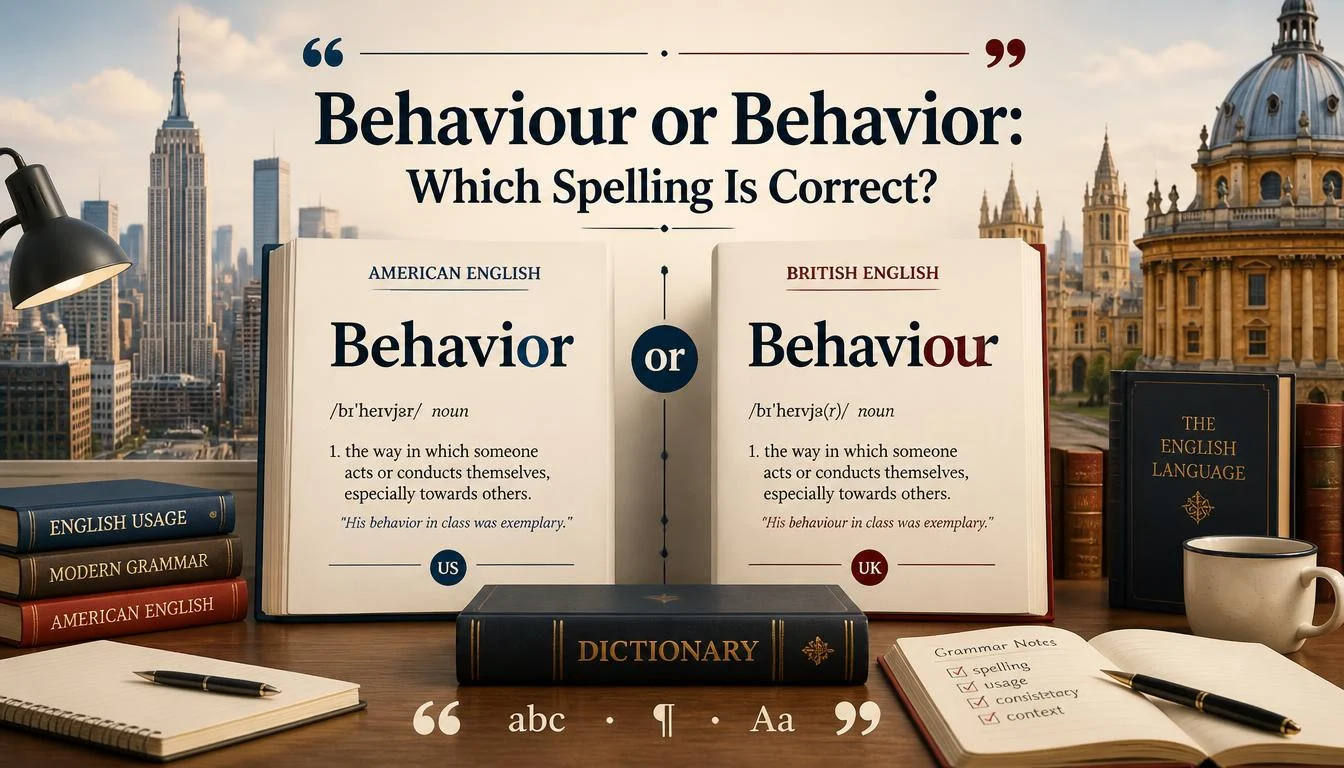
Behavior is the standard American English spelling, while behaviour is the standard British English spelling.
They have the same meaning and pronunciation; the difference is mainly regional spelling.
If you have ever wondered whether behaviour or behavior is the correct spelling, the answer depends on which variety of English you are using. Both forms are correct, and they have the same meaning: the way a person, animal, or group acts or responds in a particular situation. The main difference is regional spelling. Behaviour is the standard spelling in British English, while behavior is preferred in American English.
Choosing between these spellings becomes especially useful when you are writing for a specific audience. A British publication, school, or organization will generally use behaviour, whereas American readers are more likely to expect behavior. Understanding this small spelling difference can help you write more naturally and maintain consistency throughout an article, essay, email, or professional document. In this guide, we’ll explain the difference between behaviour or behavior, show how each form is used, and provide clear examples to help you choose the right spelling.
Which One Is Correct?
Both behavior and behaviour are correct spellings.
The correct choice depends on your English variety:
- Behavior = standard American English
- Behaviour = standard British English
If you are writing for an American audience, use behavior. This is the preferred spelling in American newspapers, schools, businesses, academic writing, and general communication.
If you are following British English conventions, use behaviour. This spelling is common in the United Kingdom and is also widely used in other English-speaking regions that traditionally follow British spelling.
Neither version is a misspelling when used in the appropriate regional variety.
For example:
The child’s behavior changed after the move.
This is natural in American English.
The child’s behaviour changed after the move.
This is natural in British English.
The key is consistency. If your document follows American spelling, do not switch between behavior and behaviour without a specific reason.
Meaning of the Correct Word
Definition
Behavior means the way a person, animal, group, or organization acts or responds in a particular situation.
It can describe visible actions, habits, reactions, or patterns of conduct.
For example:
His behavior at the meeting was professional.
Here, behavior refers to the way he acted during the meeting.
The British spelling, behaviour, has exactly the same meaning.
Explanation
Behavior can describe a single action or a repeated pattern.
A parent might discuss a child’s behavior at school. A scientist might study animal behavior. A manager might evaluate workplace behavior. A psychologist might examine behavioral patterns.
The word can also describe how something functions or responds.
For example:
The software’s behavior changed after the update.
In this sentence, behavior does not describe a person’s conduct. It describes how a system responds.
The meaning therefore depends on context, but the central idea remains the same: behavior describes actions, responses, or patterns of conduct.
Usage
Behavior is a noun.
Common expressions include:
- human behavior
- animal behavior
- social behavior
- workplace behavior
- aggressive behavior
- appropriate behavior
- unacceptable behavior
- behavioral patterns
- behavioral changes
- behavior problems
The word can also be modified by adjectives.
For example:
The teacher noticed unusual behavior.
The company has strict rules about workplace behavior.
Scientists observed the animal’s behavior carefully.
In American English, the related adjective is usually behavioral.
The study examined behavioral changes in teenagers.
British English generally uses behavioural.
Real-World Examples
Behavior appears across many fields and everyday situations.
Education:
The teacher praised Maya for her respectful behavior.
Psychology:
Researchers studied how stress affects human behavior.
Business:
Professional behavior helps create a positive workplace.
Science:
The researchers recorded the birds’ behavior during migration.
Technology:
The program’s behavior was different after the settings changed.
These examples show why the word has such a broad range of uses.
Meaning of the Incorrect or Alternative Word
Incorrect
Behaviour is not incorrect English.
It is simply the British spelling of behavior. Calling it “wrong” would be misleading.
Likewise, behavior is not incorrect in American English. In fact, it is the standard American form.
The important distinction is regional convention rather than correctness.
Typo
Neither spelling should normally be treated as a typo.
However, a writer can accidentally create an inconsistent spelling system. For example, an American document might use behavior throughout and suddenly contain behaviour.
That does not make the individual word wrong. It creates a consistency issue.
For polished writing, choose one spelling system and follow it throughout the document.
Slang
Neither behavior nor behaviour is slang.
Both are standard English nouns used in formal and informal contexts.
You can use them in everyday conversation, academic papers, professional reports, news writing, and technical material.
Regional Variation
Regional spelling is the main reason these two forms exist.
Behavior is standard in American English.
Behaviour is standard in British English.
British-style spelling is also common in countries such as Australia and New Zealand. Canadian English often uses British-style spellings for words in this family, although Canadian spelling has its own conventions and does not simply copy either American or British English in every case.
Rare but Valid Usage
There is no special rare meaning attached to either spelling.
The two forms do not normally represent different definitions. A reader who sees behaviour instead of behavior should understand the same concept.
The spelling simply signals a regional writing convention.
Key Differences Between the Two Words
| Feature | Behavior | Behaviour |
|---|---|---|
| Spelling | American English | British English |
| Meaning | Way someone or something acts | Same meaning |
| Pronunciation | bih-HAY-vyer | bih-HAY-vyer |
| Grammar | Noun | Noun |
| Usage | Standard in American English | Standard in British English |
| Recognition | Preferred in U.S. writing | Preferred in U.K. writing |
| Related adjective | behavioral | behavioural |
| Main difference | No u | Includes u |
The biggest difference is visual rather than grammatical.
American English simplifies the spelling to behavior. British English preserves the u in behaviour.
Spelling Difference
The only difference in the main word is the letter u.
Behavior: b-e-h-a-v-i-o-r
Behaviour: b-e-h-a-v-i-o-u-r
This pattern is similar to other American and British spelling pairs:
- favor / favour
- color / colour
- honor / honour
- labor / labour
- neighbor / neighbour
However, these spelling patterns do not mean that one variety is more correct than the other.
Pronunciation Difference
There is normally no pronunciation difference between behavior and behaviour.
Both can be written for beginners as:
bih-HAY-vyer
The final sound is similar to the ending in words such as savior or warrior, depending on the speaker’s accent.
Regional accents can affect the exact sound, but the additional u in behaviour does not create a separate syllable.
Grammar Difference
There is no grammatical difference.
Both words function as nouns.
For example:
His behavior surprised everyone.
His behaviour surprised everyone.
The sentence structure remains identical.
You can also use either spelling in compound phrases such as human behavior, social behavior, or behavioral research, with the related adjective changing according to the spelling system.
Usage Difference
The choice depends primarily on your intended audience.
Use behavior when writing in American English.
Use behaviour when following British English conventions.
If you are preparing an academic paper for an American university, behavior is usually the appropriate choice. If you are writing for a British publication, behaviour is normally expected.
Common Mistakes People Make
Assuming Behaviour Is Wrong
One common mistake is treating behaviour as a misspelling.
It is not. It is the standard British form.
An American reader may see it less often, but that does not make it incorrect.
Assuming Behavior Is Always Wrong
The opposite mistake also happens.
Some writers learn British spelling first and assume that behavior is missing a letter. In American English, however, behavior is the standard form.
Mixing Spelling Systems
Consistency matters more than choosing one variety as universally correct.
Consider this sentence:
The color of the building reflects its neighbour’s behavior.
This sentence mixes American color with British neighbour while using American behavior.
Mixed spelling can be distracting in formal writing.
A consistent American version would be:
The color of the building reflects its neighbor’s behavior.
A consistent British version would be:
The colour of the building reflects its neighbour’s behaviour.
Changing the Pronunciation Because of the Spelling
The extra u does not normally change the pronunciation.
Do not pronounce behaviour as though the u creates another syllable.
Both forms are generally pronounced the same way.
Changing the Meaning
Behavior and behaviour do not have separate meanings.
The difference is not similar to pairs such as affect and effect, where spelling marks different grammatical and semantic functions.
Here, spelling mainly reflects regional English conventions.
Forgetting the Related Adjective
Writers sometimes remember the main noun but forget that the related adjective follows the same regional pattern.
American English:
behavioral science
British English:
behavioural science
Keeping related words consistent makes writing look more polished.
Correct Usage Examples
Casual Examples
Everyday conversations often use behavior when talking about how someone acts.
His behavior was strange this morning.
I don’t understand her behavior.
The dog’s behavior changed after the family moved.
That kind of behavior is not acceptable.
In British English, replace behavior with behaviour without changing the sentence structure.
Professional Examples
The word is common in workplace and organizational writing.
Professional behavior is expected from every employee.
The manager addressed the employee’s inappropriate behavior.
Customer behavior has changed significantly over the past decade.
The report examines workplace behavior and communication.
In American professional writing, behavior is the natural spelling.
British professional writing would normally use behaviour.
Educational Examples
Teachers and researchers frequently discuss behavior.
Positive behavior can improve the classroom environment.
The teacher documented the student’s behavior throughout the semester.
Researchers examined children’s social behavior.
The course introduces students to human behavior.
The term also appears in fields such as psychology, sociology, education, biology, and anthropology.
Literary/Metaphorical Examples
Behavior can also work in descriptive or figurative writing.
The storm’s behavior became increasingly unpredictable.
Here, the word describes the way the storm acts.
Similarly:
The river’s behavior changed after heavy rainfall.
This use gives an inanimate subject a pattern of action or response.
In literary writing, this broader use can make descriptions more vivid without changing the basic meaning of the noun.
Word Origin / Etymology
The history of behavior and behaviour goes back to older forms of English and French.
The word is related to behave, which developed from Middle English usage and ultimately has roots connected with Old French. Earlier forms referred to conducting or carrying oneself in a particular way.
Over time, English developed the noun behaviour, with the spelling influenced by French-derived forms and established English spelling conventions.
When English developed into different regional standards, American English began favoring shorter spellings in several groups of words.
The American spelling tradition became strongly associated with dictionary makers and language reformers who preferred greater spelling regularity and simplicity. Noah Webster was particularly influential in establishing many American spelling preferences.
This helped support forms such as behavior, color, and favor in American English.
British English retained the traditional our spelling in words such as behaviour, colour, and favour.
The result is the spelling distinction we still see today.
Why the Incorrect Version Became Popular
The alternative spelling did not become popular because people started making a widespread mistake.
Instead, both forms developed as legitimate regional standards.
American English gradually adopted several spelling preferences that differed from British conventions. Some of these changes shortened words or removed letters that were not pronounced.
That is why American English commonly uses:
- behavior instead of behaviour
- color instead of colour
- favor instead of favour
- labor instead of labour
- center instead of centre
British English generally retained the traditional forms.
The difference became especially visible as dictionaries, schools, publishers, newspapers, and government institutions developed their own regional standards.
Today, digital communication has brought these varieties even closer together. American and British readers routinely encounter both forms online. As a result, seeing behaviour in an American context or behavior in a British context is unlikely to cause confusion.
Still, formal writers should follow the spelling conventions expected by their audience.
Easy Memory Tricks
A simple trick is to associate behavior with the United States.
Think:
American = behavior
The American spelling removes the u.
For British English, remember:
British = behaviour
The British form keeps the u.
You can use the same memory pattern with several related words:
American: color, favor, honor, behavior
British: colour, favour, honour, behaviour
Another useful rule is to check the style of the document before writing. If you have already used color, favor, and neighbor, then behavior will usually fit the same American spelling system.
If you have used colour, favour, and neighbour, choose behaviour.
The easiest rule is simple: match the spelling to your variety of English and stay consistent.
FAQs
Is behavior or behaviour correct?
Both are correct. Behavior is standard American English, while behaviour is standard British English.
Is behavior American or British English?
Behavior is the standard American English spelling.
Is behaviour British English?
Yes. Behaviour is the standard British English spelling and is also common in several other varieties influenced by British conventions.
Do behavior and behaviour mean the same thing?
Yes. Both mean the way a person, animal, group, or thing acts or responds.
Are behavior and behaviour pronounced differently?
Normally, no. Both are commonly pronounced bih-HAY-vyer.
Should I use behavior in American writing?
Yes. Behavior is the preferred spelling in standard American English.
What is the British spelling of behavioral?
The British spelling is behavioural, with -our- retained in the word.
Why does American English spell behavior without a u?
American English developed spelling conventions that removed the u from several French-derived -our words, producing forms such as behavior, color, and favor.
Conclusion
When choosing between behaviour or behavior, use behavior for standard American English and behaviour for standard British English.Both spellings have the same meaning, grammatical function, and usual pronunciation.The key difference is regional spelling, not correctness or meaning.Remember: American English drops the u, while British English keeps it.
Read More Articles
- Cetaphil vs CeraVe | An Easy Comparison for Everyday Skincare In 2026
- Pimple or Herpes |Understanding Bumps, Blisters, and Sores In 2026

Andrew Cooper is a blogger and writer at Gramscript.com, turning everyday ideas into clear, engaging stories. His writing blends curiosity, insight and a genuinely human perspective.
2 thoughts on “Behaviour or Behavior | Everything You Need to Know About the Spelling In 2026”