Quick Answer
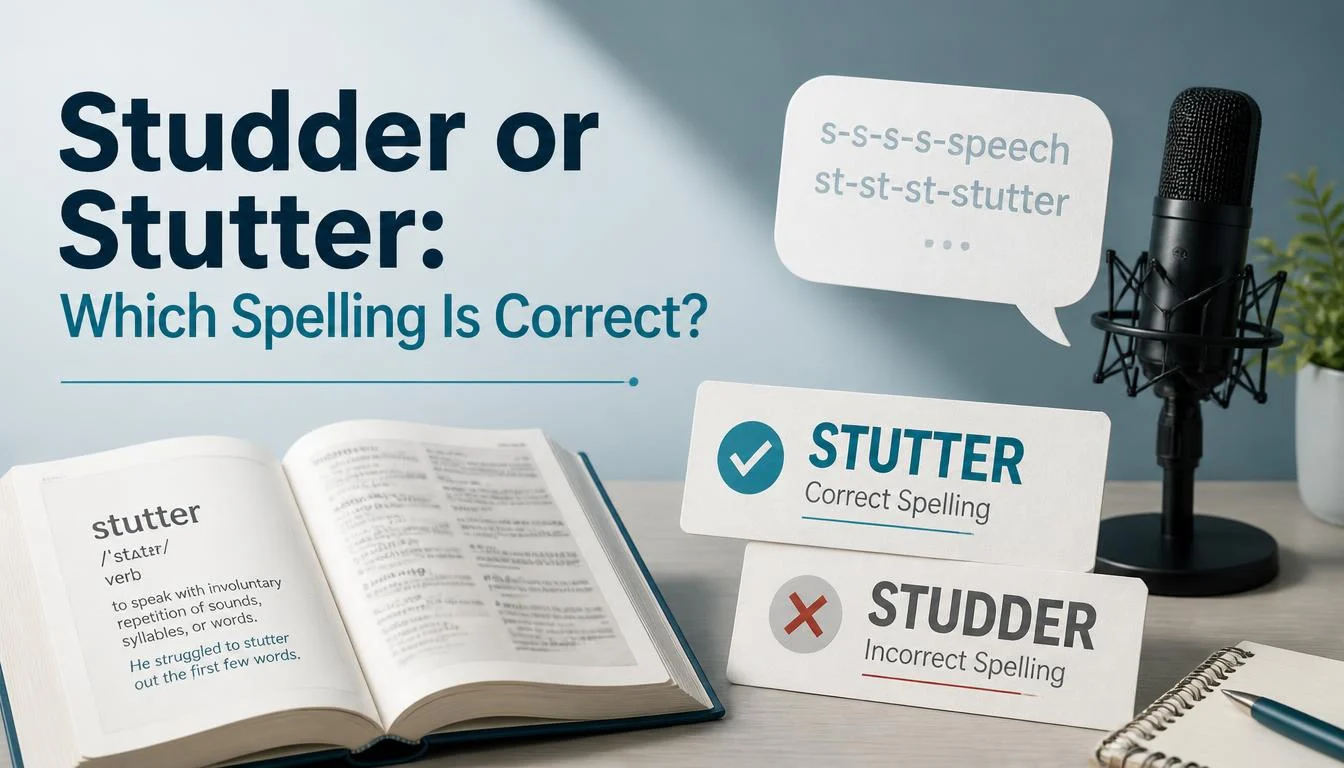
Stutter is the correct standard English spelling for repeating or struggling to produce speech sounds. Studder is a common misspelling and is not the standard spelling of the word.
If you have ever hesitated between “studder or stutter,” you are not alone. The two spellings look almost identical, which makes this a common spelling question for English learners and writers. However, only one is the standard spelling used in modern English. Stutter is the correct word when you mean speaking with involuntary repetitions, pauses, or interruptions in the flow of speech.
Studder is generally considered a misspelling of stutter, so it should be avoided in formal writing and edited English. In this guide, you’ll learn why stutter is the correct spelling, what the word means, how to use it naturally in a sentence, and why the incorrect form “studder” can be confusing. Understanding this small spelling difference can help you write more accurately and confidently.
Which One Is Correct?
Stutter is the correct spelling in standard English.
The word can function as both a verb and a noun. As a verb, stutter describes speaking with involuntary repetitions, pauses, or interruptions. As a noun, it refers to the speech pattern itself.
For example:
- He began to stutter when he became nervous.
- Her stutter became less noticeable over time.
- The speaker stuttered during the interview.
Studder is not the standard spelling for this meaning. If you are writing an essay, email, article, report, or other formal text, use stutter.
The correct forms also include related words such as stuttered, stuttering, and stutterer.
Meaning of the Correct Word
Definition
Stutter means to speak with repeated sounds, syllables, words, or noticeable pauses that interrupt the normal flow of speech.
It can also describe a repeated or interrupted action outside speech. For instance, someone might describe an engine as stuttering when it runs unevenly.
The most common meaning, however, relates to speech.
Explanation
A person who stutters may repeat part of a word, stretch a sound, or pause before completing a word.
For example:
“I-I-I wanted to ask you something.”
Another speaker might experience a noticeable block before producing a sound.
Stuttering can happen occasionally to many people, especially when they are excited, tired, stressed, or speaking quickly. Persistent stuttering is also recognized as a speech disorder that can affect communication.
The word itself does not automatically describe why someone has difficulty speaking. It simply describes the interrupted or repeated pattern of speech.
It is also useful to distinguish stuttering from ordinary hesitation. Saying “um” while thinking is not necessarily stuttering. Stuttering involves specific disruptions in speech fluency, such as repetitions, prolongations, or blocks.
Usage
Stutter works in several grammatical forms.
| Form | Example |
|---|---|
| Base verb | I sometimes stutter. |
| Third-person singular | She stutters when she is nervous. |
| Past tense | He stuttered during the presentation. |
| Present participle | The child is stuttering less often. |
| Noun | His stutter does not define him. |
The word can also appear in technical or metaphorical contexts.
For example, a computer system may be described as stuttering when its performance repeatedly pauses or becomes uneven. An engine can also stutter when it fails to run smoothly.
Real-World Examples
Here are natural examples of stutter in everyday English:
- He started to stutter when everyone looked at him.
- She does not stutter when she reads quietly.
- The student stuttered while answering the question.
- His stutter became less noticeable with practice.
- The engine began to stutter halfway through the trip.
- The video stutters whenever the connection becomes unstable.
These examples show that stutter is not limited to one grammatical role or context.
Meaning of the Incorrect or Alternative Word
Incorrect
For the speech-related meaning discussed here, studder is considered an incorrect spelling in standard English.
It does not represent a standard alternative spelling of stutter. Therefore, replacing the t with d is not a recognized American English spelling variation.
If you see studder in a text, the writer most likely intended stutter.
Typo
Studder commonly appears because of a spelling error.
The mistake is understandable because the sounds in stutter can be difficult to distinguish in rapid speech. Writers may hear a sound that resembles d and reproduce it in writing.
Autocorrect and predictive text can also contribute to confusion, especially when users type quickly.
Slang
Studder is not standard slang for stutter.
Some online communities may use unconventional spellings for humor, imitation, usernames, or informal communication. Such uses do not make studder a standard English spelling.
In professional and educational writing, stutter remains the appropriate choice.
Regional Variation
Studder is not a standard American-versus-British spelling difference.
Unlike pairs such as color and colour, English-speaking regions do not normally use stutter and studder as two accepted regional spellings of the same word.
Both American and British English use stutter for the common speech-related meaning.
Rare but Valid Usage
There is no standard modern English usage in which studder replaces stutter as the ordinary spelling of the speech term.
You may encounter the spelling in usernames, names, informal posts, transcriptions, or specialized contexts. Those appearances should not be confused with the standard dictionary spelling.
For normal English writing, choose stutter.
Key Differences Between the Two Words
| Feature | Stutter | Studder |
|---|---|---|
| Spelling | Correct | Incorrect for the standard speech meaning |
| Meaning | Interrupted or repeated speech; also uneven action | No standard equivalent meaning |
| Pronunciation | Roughly “STUT-er” | Usually intended as “STUT-er” |
| Grammar | Noun and verb | Not a standard form |
| Usage | Standard American English | Common misspelling |
| Recognition | Widely recognized | Not recognized as the standard spelling |
| Related forms | stuttered, stuttering, stutterer | No standard related forms |
| Formal writing | Appropriate | Avoid |
The biggest difference is simple: stutter is the established English word, while studder is generally a spelling mistake.
Pronunciation Difference
Although the spellings differ, people who write studder usually intend to pronounce it the same way as stutter.
A beginner-friendly pronunciation is approximately STUT-er.
The first syllable sounds like stut, followed by a softer er sound. The pronunciation does not contain a clear d sound that would justify changing the spelling.
Because spoken language moves quickly, the middle consonant can sound less distinct than it appears in writing. That helps explain why the misspelling occurs.
Grammar Difference
Stutter has normal verb and noun forms:
- stutter
- stutters
- stuttered
- stuttering
- stutterer
- stutter
By contrast, studder does not form part of the standard grammatical family.
For example, these are correct:
- She stutters when she speaks quickly.
- He stuttered during the interview.
- The child is stuttering less frequently.
- His stutter does not prevent him from communicating.
Common Mistakes People Make
Writing “Studder” Because of Pronunciation
The most common mistake is spelling the word according to how it sounds.
English contains many words whose spelling cannot be predicted perfectly from pronunciation. Stutter is one of them. Hearing the word does not necessarily tell you which consonant belongs in the middle.
Adding a “D” Between the Syllables
Some writers mentally divide the word into a sound that resembles stud-der. That leads to studder.
The correct spelling keeps the t:
s-t-u-t-t-e-r
Confusing Related Forms
Writers sometimes know that stutter is correct but become uncertain when changing its grammatical form.
The correct forms are:
- stuttered, not studdered
- stuttering, not studdering
- stutterer, not studderer
Remember that the spelling begins with the same root: stutter-.
Assuming “Studder” Is British English
This is another common misunderstanding.
Studder is not the British equivalent of American stutter. Both major English varieties use stutter.
Treating Every Speech Hesitation as Stuttering
A separate mistake involves meaning rather than spelling.
People sometimes call any pause or hesitation a stutter. In everyday conversation, that can happen, but speech fluency is more nuanced.
A person may pause to think, search for a word, or restart a sentence without having a stutter. Persistent speech disruptions can have different causes and should not be casually diagnosed from a single moment.
Correct Usage Examples
Casual Examples
These sentences show how stutter appears in everyday conversation:
- I sometimes stutter when I am really excited.
- He started to stutter after everyone turned toward him.
- She used to stutter when speaking in front of large groups.
- Don’t worry if you stutter occasionally.
- My phone connection was so bad that the audio started to stutter.
The word works naturally in both personal and technology-related conversations.
Professional Examples
In professional writing, stutter can describe speech or technical performance:
- The presenter began to stutter during the final question.
- The software may stutter when several applications are running.
- The recording contains several moments of stuttered speech.
- The technician noticed that the machine began to stutter under heavy load.
In formal contexts, the spelling remains unchanged.
Educational Examples
Teachers and students may encounter the word in language, communication, or literature discussions:
- The student may stutter when answering unfamiliar questions.
- The therapist helped the child develop strategies for fluent communication.
- The character’s stutter was mentioned several times in the novel.
- Students should understand that speech differences do not reflect intelligence.
The final example also highlights an important distinction between a person’s communication pattern and assumptions about that person.
Literary/Metaphorical Examples
English speakers sometimes use stutter metaphorically to describe repeated or interrupted movement:
- The old engine seemed to stutter before stopping.
- The lights stuttered during the storm.
- The machine gave a final stutter and went silent.
- The sentence seemed to stutter as the writer searched for the right words.
This broader use gives the word a sense of interruption or uneven repetition.
Word Origin / Etymology
The history of stutter goes back many centuries.
English developed the word from older Germanic language forms associated with faltering or hesitant speech. Middle English had forms such as stutten and related spellings. The modern form gradually settled into stutter.
The history helps explain why the word does not follow a simple sound-to-letter pattern. English spelling has developed through long periods of linguistic change, borrowing, regional pronunciation, and standardization.
The root has remained closely connected with interrupted or hesitant speech. Over time, English also extended the word into metaphorical uses involving repeated or uneven movement.
For example, saying that an engine stutters compares its irregular operation with interrupted human speech.
The modern spelling stutter is now firmly established in standard English dictionaries and everyday usage.
Why the Incorrect Version Became Popular
The spelling studder probably persists because English spelling and pronunciation do not always match neatly.
When people hear stutter, the repeated consonant sound can be difficult to identify. In rapid speech, the middle sounds may become less distinct. A writer who relies heavily on sound may therefore choose d instead of t.
Another factor is visual familiarity. English has many common words containing -dd-, so studder can look plausible at first glance. However, looking familiar does not make a spelling standard.
Internet communication can reinforce the mistake. Search suggestions, user-generated posts, comments, and repeated misspellings can expose readers to studder many times. Frequent exposure may make an incorrect form seem legitimate.
Still, frequency alone does not determine standard spelling. In edited American English, stutter is the form to use.
Easy Memory Tricks
Remember the “T” in Stutter
A simple trick is to associate stutter with two T’s in the middle:
STU + TTER
Think:
Stutter has two T’s, not a D.
This makes the spelling easier to recall.
Connect It With “Stuttered”
If you are unsure, add the past-tense ending mentally:
stutter → stuttered
The familiar spelling makes the correct root easier to recognize.
Use the “T for Talk” Trick
Think of the first T as standing for talk.
A stutter affects the flow of spoken talk, so remembering the T can help you avoid studder.
Remember the Family
The word family stays centered on stutter:
stutter → stutters → stuttered → stuttering → stutterer
If a spelling suddenly changes to studder, that is a warning sign.
FAQs
Is “studder” a correct spelling?
No. Studder is generally a misspelling of stutter when referring to interrupted or repeated speech.
Is “stutter” the correct word?
Yes. Stutter is the standard English spelling for interrupted, repeated, or blocked speech.
How do you pronounce “stutter”?
It is pronounced roughly STUT-er in simple English pronunciation.
Is “studder” a British spelling?
No. Studder is not a standard British alternative to American stutter.
What is the past tense of “stutter”?
The past tense is stuttered, with the same root spelling.
What is the correct spelling: stuttering or studdering?
The correct spelling is stuttering. The form studdering is a misspelling.
Can “stutter” describe a machine?
Yes. Stutter can describe uneven or interrupted operation, such as an engine, video, or computer system.
Why do people spell stutter as “studder”?
The error likely comes from pronunciation. The middle consonants can sound unclear, causing writers to substitute d for t.
Conclusion
When choosing between studder or stutter, use stutter because it is the standard English spelling for interrupted or repeated speech.Studder is generally a misspelling, not a recognized American or British spelling variant.Remember the two T’s in stutter, along with related forms such as stuttered and stuttering.If you remember one thing, remember this: when speech falters, stutter is the spelling to trust.
Read More Articles
- Behaviour or Behavior | Everything You Need to Know About the Spelling In 2026
- Programing or Programming | The Right Choice in Modern English In 2026

Jessica Morgan is a blogger and writer at GramScript.com, where she turns everyday ideas into engaging, relatable stories. Her writing blends a natural voice with fresh perspectives that keep readers coming back.
1 thought on “Studder or Stutter | Correct Spelling, Meaning and Examples In 2026”