Quick Answer
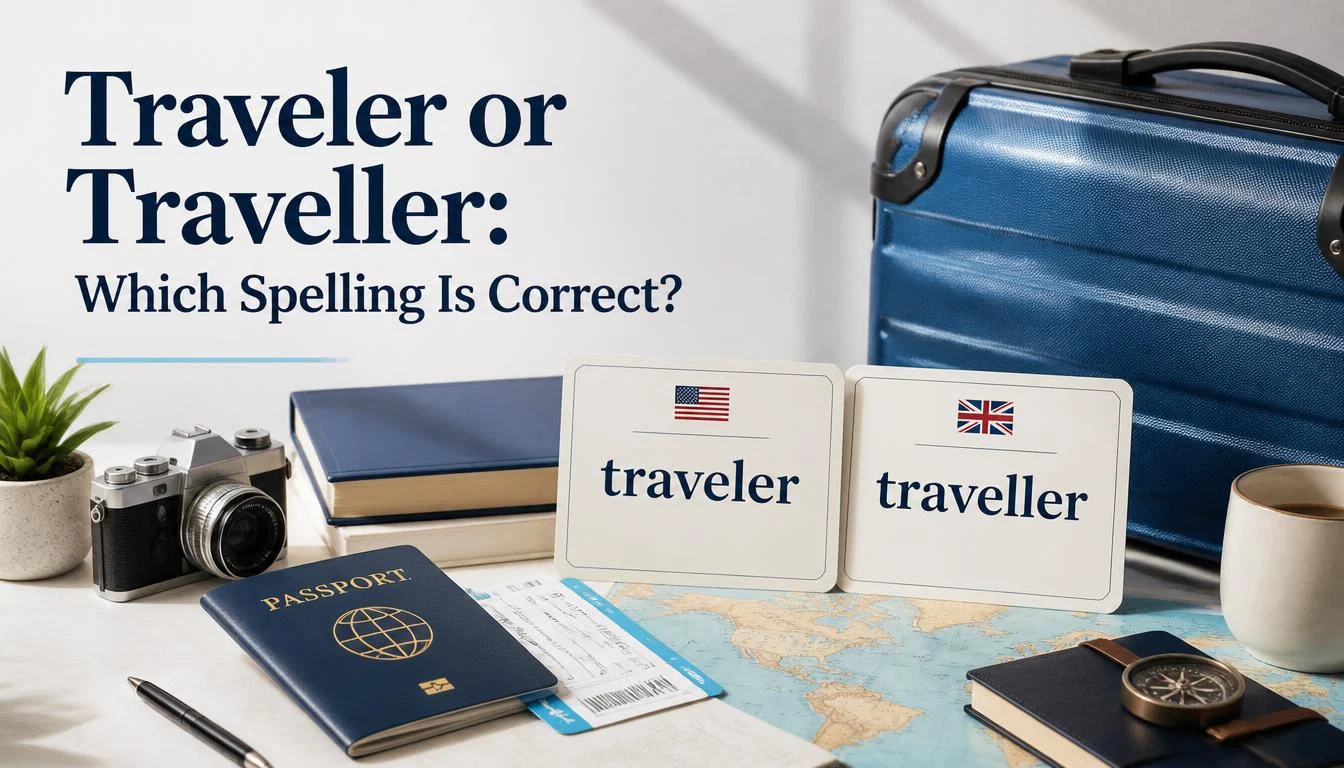
Traveler is the standard American English spelling, while traveller is the standard British English spelling. Both are correct; the choice depends on the English variety you are using.
If you have ever wondered whether traveler or traveller is the correct spelling, the answer depends on the variety of English you are using. Traveler is the standard spelling in American English, while traveller is commonly used in British English and other varieties that follow British spelling conventions. Both forms refer to a person who travels, so the difference lies in spelling rather than meaning.
The main distinction comes from the way American and British English handle certain words ending in -el. American English generally uses one l before the ending in words such as traveling and traveled, while British English often doubles the l, producing travelling and travelled. The same pattern explains traveler and traveller. Understanding this regional difference can help you choose the spelling that best matches your audience, publication style, or country.
Which One Is Correct?
Both traveler and traveller are correct spellings.
The main difference comes from regional English conventions:
- Traveler standard American English
- Traveller standard British English
For an American audience, use traveler. For a British audience, use traveller. The same distinction applies to related forms such as traveling/travelling and traveled/travelled.
Neither spelling changes the basic meaning. Both refer to a person who travels from one place to another.
If you are writing in standard American English, traveler is the appropriate choice.
Meaning of the Correct Word
Definition
A traveler is a person who travels, especially from one place to another for business, leisure, exploration, or another purpose.
The word can describe someone taking a short trip or someone who spends much of their life moving between different places.
For example:
The traveler arrived at the station before sunrise.
Here, traveler simply identifies a person who is traveling.
Explanation
The noun traveler comes from the verb travel combined with the suffix -er. The suffix often creates a noun for a person who performs an action.
For example:
- teach → teacher
- drive → driver
- write → writer
- travel → traveler
The meaning can vary slightly depending on context. A traveler may be a tourist, commuter, business visitor, backpacker, explorer, or someone making a necessary journey.
The word does not require a specific type of trip.
Usage
In American English, traveler works naturally in everyday, professional, academic, and literary writing.
You might see it in phrases such as:
- frequent traveler
- international traveler
- business traveler
- solo traveler
- air traveler
- seasoned traveler
- budget traveler
- adventurous traveler
- weary traveler
The word can also describe someone who travels regularly rather than someone taking one particular trip.
Real-World Examples
Here are several natural examples:
- The traveler checked the departure board twice.
- She is a frequent traveler who visits Europe every year.
- Business travelers often prefer hotels near airports.
- The solo traveler carried only one small backpack.
- Every traveler must show a valid passport at the border.
- The experienced traveler knew how to pack efficiently.
In each example, traveler functions as a noun referring to a person.
Meaning of the Incorrect or Alternative Word
Incorrect
Traveller is not incorrect in English. It is the standard British spelling and remains a valid form in several other varieties of English.
It becomes the less appropriate choice when you are specifically following standard American spelling.
For example, an American publication would normally write:
The traveler booked a room near the airport.
A British publication would normally write:
The traveller booked a room near the airport.
The difference is regional rather than grammatical.
Typo
Because the two spellings differ by only one letter, writers sometimes treat traveller as a spelling mistake in American English.
That interpretation is too broad.
A British writer using traveller has not necessarily made an error. The writer is following a different spelling convention. However, an American writer may need to change it to traveler when preparing content for a U.S. audience.
Slang
Traveller is not slang.
It is a standard dictionary spelling used in formal and informal British English. You can find it in newspapers, books, educational materials, government publications, and professional writing.
The extra l does not make the word informal or nonstandard.
Regional Variation
The clearest distinction is regional:
| English variety | Common spelling |
|---|---|
| American English | traveler |
| British English | traveller |
| Australian English | traveller |
| New Zealand English | traveller |
| Canadian English | traveller is common |
Usage can vary by publication and style guide, so regional patterns are not absolute in every context.
Rare but Valid Usage
In American English, traveller may still appear in certain proper names, quotations, historical references, or material that deliberately follows British spelling.
For example, a title, organization name, or quotation may preserve its original spelling.
Likewise, traveler can appear outside the United States when a writer follows American spelling or an American-based publication style.
Therefore, neither spelling is inherently wrong.
Key Differences Between the Two Words
| Feature | Traveler | Traveller |
|---|---|---|
| Spelling | One l | Two ls |
| Meaning | A person who travels | A person who travels |
| Pronunciation | TRAV-uh-ler | TRAV-uh-ler |
| Grammar | Noun | Noun |
| Main usage | American English | British English |
| Recognition | Standard U.S. form | Standard U.K. form |
| Meaning difference | None | None |
| Regional status | Preferred in U.S. writing | Preferred in British-style writing |
Spelling Difference
The only visible difference is the number of ls.
American English usually writes travel + er as traveler. British English commonly doubles the final l before the suffix, producing traveller.
This pattern appears in other related words too.
Compare:
- traveling / travelling
- traveled / travelled
- traveler / traveller
The difference becomes easier to remember when you learn the entire spelling family.
Meaning Difference
There is no meaningful difference between traveler and traveller.
Both describe a person who travels.
You do not need to choose one based on the person’s destination, purpose, age, or travel style. The spelling depends mainly on the variety of English.
Pronunciation Difference
In ordinary speech, traveler and traveller have essentially the same pronunciation.
A simple pronunciation guide is:
traveler: TRAV-uh-ler
traveller: TRAV-uh-ler
The extra l in the British spelling does not create a separate spoken meaning.
Grammar Difference
Both words function as nouns.
For example:
The traveler arrived late.
The traveller arrived late.
You can also use them as noun modifiers:
traveler information
traveller information
The grammatical role stays the same. Only the spelling convention changes.
Usage Difference
Choose the spelling according to your target variety of English.
If your article, school assignment, website, or business communication follows American English, use traveler.
If you are following British English, use traveller.
Consistency matters more than trying to mix both forms.
Common Mistakes People Make
Assuming Traveller Is Always Wrong
One common mistake is treating traveller as an incorrect spelling everywhere.
It is not.
British English uses traveller as its standard form. Calling it a spelling error without considering the regional variety can lead to incorrect corrections.
Assuming Both Spellings Can Be Mixed Freely
Another mistake involves switching between traveler and traveller in the same piece of writing.
For example:
The traveler packed early, while another traveller waited at the station.
The sentence is understandable, but the spelling is inconsistent if both people are being described under the same style.
Choose one regional spelling and maintain it.
Forgetting Related Words
Writers often remember traveler but forget that related forms can also change.
American English:
- traveling
- traveled
- traveler
British English:
- travelling
- travelled
- traveller
Learning the whole group helps prevent inconsistent spelling.
Adding an Extra Letter in American English
If you are writing for an American audience, traveller may be flagged as a spelling variation.
For example:
The international traveler arrived in Chicago.
This follows standard American spelling.
Treating Pronunciation as the Main Difference
The two forms do not have a major pronunciation distinction. Their primary difference appears in writing.
If someone says traveler and traveller aloud, listeners usually cannot identify the spelling from pronunciation alone.
Correct Usage Examples
Casual Examples
These examples show how traveler works in everyday American English:
- I met a friendly traveler on the train.
- That traveler has visited more than 30 countries.
- My brother is a frequent traveler.
- The traveler asked where to find the nearest café.
- Every traveler needs a little flexibility.
In British English, simply replace traveler with traveller.
Professional Examples
Professional writing often uses the word when discussing transportation, hospitality, or business trips:
- The airline offers special services for business travelers.
- Business travelers often value reliable Wi-Fi.
- The hotel provides information for international travelers.
- Frequent travelers may qualify for additional benefits.
- The report examines how travelers choose transportation.
These examples use standard American spelling.
Educational Examples
Teachers and textbooks may use traveler when explaining travel-related vocabulary:
- A traveler is a person who moves from one place to another.
- The story follows a traveler searching for a new home.
- Students can describe the traveler’s route on a map.
- The traveler recorded observations during the journey.
British educational materials may use traveller instead.
Literary/Metaphorical Examples
The word can also have a broader or metaphorical sense:
- The weary traveler watched the sunset over the valley.
- Every traveler carries memories from places they have visited.
- The traveler moved quietly through the unfamiliar town.
- Time is sometimes described as a traveler that never stops.
In these examples, the noun can create an image of movement, discovery, or experience.
Word Origin / Etymology
The word traveler developed from the verb travel, which entered English through a long history of linguistic change.
Travel is related to the Old French word travailler, meaning “to work” or “to toil.” That word ultimately connects to the Latin tripalium, a term associated with an instrument of torture. Over time, the meaning of the English word changed substantially.
By Middle English, forms related to travel could refer to labor, trouble, or difficult movement. The modern sense of journeying developed gradually as the word’s use changed.
The suffix -er has a straightforward role. English often uses it to form nouns for people who perform an action.
Thus:
travel + -er = traveler
British spelling developed with a doubled l:
travel + -er = traveller
The spelling difference reflects broader developments in English spelling rather than a difference in the word’s basic meaning.
Why the Incorrect Version Became Popular
Calling traveller an “incorrect version” can be misleading because it is not incorrect in British English.
The two forms became associated with different spelling systems as American and British English developed distinct conventions.
American spelling was strongly influenced by efforts to simplify and standardize spelling. Noah Webster, the American lexicographer, promoted many spelling forms that differed from British conventions. His influence helped establish patterns such as color instead of colour and other simplified spellings.
The spelling of words ending in -l also developed differently across regional varieties.
British English generally retains doubled consonants in forms such as:
- travelling
- travelled
- traveller
American English generally uses:
- traveling
- traveled
- traveler
This explains why traveller remains popular and fully standard in British English.
So, if you encounter traveller in a British book, newspaper, or website, you are seeing a regional spelling rather than a grammatical mistake.
Easy Memory Tricks
Think “U.S. = One L”
For American English, remember:
Traveler = one L
You can connect the single l with the shorter American spelling.
Think “British = Double L”
For British English:
Traveller = two Ls
This matches other common British spellings such as:
- travelling
- travelled
Learn the Whole Family
Instead of memorizing only one noun, remember the three related American forms:
travel → traveled → traveler
For British English:
travel → travelled → traveller
Once you recognize the pattern, the spelling becomes easier to reproduce.
Check Your Audience
When you are unsure, ask yourself one simple question:
Who will read this?
For a U.S. audience, choose traveler. For a British audience, choose traveller.
FAQs
Is traveler or traveller correct?
Both are correct. Traveler is standard American English, while traveller is standard British English.
Which spelling is used in American English?
American English uses traveler with one l.
Which spelling is used in British English?
British English generally uses traveller with two ls.
Are traveler and traveller pronounced differently?
No major pronunciation difference exists. Both are commonly pronounced TRAV-uh-ler.
Is traveller an American spelling mistake?
In standard American writing, traveler is preferred, but traveller is a valid British spelling.
Should I use traveler or traveller on a U.S. website?
Use traveler if the website follows standard American English spelling.
Why does British English use two Ls?
British spelling generally doubles the final l in related forms such as travelling, travelled, and traveller.
What is the plural of traveler?
The plural is travelers in American English and travellers in British English.
Conclusion
When choosing between traveler or traveller, remember that both spellings are correct in their respective varieties of English.
Use traveler for standard American English and traveller for standard British English.The words have the same meaning, grammar, and basic pronunciation, so the difference is mainly regional spelling.For consistent writing, match your spelling to your audience and remember: American traveler, British traveller.
Read More Articles
- Studder or Stutter | Correct Spelling, Meaning and Examples In 2026
- Master’s or Masters | A Quick Guide for Students and Writers In 2026

Andrew Cooper is a blogger and writer at Gramscript.com, turning everyday ideas into clear, engaging stories. His writing blends curiosity, insight and a genuinely human perspective.
2 thoughts on “Traveler or Traveller | A Complete Spelling Guide In 2026”