Quick Answer
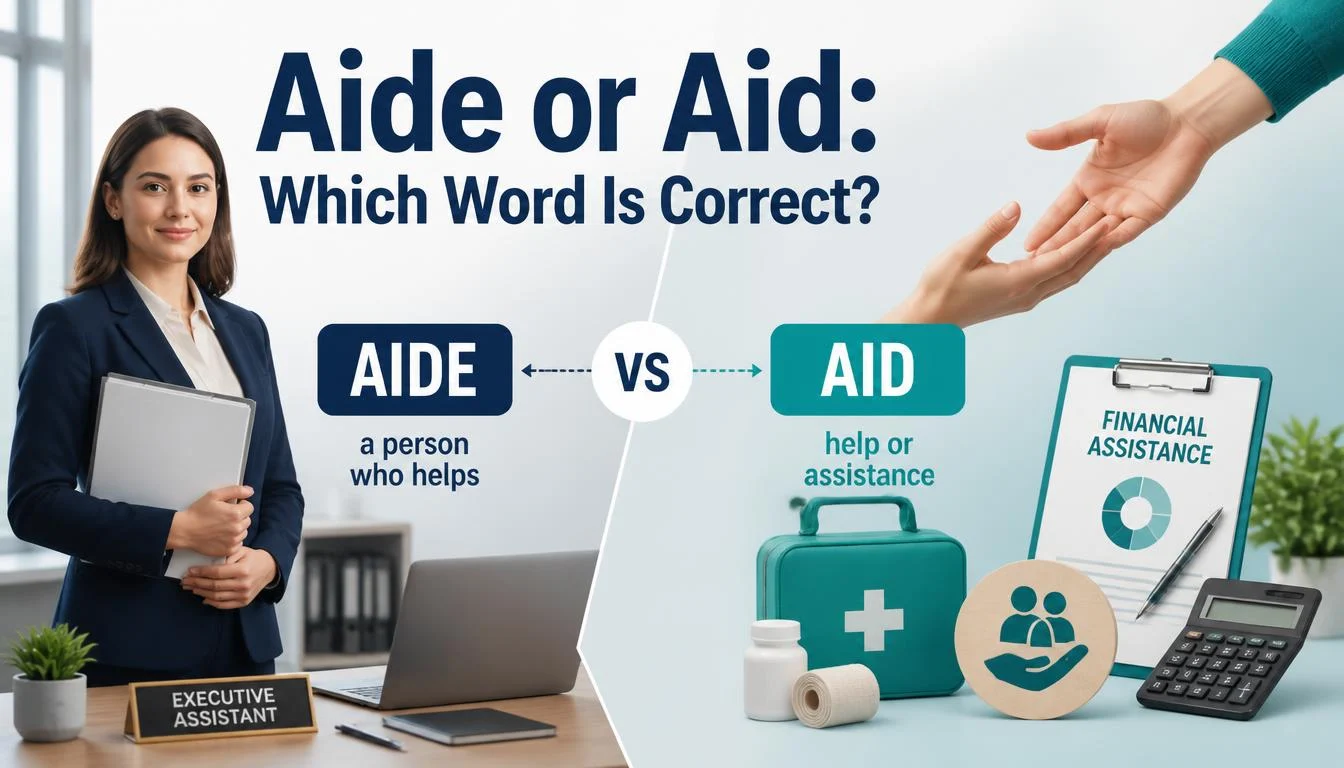
Aide means a person who helps or assists someone, while aid means help, assistance, or the act of helping.Both words are correct, but aide refers to a helper and aid refers to help or assistance.
Aide or aid can easily cause confusion because the two words sound almost identical, but they have different meanings and grammatical uses. Aid usually refers to help, assistance, or something that provides support, and it can function as either a noun or a verb. Aide, on the other hand, is a noun that describes a person who assists someone, especially someone in an official, professional, or organizational role. Knowing this distinction can help you choose the right word in both everyday and formal writing.
The difference becomes clearer when you look at how each word works in a sentence. You might say that someone provided aid to a community when referring to assistance, while a presidential aide refers to a person who works closely with a president. Although their pronunciation is very similar, their meanings are not interchangeable. In this guide, we’ll explain aide vs. aid, cover their definitions and parts of speech, and provide clear examples to help you use each word correctly.
Which One Is Correct?
Both aide and aid are correct English words. Neither spelling is simply a misspelling of the other.
The key difference is grammatical and semantic:
- Aide is usually a noun for a person who assists someone.
- Aid can be a noun meaning help or assistance.
- Aid can also be a verb meaning to help or assist.
Consider these examples:
The senator’s aide answered the phone.
Here, aide refers to a person.
The organization provided aid after the storm.
Here, aid refers to assistance.
You can also use aid as a verb:
The new software will aid researchers.
So, the choice depends on what you are trying to describe. If you mean a helper, choose aide. If you mean help, choose aid.
Meaning of the Correct Word
Definition
Aid means help, assistance, or support. It can describe something given to someone who needs help, such as money, supplies, information, or physical assistance.
As a verb, aid means to help someone achieve something or deal with a problem.
For example:
The charity provides aid to families affected by flooding.
Here, aid means assistance.
As a verb:
These tools can aid students in their research.
Here, aid means help.
Aide, by contrast, is a noun that means a person who assists another person. The person may work in an office, school, hospital, government agency, or another organization.
For example:
The teacher asked her aide to prepare the materials.
The aide is the person providing assistance.
Explanation
The easiest way to remember the distinction is to connect aide with a person.
An aide performs a helping role. The word often identifies someone’s assistant or helper.
An aid is the actual help, support, or assistance. It can also describe an object or resource designed to make a task easier.
For instance, a wheelchair can be a mobility aid, while the person helping someone use it may be an aide.
The same distinction appears in workplaces. A manager may have an aide who organizes schedules and documents. The manager may also receive administrative aid from that person.
Usage
Use aide when you can naturally replace the word with assistant, helper, or support person.
Common expressions include:
- teacher’s aide
- classroom aide
- medical aide
- nurse’s aide
- presidential aide
- congressional aide
- personal aide
- administrative aide
- legislative aide
- research aide
Use aid when you mean help, assistance, support, or a resource that provides assistance.
Common expressions include:
- financial aid
- medical aid
- legal aid
- emergency aid
- disaster aid
- foreign aid
- humanitarian aid
- first aid
- hearing aid
- visual aid
- training aid
Real-World Examples
Here are several examples that show the difference clearly:
The senator’s aide prepared the briefing documents.
The aide is a person.
The senator requested financial aid for the community.
The aid is assistance.
The classroom aide helped the teacher organize the lesson.
Again, aide refers to a person.
The chart was used as a visual aid.
Here, aid refers to something that helps.
The medicine may aid recovery.
Here, aid functions as a verb.
Emergency workers delivered aid to the affected area.
The word means assistance or supplies.
Meaning of the Incorrect or Alternative Word
Incorrect
Neither aide nor aid is inherently incorrect. The mistake occurs when you use one in a situation that requires the other.
For example:
The teacher’s aid helped the students.
If you mean the person who assists the teacher, aide is the appropriate spelling:
The teacher’s aide helped the students.
However, aid would be correct in a sentence such as:
The teacher received aid from the school.
The first sentence describes a person. The second describes assistance.
Typo
People sometimes type aid when they mean aide, especially because the words have identical pronunciations.
This mistake often appears in informal writing, quick messages, captions, and notes. Spell-checkers may not catch it because both words are legitimate English words.
For example, a spelling checker may accept:
The principal’s aid organized the meeting.
But if the writer means the principal’s assistant, the intended word is aide.
This is a useful reminder to check meaning, not just spelling.
Slang
Neither aide nor aid is normally slang. Both are established standard English words.
Aide is common in professional descriptions of assistants, while aid appears widely in formal and everyday language.
Some phrases containing aid may sound specialized, but that does not make the word slang. Examples include first aid, legal aid, and financial aid.
Regional Variation
The distinction between aide and aid does not represent a major American-versus-British spelling difference.
Both forms occur in American and British English, and their core meanings remain distinct.
You may notice differences in job titles or institutional terminology across countries, but the basic rule stays consistent: aide identifies a person, while aid refers to help or assistance.
Rare but Valid Usage
Aide can appear in formal compounds and titles. One well-known expression is aide-de-camp, which traditionally refers to an officer who serves as an assistant to a senior military officer or other high-ranking official.
The plural form of aide is usually aides.
The plural of aid is usually uncountable when it means general assistance, although aids can appear when referring to different forms or sources of assistance.
For example:
Several teaching aids were placed in the classroom.
However, AIDS in all capital letters is a separate medical acronym and should not be confused with the ordinary word aid.
Key Differences Between the Two Words
| Feature | Aide | Aid |
|---|---|---|
| Spelling | A-I-D-E | A-I-D |
| Basic meaning | A person who assists | Help or assistance |
| Pronunciation | ay-d | ay-d |
| Grammar | Usually a noun | Noun and verb |
| Refers to a person? | Yes | Usually no |
| Refers to help? | Indirectly | Yes |
| Common phrase | Teacher’s aide | Financial aid |
| Common professional use | Assistant or helper | Support or assistance |
| Example | The aide called the office. | The office provided aid. |
| Recognition | Common standard English | Very common standard English |
The most important difference is what the word represents.
If the sentence needs the name of a person, aide is usually the right choice. If the sentence needs a word for assistance, aid is usually correct.
There is also an important grammatical difference. Aide functions as a noun. You cannot normally use it as a verb.
You can say:
The aide helped the patient.
You cannot normally say:
The nurse will aide the patient.
The correct verb is:
The nurse will aid the patient.
This distinction makes aid more flexible. It can describe both assistance as a thing and helping as an action.
Common Mistakes People Make
Mistaking a Person for Assistance
One of the most common errors occurs when writers describe an assistant.
Incorrect for the intended meaning:
The manager’s aid scheduled the appointments.
Correct:
The manager’s aide scheduled the appointments.
The second sentence clearly identifies the manager’s assistant.
Using “Aide” as a Verb
Because aide sounds like aid, writers sometimes use it as though it were a verb.
Incorrect:
This program will aide teachers.
Correct:
This program will aid teachers.
Aid is the verb meaning “to help.”
Confusing “Aid” With “Aide”
Try replacing the word with help. If the sentence still makes sense, aid may be appropriate.
The government offered aid.
The government offered help, so aid works.
If you can replace the word with assistant, aide is probably appropriate.
The governor’s aide spoke with reporters.
The governor’s assistant spoke with reporters.
Forgetting That Both Words Sound Alike
Pronunciation cannot help you distinguish these words when speaking. Both are pronounced roughly ay-d.
That means context matters more in writing. A sentence can sound perfectly clear when spoken but become ambiguous when written.
Correct Usage Examples
Casual Examples
I asked my teacher’s aide for help with the assignment.
The neighbor offered aid when my car broke down.
This guide can aid you in choosing the right option.
The classroom aide helped the children find their books.
In casual writing, help is often more common than aid. Still, aid remains natural in many expressions.
Professional Examples
The director’s aide arranged the afternoon meetings.
The company provided financial aid to employees affected by the closure.
The legal aid organization offered free advice.
Her executive aide manages the director’s calendar.
Professional contexts often use both words, but they perform different grammatical jobs.
Educational Examples
The teacher’s aide prepared the classroom before the lesson.
Visual aids can make complex concepts easier to understand.
Financial aid can help students pay for college.
The tutor’s guidance may aid students as they prepare for exams.
Educational writing provides a particularly useful contrast. A teacher’s aide is a person, while a visual aid is a resource.
Literary/Metaphorical Examples
His mentor’s advice was an aid during a difficult period.
The old map served as an aid to the travelers.
Her research aided the investigation.
The scholar worked with an experienced aide who organized the archives.
In literary or descriptive writing, aid can have a broader sense of support. Aide remains tied to a person who provides assistance.
Word Origin / Etymology
The histories of aid and aide are closely connected.
Aid entered English through Anglo-French and Old French forms related to assistance and helping. It ultimately traces back to Latin adiutare, meaning “to help,” which is related to adiuvare, “to help or assist.”
The noun developed its familiar sense of help, support, or assistance. English later developed related uses for the verb aid, meaning to help.
Aide also has French roots. In French, aide means “help” or “assistance,” and related forms connect to the verb aider, meaning “to help.”
English uses aide specifically as a noun for an assistant or helper. The spelling helps distinguish that person-related meaning from the broader word aid.
The two words therefore share a historical relationship, which helps explain why they look and sound so similar today.
Why the Incorrect Version Became Popular
The so-called “incorrect” version often becomes popular because aide and aid are homophones. Homophones are words that sound alike but have different spellings or meanings.
When people hear a sentence, they do not see the spelling. For example:
The president’s aide spoke to reporters.
and
The president’s aid spoke to reporters.
Both sound the same when pronounced aloud. Only the written form reveals the difference.
Digital communication can make this confusion more common. People often write quickly, depend on autocorrect, or type words based on sound. Since both aid and aide are valid dictionary words, automated spelling tools may not identify the intended mistake.
The longer history of aid also contributes to its familiarity. It appears in many everyday expressions, including first aid, financial aid, and medical aid. Writers may therefore choose aid automatically when they hear the sound.
The best solution is simple: determine whether the sentence refers to a person or assistance.
Easy Memory Tricks
Think “Aide = Assistant”
The extra e in aide can remind you of a person.
Aide = assistant
If you mean a person who helps, choose aide.
The teacher’s aide entered the classroom.
Think “Aid = Help”
Use aid when you mean help or assistance.
The charity provided aid.
You can often substitute help for aid.
Use the Person Test
Ask:
“Am I talking about someone?”
If yes, aide may be the correct word.
The senator’s aide called me.
Ask:
“Am I talking about help?”
If yes, choose aid.
The senator requested aid.
Remember the Verb
Only aid works as the ordinary verb.
The treatment may aid recovery.
Never use aide as the standard verb meaning “help.”
A Simple Formula
Remember this:
AIDE = a person who assists.
AID = help, assistance, or the act of helping.
That single distinction solves most spelling questions involving these two words.
FAQs
Is “aide” or “aid” correct?
Both are correct. Aide means a person who assists, while aid means help, assistance, or the act of helping.
Is an aide a person?
Yes. An aide is a person who assists someone, such as a teacher’s aide, political aide, or personal aide.
What does aid mean?
Aid means help or assistance. It can also function as a verb meaning “to help.”
Are aide and aid pronounced the same?
Yes. Both are commonly pronounced ay-d in American English.
Can “aid” be used as a verb?
Yes. For example: “The new system will aid researchers.” It means “help” or “assist.”
Can “aide” be used as a verb?
No, not in standard English when you mean “help.” Use aid as the verb.
Is “teacher’s aid” correct?
If you mean a person who assists a teacher, teacher’s aide is correct. Teacher’s aid means the teacher’s help or assistance.
What is the easiest way to remember aide vs. aid?
Think aide = assistant and aid = help. If you mean a person, use aide; if you mean assistance, use aid.
Conclusion
When choosing aide or aid, focus on the meaning rather than the sound because both words are pronounced the same.
Use aide for a person who provides assistance, and use aid for help, support, or the act of helping.Remember that aid can also work as a verb, while aide normally functions as a noun.A simple rule will keep you on track: an aide is a helper, while aid is the help itself.
Read More Articles
- Traveler or Traveller | A Complete Spelling Guide In 2026
- Analyzing or Analysing | American and British Spelling Rules In 2026

Andrew Cooper is a blogger and writer at Gramscript.com, turning everyday ideas into clear, engaging stories. His writing blends curiosity, insight and a genuinely human perspective.
1 thought on “Aide or Aid | Similar Words With Different Meanings In 2026”