Quick Answer
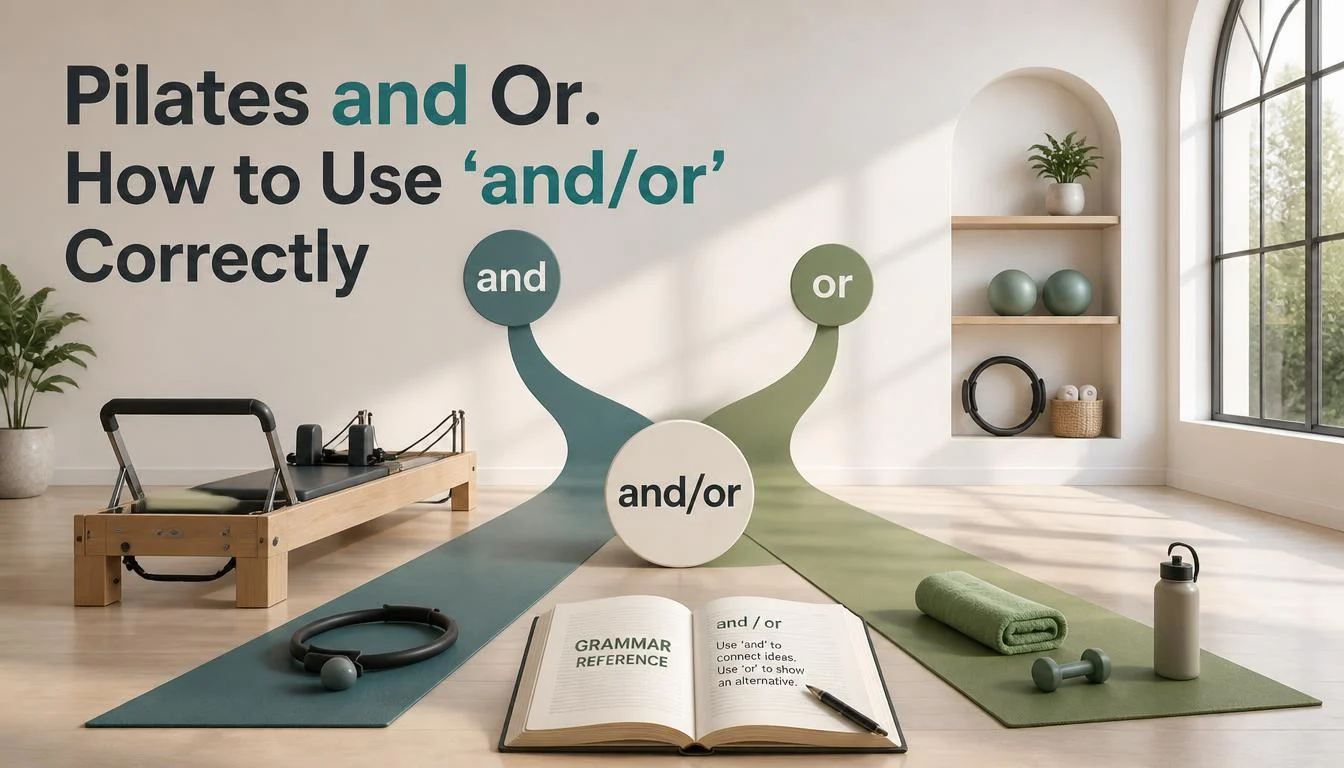
“Pilates and/or” is correct when you mean Pilates, another option, or both. The phrase “pilates and or” is usually missing the slash, while “Pilates” should be capitalized because it is a proper name.
If you have come across the phrase “Pilates and or” and wondered whether it is written correctly, you are not alone. This type of wording can cause confusion because Pilates is the name of a specific exercise method, while and and or are conjunctions with different grammatical functions. Understanding how these words work together can help you avoid awkward phrasing and choose the correct expression for your sentence.
In this guide, we’ll clarify the meaning and proper usage of Pilates and or, explain when and or or fits the context, and provide simple examples to make the distinction easier to understand. Whether you are writing about fitness routines, comparing exercise options, or describing different activities, learning the correct structure will help your English sound clearer and more natural.
Which One Is Correct?
The correct form depends on the meaning you want to express.
If you mean both options together, use and:
You can take Pilates and yoga classes.
If you mean one option or the other, use or:
You can take Pilates or yoga classes.
If either option can apply individually or together, use and/or:
You can take Pilates and/or yoga classes.
Therefore, “Pilates and or” is not normally the preferred written form when you intend the combined construction. The standard form is “Pilates and/or.”
There is another detail worth remembering. Pilates is normally capitalized because the exercise system takes its name from Joseph Pilates.
Meaning of the Correct Word
Definition
Pilates is a form of physical exercise developed around controlled movement, posture, balance, flexibility, and core strength.
When discussing the word choice “Pilates and/or,” however, the main grammar issue concerns and/or, not the meaning of Pilates itself.
The construction and/or means that two possibilities can apply separately or together. It combines the inclusive meanings of and and or.
Explanation
Consider this sentence:
The program includes Pilates and/or stretching.
This sentence allows three possibilities:
- The program includes Pilates only.
- The program includes stretching only.
- The program includes both Pilates and stretching.
That is why and/or can be useful when the writer wants to avoid excluding either possibility.
The word and normally connects things that occur together. The word or normally presents alternatives. Adding the slash creates a compact construction that allows either interpretation.
Still, and/or should not be used automatically. In many sentences, a clearer rewrite works better.
For example:
You can choose Pilates and/or yoga.
This is understandable, but:
You can choose Pilates, yoga, or both.
is often clearer.
Usage
Use and/or when the context genuinely permits one option, the other option, or both.
You may see it in:
- Fitness programs
- Registration forms
- Instructions
- Policies
- Medical or wellness information
- Business documents
- Technical writing
- Scheduling information
- Lists of available activities
For example:
Members may attend Pilates and/or strength-training sessions.
The sentence tells readers that they may attend either type of session or both.
In casual writing, however, and/or can sometimes sound unnecessarily formal. A direct construction often reads more naturally.
Instead of:
You can join Pilates and/or yoga.
You could write:
You can join Pilates, yoga, or both.
The second version makes the three possibilities explicit.
Real-World Examples
Here are several natural examples:
The studio offers Pilates and/or barre classes.
Members can participate in Pilates and/or mobility training.
The package includes Pilates and/or private coaching.
You may need to complete Pilates and/or strength exercises.
The instructor teaches Pilates and/or beginner fitness sessions.
Notice that Pilates remains capitalized in each example.
Meaning of the Incorrect or Alternative Word
Incorrect
The phrase “pilates and or” is generally not the preferred standard written form when the writer intends the combined conjunction.
For example:
You can choose pilates and or yoga.
A polished version would be:
You can choose Pilates and/or yoga.
There are two issues in the first sentence: Pilates should normally be capitalized, and and/or should be written as the established compound construction when that meaning is intended.
Typo
“Pilates and or” may simply result from typing the phrase without the slash.
Someone may know that the expression combines and and or, but accidentally write:
and or
instead of:
and/or
This can happen quickly when drafting emails, forms, blog posts, or notes.
If the intended meaning is “one, the other, or both,” adding the slash fixes the construction.
Slang
“Pilates and or” is not a slang expression.
People may write it informally because they are typing quickly, but the missing slash does not create a recognized slang form.
Likewise, and/or is not slang. It is a conventional written construction.
Regional Variation
There is no major American versus British spelling difference between and/or and and or in this context.
The slash construction appears in English language writing across different regions.
The capitalization of Pilates also remains standard because the exercise method is associated with its founder, Joseph Pilates.
Rare but Valid Usage
There are situations where a writer may deliberately use the words “and or” separately, but the meaning must come from the sentence structure rather than from an intended and/or construction.
For example:
The phrase “and or” may appear when someone is discussing the words themselves.
That sentence is talking about the literal words and and or. It is not using them as the combined grammatical construction.
So, when you mean the inclusive alternative, and/or is the safer standard form.
Key Differences Between the Two Words
The comparison is slightly unusual because “Pilates and or” is a phrase rather than a separate English word. The important distinction concerns capitalization, punctuation, and meaning.
| Feature | Pilates and/or | pilates and or |
|---|---|---|
| Spelling | Standard form | Usually nonstandard for this meaning |
| Meaning | Pilates plus an alternative, either separately or together | Ambiguous or incomplete |
| Pronunciation | “puh-LAH-teez and or” | “puh-LAH-teez and or” |
| Grammar | Uses the conventional and/or construction | Usually needs correction |
| Usage | Suitable when either or both options apply | Often a typo or informal omission |
| Recognition | Widely understood | Less polished in edited writing |
| Capitalization | Pilates | pilates should normally be capitalized |
| Best use | Clear when alternatives may overlap | Better replaced with Pilates and/or or a clearer sentence |
Why the Slash Matters
The slash signals that and and or are being treated as a combined expression.
Compare these sentences:
You can attend Pilates and yoga.
This means both activities are included.
You can attend Pilates or yoga.
This presents two alternatives.
You can attend Pilates and/or yoga.
This permits Pilates, yoga, or both.
That small slash can therefore change the scope of the sentence.
Is “And/Or” Always the Best Choice?
No. Although and/or is widely understood, some editors prefer a clearer construction.
For example:
The class includes Pilates and/or yoga.
can become:
The class includes Pilates, yoga, or both.
The second version removes any possible ambiguity.
For simple reader-facing content, the expanded form can often be more conversational.
Common Mistakes People Make
Writing “Pilates and or”
The most direct mistake is leaving out the slash:
Pilates and or yoga
Use:
Pilates and/or yoga
when you mean either activity or both.
Lowercasing “Pilates”
Another common mistake is writing:
pilates
in a sentence where the exercise method is being named.
The standard form is:
Pilates
The capital P reflects the proper-name origin of the term.
Confusing “and/or” With “or”
These constructions do not necessarily mean the same thing.
You can choose Pilates or yoga.
This may suggest one choice from two options.
You can choose Pilates and/or yoga.
This explicitly allows both.
When both options are permitted, or alone may not communicate the full meaning.
Using “and/or” When “and” Is Enough
Some writers add and/or because it seems safer, even when both things definitely occur.
For example:
The course includes Pilates and/or stretching exercises every morning.
If both activities are required, write:
The course includes Pilates and stretching exercises every morning.
A precise writer chooses the conjunction that matches the actual situation.
Using “and/or” When “or” Is Enough
The opposite problem also occurs.
If a person must select only one option, or may be more appropriate:
Choose Pilates or swimming.
Adding and/or could imply that choosing both is acceptable.
Forgetting That Context Controls Meaning
The phrase and/or does not automatically tell the reader how a real-world choice works.
Suppose a form says:
Select Pilates and/or yoga.
The reader understands that one or both can be selected. But if the organization actually requires exactly one choice, the wording should say so directly.
Clear writing reflects the real rule.
Correct Usage Examples
Casual Examples
I usually do Pilates and/or yoga during the week.
We can try Pilates and/or a beginner dance class.
She enjoys Pilates and/or stretching after work.
You can bring a friend to Pilates and/or another fitness class.
I might take Pilates and/or swimming this summer.
These sentences work because the writer allows either activity or both.
Professional Examples
Professional writing often benefits from replacing and/or with a more explicit phrase when precision matters.
Instead of:
Employees may participate in Pilates and/or wellness workshops.
You could write:
Employees may participate in Pilates, wellness workshops, or both.
Another example:
Members may register for Pilates and/or personal training.
This means registration for Pilates, personal training, or both is possible.
A policy might say:
Participants may receive Pilates and/or mobility instruction.
The construction is acceptable when the program genuinely offers those combinations.
Educational Examples
Teachers and instructors can use and/or when students have flexible choices.
Students may complete Pilates and/or stretching exercises during the practical session.
The lesson covers Pilates and/or basic mobility techniques.
Learners can practice Pilates and/or breathing exercises at home.
For younger learners, however, simpler wording may be preferable:
You can practice Pilates, stretching, or both.
That version makes the choices immediately obvious.
Literary/Metaphorical Examples
The construction can also appear in descriptive writing, although polished literary prose often avoids unnecessary slashes.
For example:
Her evening routine became a quiet ritual of Pilates and/or meditation.
The sentence suggests that either practice, or both, may form part of her routine.
A more natural literary alternative might be:
Her evening routine blended Pilates, meditation, or sometimes both.
The second version has a more flowing rhythm.
Word Origin / Etymology
The word Pilates comes from the surname of Joseph Pilates, the German-born physical trainer who developed the exercise system in the early twentieth century.
Joseph Pilates originally called his method Contrology. The system emphasized controlled physical movement, breathing, posture, and body awareness.
The modern name Pilates developed from his surname and eventually became the widely recognized name of the exercise method.
The grammar question surrounding and/or has a different history. The slash construction developed as a compact way to combine the meanings of and and or.
The slash itself has a long history in written language. Writers have used it for various kinds of alternatives, combinations, and paired terms.
Over time, and/or became especially common in legal, administrative, business, and technical writing. Its purpose is usually to express an inclusive choice without repeating a longer phrase.
For example:
Pilates and/or yoga
can communicate:
Pilates, yoga, or both.
The shorter form is convenient, although the expanded version can sometimes be easier for readers.
Why the Incorrect Version Became Popular
The phrase “pilates and or” is understandable because speakers naturally say “and or” as separate words.
When people speak, they do not pronounce the slash in and/or. They simply say something similar to:
“Pilates and or yoga.”
As a result, writers may transfer the spoken form directly into text.
Typing habits can create the same problem. Someone may type and or quickly without remembering that the conventional written construction uses a slash.
Search queries also contribute to unusual-looking phrases. People often type words exactly as they hear them, even when the standard written form differs.
There is nothing unusual about this kind of spelling uncertainty. English contains many expressions whose spoken and written forms do not line up perfectly.
The key is to distinguish spoken wording from standard written punctuation.
In speech, you can naturally say:
“Pilates and or yoga.”
In edited writing, use:
“Pilates and/or yoga.”
Or, when clarity matters more:
“Pilates, yoga, or both.”
Easy Memory Tricks
Think “Both or Either”
Remember this simple rule:
And = together.
Or = alternative.
And/or = together or alternative.
So if your sentence means one, the other, or both, use and/or.
Remember the Slash
Think of the slash as a visual bridge between two possibilities:
and / or
It tells the reader that the sentence includes both logical options.
Check the Three Possibilities
When you are unsure, ask yourself:
- Can Pilates happen alone?
- Can the other activity happen alone?
- Can both happen together?
If the answer to all three is yes, and/or may fit.
Use “Or Both” for Clarity
If and/or feels awkward, replace it with:
A, B, or both
For example:
You can choose Pilates and/or yoga.
becomes:
You can choose Pilates, yoga, or both.
This is often an excellent choice for beginner-friendly writing.
FAQs
Is “Pilates and or” correct?
Usually not when you mean “Pilates, another option, or both.” The standard written form is “Pilates and/or.”
Should Pilates be capitalized?
Yes. Pilates is normally capitalized because the exercise method derives from the surname of Joseph Pilates.
What does “Pilates and/or yoga” mean?
It means a person may choose Pilates, yoga, or both, depending on the context.
Is “and/or” grammatically correct?
Yes. And/or is an established written construction, although some writers prefer clearer alternatives such as “A, B, or both.”
How do you pronounce “and/or”?
You can pronounce it naturally as “and or.” The slash is a writing symbol and is not normally spoken.
Is “and or” a spelling mistake?
It can be an error when the writer intends the conventional and/or construction. In other contexts, the separate words may be grammatically meaningful.
Is “Pilates or yoga” different from “Pilates and/or yoga”?
Yes. Pilates or yoga presents the alternatives, while Pilates and/or yoga allows either one or both.
Can I use “and/or” in formal writing?
Yes, but use it carefully. If a clearer phrase such as “A, B, or both” improves understanding, that version may be preferable.
Conclusion
When writing pilates and or, use Pilates and/or when you mean Pilates, another option, or both.Remember to capitalize Pilates and use the slash in and/or when the combined meaning is intended.For maximum clarity, you can also write “Pilates, yoga, or both” instead of using the slash.The simplest rule is easy to remember: and means together, or means a choice, and/or allows both possibilities.
Read More Articles
- Friend or Foe | Understanding the Meaning and Proper Usage In 2026
- Misspelled or Misspelt | Grammar, Meaning and Regional Usage In 2026

Jessica Morgan is a blogger and writer at GramScript.com, where she turns everyday ideas into engaging, relatable stories. Her writing blends a natural voice with fresh perspectives that keep readers coming back.
1 thought on “Pilates and Or | Correct Usage Guide for English Learners In 2026”