Quick Answer
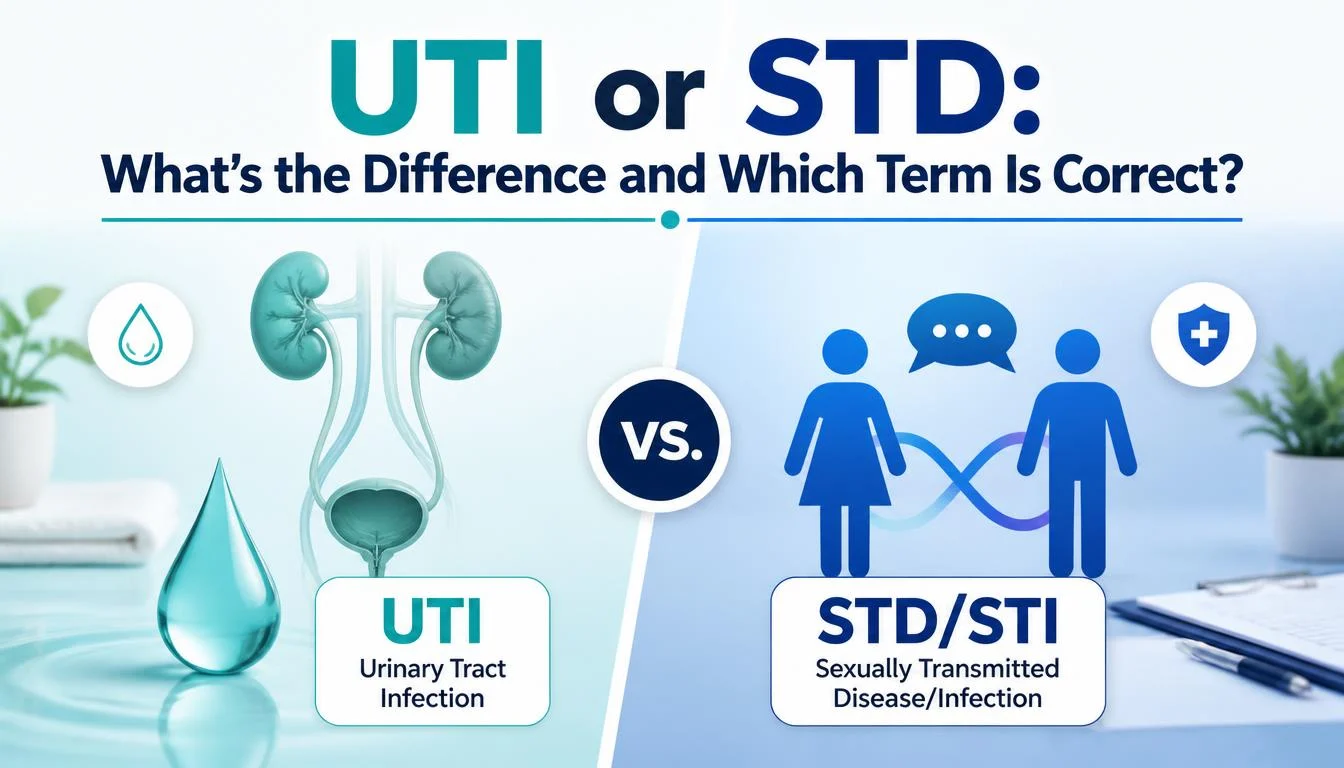
Both UTI and STD are correct terms, but they do not mean the same thing. A UTI is an infection of the urinary tract, while an STD refers to an infection that can spread through sexual contact.
A urinary tract infection (UTI) and a sexually transmitted disease (STD), now commonly called a sexually transmitted infection (STI), can sometimes cause similar symptoms. Burning during urination, frequent urination, pelvic discomfort, or unusual discharge may occur with either condition, which can make it difficult to know what is causing the problem based on symptoms alone. However, the causes, testing methods, and treatments can be quite different.
Understanding the differences between a UTI or STD can help you recognize when medical testing may be appropriate. UTIs usually involve bacteria affecting parts of the urinary system, while STIs spread through sexual contact and can affect several areas of the body. Some STIs also cause few or no noticeable symptoms, so testing can be important when there has been a possible exposure.
Which One Is Correct?
Both UTI and STD are correct. The important point is that they refer to different things.
UTI stands for urinary tract infection. It describes an infection affecting part of the urinary system.
STD stands for sexually transmitted disease. It is a traditional term for a disease that can result from a sexually transmitted infection.
The terms should not be treated as competing spellings. You would use UTI when discussing a urinary tract infection and STD when discussing a sexually transmitted disease.
There is also an important modern terminology distinction. Health professionals often use STI, meaning sexually transmitted infection, because an infection may exist without causing symptoms or disease. The term STD remains widely recognized and is still used in everyday language and some medical contexts.
Meaning of the Correct Word: UTI
Definition
UTI is an abbreviation for urinary tract infection. It refers to an infection in any part of the urinary system.
The urinary tract includes the kidneys, ureters, bladder, and urethra. UTIs commonly involve the lower urinary tract, particularly the bladder and urethra.
Explanation
A UTI occurs when microorganisms enter and multiply in the urinary tract. Bacteria are a common cause.
The location of the infection can affect the symptoms. A bladder infection may cause frequent urination, a strong urge to urinate, or pain during urination.
An infection involving the kidneys can cause more serious symptoms and requires prompt medical attention.
A UTI is not automatically a sexually transmitted infection. Sexual activity can sometimes increase the risk of developing a UTI, but that does not make a UTI an STD.
This distinction is important because the cause, transmission, testing, and treatment of different infections can vary.
Usage
Use UTI when the subject is specifically a urinary tract infection.
Examples include:
- “She was diagnosed with a UTI.”
- “The doctor asked about symptoms of a UTI.”
- “Drinking fluids may be part of general supportive care for some urinary conditions.”
- “The patient reported discomfort while urinating.”
The abbreviation is especially common in medical conversations, health articles, patient information, and everyday speech.
Real-World Examples
- Example 1:
“Frequent urination can occur with a UTI.” - Example 2:
“The clinic evaluated him for a possible UTI.” - Example 3:
“She wanted to know whether her symptoms could be related to a UTI.” - Example 4:
“A UTI affects the urinary tract rather than describing a mode of transmission.”
These examples show why UTI works as a specific medical term rather than a general label for every genital or urinary symptom.
Meaning of the Incorrect or Alternative Word: STD
Incorrect
STD is not incorrect. It is a legitimate abbreviation for sexually transmitted disease.
It becomes incorrect only when someone uses it as a synonym for UTI. A UTI and an STD describe different medical concepts.
For example, this statement is misleading:
“A UTI is another word for an STD.”
A clearer statement would be:
“A UTI is a urinary tract infection, while an STD is a sexually transmitted disease.”
Typo
STD is not a misspelling of UTI, and UTI is not a misspelling of STD.
They come from different phrases:
- UTI = urinary tract infection
- STD = sexually transmitted disease
Because both abbreviations are short, people sometimes confuse them when typing or speaking quickly. However, the letters represent completely different terms.
Slang
Neither UTI nor STD is slang.
Both are established abbreviations used in health communication. UTI is especially common in everyday medical language, while STD is widely understood as a term for sexually transmitted disease.
Regional Variation
UTI and STD are not primarily American-versus-British spelling differences.
English speakers in different countries generally recognize both abbreviations. Medical terminology can vary by institution and country, but the underlying concepts remain distinct.
One notable terminology preference is the use of STI instead of STD. STI means sexually transmitted infection and is widely used in modern health communication.
Rare but Valid Usage
The phrase sexually transmitted disease remains valid, but many modern health organizations prefer the broader term sexually transmitted infection.
That preference reflects an important medical distinction. Someone can have an infection without developing noticeable symptoms or a disease state.
Therefore, STD is still understandable and correct in many contexts, while STI may be more precise in current health-related writing.
Key Differences Between the Two Words
| Feature | UTI | STD |
|---|---|---|
| Full form | Urinary tract infection | Sexually transmitted disease |
| Meaning | Infection affecting the urinary tract | Disease resulting from a sexually transmitted infection |
| Pronunciation | “you-tee-eye” | “ess-tee-dee” |
| Grammar | Noun abbreviation | Noun abbreviation |
| Main context | Urinary health | Sexual and reproductive health |
| Transmission | Not necessarily sexually transmitted | Associated with sexual transmission |
| Relationship | Describes location/type of infection | Describes sexual transmission and disease |
| Recognition | Very common medical abbreviation | Very common health abbreviation |
| Modern alternative | Usually still called UTI | STI is often preferred |
| Interchangeable? | No | No |
The biggest difference is what each abbreviation describes.
UTI focuses on the urinary tract. STD focuses on a sexually transmitted disease.
A person can have urinary symptoms without having an STD. Likewise, an STD may cause symptoms outside the urinary tract or may cause no noticeable symptoms at all.
UTI Pronunciation
UTI is pronounced:
“you-tee-eye”
It is normally spoken letter by letter rather than as a single word.
STD Pronunciation
STD is pronounced:
“ess-tee-dee”
Like UTI, it is usually pronounced as three individual letters.
STI Pronunciation
STI is pronounced:
“ess-tee-eye”
This abbreviation appears frequently in current health education and medical communication.
Common Mistakes People Make
Mistaking UTI for an STD
One of the most common mistakes is assuming that every urinary infection is sexually transmitted.
That is not correct. A UTI and an STD have different definitions.
Assuming Similar Symptoms Mean the Same Condition
Another mistake is identifying an infection based only on one symptom.
Burning while urinating, for example, can occur with different conditions. Symptoms alone do not establish a diagnosis.
Treating STD and STI as Completely Different Categories
STD and STI are closely related terms. STI refers to a sexually transmitted infection, while STD emphasizes disease caused by such an infection.
The terminology has evolved because an infection does not always produce symptoms or disease.
Using UTI as a General Term for Genital Infections
A UTI specifically involves the urinary tract. It should not be used as a broad label for every infection involving the genital area.
Assuming Sexual Activity Automatically Means an STD
Sexual activity and sexually transmitted infections are related, but not every infection following sexual activity is an STD.
For example, sexual activity can sometimes be associated with the development of a UTI without the UTI itself being sexually transmitted.
Ignoring the Difference Between Symptoms and Diagnosis
A symptom can have several possible causes.
That is why terms such as UTI, STI, and STD should be used carefully. A person should not assume which condition they have based only on a symptom description.
Correct Usage Examples
Casual Examples
Here are natural examples from everyday conversation:
- “I think I might have a UTI.”
- “She went to the doctor because she was worried about an infection.”
- “Is a UTI the same thing as an STD?”
- “He asked whether the symptoms could be caused by an STI.”
- “The doctor explained the difference between a UTI and an STD.”
These sentences use the abbreviations naturally without treating them as synonyms.
Professional Examples
In professional or healthcare-related writing, precise terminology matters.
- “The patient reported symptoms consistent with a possible urinary tract infection.”
- “The clinician discussed testing for sexually transmitted infections.”
- “A UTI and an STI have different causes and transmission patterns.”
- “The patient was advised to seek appropriate medical evaluation.”
- “The medical history included previous urinary tract infections.”
Professional writing often spells out an abbreviation at first mention, especially when the audience may not know it.
For example:
“A urinary tract infection (UTI) can affect different parts of the urinary system.”
Afterward, UTI can be used on its own.
Educational Examples
Educational writing can make the distinction especially clear:
- “UTI means urinary tract infection.”
- “STD means sexually transmitted disease.”
- “UTIs are not automatically sexually transmitted.”
- “STI is often preferred when discussing sexually transmitted infections.”
- “UTI and STD describe different medical concepts.”
These examples are useful for students, health writers, and anyone learning medical vocabulary.
Literary/Metaphorical Examples
UTI and STD are technical medical abbreviations, so metaphorical use is uncommon.
You should normally use them literally. Unlike ordinary English words, these abbreviations do not have useful figurative meanings in standard writing.
For example, using “UTI” metaphorically could confuse readers because the abbreviation has a well-established medical meaning.
Word Origin / Etymology
UTI
The abbreviation UTI comes from the phrase urinary tract infection.
The term combines three straightforward elements:
- Urinary relates to urine or the urinary system.
- Tract refers to a connected anatomical passage or system.
- Infection refers to invasion or multiplication of microorganisms in the body.
The phrase therefore describes an infection involving the urinary tract.
The abbreviation UTI developed from the initial letters of those words and became common in clinical and everyday health communication.
STD
STD comes from sexually transmitted disease.
The phrase contains three key ideas:
- Sexually refers to sexual activity or sexual transmission.
- Transmitted means passed from one person to another.
- Disease refers to a condition affecting normal health.
The term describes a disease that can be transmitted through sexual contact.
STI
The related abbreviation STI means sexually transmitted infection.
This terminology highlights infection rather than disease. That difference matters because some infections produce no obvious symptoms.
As medical communication has become more precise, STI has become common in health education and clinical contexts.
Why the Incorrect Version Became Popular
There is no incorrect version between UTI and STD. The confusion comes from their overlapping subject matter.
Both terms can appear in conversations about urination, genital symptoms, sexual health, and infections. That overlap can make the abbreviations seem interchangeable even though their definitions differ.
The abbreviation STD has also been widely used for decades, making it familiar to many English speakers. More recently, STI has become increasingly common because it describes infections that may exist without causing disease or symptoms.
Another source of confusion is the fact that sexual activity can be associated with some UTIs. That connection does not mean that a UTI itself is sexually transmitted.
The safest approach is to focus on the exact meaning of each abbreviation rather than relying on the general topic.
Easy Memory Tricks
Remember UTI with the word urinary:
U = Urinary
T = Tract
I = Infection
If the topic is the urinary system, think UTI.
Remember STD with the word sexually:
S = Sexually
T = Transmitted
D = Disease
If the topic specifically concerns a sexually transmitted disease, STD may be the appropriate term.
You can also remember the distinction this way:
UTI tells you where the infection is.
STD tells you about sexual transmission and disease.
And when you see STI, remember:
I = Infection
That wording is useful when discussing sexually transmitted infections, including those that may not cause symptoms.
FAQs
Is a UTI the same as an STD?
No. A UTI affects the urinary tract, while an STD refers to a sexually transmitted disease.
Can a UTI be caused by sex?
Sexual activity can sometimes increase the risk of a UTI, but that does not make the UTI a sexually transmitted disease.
Is STD still a correct term?
Yes. STD is a recognized abbreviation for sexually transmitted disease, although STI is often preferred in modern health communication.
What does UTI stand for?
UTI stands for urinary tract infection, an infection affecting part of the urinary system.
What does STD stand for?
STD stands for sexually transmitted disease, a disease associated with sexual transmission.
Is STI the same as STD?
They are closely related, but STI means sexually transmitted infection, while STD emphasizes disease.
How do you pronounce UTI?
UTI is pronounced “you-tee-eye.”
How do you pronounce STD?
STD is pronounced “ess-tee-dee.”
Conclusion
When comparing UTI or STD, remember that both terms are correct but describe different medical concepts.A UTI refers to an infection of the urinary tract, while an STD refers to a sexually transmitted disease.Do not use the two abbreviations interchangeably, especially when discussing symptoms or health information.The easiest rule is simple: UTI describes the urinary tract, while STD describes sexually transmitted disease.
Read More Articles
- Pilates and Or | Correct Usage Guide for English Learners In 2026
- Behaviour or Behavior | Everything You Need to Know About the Spelling In 2026

Andrew Cooper is a blogger and writer at Gramscript.com, turning everyday ideas into clear, engaging stories. His writing blends curiosity, insight and a genuinely human perspective.