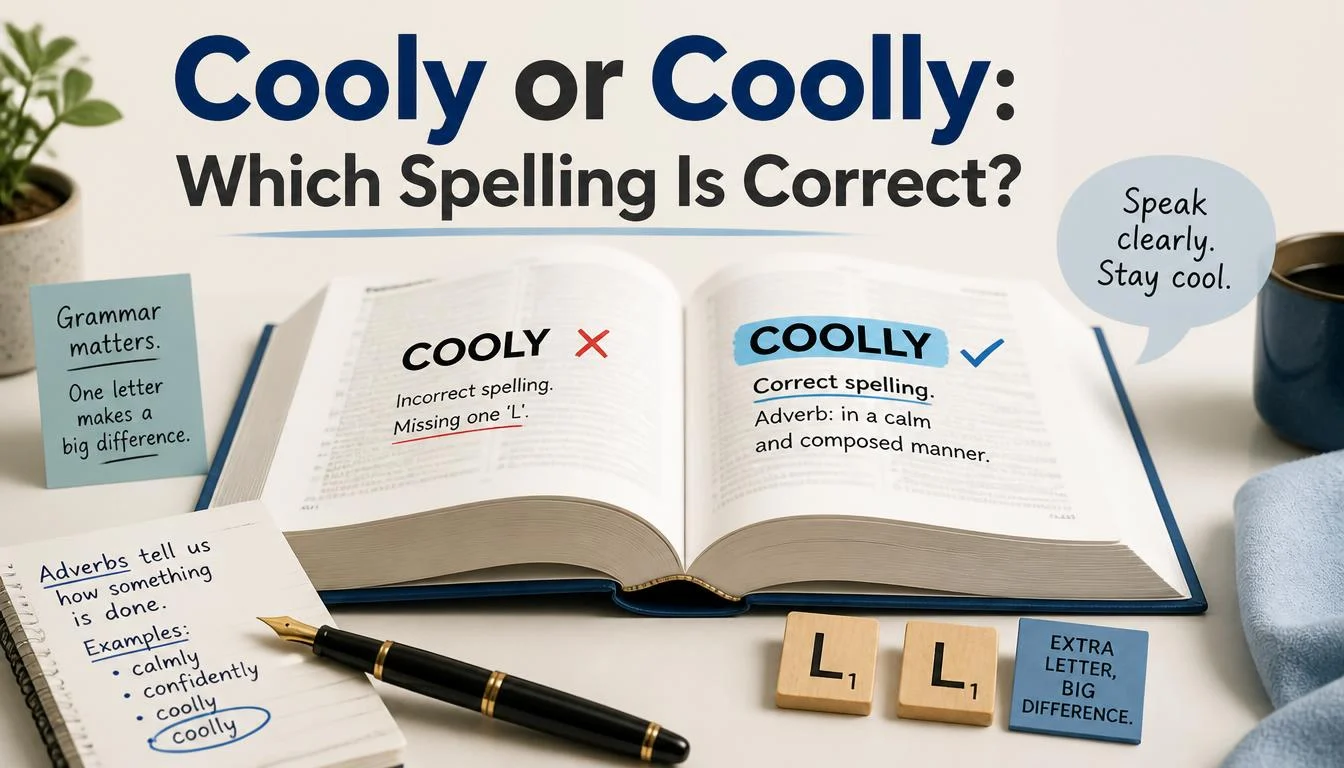
Quick Answer
Coolly is the correct standard spelling when you need the adverb meaning “in a calm, composed, or unemotional way.”Cooly is not the standard spelling for this adverb and usually appears as a spelling mistake.
When you want to describe someone doing something in a calm, composed, or relaxed manner, you may wonder whether the correct spelling is cooly or coolly. These forms look almost identical, but only one is the standard spelling in modern English. Knowing the correct form can help you avoid a common spelling mistake in emails, essays, professional writing, and everyday communication.
The correct word is coolly, formed by adding the adverb ending -ly to the adjective cool. It can describe an action performed calmly or without showing strong emotion, as in “She coolly handled the difficult question.” In this guide, we’ll explain why coolly is correct, what cooly means in comparison, and how to use the correct form naturally in different sentences.
Which One Is Correct?
The correct standard adverb is coolly.
The word coolly comes from the adjective cool plus the adverb-forming suffix -ly. The final l in cool remains when the suffix is added:
cool + ly = coolly
This spelling follows the normal pattern of keeping the original word intact when adding -ly.
| Word | Standard adverb? | Meaning |
|---|---|---|
| coolly | Yes | In a calm, controlled, unemotional, or sometimes unfriendly way |
| cooly | No, in this sense | Generally treated as a misspelling of coolly |
So, if you want to describe someone acting calmly or without showing much emotion, choose coolly.
For example:
She coolly explained what had happened.
Not:
She cooly explained what had happened.
The second spelling is not the accepted standard form for this meaning.
Meaning of the Correct Word
Definition
Coolly is an adverb that means in a calm, controlled, composed, or unemotional manner.
It can describe someone who stays relaxed during a difficult situation. It can also describe behavior that seems emotionally distant, detached, or unfriendly.
For example:
He coolly answered the difficult question.
Here, coolly suggests that he remained calm and did not become nervous or emotional.
The word can have a positive, neutral, or slightly negative sense depending on context.
Explanation
The meaning of coolly depends heavily on the situation.
In a stressful moment, it often suggests self-control. A person who responds coolly does not panic or lose control.
The firefighter coolly assessed the situation.
In an interpersonal situation, however, coolly may suggest emotional distance.
She coolly rejected his suggestion.
In this sentence, the word may imply that she responded without warmth or sympathy.
Therefore, coolly does not always mean “nicely” or “politely.” It describes the manner of an action, especially the emotional quality behind it.
Usage
Coolly usually modifies a verb because it is an adverb.
Common combinations include:
- coolly responded
- coolly replied
- coolly explained
- coolly refused
- coolly observed
- coolly stated
- coolly handled
- coolly dismissed
- coolly accepted
- coolly assessed
It can appear before or after the main verb.
She coolly responded to the criticism.
She responded coolly to the criticism.
Both sentences are grammatically correct.
The word is especially useful when writing about someone’s reaction, behavior, speech, or decision-making.
Real-World Examples
Here are several natural examples of coolly in everyday and professional contexts:
The manager coolly handled the complaint.
He coolly explained why the plan had failed.
She coolly ignored the criticism.
The athlete coolly stepped forward for the final attempt.
He coolly answered the reporter’s question.
The lawyer coolly presented the evidence.
She coolly accepted the unexpected result.
In each sentence, coolly tells us how the person performed the action.
Meaning of the Incorrect or Alternative Word
Incorrect
When cooly is intended as the adverb formed from cool, it is not the standard spelling in modern American English.
If your sentence means “in a calm or emotionally controlled way,” write coolly, not cooly.
For example:
Correct: He coolly rejected the offer.
Incorrect: He cooly rejected the offer.
The extra l is essential.
Typo
Cooly commonly appears because writers may apply a simplified spelling pattern to cool + ly.
They may think that the adjective already ends in l, so adding -y produces cooly. That reasoning does not match the standard formation of this adverb.
The correct construction is:
cool + ly → coolly
The spelling keeps both original l letters from cool.
Slang
Cooly is not a standard slang replacement for coolly in formal or general American English.
You may occasionally encounter unusual spellings online, in informal writing, usernames, or creative text. Such appearances do not make cooly the standard adverb.
For school, work, publishing, and professional communication, use coolly.
Regional Variation
Cooly is not a standard American-versus-British spelling difference.
American English and British English both use coolly as the normal adverb.
So you do not need to choose between cooly and coolly based on location. The standard spelling remains coolly.
Rare but Valid Usage
There is an important detail about cooly: the sequence of letters can appear in other lexical contexts.
Historically, cooly has been used as a variant spelling of coolie, an old term associated with laborers in parts of Asia and other regions. That historical noun is unrelated to the ordinary adverb coolly.
Because the historical term carries dated and potentially offensive usage concerns, modern writers should avoid using it casually. This does not change the spelling rule for the adverb.
If your intended meaning is “in a calm or controlled manner,” coolly is the word you need.
Key Differences Between the Two Words
The main difference is simple: coolly is the standard adverb, while cooly is not the standard spelling for that meaning.
| Feature | Coolly | Cooly |
|---|---|---|
| Spelling | Standard | Nonstandard for this adverb |
| Meaning | Calmly, composedly, unemotionally, or coldly | Not the standard adverb meaning |
| Pronunciation | “KOOL-lee” | Usually intended to represent coolly |
| Grammar | Adverb | Not a standard adverb in this use |
| Usage | Standard American English | Usually a spelling error |
| Recognition | Widely recognized | May be flagged or misunderstood |
| Word formation | cool + ly | Incorrect simplification in this context |
| Suitable for formal writing | Yes | No, when intended as the adverb |
Why Does Coolly Have Two Ls?
The spelling becomes easier to understand when you look at the base word.
The adjective is:
cool
It already contains two l letters.
The adverbial suffix is:
-ly
When you combine them, you get:
cool + ly = coolly
The word does not drop one of the existing l letters.
Compare these forms:
- cool → coolly
- real → really
- full → fully
- dull → dully
These examples show why the spelling of coolly should not surprise you.
Common Mistakes People Make
Mistake 1: Writing “cooly”
The most common mistake is removing one l.
Incorrect: He cooly answered the question.
Correct: He coolly answered the question.
Remember that the base adjective is cool, not col or coo.
Mistake 2: Confusing “cool” and “coolly”
Cool is usually an adjective, while coolly is an adverb.
Compare:
She is cool under pressure.
Here, cool describes she.
She responded coolly under pressure.
Here, coolly describes responded.
The grammatical roles are different.
Mistake 3: Assuming Every -ly Word Drops a Letter
English spelling does not follow one universal rule for every adjective ending.
Writers sometimes expect the final letters of a base word to change when -ly is added. In coolly, however, the two l letters remain.
The safest approach is to remember the complete form:
cool → coolly
Mistake 4: Using “Cooly” in Formal Writing
A spelling that looks understandable may still be inappropriate in formal writing.
If you are writing an essay, report, email, article, or professional document, use coolly.
Mistake 5: Confusing “Coolly” With “Coldly”
The two words can overlap, but they are not always identical.
Coolly often emphasizes emotional control.
Coldly more strongly suggests a lack of warmth, sympathy, or kindness.
For example:
She coolly handled the pressure.
This emphasizes composure.
She coldly rejected his request.
This emphasizes emotional distance or lack of warmth.
Correct Usage Examples
Casual Examples
In everyday conversation and informal writing, coolly can describe a relaxed reaction.
He coolly told everyone not to worry.
She coolly walked away from the argument.
I thought he would panic, but he coolly handled it.
She coolly answered the question and changed the subject.
These examples show emotional control without requiring a formal setting.
Professional Examples
In workplace writing, coolly can describe measured behavior during negotiations, meetings, or disagreements.
The director coolly addressed the team’s concerns.
The negotiator coolly rejected the proposed terms.
She coolly explained the financial risks.
The supervisor coolly responded to the complaint.
In professional contexts, the word can suggest confidence and self-control. However, it can also imply emotional distance, so choose it carefully when describing someone’s attitude.
Educational Examples
Students may encounter coolly in literature, grammar exercises, and descriptive writing.
The student coolly explained the answer to the class.
The professor coolly responded to the challenge.
The character coolly faced the difficult decision.
When teaching the spelling, a useful example is:
cool + ly = coolly
This makes the word formation easy to visualize.
Literary/Metaphorical Examples
Writers often use coolly to create a strong impression of character or mood.
The detective coolly examined the empty room.
She coolly watched the storm gather beyond the window.
The king coolly listened to the messenger’s warning.
He coolly faced the uncertainty ahead.
In literary contexts, coolly can make a character seem controlled, detached, fearless, or emotionally guarded.
The exact interpretation depends on the surrounding description.
Word Origin / Etymology
The adjective cool has a long history in English and is related to words in other Germanic languages that refer to a low temperature or a sense of coolness.
Over time, cool developed several figurative meanings. English speakers began using it to describe people who remained calm and composed rather than physically cold.
The adverb coolly developed from cool with the productive English suffix -ly. This suffix commonly turns adjectives into adverbs describing how an action occurs.
For example:
- calm → calmly
- quiet → quietly
- serious → seriously
- cool → coolly
The figurative sense of coolly therefore connects naturally with the idea of maintaining control instead of showing strong emotion.
The spelling also reflects the structure of the base word. Since cool ends in two l letters, the standard adverb keeps them:
cool + ly = coolly
Why the Incorrect Version Became Popular
The spelling cooly is easy to produce because English spelling can create uncertainty around words ending in l.
When people see:
cool + ly
they may expect the result to contain only one l before the y. That produces cooly, which looks visually simple.
Another reason is pronunciation. Coolly and the mistaken cooly are normally pronounced very similarly when someone intends cooly as an adverb. Because the spoken form does not clearly reveal the extra l, writers may not notice the spelling problem.
Digital typing can also contribute to unusual spellings. Autocorrect, fast messaging, and informal online writing sometimes allow nonstandard forms to circulate.
However, familiarity does not make the spelling standard. In careful English, the adverb remains coolly.
Easy Memory Tricks
Remember “Cool Keeps Both Ls”
The easiest trick is:
COOL + LY = COOLLY
Think of the two l letters as belonging to the word cool. The suffix -ly simply joins the base word.
Say “Cool, Then Ly”
Break the spelling into two parts:
cool + ly
When you can see the two parts, the spelling becomes much harder to forget.
Compare “Cool” and “Coolly”
Write these side by side:
cool → adjective
coolly → adverb
The adverb keeps the complete spelling of cool.
Use the “Two Ls” Reminder
If you are unsure, ask yourself:
Does the base word have two Ls?
Yes.
Am I adding -ly?
Yes.
Then write:
coolly
Not cooly.
FAQs
Is “cooly” a correct word?
Not as the standard adverb meaning “in a calm or controlled way.” Use coolly instead.
How do you spell coolly?
The correct spelling is c-o-o-l-l-y: coolly.
How do you pronounce “coolly”?
It is pronounced approximately KOOL-lee, with two clear syllables.
Is “coolly” an adjective or an adverb?
Coolly is an adverb. It describes how someone performs an action.
What does “coolly” mean?
It means in a calm, composed, unemotional, or sometimes emotionally distant manner.
Is “cooly” a British spelling?
No. Cooly is not a standard British alternative to coolly for this meaning.
Why does “coolly” have two Ls?
It combines cool with -ly, so the two Ls from the base word remain: cool + ly = coolly.
What is the difference between “cool” and “coolly”?
Cool commonly works as an adjective, while coolly is an adverb that describes the manner of an action.
Conclusion
When choosing between cooly or coolly, use coolly for the standard adverb meaning calm, controlled, or emotionally detached.The spelling follows a simple pattern: cool + ly = coolly, so both original Ls remain.Although cooly may appear as a typo or in unrelated historical usage, it is not the standard adverb.Remember “cool keeps both Ls,” and you will have the correct spelling every time.
Read More Articles
- Aide or Aid | Similar Words With Different Meanings In 2026
- Pilates and Or | Correct Usage Guide for English Learners In 2026

Andrew Cooper is a blogger and writer at Gramscript.com, turning everyday ideas into clear, engaging stories. His writing blends curiosity, insight and a genuinely human perspective.
1 thought on “Cooly or Coolly | A Simple Guide to Correct Usage In 2026”