Quick Answer
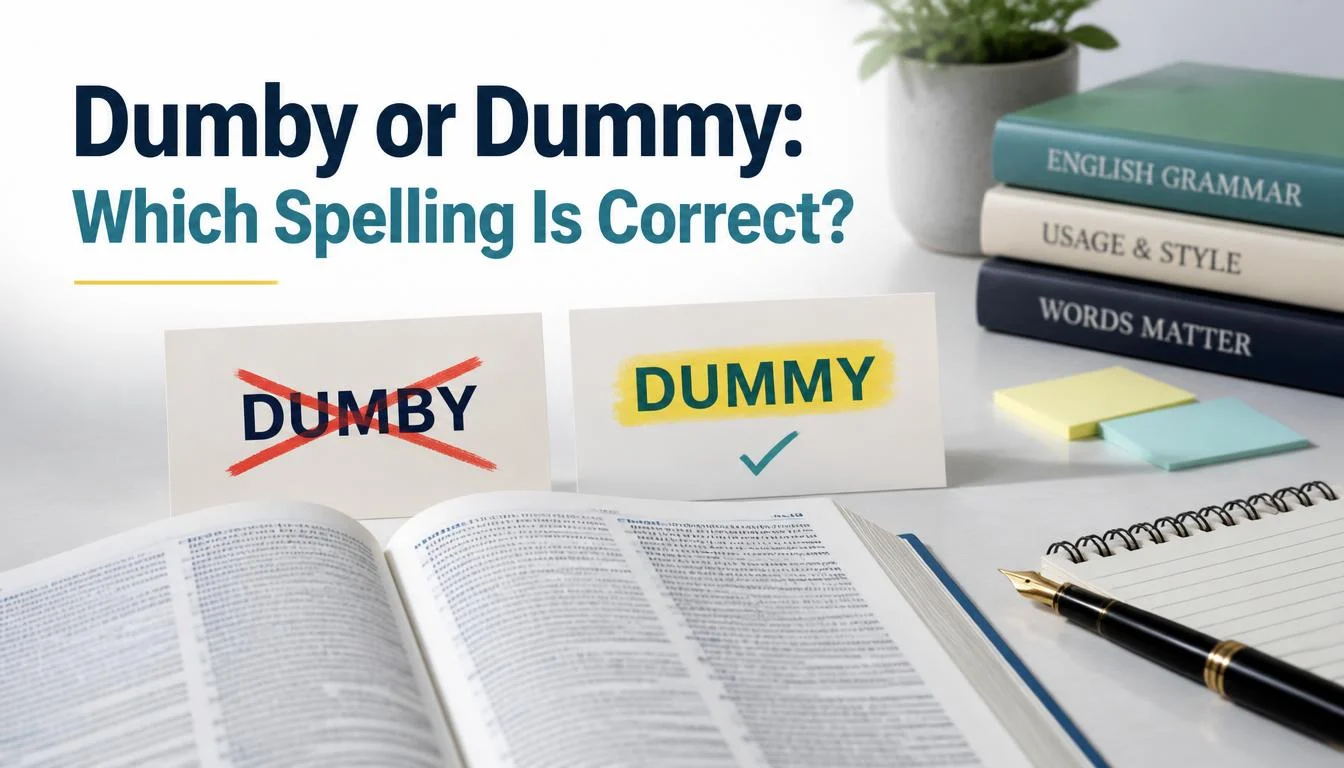
Dummy is the correct standard spelling; dumby is a misspelling and is not a standard English word.Use dummy for a foolish person, a model or imitation, or something used for practice or testing.
If you have ever wondered whether the correct spelling is dumby or dummy, you are not alone. These two spellings look almost identical, but only one is the standard spelling in modern English. Dummy is the correct and widely accepted form, while dumby is generally considered a misspelling. You may still encounter “dumby” in informal writing, usernames, names, or online posts, but it is not the standard spelling used in dictionaries and formal writing.
Understanding the difference becomes especially useful when you want your writing to look clear and polished. Dummy can describe a person who is perceived as foolish, a model used for practice or demonstration, or something designed to look real without functioning like the real thing. In this guide, we will explain why dummy is correct, what dumby means when you encounter it, and how to use the standard spelling naturally in a sentence.
Which One Is Correct?
Dummy is the correct spelling in standard English.
Dumby is generally considered a spelling mistake. It does not function as a standard alternative spelling of dummy in modern American English.
| Word | Status | Standard English? |
|---|---|---|
| dummy | Correct spelling | Yes |
| dumby | Misspelling | No |
The confusion is understandable because English pronunciation does not always reveal spelling. The final sound in dummy is the long “ee” sound, but English often represents that sound with y at the end of a word.
For example:
- funny
- sunny
- happy
- silly
- dummy
The same spelling pattern appears in all these words. Writing dumby changes the established spelling without changing the pronunciation.
Meaning of the Correct Word
Definition
Dummy is a noun, adjective, and verb with several related meanings.
- As a noun, it can mean a model, imitation, practice object, or a person who is considered foolish.
- As an adjective, it can describe something designed to imitate or temporarily represent something else.
- As a verb, it can mean to make something ineffective, conceal something, or use a dummy version for a particular purpose.
- The exact meaning depends on the sentence.
Explanation
One common meaning of dummy refers to a person who behaves foolishly or lacks good judgment.
For example:
Don’t be a dummy. Read the instructions first.
This use can sound teasing, insulting, or playful depending on the relationship between speakers.
Another meaning refers to an object that represents something real. A store might use a dummy camera to look like a working security camera. A clothing store might display clothes on a dummy or mannequin.
The word also appears in training and testing. A driving school may use a crash-test dummy to study what happens during a collision. A software developer may create dummy data to test a system without using real customer information.
Usage
Dummy works in several grammatical roles.
- As a noun:
- The crash test dummy remained secured in the vehicle.
- He called himself a dummy after making the mistake.
- As an adjective:
- We entered dummy information into the form.
- The engineers built a dummy system for testing.
- As a verb:
- The team used a temporary process to dummy up the demonstration.
The noun and adjective uses are much more common in everyday English.
Real-World Examples
You can encounter dummy in many fields.
Everyday conversation:
I felt like a dummy after forgetting my keys.
Retail:
The designer placed the new jacket on a dummy.
Automotive safety:
Researchers tested the vehicle with a crash-test dummy.
Technology:
The developer created dummy data before launching the application.
Education:
The instructor used a dummy model to demonstrate the procedure.
Business:
The team prepared a dummy report for the presentation.
These examples show why context is important. The word can refer to a person, object, model, placeholder, or test material.
Meaning of the Incorrect or Alternative Word
Incorrect
Dumby is not the standard spelling of the word dummy. If you mean the common English word pronounced “DUM-ee,” write dummy.
For example:
Correct: The technician entered dummy data.
Incorrect: The technician entered dumby data.
The second sentence contains a spelling error rather than a meaningful variation.
Typo
In most cases, dumby is simply a typo or spelling mistake.
Writers may produce it because they connect the final sound of dummy with other words that contain -by. They may also type quickly and unconsciously substitute b for m.
Because spell-checkers and autocorrect tools may vary, it is still useful to know the standard spelling yourself.
Slang
Dumby is not established standard slang that replaces dummy in general American English.
You may occasionally see unusual spellings online, in informal messages, usernames, jokes, or creative writing. Such uses do not make dumby a standard spelling.
If you are writing an email, article, school assignment, report, or professional document, use dummy.
Regional Variation
There is no widely recognized American-English regional spelling in which dumby is the standard form of dummy.
English does contain many genuine regional spelling differences, but this is not one of them. Standard dictionaries and conventional American English usage use dummy.
Rare but Valid Usage
There is no common modern dictionary-based usage that makes dumby a standard alternative to dummy.
If you encounter dumby in a particular source, it is usually best to consider the surrounding context. It may be an intentional creative spelling, a username, a proper name, or simply an error.
The spelling dummy remains the reliable choice for standard writing.
Key Differences Between the Two Words
The main difference is simple: dummy is the established English word, while dumby is normally a misspelling.
| Feature | Dummy | Dumby |
|---|---|---|
| Spelling | Correct | Incorrect |
| Meaning | Has several established meanings | No standard independent meaning |
| Pronunciation | DUM-ee | Usually intended to sound like “dummy” |
| Grammar | Noun, adjective, and verb | No standard grammatical role |
| Usage | Common in everyday and technical English | Usually limited to errors or creative spelling |
| Recognition | Widely recognized | Not recognized as a standard variant |
The pronunciation does not create a spelling difference. Both forms may be intended to represent the same spoken word, but only dummy follows the conventional spelling.
This distinction becomes especially important in formal writing. A reader will understand dummy immediately. The spelling dumby may interrupt reading because it looks like an error.
Common Mistakes People Make
Mistake 1: Writing the Word by Sound
Some people hear dummy and spell it according to what they think the ending sounds like.
Incorrect: He used a dumby model.
Correct: He used a dummy model.
English spelling often requires memorizing conventional forms rather than writing exactly what you hear.
Mistake 2: Assuming “-by” Is the Natural Ending
The letter combination -by appears in many English words, such as nearby, standby, and hobby has a different pattern altogether. That does not mean every final “bee” sound uses -by.
The established spelling of dummy comes from its own word history and spelling pattern.
Mistake 3: Confusing Dummy With foolish
Dummy is historically connected tofoolish, but modern usage gives dummy its own range of meanings.
For example:
The technician used a dummy battery.
Here, dummy does not mean “foolish.” It means a substitute or imitation.
Mistake 4: Treating Dumby as a Valid Variant
Seeing an unusual spelling online does not automatically make it a recognized English variant.
If you are unsure, check the standard form before using the word in formal writing. In this case, the answer is dummy.
Mistake 5: Using “Dummy” Without Considering Tone
When dummy describes a person, it can sound insulting.
You’re such a dummy!
Friends may use this playfully, but the same sentence could sound rude in a professional setting. When referring to a person, consider the relationship and context.
Correct Usage Examples
Casual Examples
These examples show everyday uses of dummy:
- Don’t be a dummy; check the label first.
- I left my phone at home like a dummy.
- He jokingly called his brother a dummy.
- That dummy battery isn’t connected to the circuit.
- We used a dummy key for the demonstration.
When dummy describes a person, the tone often depends on context. Among friends, it can be affectionate teasing. In formal settings, choose a more neutral expression.
Professional Examples
Dummy also appears naturally in business and technical communication.
- The team created dummy accounts for testing.
- Please enter dummy information in the training form.
- The designer prepared a dummy version of the brochure.
- Engineers placed a test dummy inside the vehicle.
- The developer used dummy values during the initial test.
In these examples, dummy means a substitute, model, placeholder, or test version. It does not describe someone’s intelligence.
Educational Examples
Teachers and trainers often use dummy objects to demonstrate processes safely.
- The instructor used a dummy patient during the training session.
- Students practiced the procedure on a dummy model.
- The teacher entered dummy numbers into the spreadsheet.
- The class examined a dummy sample before handling the real material.
This use is particularly common when students need hands-on practice without affecting real data, equipment, or people.
Literary/Metaphorical Examples
Writers can also use dummy in figurative or descriptive language.
- He felt like a dummy after missing the obvious clue.
- The empty display served as a dummy for the real product.
- She refused to be treated like a dummy in the negotiations.
- The fake document was only a dummy for the final version.
The intended meaning becomes clear from the surrounding words.
Word Origin / Etymology
The history of dummy helps explain why its spelling should not be changed to dumby.
The word developed from foolish, an older English word associated with being unable or unwilling to speak. Over time, English formed dummy as a related noun. Earlier uses referred to a person who could not speak or to someone who remained silent.
The meaning later expanded. A dummy could represent a person or thing without being the real thing itself. That development led to familiar expressions such as dummy figure, dummy model, and crash-test dummy.
The word also developed a figurative sense for a foolish person. That meaning appears in informal English today.
Modern English therefore uses dummy for several related ideas:
- a person who is foolish
- a representation of something
- a practice or test object
- a placeholder
- an imitation or nonfunctional version
The spelling has become firmly established as dummy.
Why the Incorrect Version Became Popular
The spelling dumby is easy to understand as a mistake because pronunciation and spelling do not always match in English.
When people hear dummy, they hear something close to “DUM-ee.” Someone unfamiliar with the written form may try to reconstruct the spelling from sound. The result can be dumby, especially when the writer associates the final sound with words containing -by.
Another factor is informal digital communication. Fast typing encourages people to write words from memory without checking them. Unusual spellings can then appear repeatedly in messages, comments, or social posts.
Online repetition can make a misspelling look more legitimate than it is. However, frequency in informal writing does not establish a standard dictionary spelling.
There is also a connection between dummy and foolish, which can create additional spelling uncertainty. Someone may recognize the root but still choose an incorrect ending.
The important point is that dumby did not become a standard regional or modern spelling of dummy. In ordinary English, it remains a misspelling or intentional nonstandard form.
Easy Memory Tricks
Remember the “Y” Ending
The easiest trick is:
Dummy = D-U-M-M-Y
Notice the two m’s before the final y.
Say it slowly:
DUM + MY
The spelling matches the familiar word pattern rather than using -by.
Connect It With “Funny”
Both funny and dummy end with -ny.
You can remember:
Funny and dummy both end in -ny.
This simple connection can help you avoid writing dumby.
Use the Two-M Rule
Think:
Dummy has two M’s.
If you write dumby, you have replaced the second m with b.
A quick mental check can catch the mistake before you submit your writing.
Remember the Meaning
If you mean a model, substitute, practice object, or foolish person, choose dummy.
Dummy = the standard English word.
That rule works in everyday writing, technical documentation, schoolwork, and professional communication.
FAQs
Is “dumby” a correct word?
No. Dumby is generally a misspelling of the standard word dummy.
Is it “dummy” or “dumby”?
The correct spelling is dummy. The spelling dumby is not a standard English variant.
How do you pronounce “dummy”?
Dummy is pronounced approximately DUM-ee.
What does “dummy” mean?
Dummy can mean a foolish person, a model, a substitute, a practice object, or placeholder data.
Is “dumby” slang?
Not in standard American English. You may see it informally online, but it is not the accepted spelling.
Is “dummy” an adjective?
Yes. For example, dummy data, dummy account, and dummy model use dummy as an adjective.
Can “dummy” be offensive?
Yes, when it describes a person as foolish. Its tone can range from playful teasing to insulting, depending on context.
What is the difference between dummy and foolish?
Foolish is an adjective with several meanings, while dummy can be a noun, adjective, or verb with a wider range of uses.
Conclusion
When choosing between dumby or dummy, use dummy in standard English because it is the established spelling.It can describe a foolish person, a model, a substitute, or something used for practice and testing.Dumby is generally a misspelling, not a recognized regional alternative.Remember the two M’s: dummy is the spelling that belongs in your writing.
Read More Articles
- Cooly or Coolly | A Simple Guide to Correct Usage In 2026
- Rancher or Tiller | Definitions, Uses and Key Differences In 2026

Andrew Cooper is a blogger and writer at Gramscript.com, turning everyday ideas into clear, engaging stories. His writing blends curiosity, insight and a genuinely human perspective.
1 thought on “Dumby or Dummy | Common Spelling Mistake Explained In 2026”