Quick Answer
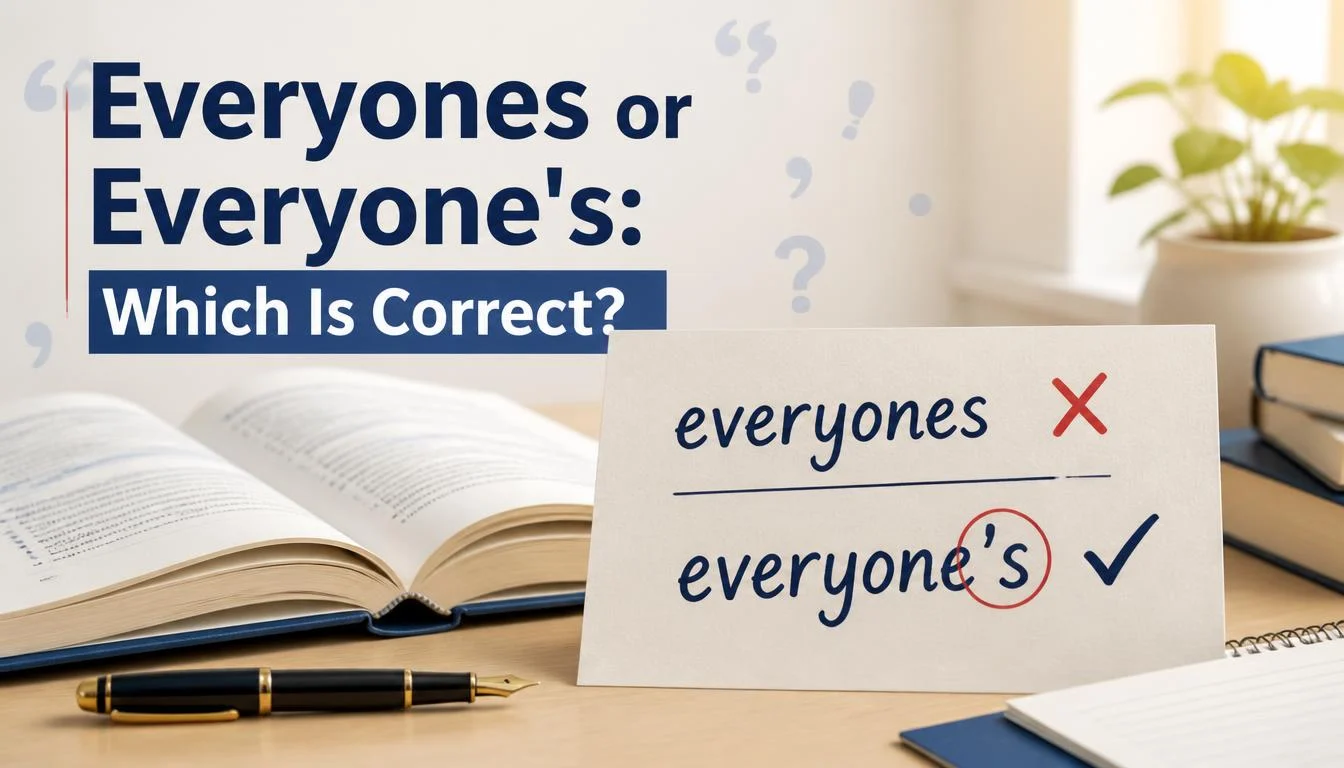
Everyone’s is the correct form when you mean “everyone is,” “everyone has,” or something belongs to everyone.Everyones is generally incorrect because everyone is already singular and does not form a plural by adding -s.
When you are unsure about everyones or everyone’s, the apostrophe is the key detail to check. Everyone’s is the standard correct form when you need to show possession or use the contraction of “everyone is” or “everyone has.” For example, “Everyone’s opinion matters” shows possession, while “Everyone’s ready” means “everyone is ready.” The form “everyones” without an apostrophe is generally not correct in standard English.
Understanding when to use everyone’s becomes much easier once you identify what the word is doing in a sentence. If it shows that something belongs to or relates to everyone, use the possessive form with an apostrophe. If you mean “everyone is” or “everyone has,” the same spelling also works as a contraction. This guide explains the difference between everyones or everyone’s, with clear examples to help you choose the correct form confidently.
Which One Is Correct?
Everyone’s is the correct form in standard English.
It can serve two main purposes:
- Possessive form: It shows that something belongs to or is associated with everyone.
- “Everyone’s responsibility matters.”
- “Everyone’s opinion deserves consideration.”
- Contraction: It can mean everyone is or everyone has, depending on the sentence.
- “Everyone’s coming to the meeting.” = “Everyone is coming to the meeting.”
- “Everyone’s finished the assignment.” = “Everyone has finished the assignment.”
By contrast, everyones is not the standard spelling of this word. The word everyone is already a singular indefinite pronoun, so adding -s does not create a normal plural form.
If you are writing a school assignment, email, report, article, or professional message, use everyone’s when the sentence requires the apostrophe.
Meaning of the Correct Word
Definition
Everyone’s is the apostrophe form of everyone. It can indicate possession or act as a contraction for everyone is or everyone has.
The exact meaning depends on the words that follow it.
Consider these examples:
- “Everyone’s favorite book was on the table.”
Here, everyone’s shows possession or association. - “Everyone’s excited about the event.”
Here, everyone’s means everyone is. - “Everyone’s completed the test.”
Here, everyone’s means everyone has.
This makes context especially important.
Explanation
The base word everyone means every person in a particular group or situation. Grammatically, it is treated as singular.
For example:
Everyone wants to feel respected.
Although everyone refers to many people, the pronoun takes a singular verb. We say everyone is, not everyone are.
When an apostrophe and s are added, the form becomes everyone’s. The apostrophe tells the reader that the s has a grammatical purpose.
It may mark possession:
Everyone’s name was written on the list.
Or it may represent omitted letters in a contraction:
Everyone’s welcome here.
In the second example, everyone’s means everyone is.
Usage
Use everyone’s when the sentence needs one of these three meanings:
| Use | Meaning | Example |
|---|---|---|
| Possessive | Belonging to everyone | Everyone’s opinion matters. |
| Contraction | Everyone is | Everyone’s waiting outside. |
| Contraction | Everyone has | Everyone’s finished the project. |
A useful test is to replace everyone’s with everyone is or everyone has.
If the sentence still makes sense, the apostrophe form is being used as a contraction.
For example:
Everyone’s ready.
Replace it:
Everyone is ready.
The sentence works, so everyone’s is correct.
For possession, try asking “Whose?”:
Everyone’s seats are reserved.
Whose seats? Everyone’s.
That tells you the apostrophe marks possession.
Real-World Examples
Here are several natural examples of everyone’s in everyday English:
- Everyone’s invited to the party.
- Everyone’s opinion deserves respect.
- Everyone’s waiting for the results.
- Everyone’s schedule is different.
- Everyone’s favorite part was the final scene.
- Everyone’s been working hard today.
- Everyone’s name appears on the attendance sheet.
- Everyone’s responsible for cleaning the shared space.
Notice that the same spelling can perform different grammatical jobs. The surrounding words reveal whether everyone’s means possession, everyone is, or everyone has.
Meaning of the Incorrect or Alternative Word
Incorrect
In standard American English, everyones is generally incorrect.
The problem is not that the letters are impossible to pronounce. The problem is grammatical. Everyone already functions as a singular indefinite pronoun, and everyones does not normally represent a valid plural form.
For example:
Incorrect: Everyones opinions were different.
The correct sentence is:
Correct: Everyone’s opinions were different.
The apostrophe shows that the opinions belong to everyone.
Typo
Everyones often appears as a typing mistake. Writers may know the correct pronunciation but forget the apostrophe.
This happens because the spoken forms sound almost identical:
- everyone’s pronounced roughly “EV ree wunz”
- everyones often read the same way when the apostrophe is missing
Since the apostrophe does not create a separate spoken sound, it is easy to overlook in casual writing.
Spell-checkers may catch some instances, but they cannot always determine the intended grammatical meaning. A sentence such as “Everyone’s here” is clearly different from “Everyones here,” but a writer may simply omit the punctuation while typing.
Slang
Everyones is not a standard slang form of everyone’s.
You may encounter it in informal online writing, social media comments, messages, or user generated text. However, frequent informal use does not make it standard grammar.
If you are writing something that needs to follow conventional English rules, retain the apostrophe.
Regional Variation
There is no major standard American English or British English distinction that makes everyones correct while everyone’s is incorrect.
Both major varieties of English use everyone’s for possession and for the relevant contractions.
For example:
- American English: Everyone’s welcome.
- British English: Everyone’s welcome.
The spelling remains the same.
Rare but Valid Usage
There is no ordinary standard English situation in which everyones functions as the accepted plural of everyone.
In specialized linguistic discussion, a writer might reproduce everyones as an example of an error, a quoted form, or a feature of informal writing. That does not make it a standard word.
For normal writing, the practical rule is simple: do not use everyones as a substitute for everyone’s.
Key Differences Between the Two Words
The main difference is the apostrophe. That small mark signals an important grammatical distinction.
| Feature | Everyone’s | Everyones |
|---|---|---|
| Spelling | Correct with apostrophe | Generally incorrect |
| Meaning | Everyone is, everyone has, or belonging to everyone | No standard grammatical meaning |
| Pronunciation | Roughly “EV-ree-wunz” | Usually read the same way |
| Grammar | Standard possessive form or contraction | Nonstandard form |
| Usage | Common in speech and writing | Usually a spelling or punctuation error |
| Recognition | Standard English | Not normally accepted as a standard form |
The most important point is that the apostrophe does not simply make the word look more polished. It communicates grammatical information.
Compare these sentences:
Everyone’s ready.
Here, everyone’s means everyone is.
Now compare:
Everyone’s bags are by the door.
Here, everyone’s indicates possession or association.
In both cases, removing the apostrophe produces everyones, which does not perform the intended grammatical function.
Common Mistakes People Make
Mistake 1: Treating Everyone Like an Ordinary Plural Noun
One common error is assuming that everyone works like a noun that can take a plural ending.
For example:
Incorrect: Everyones were invited.
This sentence does not work because everyone already refers to every person in the relevant group.
Use:
Correct: Everyone was invited.
If you need to show possession, use everyone’s:
Correct: Everyone’s invitation was personalized.
Mistake 2: Forgetting the Apostrophe
A writer may type:
Everyones favorite song was playing.
The correct version is:
Everyone’s favorite song was playing.
The apostrophe shows that the favorite song is associated with everyone.
Mistake 3: Confusing Possession With Plurality
The ‘s in everyone’s does not make everyone plural.
In fact, the apostrophe has a different job. It can mark possession:
Everyone’s opinion
The opinion belongs to or is associated with everyone.
The apostrophe can also appear in a contraction:
Everyone’s happy.
Here, it replaces letters in everyone is.
Mistake 4: Using “Everyone Are”
Because everyone refers to many people, learners sometimes use a plural verb.
For example:
Incorrect: Everyone are excited.
The standard form is:
Correct: Everyone is excited.
Even though everyone refers to multiple people, the pronoun is grammatically singular.
That rule also explains why everyones is not a normal plural form.
Mistake 5: Confusing Everyone’s With Everyones’
Some writers may add the apostrophe after the s:
Everyones’ opinions
This is also incorrect in standard English.
Everyone does not become a plural noun simply because it refers to many individuals. Therefore, it does not take the plural possessive form everyones’.
Use:
Everyone’s opinions
The apostrophe comes before the s.
Correct Usage Examples
Casual Examples
In everyday conversation and casual messages, everyone’s appears frequently.
- Everyone’s coming over tonight.
- Everyone’s ready to leave.
- Everyone’s favorite snack is on the table.
- Everyone’s talking about the new movie.
- Everyone’s having a good time.
- Everyone’s been really friendly.
These examples show how naturally everyone’s fits into ordinary speech.
Professional Examples
Professional writing often uses everyone’s to discuss shared responsibility, opinions, schedules, or participation.
- Everyone’s contribution helped complete the project.
- Everyone’s schedule should be considered before the meeting.
- Everyone’s feedback will be reviewed carefully.
- Everyone’s role is important to the team’s success.
- Everyone’s attention is needed during the presentation.
In these examples, everyone’s commonly expresses association or possession.
Educational Examples
Teachers and students also use everyone’s in classroom instructions and academic writing.
- Everyone’s assignment must include a title.
- Everyone’s answer will be reviewed before the discussion.
- Everyone’s participation can improve the class discussion.
- Everyone’s work should include the required sources.
- Everyone’s progress will be checked at the end of the week.
For students, remembering the apostrophe can prevent simple punctuation errors in essays and assignments.
Literary/Metaphorical Examples
Writers may use everyone’s when discussing shared emotions, experiences, or reactions.
- Everyone’s heart seemed lighter after the news.
- Everyone’s eyes turned toward the doorway.
- Everyone’s hopes rested on a peaceful solution.
- Everyone’s silence revealed how serious the moment felt.
These sentences demonstrate that everyone’s can appear in descriptive and creative writing as well as ordinary prose.
Word Origin / Etymology
The word everyone developed from the combination of every and one.
The word every has Old English roots connected with the idea of each individual member within a group. One comes from the Old English word ān, meaning “one.”
Over time, combinations involving every and one developed into the modern pronoun everyone, meaning every person or each person in a particular group.
The possessive form follows a familiar English pattern. When a singular noun or pronoun requires possession, English commonly uses an apostrophe followed by s.
For example:
- person → person’s
- student → student’s
- child → child’s
- everyone → everyone’s
The contraction works differently but uses the same written form. In everyone’s, the apostrophe can represent omitted letters:
everyone is → everyone’s
and:
everyone has → everyone’s
The surrounding context determines which meaning applies.
Why the Incorrect Version Became Popular
The form everyones is easy to produce because apostrophes are silent.
When people speak, they do not hear the punctuation. Everyone’s and the incorrectly written everyones can sound almost identical in ordinary conversation.
Digital communication makes the problem more common. People often type quickly, use phones, or focus on meaning rather than punctuation. Apostrophes can also be overlooked during editing because they are visually small.
Another reason is the common misunderstanding of apostrophes. Some learners associate s mainly with plurals and may assume that everyones should mean “all people.” But everyone already contains the meaning of “all people in a group.”
The apostrophe has a specific grammatical purpose. It does not merely decorate the word.
This is why everyone’s remains the standard written form, even though the apostrophe may be easy to miss.
Easy Memory Tricks
Think “Everyone Is”
If you can replace everyone’s with everyone is, keep the apostrophe.
Everyone’s excited.
becomes:
Everyone is excited.
The sentence still works, so everyone’s is correct.
Think “Everyone Has”
The same trick works with everyone has.
Everyone’s finished their work.
can become:
Everyone has finished their work.
Again, the apostrophe is required.
Ask “Whose?”
When everyone’s shows possession, ask “Whose?”
Everyone’s bags are outside.
Whose bags?
Everyone’s.
That tells you the apostrophe belongs there.
Remember: Everyone Is Already Complete
Do not add -s to everyone just because it refers to many people.
Think of it this way:
everyone = every person
So:
Everyone is welcome.
Not:
Everyones are welcome.
When you need possession, write:
Everyone’s belongings
The apostrophe marks the grammatical relationship.
FAQs
Is “everyones” grammatically correct?
No. Everyones is generally incorrect in standard English. Use everyone’s when you need possession or a contraction.
What is the difference between everyone and everyone’s?
Everyone means every person. Everyone’s can mean “everyone is,” “everyone has,” or show that something belongs to everyone.
Is everyone’s a contraction?
Yes. Everyone’s can be a contraction of everyone is or everyone has. It can also be a possessive form.
Is “everyones” a plural word?
No. Everyones is not the standard plural form of everyone. The word everyone is already a singular indefinite pronoun.
Should I write “everyone’s opinion” or “everyones opinion”?
Write everyone’s opinion. The apostrophe shows that the opinion is associated with everyone.
How do you pronounce everyone’s?
Everyone’s is pronounced roughly “EV-ree-wunz.” In normal speech, the apostrophe does not create a separate sound.
Can everyone’s mean everyone has?
Yes. For example, “Everyone’s finished” can mean “Everyone has finished.” Context determines whether ‘s means “is” or “has.”
Is everyone’s correct in American English?
Yes. Everyone’s is standard and correct in American English when the sentence requires a possessive form or contraction.
Conclusion
The correct choice between everyones or everyone’s is everyone’s when you need possession or a contraction.Use everyone by itself when you simply mean every person in a group.Remember that the apostrophe can mean “is,” “has,” or show that something belongs to everyone.When in doubt, remember: everyone is complete, but everyone’s needs the apostrophe for its special jobs.
Read More Articles
- Rock or Something | How to Use These Words Naturally In 2026
- Brookings or Weather | Common Confusion Explained In 2026

Jessica Morgan is a blogger and writer at GramScript.com, where she turns everyday ideas into engaging, relatable stories. Her writing blends a natural voice with fresh perspectives that keep readers coming back.
2 thoughts on “Everyones or Everyone’s | How to Use the Apostrophe Correctly In 2026”