Quick Answer
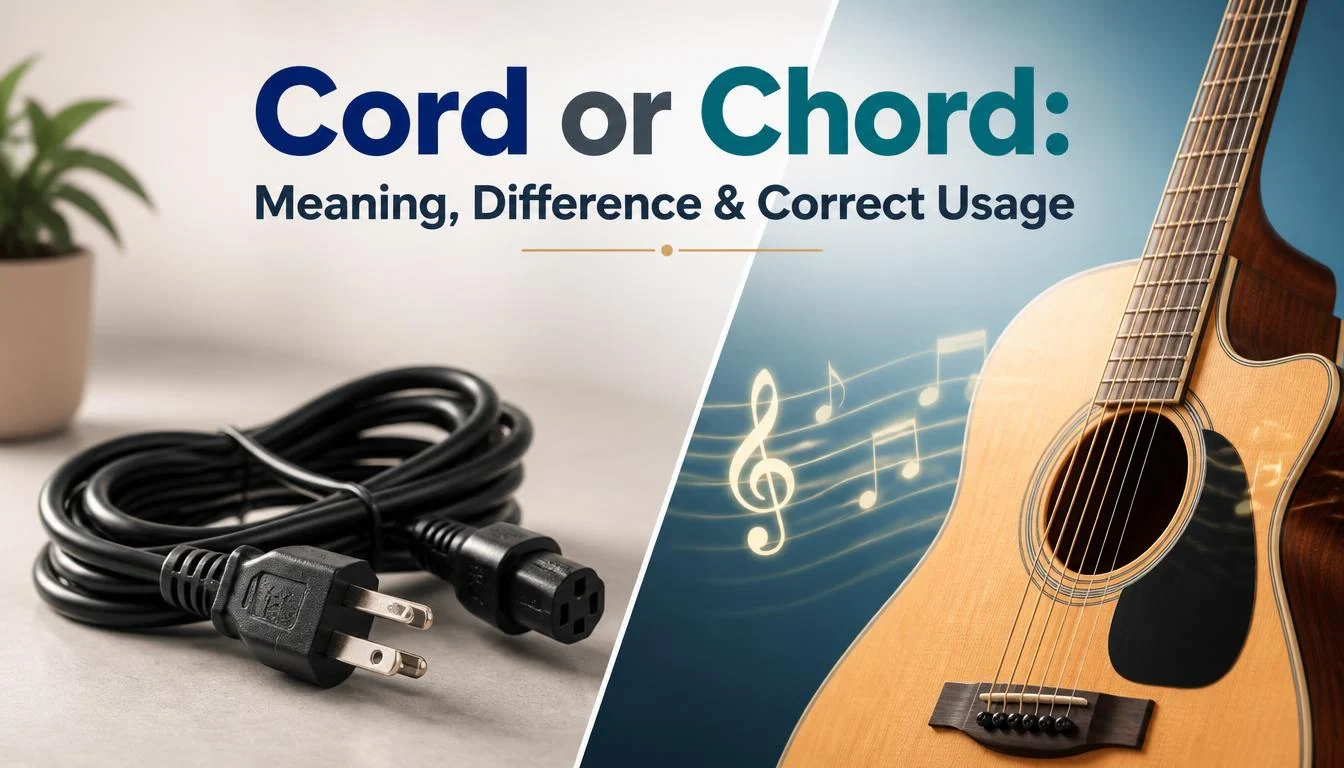
Cord means a string, rope, wire, or flexible material, while chord usually refers to a group of musical notes played together.Both words are correct, but they have different meanings and uses.
Cord or chord can be confusing because these words sound alike but have completely different meanings. Cord usually refers to a long, flexible material made from strands twisted or braided together, such as an electrical cord, a piece of rope, or a cord used to tie something. Chord, on the other hand, commonly refers to a group of musical notes played together. In geometry, chord also has a specific meaning: a straight line segment connecting two points on a circle.
Knowing the difference between cord or chord becomes easier when you connect each spelling with its meaning. If you are talking about a cable, rope, string, or similar object, cord is the correct word. If you are discussing music or geometry, chord is usually the right choice. This guide explains their meanings, differences, pronunciation, and common examples so you can use each word confidently in your writing.
Which One Is Correct?
Both cord and chord are correct English words. Neither spelling is a general mistake or a misspelling of the other.
The key is context. Use cord when you mean a flexible length of material, especially one used to connect, tie, support, or carry something. Use chord when you mean a combination of musical notes, or when you are discussing its specialized mathematical or anatomical meanings.
For example:
- The phone charger has a long cord.
- The guitarist played a beautiful chord.
- The extension cord is behind the desk.
- She learned a new chord on the piano.
The words are pronounced the same, but their meanings and spellings are different.
Meaning of the Correct Word
Definition
Cord is a noun that generally means a long, flexible piece of material. It can consist of fibers, threads, strands, or wires.
The word can describe something used for tying, fastening, supporting, or transmitting electricity. In modern American English, you will often see it in phrases such as power cord, extension cord, charging cord, and electrical cord.
Explanation
A cord can be physical and practical. It may be made from cotton, nylon, leather, or another flexible material. It can also contain electrical wires covered by protective material.
The meaning depends on the context.
For example, a shoelace can be considered a type of cord, while a power cord carries electricity to an appliance. A decorative cord might simply add detail to clothing or furniture.
The word can also appear in specialized expressions. A spinal cord is the long bundle of nerve tissue that connects the brain with much of the nervous system.
Usage
Use cord when you are talking about a physical object or structure rather than a musical combination of notes.
Common expressions include:
- extension cord
- power cord
- electrical cord
- charging cord
- USB cord
- headphone cord
- rope cord
- drawstring cord
- spinal cord
- cord of wood
Here, cord functions most often as a noun. It can also appear in compound nouns where it helps identify a particular type of object.
Real-World Examples
- I need a longer cord for my desk lamp.
- Please unplug the power cord before moving the machine.
- The child pulled the cord to close the curtain.
- My headphones have a tangled cord.
- We bought a strong cord to secure the camping equipment.
- The jacket has a cord around the hood.
These examples all involve a physical line, strand, cable, or similar structure.
Meaning of the Incorrect or Alternative Word
Incorrect
Chord is not incorrect. It is a standard English word with several established meanings.
The mistake happens when someone uses chord when they actually mean cord, or vice versa. Since the two words sound identical, spelling mistakes are common.
For example, “extension chord” is incorrect when referring to an electrical cable. The correct phrase is “extension cord.”
Likewise, “guitar cord” is usually incorrect when you mean a combination of musical notes. The standard term is “guitar chord.”
Typo
Because cord and chord are homophones, people sometimes type the wrong spelling without noticing.
A person may hear someone say, “Play this chord,” and later write cord because both spellings produce the same pronunciation.
These mistakes often appear in informal messages, social media posts, captions, and beginner writing.
Slang
Neither cord nor chord is simply a slang spelling of the other.
You may encounter creative or informal uses online, but standard English keeps their meanings separate. In formal and educational writing, use the spelling that matches the intended meaning.
Regional Variation
The difference between cord and chord is not a standard American-versus-British spelling issue. Both words exist in American and British English with the same basic distinction.
Pronunciation also does not normally separate them.
Rare but Valid Usage
Chord has meanings beyond music. In geometry, a chord is a line segment that connects two points on a circle.
For example:
The chord passes through two points on the circle.
In anatomy, chord can occur in terms such as notochord, a flexible supporting structure found in embryos of chordates.
These meanings are less common in everyday conversation, but they are fully valid.
Key Differences Between the Two Words
| Feature | Cord | Chord |
|---|---|---|
| Spelling | Cord | Chord |
| Main meaning | A flexible strand, rope, cable, or wire | A group of musical notes played together |
| Pronunciation | “KORD” | “KORD” |
| Grammar | Usually a noun | Usually a noun |
| Common usage | Cables, ropes, strings, wires, anatomy | Music, geometry, anatomy |
| Recognition | Common in everyday language | Common in music and mathematics |
| Example | The cord is too short. | Play the chord again. |
The biggest difference is meaning, not pronunciation. If you can identify the subject of the sentence, choosing the correct spelling becomes much easier.
When the sentence involves electricity, cables, tying, clothing, or physical strands, cord is usually the right choice.
When the sentence involves music, harmony, circles, or certain scientific terms, chord may be correct.
Common Mistakes People Make
Writing “guitar cord” Instead of “guitar chord”
A guitar player uses chords, not cords, to describe combinations of notes.
Correct:
He taught me three basic guitar chords.
Incorrect:
He taught me three basic guitar cords.
The guitar itself may have strings and a cord for an amplifier, but the musical combinations are chords.
Writing “extension chord” Instead of “extension cord”
An electrical cable is a cord.
Correct:
I bought an extension cord for the living room.
Incorrect:
I bought an extension chord for the living room.
The word extension does not change the meaning. You are still talking about a physical electrical cable.
Confusing a Power Cord With a Musical Chord
These phrases sound almost identical when spoken:
- power cord
- power chord
However, they refer to completely different things.
A power cord supplies electrical power. A power chord is a type of musical chord commonly associated with rock and other guitar-based music.
Using “Cord” for Every Musical Term
Not every musical line or combination uses cord. If you are talking about several notes sounding together, chord is generally the correct word.
For example:
The pianist played a minor chord.
The spelling chord signals the musical meaning.
Assuming “Chord” Is Just a Fancy Spelling of “Cord”
It is not. The two words developed separately and acquired different meanings.
Their identical pronunciation can make them feel interchangeable, but standard written English does not treat them as interchangeable.
Correct Usage Examples
Casual Examples
- Where’s the charging cord for my phone?
- Can you hand me that cord?
- I can’t remember this chord on the guitar.
- The cord on my headphones keeps getting tangled.
- That chord sounds really nice.
These examples reflect everyday conversations about electronics, cables, and music.
Professional Examples
- Please disconnect the power cord before servicing the equipment.
- The technician replaced the damaged electrical cord.
- The musician used a minor chord during the introduction.
- The instructor demonstrated the chord progression on the piano.
- Make sure the cord does not create a tripping hazard.
Professional writing often requires extra precision because a spelling error can change the meaning.
Educational Examples
- A chord in music combines multiple notes played at the same time.
- A cord can consist of several strands twisted together.
- In geometry, a chord connects two points on a circle.
- Students learned how to identify major and minor chords.
- The teacher explained why cord and chord are homophones.
These examples show why context matters when two words have the same pronunciation.
Literary/Metaphorical Examples
Cord can also appear in figurative language.
- The two families remained connected by an invisible cord of loyalty.
- She felt a strong cord of friendship between them.
Here, cord suggests a bond or connection.
Chord also has a figurative use connected to emotion. The phrase “strike a chord” means to create a strong emotional reaction or sense of recognition.
For example:
The story struck a chord with readers who had experienced similar struggles.
In this expression, chord relates to the idea of producing an emotional response, much like a musical chord creates a particular sound.
Word Origin / Etymology
The histories of cord and chord help explain why they have different spellings.
Cord comes through French from Latin chorda, meaning a string or cord. Over time, the spelling developed into the English form cord, especially for a physical string-like object.
Chord also traces back to the Greek word khordē, meaning a string or gut used as a string. It entered English through forms influenced by Latin and French and became associated strongly with music.
Interestingly, the two words have related historical roots. Their meanings later developed in different directions.
Chord became closely connected with music and the idea of strings producing notes. It also developed technical meanings in geometry and anatomy.
Cord, meanwhile, remained strongly associated with physical strands, ropes, cables, and similar structures.
Their shared historical background helps explain their similar sound, but modern English uses the two spellings for different concepts.
Why the Incorrect Version Became Popular
The “incorrect version” is often not truly incorrect. Instead, writers frequently choose the wrong word because cord and chord are homophones.
A homophone is a word that sounds the same as another word but has a different spelling and meaning. English has many such pairs, including:
- to / too / two
- there / their / they’re
- right / write
- flower / flour
- brake / break
- peace / piece
Cord and chord fit the same pattern.
When people learn a word through speech, they may know its sound before they learn its spelling. This creates uncertainty when they later write the word.
Music creates another source of confusion. A musician might hear chord frequently but have little reason to write it. Someone working with electronics may know cord well but rarely encounter the musical spelling.
Digital communication can make the problem more noticeable. Autocorrect may not always recognize which meaning the writer intends because both words are legitimate dictionary entries.
The solution is not to memorize which word “looks right.” Instead, connect each spelling to its meaning.
Easy Memory Tricks
Think “Cable = Cord”
If you can physically hold, pull, plug in, tie, or wrap it, think cord.
Remember:
Cord = cable, rope, or string-like object.
Examples include:
- charging cord
- extension cord
- power cord
- headphone cord
Think “Music = Chord”
If you are talking about several musical notes played together, use chord.
A simple association is:
Ch = chord = music
For example:
The guitarist changed chords during the song.
Remember the “H”
The H in chord can remind you of harmony.
Music uses chords to create harmony, so you can connect:
CHORD → H → HARMONY
This is not a spelling rule, but it provides a quick memory aid.
Use the Sentence Test
Ask yourself:
Can I plug it in or tie it up?
If yes, cord is probably correct.
Ask:
Am I talking about notes played together?
If yes, chord is probably correct.
For technical writing, check the specific context. A geometry problem may also require chord even though no music is involved.
FAQs
Is it a guitar cord or guitar chord?
Guitar chord is correct when you mean a group of musical notes played together.
Is it an extension cord or extension chord?
Extension cord is correct for an electrical cable used to extend a power connection.
Do cord and chord sound the same?
Yes. In standard American English, both are commonly pronounced “KORD.”
What is the difference between cord and chord?
Cord usually means a physical string, rope, cable, or wire. Chord usually means a combination of musical notes.
Is chord always related to music?
No. Chord also has technical meanings in geometry and anatomy.
Is “power cord” correct?
Yes. Power cord refers to a cable that supplies electrical power to a device.
Is “power chord” also correct?
Yes, but it means something different. A power chord is a musical term, especially common in guitar-based music.
What is a chord in geometry?
A chord is a line segment whose endpoints lie on a circle.
Conclusion
When choosing between cord or chord, focus on meaning rather than sound because both words are pronounced the same.
Use cord for cables, ropes, strings, and similar physical objects, while chord usually refers to music or specialized concepts.
Remember “cable = cord” and “music = chord” to avoid common spelling mistakes.Once you connect each spelling with its meaning, cord or chord becomes an easy distinction to remember.
Read More Articles
- Everyones or Everyone’s | How to Use the Apostrophe Correctly In 2026
- Dumby or Dummy | Common Spelling Mistake Explained In 2026

Andrew Cooper is a blogger and writer at Gramscript.com, turning everyday ideas into clear, engaging stories. His writing blends curiosity, insight and a genuinely human perspective.
1 thought on “Cord or Chord | What’s the Difference and Which Word Should You Use In 2026”