Quick Answer
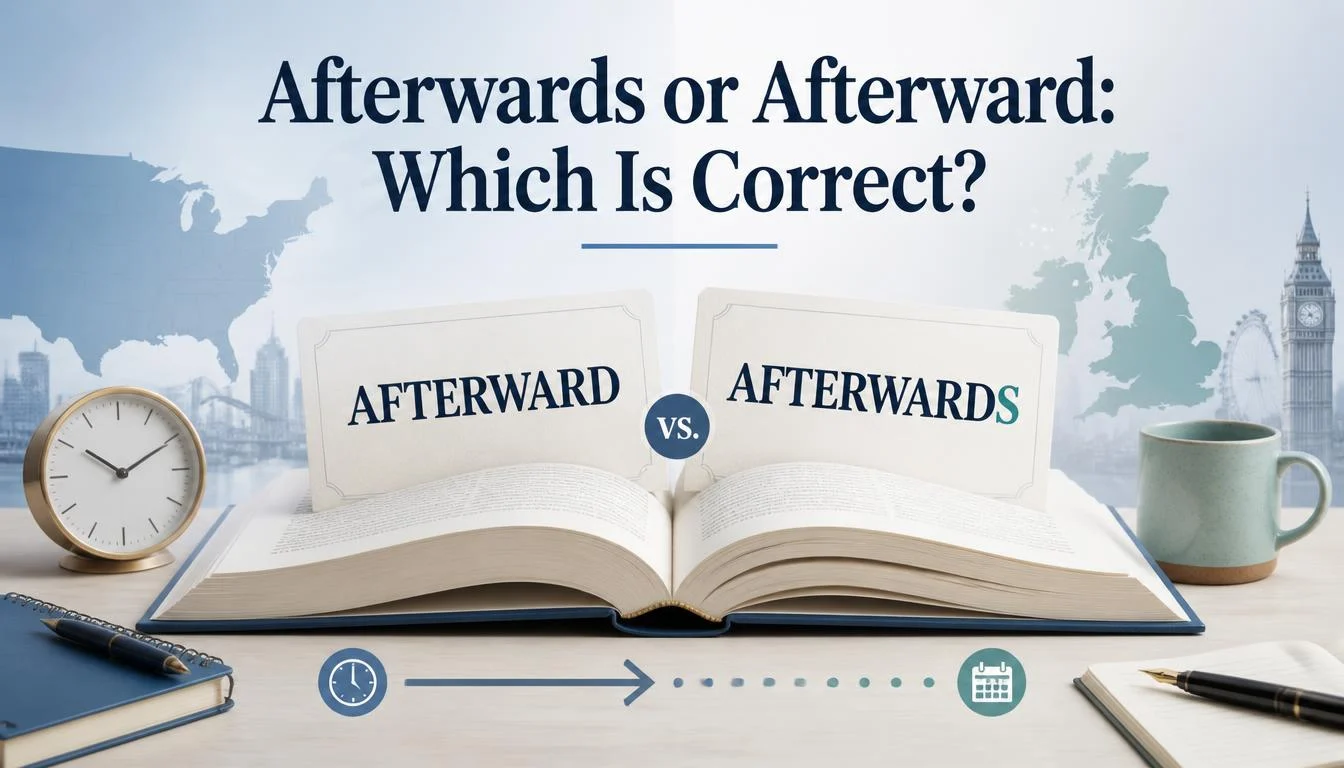
Afterward and afterwards are both correct adverbs meaning “later” or “after that.” In American English, afterward is usually preferred, while afterwards is especially common in British English.
Afterwards or afterward can cause confusion because the two words have the same meaning and usually work in the same places in a sentence. Both are adverbs that mean “at a later time” or “after something has happened.” For example, you can say, “We went for coffee afterward” or “We went for coffee afterwards.” The main difference comes from regional usage rather than meaning.
In general, afterward appears more often in American English, while afterwards is especially common in British English and other varieties of English. However, both forms are grammatically correct, so the choice often depends on the style of English you use. Understanding this small difference can help you write naturally and consistently in emails, essays, conversations, and everyday English.
Which One Is Correct?
Both afterward and afterwards are correct.
They do not have different meanings or different grammatical roles. Both are adverbs that tell readers that something happens later than an event or time already mentioned.
The main distinction is regional preference:
- Afterward is the usual choice in American English.
- Afterwards is especially common in British English.
- Both forms are understood in both varieties of English.
- Neither form is inherently incorrect.
Cambridge identifies afterward as the US form and notes that afterwards is mainly used in the UK. Oxford similarly describes afterwards as especially British and afterward as the usual North American form.
So, if you are writing for an American audience, afterward is the safest and most natural choice.
For example:
We finished dinner and went home afterward.
This sentence sounds completely natural in American English.
A British writer might naturally write:
We finished dinner and went home afterwards.
The meaning remains exactly the same.
Meaning of the Correct Word
Definition
Afterward means at a later time or after something has happened.
It refers to an action, event, or situation that follows another event.
For example:
We watched a movie and talked about it afterward.
The conversation happened after the movie.
You can replace afterward with expressions such as:
- later
- after that
- subsequently
- at a later time
- following that
However, these alternatives do not always sound equally natural in every sentence.
Explanation
Afterward connects two points in time.
Usually, the first event appears earlier in the sentence or has already been established by context. Afterward then points readers toward the later event.
Consider this example:
Sarah finished her exam and went for coffee afterward.
First, Sarah finished the exam. Then, she went for coffee.
The word afterward prevents you from repeating the first event:
Sarah finished her exam and went for coffee after she finished her exam.
The second version is grammatically possible, but it sounds repetitive. Afterward keeps the sentence shorter and smoother.
Usage
Afterward works as an adverb. It can appear at the end of a sentence or clause, and it can also appear near the beginning.
Common patterns include:
We talked afterward.
Afterward, we talked about the problem.
She apologized shortly afterward.
What happened afterward surprised everyone.
It often appears with words such as soon, shortly, immediately, and not long.
Examples include:
Shortly afterward, the meeting ended.
They moved away soon afterward.
I realized my mistake immediately afterward.
The word can refer to a specific later moment or to a broader period that follows an event.
Real-World Examples
You can hear and read afterward in everyday conversations, workplace communication, education, news writing, and personal writing.
I will call you afterward.
We can discuss the details afterward.
He felt much better afterward.
She went back to work shortly afterward.
The students completed the activity and cleaned the room afterward.
I did not understand the decision until afterward.
In each example, afterward refers to time following something already mentioned or understood.
Meaning of the Incorrect or Alternative Word
Incorrect
Afterwards is not grammatically incorrect.
This point matters because many learners assume that the extra s makes the word wrong. It does not.
Afterwards is a standard English adverb. Major dictionaries recognize it as a valid form. Its strongest regional association is with British English, while American English generally prefers afterward.
So, writing afterwards in an American sentence does not create a grammar error.
Typo
Afterwards is sometimes treated as a typo by American writers who have learned that afterward is the common US form.
However, the spelling is legitimate.
If you see afterwards in a book, article, email, or conversation, you should not automatically assume the writer made a spelling mistake.
Slang
Afterwards is not slang.
It is a standard adverb used in formal, informal, academic, and literary English.
Likewise, afterward is not slang. Both forms belong to standard English vocabulary.
Regional Variation
The clearest difference between the two forms is regional.
American English tends to use afterward:
We went home afterward.
British English commonly uses afterwards:
We went home afterwards.
Cambridge lists afterwards as mainly UK and notes that US English usually uses afterward. Oxford gives the same broad usage distinction.
This pattern does not mean British speakers never use afterward or Americans never use afterwards. Both forms occur across English varieties.
Rare but Valid Usage
Neither form qualifies as a rare grammatical curiosity.
Both have a long history in English, and afterwards remains a normal word in modern British English. Afterward is equally normal in American English.
The difference is better understood as a regional preference rather than a difference between correct and incorrect English.
Key Differences Between the Two Words
| Feature | Afterward | Afterwards |
|---|---|---|
| Spelling | A-F-T-E-R-W-A-R-D | A-F-T-E-R-W-A-R-D-S |
| Meaning | Later; after that | Later; after that |
| Pronunciation | af-ter-werd | af-ter-werdz |
| Grammar | Adverb | Adverb |
| Usage | Especially common in American English | Especially common in British English |
| Recognition | Standard English | Standard English |
| Meaning difference | None | None |
| Formality | Standard | Standard |
| Best choice for US writing | Usually preferred | Valid, but less typical |
| Best choice for UK writing | Valid | Usually preferred |
The table shows why this pair causes so much confusion. Almost everything stays the same.
The only visible spelling difference is the final s, and that difference does not create a different meaning.
Pronunciation Difference
In simple American pronunciation, afterward sounds like AF-ter-werd.
Afterwards sounds like AF-ter-werdz.
The final s adds a z sound at the end. It does not change the basic pronunciation of the rest of the word.
Grammar Difference
There is no grammatical difference between the two.
Both words act as adverbs.
We left afterward.
We left afterwards.
Both sentences are grammatically complete.
The choice depends mainly on the variety of English you are using.
Usage Difference
The most useful rule for American writers is simple:
Choose “afterward” when you want the usual American form.
If you are writing for a British audience, afterwards may sound more natural.
This is especially useful when writing consistently for a particular audience. Consistency helps your writing sound intentional rather than accidental.
Common Mistakes People Make
Mistake 1: Thinking “afterwards” Is Wrong
This is the most common misunderstanding.
The final s does not make afterwards incorrect. It is a standard form, especially in British English.
Mistake 2: Thinking the Words Have Different Meanings
They do not.
Both mean that something happens later.
I called her afterward.
I called her afterwards.
The meaning is the same.
Mistake 3: Using “afterward” as a Preposition
Afterward is an adverb, not a preposition.
You should not normally use it directly before a noun in the way you use after.
Incorrect:
Afterward the meeting, we went home.
Better:
After the meeting, we went home.
Or:
We went home afterward.
This distinction is important because after and afterward perform different grammatical jobs.
Mistake 4: Confusing “Afterward” With “Afterword”
The words afterward and afterword look and sound similar, but they have different meanings.
Afterward means “later.”
Afterword is a section added at the end of a book, usually written by the author or another contributor.
For example:
We discussed the issue afterward.
But:
The author included an afterword in the new edition.
Do not use afterword when you mean “later.”
Mistake 5: Mixing Regional Preferences Without a Reason
There is nothing grammatically wrong with either form. Still, writers sometimes want their language to match their audience.
If your article uses American English throughout, afterward will usually provide better regional consistency.
If you are writing in British English, afterwards is a natural choice.
Mistake 6: Assuming the Final “S” Changes the Tense
It does not.
Neither word changes the tense of the sentence.
Compare:
We finished dinner afterward.
We finished dinner afterwards.
Both sentences use the past tense finished. The adverb simply indicates what happened later.
Correct Usage Examples
Casual Examples
These examples show how people might use the word in everyday conversation:
I will call you afterward.
We can grab coffee afterward.
She felt tired afterward.
Did you go anywhere afterward?
We talked about it afterward.
I realized what happened afterward.
In casual American English, afterward fits naturally into all of these sentences.
Professional Examples
The word also works well in workplace communication.
We will review the report afterward.
The team held a short discussion afterward.
Please send the final document afterward.
The manager spoke with the client shortly afterward.
We can address the remaining questions afterward.
There is nothing informal about afterward. It works in professional writing when the context calls for it.
Educational Examples
Students and teachers can use afterward to describe events in a sequence.
The students completed the experiment and recorded their results afterward.
Read the passage first and answer the questions afterward.
The teacher explained the concept and gave the class a short quiz afterward.
We reviewed the lesson afterward to check our understanding.
The word can make instructions more concise because it avoids repeating a complete time phrase.
Literary/Metaphorical Examples
Writers can also use afterward in reflective or narrative sentences.
Years afterward, she still remembered that afternoon.
He understood the significance only afterward.
Long afterward, the old house remained part of their family stories.
Only afterward did they realize how quickly everything had changed.
In these examples, afterward helps establish a relationship between past events and later reflection.
Word Origin / Etymology
The history of afterward reaches back to Old English.
Etymological sources trace it to Old English æfterwearde, a form connected with the ideas of “behind,” “in the rear,” or movement in a direction related to what follows. The modern form developed through historical changes involving after and the suffix -ward.
The suffix -ward appears in several English words that express direction or movement.
Consider:
- forward
- backward
- upward
- downward
- toward
In afterward, the historical structure points toward something that comes after.
The form afterwards developed with an additional adverbial -s. Etymological sources trace this variant back to forms such as Middle English afterwardes.
This history explains why the two modern forms are so closely related. They did not develop as unrelated words. They share the same historical foundation.
Why the Incorrect Version Became Popular
The premise needs a small correction: afterwards did not become popular because people started using an incorrect spelling.
Instead, both forms developed within the history of English.
The ending -s has appeared in adverbial forms throughout the development of English. Over time, different varieties of English retained or favored different forms.
Today, afterwards has a particularly strong association with British English, while afterward is the usual choice in American English.
That regional split explains why learners may encounter both forms in reliable sources.
For example, an American textbook may consistently use afterward, while a British novel may frequently use afterwards.
Neither writer needs to be corrected.
The important lesson is that spelling variation does not always signal a grammar error. English contains many regional differences that remain fully standard.
Easy Memory Tricks
Think “US = No S”
For American English, remember:
Afterward = US preference
The shorter form is usually the easier choice for American writing.
Think “UK = Extra S”
A simple memory association is:
Afterwards = British preference
This is not an absolute rule, but it can help you remember the common regional pattern.
Remember the Meaning, Not the S
If you forget which form your audience prefers, focus first on the meaning.
Both forms mean:
later + after an earlier event
Once you know that, the spelling choice becomes much easier.
Use “After” When a Noun Follows
Another helpful trick is to separate after from afterward.
Use after before a noun:
After lunch, we left.
Use afterward when you mean “later”:
We left afterward.
This simple distinction can prevent many sentence errors.
Keep “Afterword” Separate
Remember:
Afterward = later
Afterword = a section at the end of a book
That one-letter difference can completely change the meaning.
FAQs
Is “afterward” correct?
Yes. Afterward is a standard adverb, and it is the usual form in American English.
Is “afterwards” correct?
Yes. Afterwards is also standard English and is especially common in British English.
Which is better in American English, afterward or afterwards?
American English usually prefers afterward, although afterwards is still understood and accepted.
Do afterward and afterwards mean the same thing?
Yes. Both mean “later,” “after that,” or “at a later time.”
Is afterward more formal than afterwards?
No. Neither word is inherently more formal. The main difference is regional preference.
How do you pronounce afterward?
In simple American pronunciation, afterward sounds like AF-ter-werd.
How do you pronounce afterwards?
Afterwards sounds like AF-ter-werdz, with a final z sound.
What is the difference between afterword and afterward?
Afterward means “later.” Afterword is a section at the end of a book or other written work.
Conclusion
Afterwards or afterward can both be correct, but American English usually favors afterward.Both words have the same meaning and grammatical function, while regional usage explains the spelling difference.Use afterward for a natural American style, and recognize afterwards as a standard British form.When in doubt, remember: afterward means later, and the extra “s” marks a regional preference, not a grammar mistake.
Read More Articles
- Everyones or Everyone’s | How to Use the Apostrophe Correctly In 2026
- Dumby or Dummy | Common Spelling Mistake Explained In 2026

Andrew Cooper is a blogger and writer at Gramscript.com, turning everyday ideas into clear, engaging stories. His writing blends curiosity, insight and a genuinely human perspective.
1 thought on “Afterwards or Afterward | When and How to Use Them In 2026”