Quick Answer
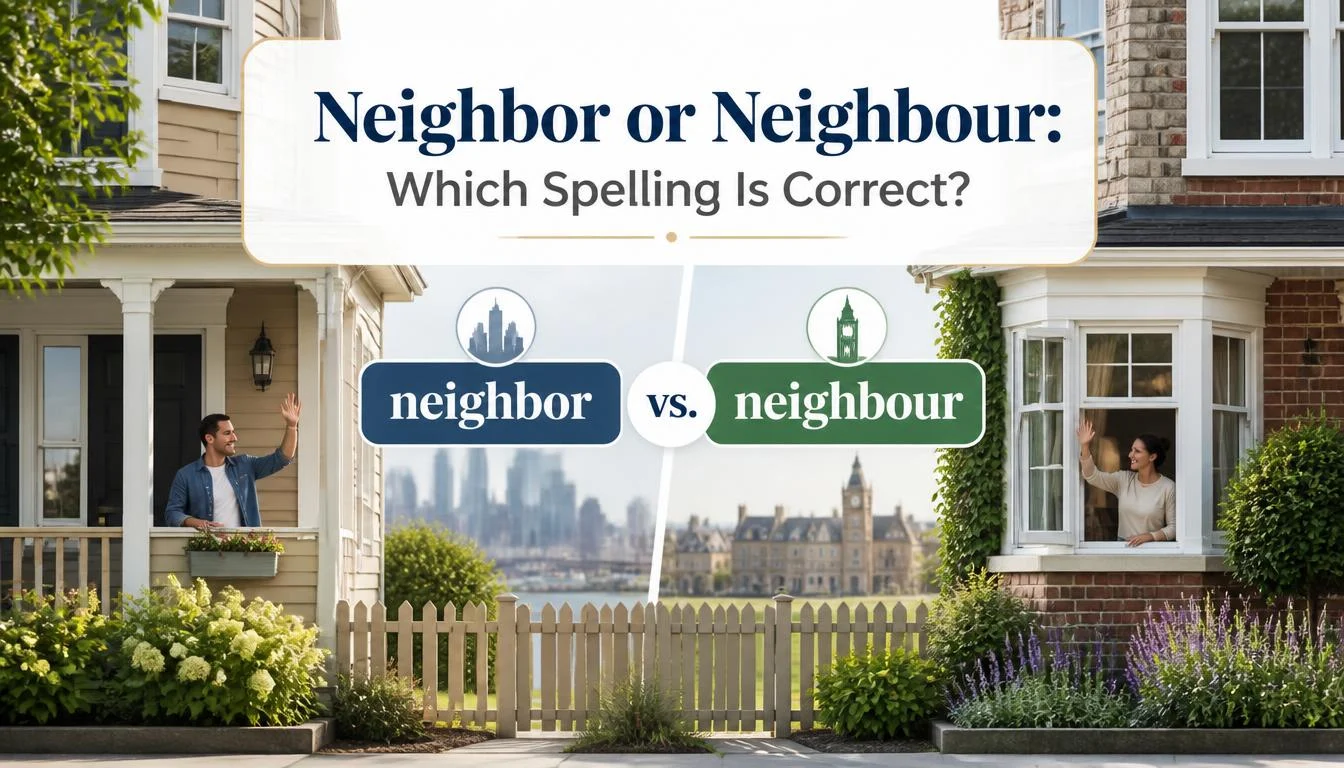
Neighbor is the standard American English spelling, while neighbour is the standard British English spelling.Both words have the same meaning, pronunciation, and grammar; the difference is mainly regional spelling.
If you have ever wondered whether neighbor or neighbour is the correct spelling, the answer depends on which variety of English you are using. Both spellings have the same meaning and refer to a person who lives near you. Neighbor is the standard spelling in American English, while neighbour is commonly used in British English and other varieties influenced by British spelling, including Australian and Canadian English.
The difference comes from a spelling convention rather than a difference in meaning or pronunciation. The American form drops the u, while the British form keeps it, just as with words such as color/colour and favor/favour. In this guide, you’ll learn when to use neighbor and neighbour, how each spelling fits different English varieties, and which form is best for your writing.
Which One Is Correct?
Both neighbor and neighbour are correct spellings.
The choice depends on the variety of English you are using:
- Neighbor = standard American English
- Neighbour = standard British English
- Neighbour = also widely used in Canadian, Australian, and other British-influenced varieties of English
If you are writing for an American audience, use neighbor. If you are following British English conventions, use neighbour.
There is no difference in meaning between the two spellings. They can both function as nouns and verbs.
For example:
My neighbor lives across the street.
British English:
My neighbour lives across the street.
Both sentences communicate exactly the same idea.
American English: Neighbor
American English generally drops the u from this word. This follows a broader pattern found in several English words.
For example:
- neighbor
- favor
- color
- honor
American spelling often uses shorter forms such as neighbor and favor.
British English: Neighbour
British English retains the u in neighbour. The same pattern appears in words such as:
- favour
- colour
- honour
- labour
Therefore, if your writing follows British spelling conventions, neighbour is the natural choice.
Meaning of the Correct Word
Definition
A neighbor is a person who lives near you, especially someone who lives in a nearby house or apartment.
The word can also describe someone or something located close to another person or thing.
For example:
Our neighbor brought us some fresh vegetables.
The word can refer to a person next door, across the street, or somewhere nearby.
Explanation
The noun neighbor usually describes a person who lives close to you. However, its meaning can extend beyond residential relationships.
You can call nearby countries neighbors because they share a border or exist close to one another.
For example:
Canada is a neighbor of the United States.
The word can also describe nearby objects in technical, mathematical, or academic contexts.
As a verb, neighbor means to be located next to or near something.
For example:
The park neighbors several apartment buildings.
This verb use is less common in everyday conversation, but it is grammatically valid.
Usage
Most people use neighbor as a noun.
Common expressions include:
- next-door neighbor
- friendly neighbor
- good neighbor
- new neighbor
- noisy neighbor
- helpful neighbor
- old neighbor
- close neighbor
The plural form is neighbors in American English and neighbours in British English.
The verb also changes according to the same spelling convention:
- neighbor
- neighbors
- neighbored
- neighboring
British English uses:
- neighbour
- neighbours
- neighboured
- neighbouring
Real-World Examples
Here are several natural examples:
Our new neighbor introduced herself yesterday.
I borrowed a ladder from my neighbor.
The neighbors are having a barbecue this weekend.
A friendly neighbor helped me carry the boxes.
We invited our neighbors to dinner.
The two houses neighbor a small community garden.
These examples show how naturally the word fits into everyday English.
Meaning of the Incorrect or Alternative Word
Incorrect
Neighbour is not incorrect. It is a standard spelling in British English and other varieties that follow British spelling conventions.
Likewise, neighbor is not incorrect in American English.
Calling one spelling universally wrong would ignore regional English differences.
Typo
A writer may accidentally type neighbour when following American English or neighbor when following British English.
However, the spelling itself is not a typo. It becomes a problem only when it conflicts with the spelling system used throughout the document.
For example, an American document that consistently uses color, favor, and honor may look inconsistent if it suddenly uses neighbour.
Consistency matters more than choosing one spelling as universally correct.
Slang
Neither neighbor nor neighbour is slang.
Both are standard dictionary words used in formal, informal, academic, and everyday English.
The surrounding phrase can be informal, but the word itself is completely standard.
Regional Variation
The biggest difference between the two forms is regional.
Neighbor is standard in American English.
Neighbour is standard in British English and is also widely used in Canadian English, Australian English, and other varieties influenced by British spelling.
You may therefore see both spellings in reputable publications.
Rare but Valid Usage
The noun is extremely common, while the verb is less common.
As a verb, neighbor or neighbour means to be next to or near something.
For example:
The school neighbors a public library.
This construction may sound formal or unusual to some readers. Still, it is a valid use of the word.
Key Differences Between the Two Words
| Feature | Neighbor | Neighbour |
|---|---|---|
| Spelling | American English | British English |
| Meaning | A person or thing nearby | A person or thing nearby |
| Pronunciation | NAY-ber | NAY-ber |
| Grammar | Noun and verb | Noun and verb |
| Usage | Common in the United States | Common in Britain and other British-influenced varieties |
| Recognition | Widely recognized internationally | Widely recognized internationally |
| Plural | Neighbors | Neighbours |
| Past form | Neighbored | Neighboured |
| -ing form | Neighboring | Neighbouring |
The most noticeable difference is the letter u.
American English writes neighbor, while British English writes neighbour. The pronunciation does not change.
Spelling Difference
The spelling difference follows a familiar American-versus-British pattern.
American English often removes the u from words ending in -our or related forms.
For example:
- color / colour
- favor / favour
- honor / honour
- labor / labour
- neighbor / neighbour
This does not mean American English shortened every British word. Spelling conventions developed differently over time.
Meaning Difference
There is no meaningful difference in definition.
A neighbor and a neighbour are the same thing.
Both can refer to:
- A person living nearby.
- A nearby person in a community.
- A nearby country or region.
- Something positioned next to another thing.
- Something that exists close to another object or location.
Pronunciation Difference
Both forms are generally pronounced NAY-ber.
The extra u in neighbour does not create a separate syllable or a different vowel sound.
So these sentences sound the same:
My neighbor moved yesterday.
My neighbour moved yesterday.
The difference becomes visible in writing rather than audible in ordinary speech.
Grammar Difference
Both spellings work as nouns and verbs.
As a noun:
My neighbor has a new car.
As a verb:
The hotel neighbors a busy shopping district.
The grammar does not change when the spelling changes.
Only the regional spelling changes.
Common Mistakes People Make
One common mistake is assuming that neighbour must be wrong because American English uses neighbor.
That assumption is incorrect. British English uses neighbour as its standard spelling.
Another mistake is mixing spelling systems in the same piece of writing.
For example:
My neighbour likes the color of my car.
This sentence combines the British spelling neighbour with the American spelling color.
It is understandable, but a consistent style would normally be better.
An American version would be:
My neighbor likes the color of my car.
A British version would be:
My neighbour likes the colour of my car.
Mistake 1: Using British Spelling in American Writing
If your school, workplace, publication, or audience follows American English, use neighbor.
This is especially useful when writing essays, business documents, applications, or other formal material.
Mistake 2: Assuming the Pronunciation Changes
The spelling changes, but the normal pronunciation does not.
Do not pronounce the extra u in neighbour as a separate sound.
Both forms are pronounced approximately NAY-ber.
Mistake 3: Treating One Form as a Typo
Neither word is automatically a spelling mistake.
Your dictionary settings may flag one version depending on the selected language.
For example, an American English spell checker may underline neighbour, while a British English spell checker may accept it without a problem.
Mistake 4: Switching Forms Without a Reason
Choose the spelling that matches your intended English variety.
Once you choose it, use the same convention throughout the article or document.
This makes your writing look polished and consistent.
Correct Usage Examples
Casual Examples
My neighbor’s dog keeps barking at night.
I met our new neighbor yesterday.
Our neighbors invited us over for dinner.
The neighbor next door has a beautiful garden.
I asked my neighbor if she had seen my package.
For British English, replace neighbor with neighbour and neighbors with neighbours.
Professional Examples
We contacted the neighboring business about the construction schedule.
The company works closely with its neighboring communities.
Several neighboring properties were affected by the storm.
The project will benefit neighboring businesses.
These examples show that the word can appear in professional writing without sounding informal.
Educational Examples
The United States and Canada are neighboring countries.
Students discussed how neighboring communities share resources.
The diagram shows the neighboring cells.
A country may cooperate with its neighboring states.
The word is useful in geography, science, history, and social studies.
Literary/Metaphorical Examples
Writers sometimes use neighbor in a broader or metaphorical sense.
For example:
The village welcomed every neighbor with warmth.
Here, the word can suggest community and social connection.
It can also describe nearby things:
The two stars appeared like neighboring lights in the night sky.
This use extends the basic idea of closeness without changing the word’s central meaning.
Word Origin / Etymology
The history of neighbor and neighbour goes back to Old English.
The Old English form was nēahgebūr, which combined ideas related to being near and being a dweller or inhabitant. In simple terms, it referred to someone who lived nearby.
Over centuries, the spelling changed as English developed.
Middle English forms included spellings such as neighebour and related variations. English spelling was not always standardized, so different forms appeared in different regions and periods.
Eventually, modern English developed the two familiar forms:
neighbor in American English and neighbour in British English.
The word’s core idea has remained remarkably stable. It still refers to someone or something nearby.
The spelling difference reflects the broader development of American and British spelling conventions.
Why the Incorrect Version Became Popular
The so-called “incorrect version” became popular because it is not actually incorrect.
Instead, neighbor and neighbour developed as regional spelling forms.
British English retained the u in many words ending in -our, while American English increasingly favored shorter spellings in words such as color, favor, and honor.
American spelling was strongly shaped by efforts to simplify and standardize spelling. Noah Webster played an influential role in promoting distinctive American spelling conventions through his dictionaries and educational works.
However, the story is not simply about one person removing letters. Spelling differences had already developed through historical usage, pronunciation, printing, dictionaries, and regional preferences.
Today, both forms remain established.
If you see neighbour in a British newspaper, that spelling is normal. If you see neighbor in an American publication, that spelling is equally normal.
Easy Memory Tricks
A simple way to remember the difference is to connect neighbor with America.
Neighbor = American English
Think of the American spelling as the shorter version:
neighbor
For British English, remember:
neighbour = British spelling
You can also compare it with familiar pairs:
- color → colour
- favor → favour
- honor → honour
- neighbor → neighbour
If you write in American English, choose the forms without u.
If you write in British English, choose the forms with u where that spelling convention applies.
A Quick Rule
Ask yourself:
“Who is my audience?”
If the answer is mainly American readers, write neighbor.
If the answer is mainly British readers, write neighbour.
That one question solves most spelling confusion.
FAQs
Is neighbor or neighbour correct?
Both are correct. Neighbor is standard American English, while neighbour is standard British English.
Is neighbor American or British English?
Neighbor is the standard American English spelling.
Is neighbour British English?
Yes. Neighbour is the standard British English spelling and is also common in other British-influenced varieties.
Do neighbor and neighbour sound different?
No. They are normally pronounced the same, approximately NAY-ber.
Which spelling should I use in American English?
Use neighbor in American English.
Which spelling should I use in British English?
Use neighbour in British English.
Is neighbour spelled wrong in the United States?
Not necessarily, but it is the British spelling. American English normally uses neighbor.
What is the plural of neighbor?
In American English, the plural is neighbors. In British English, it is neighbours.
Conclusion
When choosing between neighbor or neighbour, remember that both spellings are correct in their respective English varieties.
Use neighbor for American English and neighbour for British English and other varieties that follow British spelling.The meaning, pronunciation, and grammar remain essentially the same in both forms.Choose one spelling system, use it consistently, and let your audience guide your final choice.
Read More Articles
- Accept or Except | When to Use Each Word Correctlyb In 2026
- Tomato or Tomatoe | Cultural Roots and Historical Background In 2026

Christopher Parker is a writer and blogger at GramScript.com, sharing thoughtful insights and engaging stories across a range of topics. His writing blends clarity, curiosity, and a distinctly human perspective.
2 thoughts on “Neighbor or Neighbour | Meaning, Spelling and Usage In 2026”