Quick Answer
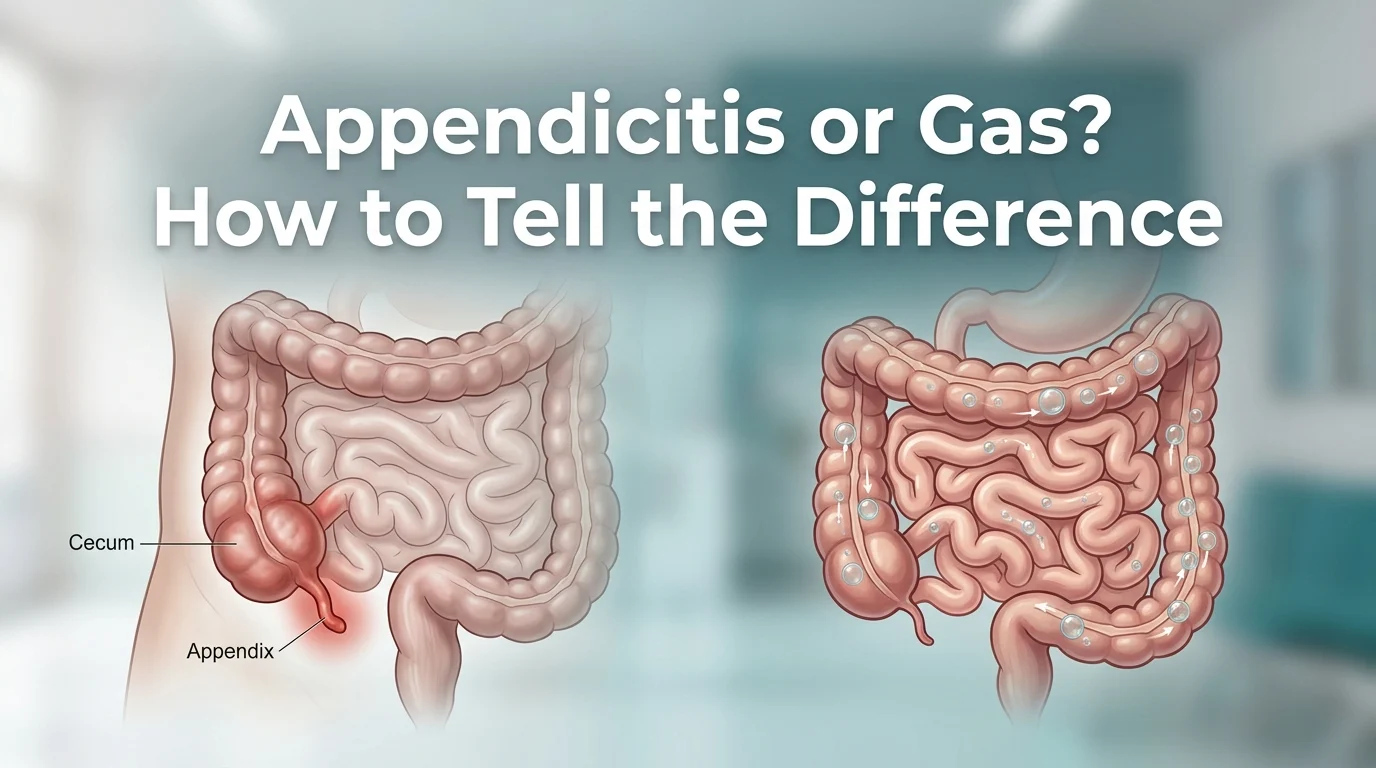
Appendicitis is inflammation of the appendix, while gas is a normal digestive process that can cause bloating, pressure, and abdominal discomfort.They can feel similar at first, but worsening pain, especially pain that moves to the lower right abdomen, needs prompt medical evaluation.
Abdominal pain can have many causes, and gas is one of the most common. However, pain from appendicitis can sometimes begin with symptoms that seem similar to ordinary digestive discomfort. Knowing the differences between appendicitis and gas can help you understand what your symptoms may indicate and recognize signs that need prompt medical attention.
Gas pain often comes with bloating, belching, or changes in bowel movements and may improve after passing gas or having a bowel movement. Appendicitis, on the other hand, typically causes worsening abdominal pain and may occur with symptoms such as nausea, vomiting, loss of appetite, or fever. Because appendicitis can become a medical emergency, severe or worsening abdominal pain should not be dismissed as gas without proper medical evaluation.
Which One Is Correct?
Both “appendicitis” and “gas” are correct words, but they do not mean the same thing.
Appendicitis is a medical condition involving inflammation of the appendix. The appendix is a small, finger-shaped pouch connected to the colon. Appendicitis commonly causes abdominal pain and may also cause nausea, vomiting, fever, appetite loss, constipation, or diarrhea.
Gas, on the other hand, refers to air and other gases inside the digestive tract. Everyone has digestive gas. It can cause belching, bloating, abdominal distention, discomfort, and passing gas.
So, there is no spelling contest between the two terms. The real question is which condition better explains the symptoms.
Appendicitis and Gas Are Not Synonyms
It is incorrect to use “appendicitis” as another word for gas.
For example:
- “I have gas” describes a digestive symptom.
- “I have appendicitis” describes a specific medical condition.
- “Could this pain be appendicitis or gas?” asks about two possible causes of abdominal discomfort.
A person can also have gas while experiencing appendicitis. Mayo Clinic lists gas and bloating among possible appendicitis symptoms, which is one reason the conditions can be confusing.
Meaning of the Correct Word
Definition
Appendicitis means inflammation of the appendix.
The appendix is a narrow pouch attached to the large intestine. When appendicitis develops, inflammation can cause significant abdominal pain and other digestive symptoms.
The condition can require urgent treatment. Untreated appendicitis can lead to complications such as a ruptured appendix, an abscess, or infection within the abdomen.
Explanation
Appendicitis often begins with abdominal pain around the belly button. In many people, the pain later shifts toward the lower right side of the abdomen.
The pain may become worse with movement, coughing, sneezing, or taking deep breaths. It can also become increasingly severe over several hours.
Other possible symptoms include:
- Loss of appetite
- Nausea
- Vomiting
- Fever
- Abdominal swelling
- Constipation
- Diarrhea
- Difficulty passing gas
Not everyone develops the classic pattern. Children and some other patients may have less typical symptoms, so the location of pain alone cannot confirm or rule out appendicitis.
Usage
The noun appendicitis is normally used as the name of a condition.
Common examples include:
- “The doctor suspected appendicitis.”
- “She went to the emergency room because of severe abdominal pain.”
- “Appendicitis can require immediate treatment.”
You would not normally say “an appendicitis.” Instead, say “appendicitis” or “a case of appendicitis.”
The word can appear with verbs such as have, develop, suspect, diagnose, treat, and rule out.
Real-World Examples
“His abdominal pain started near his belly button and later moved lower and to the right.”
That pattern can occur with appendicitis.
“She had nausea, loss of appetite, and worsening abdominal pain.”
Those symptoms can occur with appendicitis, although they do not prove the diagnosis.
“The doctor ordered tests to determine whether the pain was caused by appendicitis or another condition.”
This reflects how abdominal pain may require medical evaluation rather than a self-diagnosis.
Meaning of the Incorrect or Alternative Word
Incorrect
Gas is not an incorrect word. It is a correct English word and a normal medical term for gas in the digestive tract.
The mistake occurs when someone treats “gas” and “appendicitis” as interchangeable. They describe different things.
Typo
Neither gas nor appendicitis is a common spelling mistake for the other.
People searching for “appendicitis or gas” are usually not asking about spelling. They are trying to understand whether abdominal symptoms could indicate one condition or the other.
Slang
Gas is not merely slang. It is standard English and standard medical terminology.
Doctors and health organizations use the term when discussing digestive gas, gas symptoms, bloating, and flatulence.
In everyday speech, people may say:
- “I have gas.”
- “I feel gassy.”
- “I’m bloated.”
- “I have trapped gas.”
These expressions can describe digestive discomfort, but they do not establish the cause of abdominal pain.
Regional Variation
There is no major American-versus-British spelling difference between appendicitis and gas.
Both forms are widely recognized in standard English.
Some related medical vocabulary can vary by region, but the terms appendicitis and gas remain essentially unchanged.
Rare but Valid Usage
The word gas has several meanings outside digestive health.
For example, it can refer to a gaseous substance, fuel, or gasoline in American English. Context determines which meaning applies.
In a health context, however, “gas” usually refers to gas in the digestive tract.
Appendicitis has a much narrower meaning. It refers specifically to inflammation of the appendix.
Key Differences Between the Two Words
| Feature | Appendicitis | Gas |
|---|---|---|
| Spelling | Appendicitis | Gas |
| Meaning | Inflammation of the appendix | Gas within the digestive tract |
| Pronunciation | uh-PEN-duh-SY-tis | GASS |
| Grammar | Medical condition; uncountable noun | Usually an uncountable noun |
| Typical symptoms | Worsening abdominal pain, nausea, appetite loss, fever | Bloating, belching, passing gas, abdominal discomfort |
| Pain pattern | May begin near the belly button and move to the lower right abdomen | Can cause shifting discomfort, pressure, or bloating |
| Movement | Pain may worsen with movement | Discomfort may change as gas moves |
| Medical urgency | Can require immediate medical care | Usually not an emergency by itself |
| Recognition | Specific diagnosis | Common digestive symptom |
| Diagnosis | Medical history, exam, and sometimes tests or imaging | Usually based on symptoms and history; testing may identify an underlying cause |
The table shows why the terms should not be treated as competing spellings. They belong to different medical categories.
Gas can be normal, while appendicitis is an inflammatory condition that may require urgent treatment.
Common Mistakes People Make
One common mistake is assuming that every abdominal pain episode comes from gas. Gas can certainly cause discomfort, but abdominal pain has many possible causes.
Another mistake is assuming that passing gas automatically rules out appendicitis. Appendicitis can involve bowel symptoms, and some people may experience gas or bloating.
People also sometimes focus only on the location of pain. Lower-right abdominal pain can occur with appendicitis, but not every case follows the classic pattern.
A further mistake is waiting for every classic symptom to appear. Appendicitis does not look exactly the same in every person. Some patients may lack typical symptoms.
Mistake 1: Assuming Gas Always Causes Mild Pain
Gas can cause abdominal pain or discomfort. However, severe or persistent abdominal pain should not automatically be blamed on gas.
NIDDK recommends speaking with a doctor when gas symptoms occur with abdominal pain or other concerning changes.
Mistake 2: Waiting for a Fever
Fever can occur with appendicitis, but waiting for a fever before seeking care can be misleading.
Symptoms vary between people. A person does not need to experience every textbook symptom before contacting a healthcare professional.
Mistake 3: Treating Pain Location as a Diagnosis
Pain near the lower right abdomen can raise concern for appendicitis. Still, location alone cannot establish the diagnosis.
Doctors consider the full symptom pattern, medical history, physical examination, and, when appropriate, blood tests or imaging.
Mistake 4: Assuming Bloating Means Only Gas
Bloating is common with gas, but bloating can occur with other digestive conditions as well.
Mayo Clinic also lists bloating and gas among possible symptoms of appendicitis.
Correct Usage Examples
Casual Examples
- “I think I have gas after that meal.”
- “My stomach feels bloated, and I keep passing gas.”
- “Could this abdominal pain be gas?”
- “I’m worried this pain might be appendicitis.”
- “The pain keeps getting worse, so I’m going to get medical advice.”
These examples show how ordinary conversation may describe symptoms without claiming a diagnosis.
Professional Examples
- “The patient reported worsening abdominal pain.”
- “The clinician considered appendicitis among the possible causes.”
- “The patient reported bloating and increased gas.”
- “The medical team evaluated the abdominal pain before determining the cause.”
- “Appendicitis requires prompt medical assessment when suspected.”
In professional writing, avoid claiming that symptoms prove appendicitis. A symptom can suggest a possibility without confirming it.
Educational Examples
- “Gas commonly causes bloating, belching, and passing gas.”
- “Appendicitis commonly causes abdominal pain that may move toward the lower right abdomen.”
- “Appendicitis and gas can share some digestive symptoms.”
- “A healthcare professional can evaluate symptoms and determine whether further testing is necessary.”
NIDDK notes that doctors may use a medical history, physical examination, blood tests, urine testing, pregnancy testing when relevant, and imaging to evaluate suspected appendicitis.
Literary/Metaphorical Examples
In literary writing, gas can be used metaphorically, although this meaning is unrelated to abdominal symptoms.
For example:
“The argument disappeared like gas in the wind.”
Appendicitis rarely works as a metaphor because it has a specific medical meaning.
For health-related writing, literal usage is clearer and safer.
Word Origin / Etymology
The word appendicitis comes from appendix, referring to the appendix, combined with the medical suffix -itis, which indicates inflammation.
So, the structure of the word gives readers a useful clue: appendicitis means inflammation involving the appendix.
The word gas has a much older and broader history. The modern scientific sense of “gas” developed from a word introduced by Flemish chemist Jan Baptista van Helmont in the 17th century. He used the term to describe a substance that did not have the properties of a solid or liquid.
Over time, gas became a standard scientific term. Its medical use developed naturally from the fact that gases can exist within the digestive system.
Today, “gas” can therefore describe a broad physical substance or, in a digestive context, gas within the gastrointestinal tract.
Why the Incorrect Version Became Popular
There is no genuinely incorrect version in “appendicitis or gas.”
The confusion comes from symptom overlap rather than spelling.
Gas can cause abdominal pain, bloating, and distention. Appendicitis can also involve abdominal pain, bloating, and gas. That overlap encourages people to search for comparisons between the two.
The phrase “appendicitis or gas” is therefore better understood as a symptom-comparison question.
Someone asking it may really mean:
- “How can I tell appendicitis from gas?”
- “Does this stomach pain sound like gas?”
- “What does appendicitis pain feel like?”
- “Can gas cause lower-right abdominal pain?”
- “When should abdominal pain be checked?”
These are useful questions, but symptoms alone cannot reliably provide a diagnosis.
Easy Memory Tricks
A simple way to remember the difference is:
Appendicitis = appendix + inflammation.
The ending -itis appears in many medical terms and generally refers to inflammation.
For gas, think of movement through the digestive tract:
Gas → bloating → belching or passing gas.
You can also remember the difference by asking what the word describes.
If the word names a specific medical condition, think appendicitis.
If it describes a digestive symptom or substance, think gas.
One more useful reminder is:
Gas can be a symptom. Appendicitis is a condition.
That distinction makes the phrase “appendicitis or gas” much easier to understand.
FAQs
Is gas a symptom of appendicitis?
Yes. Gas and bloating can occur with appendicitis, so their presence does not automatically rule it out.
How does appendicitis pain usually start?
Pain often begins around the belly button and may move toward the lower right abdomen as it worsens.
Can gas cause lower-right abdominal pain?
Gas can cause abdominal discomfort, but lower-right pain should not automatically be attributed to gas. Persistent or worsening pain deserves medical evaluation.
Can appendicitis feel like gas?
Yes. Appendicitis can include bloating and gas, which can make the early symptoms confusing.
Does passing gas rule out appendicitis?
No. Passing gas alone cannot reliably rule out appendicitis because symptoms vary between people.
When should abdominal pain be treated as an emergency?
Severe or worsening abdominal pain, especially when appendicitis is suspected, requires prompt medical attention.
What tests can diagnose appendicitis?
Doctors may use an examination, blood or urine tests, and imaging such as ultrasound, CT, or MRI when appropriate.
Is “appendicitis or gas” grammatically correct?
Yes. Both terms are correctly spelled, and the phrase asks whether symptoms could relate to appendicitis or digestive gas.
Conclusion
Appendicitis or gas describes two very different possibilities behind abdominal discomfort, not two competing spellings or synonyms.Gas commonly causes bloating, belching, and passing gas, while appendicitis can cause worsening abdominal pain and other symptoms.Because appendicitis can become serious, severe or worsening abdominal pain should receive prompt medical attention.Remember the simple distinction: gas is a digestive symptom, while appendicitis is inflammation of the appendix.
Read More Articles
- Brookings or Weather | Common Confusion Explained In 2026
- Rock or Something | How to Use These Words Naturally In 2026

Jessica Morgan is a blogger and writer at GramScript.com, where she turns everyday ideas into engaging, relatable stories. Her writing blends a natural voice with fresh perspectives that keep readers coming back.
1 thought on “Appendicitis or Gas | How to Know What Your Abdominal Pain Means In 2026”