Quick Answer
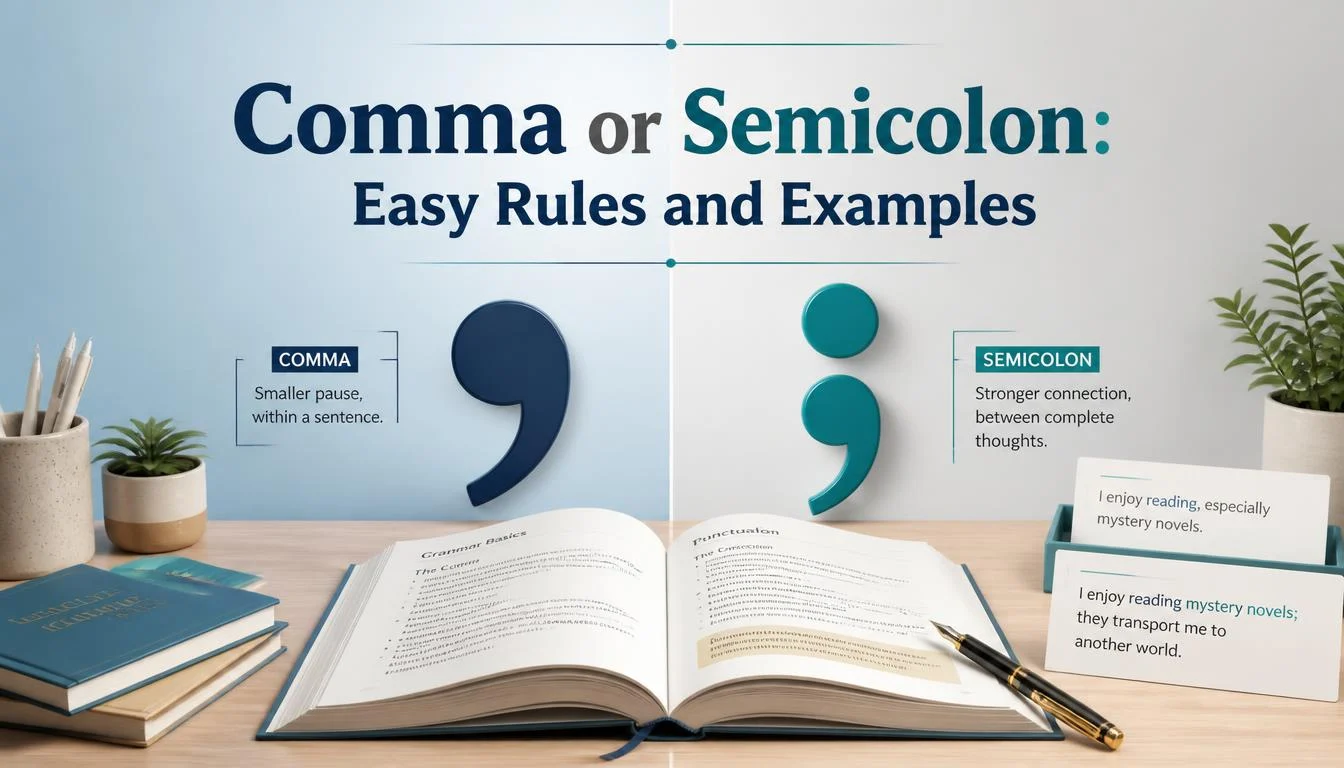
A comma (,) usually separates words, phrases, or parts of a sentence, while a semicolon (;) connects closely related independent clauses.Both are correct punctuation marks, but they perform different grammatical jobs.
Choosing between a comma or semicolon can be confusing, especially when two parts of a sentence seem closely connected. Both punctuation marks can help organize ideas and make writing easier to read, but they do not serve the same purpose. A comma usually separates parts of a sentence, while a semicolon can connect two closely related independent clauses without using a conjunction.
Understanding the difference between a comma and semicolon becomes much easier when you look at how each mark works in a complete sentence. In this guide, you’ll learn the basic rules, see clear examples, and discover common mistakes to avoid. By the end, you’ll know when a comma fits naturally and when a semicolon creates the stronger grammatical connection.
Which One Is Correct?
Both comma and semicolon are correct terms, but neither replaces the other.
A comma (,) separates smaller grammatical units within a sentence. It can divide items in a list, introduce a phrase, separate an introductory element, or join certain sentence structures with a coordinating conjunction.
A semicolon (;) creates a stronger separation. It commonly joins two closely related independent clauses without using a coordinating conjunction.
Compare these examples:
I bought apples, oranges, and bananas.
The comma separates items in a series.
I wanted to call you; I was too busy.
The semicolon connects two complete, closely related thoughts.
The choice depends on the grammatical structure and the relationship between the ideas.
Meaning of the Correct Word
Definition
A comma is a punctuation mark written as ,. It signals a short separation between words, phrases, or clauses.
A semicolon is written as ;. It creates a stronger break than a comma but a weaker break than a period.
Neither punctuation mark has one single function. Their roles depend on how a sentence is constructed.
Explanation
Think of punctuation as a way to show relationships between ideas.
A comma usually indicates a smaller separation:
After dinner, we watched a movie.
The comma separates the introductory phrase After dinner from the main clause.
A semicolon signals a closer relationship between two complete sentences:
The store was closed; we went home.
Both sides can stand alone:
- The store was closed.
- We went home.
The semicolon connects them because the ideas are closely related.
Usage
Use a comma in several common situations.
For items in a series:
She packed shirts, shoes, socks, and a jacket.
After many introductory phrases:
Before the meeting, I checked my notes.
Around nonessential information:
My brother, who lives in Texas, is visiting next week.
Before a coordinating conjunction when joining independent clauses:
I wanted to stay, but I had work to finish.
Use a semicolon when you have two independent clauses that are closely connected:
The weather changed quickly; we canceled the picnic.
You can also use a semicolon to separate complex list items that already contain commas:
The conference has offices in Austin, Texas; Denver, Colorado; and Miami, Florida.
Real-World Examples
Here are some natural examples of comma usage:
After work, I stopped at the grocery store.
Maria bought coffee, bread, fruit, and cheese.
If you need help, call me tonight.
The blue car, which belongs to James, is parked outside.
Now compare semicolon examples:
I finished my report; my manager reviewed it.
The restaurant was crowded; we decided to eat elsewhere.
She loves classical music; her brother prefers jazz.
The semicolon works because each side contains a complete thought.
Meaning of the Incorrect or Alternative Word
Incorrect
Neither comma nor semicolon is inherently incorrect. They are both standard punctuation marks.
However, using one where the other is required can create a grammatical error.
For example:
I finished my homework, I went to bed.
This creates a comma splice because two independent clauses are joined with only a comma.
A semicolon can correct the structure:
I finished my homework; I went to bed.
You could also use a period:
I finished my homework. I went to bed.
Typo
A comma and semicolon are unlikely to be confused as spelling errors because they are punctuation marks rather than words.
However, typing errors can happen. A writer may accidentally enter a comma instead of a semicolon, especially when typing quickly.
On a standard keyboard, the two marks sit on nearby keys. Careless typing can therefore produce the wrong punctuation.
Slang
Neither punctuation mark represents slang.
Both are established parts of standard written English. Their meanings come from grammar and punctuation conventions, not informal speech.
Regional Variation
American and British English generally use commas and semicolons according to the same basic grammatical principles.
Style guides may differ on certain details, such as the Oxford comma or specific punctuation preferences. However, the fundamental difference between a comma and semicolon remains consistent.
Rare but Valid Usage
Semicolons can appear in more specialized writing, especially when separating complicated items in a series.
For example:
The speakers came from Boston, Massachusetts; Portland, Oregon; and Seattle, Washington.
A comma would not clearly separate the locations because each location already contains a comma.
Semicolons also appear before conjunctive adverbs such as however, therefore, and nevertheless when they connect independent clauses:
I wanted to attend the event; however, I had another appointment.
Key Differences Between the Two Words
| Feature | Comma | Semicolon |
|---|---|---|
| Symbol | , | ; |
| Main function | Creates a lighter separation | Creates a stronger separation |
| Typical use | Words, phrases, clauses, and lists | Closely related independent clauses |
| Can join two independent clauses alone? | No | Yes |
| Common with conjunctions | Yes | Usually not when a coordinating conjunction joins the clauses |
| Strength of pause | Shorter | Stronger |
| Common in lists | Yes | Sometimes, especially in complex lists |
| Recognition | Very common | Less frequent but widely recognized |
| Example | I called John, but he was busy. | I called John; he was busy. |
The most important difference is sentence structure.
Consider:
I was tired, so I went home.
The comma works because so is a coordinating conjunction connecting two independent clauses.
Now remove the conjunction:
I was tired; I went home.
The semicolon can connect the two independent clauses directly.
This does not mean semicolons are simply “stronger commas.” They have their own grammatical purpose.
A semicolon also should not replace every comma. For example, this sentence is correct:
After lunch, we went for a walk.
A semicolon would be incorrect:
After lunch; we went for a walk.
The phrase After lunch cannot stand alone as an independent clause, so a semicolon does not belong there.
Common Mistakes People Make
Using a Comma Between Two Complete Sentences
One of the most common errors is the comma splice.
Incorrect:
The movie was long, we left early.
Both parts can stand as sentences, so a comma alone cannot join them.
Correct:
The movie was long, so we left early.
Or:
The movie was long; we left early.
Or:
The movie was long. We left early.
Using a Semicolon Before an Incomplete Clause
A semicolon normally requires an independent clause on both sides.
Incorrect:
I went home; because I was tired.
The second part begins with because and cannot stand alone.
Correct:
I went home because I was tired.
You could also write:
I was tired; therefore, I went home.
Treating a Semicolon Like a Fancy Comma
A semicolon should not separate ordinary list items when commas already do the job.
Correct:
We bought apples, pears, and peaches.
Unnecessary:
We bought apples; pears; and peaches.
The semicolon becomes useful when the individual list items contain commas:
We visited Dallas, Texas; Phoenix, Arizona; and Orlando, Florida.
Forgetting the Comma After an Introductory Element
Many sentences begin with introductory words or phrases.
Correct:
After the meeting, we discussed the proposal.
Correct:
However, the results were different.
The comma helps readers recognize where the introductory element ends.
Using a Semicolon When a Period Is Better
A semicolon is useful when two ideas are closely connected, but you do not need one simply because two sentences are related.
For example:
I finished the project. I submitted it before noon.
This is perfectly clear.
You could write:
I finished the project; I submitted it before noon.
That version emphasizes the connection between the two actions.
Adding a Comma Before Every Conjunction
Not every conjunction requires a comma.
Correct:
I washed the dishes and cleaned the kitchen.
The subject remains the same, and the sentence does not need a comma.
But when two independent clauses are joined, a comma usually appears before a coordinating conjunction:
I washed the dishes, and my sister cleaned the kitchen.
Correct Usage Examples
Casual Examples
I need coffee, breakfast, and a few minutes to wake up.
We can watch a movie, or we can play a game.
I wanted to go; it started raining.
She called me, but I missed the call.
The bus was late; we took a taxi instead.
In casual writing, commas appear much more often than semicolons. A semicolon can still work when the sentence contains two closely related complete thoughts.
Professional Examples
Please review the document, sign the final page, and return it by Friday.
The first proposal focuses on cost; the second focuses on long-term growth.
We completed the analysis, but the client requested additional information.
The meeting ended early; everyone agreed on the next steps.
Professional writing benefits from punctuation that makes relationships between ideas obvious.
Educational Examples
A noun names a person, place, thing, or idea.
Study the examples carefully; they show how the rule works.
Students should complete the first exercise, check their answers, and review any mistakes.
The experiment produced unexpected results; the researchers repeated the test.
When teaching grammar, the semicolon can clearly connect related statements without making them separate paragraphs.
Literary/Metaphorical Examples
The city never seemed to sleep; its lights remained bright until dawn.
The rain stopped, and the streets slowly dried.
She opened the letter, paused for a moment, and smiled.
He had one goal; nothing could distract him from it.
Literary writing allows more stylistic flexibility, but the underlying grammar still matters.
Word Origin / Etymology
The word comma comes from the Greek komma, meaning a piece or something cut off. Latin and later European languages carried the term into grammatical terminology.
The punctuation mark itself developed from systems used to organize written language and guide readers through text. Over time, the comma became a standard way to mark smaller divisions within sentences.
The word semicolon combines semi-, meaning “half,” with colon. The name reflects its position between a comma and a colon in traditional punctuation systems.
The semicolon developed as writers needed a mark that could separate larger units while still showing a relationship between them.
Today, both marks serve highly practical functions. Their shapes may look small, but they can significantly change how readers understand a sentence.
Why the Incorrect Version Became Popular
There is no universally “incorrect version” in comma or semicolon because both marks are legitimate punctuation.
The real source of confusion comes from overlapping functions. Both marks can appear between ideas, and both can influence the rhythm of a sentence.
The comma appears much more frequently in everyday writing. As a result, writers sometimes use it automatically when they need a stronger separation.
Another reason is speech. When we speak, we naturally pause between ideas, but spoken pauses do not always reveal the correct punctuation.
For example:
I wanted to call you, but I was busy.
The conjunction but helps create the correct structure.
Compare:
I wanted to call you; I was busy.
Here, the semicolon connects the two complete clauses directly.
Writers also sometimes avoid semicolons because they seem more formal. That can lead to excessive use of commas or short sentences.
The solution is not to prefer one punctuation mark. Instead, identify the grammatical structure first.
Easy Memory Tricks
Think “Small Break” for Comma
A comma usually handles a smaller grammatical separation.
We bought milk, bread, and eggs.
Think:
Comma = smaller division.
Think “Two Sentences Together” for Semicolon
A semicolon can connect two independent clauses.
I was hungry; I made a sandwich.
Think:
Semicolon = two complete thoughts connected.
Use the Period Test
When you are unsure about a semicolon, replace it with a period.
The store was closed; we went home.
Try:
The store was closed. We went home.
If both sentences work independently, the semicolon may be appropriate.
Remember the “Complete on Both Sides” Rule
Before using a semicolon, check both sides.
The rain stopped; we went outside.
Both parts are complete.
But:
Because the rain stopped; we went outside.
The first part is incomplete, so the semicolon does not work.
Remember “Comma + Conjunction”
If two independent clauses are joined by and, but, for, or, nor, so, or yet, a comma commonly appears before the conjunction.
I wanted to stay, but I had to leave.
Without the conjunction, a semicolon can often do the job:
I wanted to stay; I had to leave.
FAQs
Is a comma or semicolon stronger?
A semicolon creates a stronger separation than a comma. It can connect two complete, closely related clauses.
Can a semicolon replace a comma?
Not usually. A semicolon has different grammatical functions and cannot replace commas in ordinary lists or introductory phrases.
Can a comma join two complete sentences?
Not by itself. Joining two independent clauses with only a comma creates a comma splice.
When should I use a semicolon?
Use a semicolon to connect closely related independent clauses or to separate complex list items containing internal commas.
Do you capitalize after a semicolon?
Usually, no. The word after a semicolon normally begins with a lowercase letter unless it is a proper noun.
Is a semicolon the same as a colon?
No. A semicolon connects closely related ideas, while a colon often introduces an explanation, example, list, or elaboration.
Which is more common, a comma or semicolon?
Commas are much more common in everyday writing because they have many uses within sentences.
Can I use a semicolon before “however”?
Yes. When however connects two independent clauses, a semicolon can come before it, and a comma normally follows it.
I wanted to go; however, I was too tired.
Conclusion
Understanding comma or semicolon becomes easier when you focus on sentence structure rather than pauses.Use a comma for smaller divisions and a semicolon to connect closely related independent clauses.Neither punctuation mark is better; each has a specific grammatical purpose.When both sides can stand alone, think semicolon; when the separation is smaller, think comma.
Read More Articles
- Appendicitis or Gas | How to Know What Your Abdominal Pain Means In 2026
- Afterwards or Afterward | When and How to Use Them In 2026

Andrew Cooper is a blogger and writer at Gramscript.com, turning everyday ideas into clear, engaging stories. His writing blends curiosity, insight and a genuinely human perspective.
2 thoughts on “Comma or Semicolon | When to Use a Comma and When to Use a Semicolon In 2026”