Quick Answer
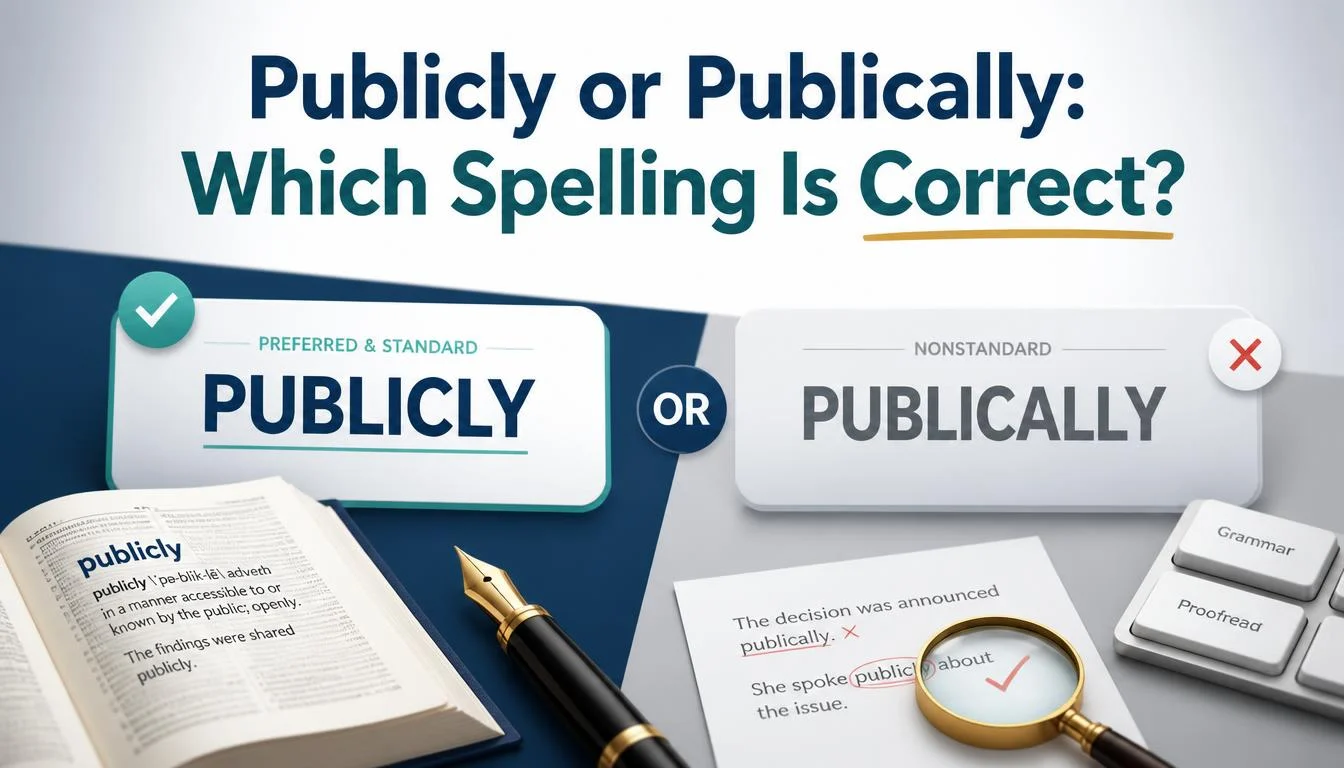
Publicly is the standard spelling in American English and the form you should use in formal writing. Publically appears as a rare or disputed variant, but it is not the preferred standard form.
Publicly or publically which spelling should you use in your writing? These two forms can look interchangeable because public becomes publicly when the adverb suffix -ly is added. However, the spelling publicly is the standard and widely accepted form in modern English. It means doing something openly, in front of other people, or in a way that is available for the public to see or know.
Publically does appear occasionally, but most modern dictionaries and standard writing guides prefer publicly. For everyday writing, professional communication, academic work, and published content, publicly is the safer choice. In this guide, we’ll explain why publicly is preferred, whether publically is considered wrong, and show clear examples so you can use the correct form with confidence.
Which One Is Correct?
Publicly is the standard and widely preferred spelling.
Use publicly when you mean “in a public way,” “openly,” or “in a way that is known or visible to the public.” Major dictionary sources define publicly as an adverb with these meanings.
For example:
The company publicly announced the change.
Here, publicly explains how the company announced the change. The announcement was made openly rather than privately.
The spelling publically does appear in English. Collins lists it as a variant spelling in British English and a disputed variant in American English. The American Heritage Dictionary labels it a nonstandard variant of publicly.
Therefore, the safest choice in standard American English is publicly.
Meaning of the Correct Word
Definition
Publicly is an adverb that means in a public or open manner. It can describe an action, statement, announcement, reaction, or decision that people can see, hear, or know about.
It can also describe something done by, for, or with the consent of the public. Dictionary definitions include uses connected with public action, public access, and community interests.
Common meanings include:
- openly
- in front of other people
- in a way known to the public
- through a public announcement
- in a manner accessible to the public
The opposite of publicly is often privately or secretly, depending on the context.
Explanation
The word publicly comes from the adjective public and functions as an adverb.
Compare these forms:
- public adjective
- publicly adverb
- publicity noun
- publicize verb
- publicized past tense or past participle form
When you say someone acted publicly, you explain that the action happened openly or in a public setting.
For example:
She publicly supported the proposal.
The word publicly tells us that her support was expressed openly.
By contrast:
She privately supported the proposal.
Here, privately creates the opposite idea.
Usage
Publicly commonly appears with verbs connected to communication, behavior, disclosure, and announcements.
You might see phrases such as:
- publicly announce
- publicly apologize
- publicly criticize
- publicly support
- publicly acknowledge
- publicly confirm
- publicly disclose
- publicly reject
- publicly discuss
- publicly respond
- publicly available
- publicly funded
- publicly known
- publicly stated
For example:
The author publicly apologized for the mistake.
The sentence means that the apology was made openly rather than privately.
Real-World Examples
Here are several natural examples:
The university publicly released the research findings.
The manager publicly thanked the staff for their work.
The company has publicly confirmed the new policy.
She did not want to discuss the matter publicly.
The records are publicly available online.
He publicly accepted responsibility for the error.
Each sentence uses publicly to describe something open, visible, known, or accessible to others.
Meaning of the Incorrect or Alternative Word
Incorrect
Calling publically simply “wrong” needs a little qualification.
In standard edited American English, publicly is the preferred form. However, publically is not an invented string of letters with no dictionary history. Some dictionaries record it as a variant or disputed form.
For professional writing, however, publicly is the safer choice because readers widely recognize it as the standard spelling.
Typo
Publically often appears because writers apply a familiar spelling pattern.
Many adjectives ending in -ic form adverbs with -ically:
- basic → basically
- tragic → tragically
- dramatic → dramatically
- automatic → automatically
That pattern can encourage writers to think:
public → publically
But English does not consistently follow one spelling rule for every word. The established standard form is:
public → publicly
So publically can result from a predictable spelling assumption rather than a lack of understanding.
Slang
Publically is not normally slang.
It does not represent a casual spoken expression, internet slang term, or special youth vocabulary. Instead, it appears as a spelling variant of publicly.
Because it can occur in real English sources, it is better described as a rare or disputed variant than as slang. Collins specifically identifies it as a variant or disputed variant.
Regional Variation
There is no simple US-versus-UK distinction in which one country officially uses publically and the other uses publicly.
Publicly is the standard form across mainstream English usage. Collins records publically in both British and American entries, but its status differs: it is described as a variant in British English and a disputed variant in American English.
So you should not treat publically as a normal British spelling equivalent to the American publicly.
Rare but Valid Usage
The status of publically explains why you may encounter it in published material.
Some dictionaries document it rather than completely excluding it. Collins lists it, and the American Heritage Dictionary describes it as a nonstandard variant.
That means the spelling exists in recorded English, but existence does not make it the best choice for standard writing.
A useful distinction is:
Documented does not always mean preferred.
For an essay, article, report, résumé, application, or professional email, choose publicly.
Key Differences Between the Two Words
| Feature | Publicly | Publically |
|---|---|---|
| Spelling | publicly | publically |
| Meaning | Openly or in a public manner | Same intended meaning |
| Pronunciation | PUHB-lik-lee | Usually the same or very similar |
| Grammar | Adverb | Variant/nonstandard adverb |
| Usage | Standard and widely preferred | Rare, disputed, or nonstandard |
| Recognition | Broadly recognized | Recognized but less accepted |
| Formal writing | Recommended | Best avoided |
| American English | Standard form | Disputed variant |
The main difference is spelling and standard usage, not meaning.
Both forms attempt to express the same idea. If someone writes publically, the intended meaning is usually obvious. The issue is that publicly is the established standard form for careful modern writing.
Pronunciation does not provide a useful way to distinguish them. In normal speech, the two spellings may sound essentially the same. This explains why listening alone cannot help you decide which spelling to write.
The spelling must be learned separately.
Common Mistakes People Make
Adding “al” Automatically
One of the most common mistakes is assuming that public must become publically.
Writers often remember forms such as basically and logically. They then transfer that pattern to public.
But publicly has its own established spelling.
Incorrect or nonstandard: The actor spoke publically.
Preferred: The actor spoke publicly.
Confusing the Adjective and Adverb
Another mistake involves using public when an adverb is needed.
She made a public statement.
Here, public describes the noun statement.
She spoke publicly about the issue.
Here, publicly describes the verb spoke.
This distinction is useful:
Public describes a person, place, thing, or situation.
Publicly describes how an action happens.
Assuming Every “-ic” Word Uses “-ically”
English has many words that follow the -ically pattern, but publicly is an established exception to that expectation.
For example:
The machine operates automatically.
But:
The organization publicly released the report.
Do not create publically simply because another word follows a similar-looking pattern.
Thinking the Two Forms Have Different Meanings
They do not normally express two separate concepts.
When someone writes publically, they generally mean the same thing as publicly. The distinction concerns standard spelling and acceptance rather than a major difference in meaning.
Treating Spell-Checker Corrections as Grammar Rules
A spell checker may flag publically, but software alone does not explain why the form appears in some dictionaries.
The more useful approach is to check established dictionary usage. Current dictionary evidence shows that publicly is the standard choice, while publically has a documented but disputed or nonstandard status.
Correct Usage Examples
Casual Examples
She publicly thanked everyone who helped her.
He publicly admitted that he was wrong.
They publicly discussed the problem.
I would rather not argue about it publicly.
The singer publicly responded to the rumors.
These examples fit conversations, social situations, interviews, and everyday communication.
Professional Examples
The company publicly announced its updated policy.
The director publicly addressed the employees’ concerns.
The organization publicly released its annual report.
The executive publicly apologized for the error.
The firm has publicly confirmed the agreement.
Professional writing often uses publicly with verbs such as announce, confirm, release, address, and acknowledge.
Educational Examples
The professor publicly presented the research findings.
The school publicly announced the scholarship program.
The study’s results were publicly available.
Students should not publicly share private information.
The university publicly explained the change in its admission policy.
These sentences show how publicly works in academic and educational contexts.
Literary/Metaphorical Examples
She publicly faced the criticism without backing away.
The town publicly celebrated its long history.
His decision publicly marked a new chapter for the organization.
The artist publicly challenged expectations through her work.
Literary writing can use publicly to emphasize visibility, openness, or a change that takes place before an audience.
Word Origin / Etymology
The word publicly is formed from public plus the adverbial ending -ly.
Dictionary sources give its word origin as public + -ly, with the modern adverb recorded from the early twentieth century. Collins dates the form to 1925–30.
The adjective public has a much older history. It ultimately traces through French and Latin forms associated with the idea of the people or community.
The important point for modern spelling is simpler: English established publicly as the standard adverb.
The spelling may look unusual because many adjectives ending in -ic produce adverbs with -ically. Yet word formation in English depends on established usage, not just a single mechanical rule.
That is why you should learn publicly as a complete word rather than trying to construct it from a general pattern.
Why the Incorrect Version Became Popular
The popularity of publically is understandable.
English contains many adverbs that add -ally to an adjective ending in -ic. Examples include:
- scientific → scientifically
- realistic → realistically
- specific → specifically
- energetic → energetically
- dramatic → dramatically
Because public ends with the letters -lic, writers may expect the same -ally pattern.
That produces:
public + ally → publically
The spelling looks regular at first glance.
However, publicly has a long-established spelling that does not follow that expected pattern. Historical and modern usage have kept the shorter form prominent.
Current dictionary evidence also shows that publically has not disappeared completely. Collins records it, while the American Heritage Dictionary calls it a nonstandard variant.
So the spelling survives partly because it feels natural to many writers.
Another factor is pronunciation. Since publicly and publically can sound very similar, speakers do not receive a clear pronunciation clue that would help them remember the spelling.
This makes the word a classic spelling trap: the alternative looks logical, sounds familiar, and sometimes appears in real-world writing.
Still, for standard American English, publicly remains the form to choose.
Easy Memory Tricks
Think “Public + Ly”
The easiest memory trick is:
public + ly = publicly
Do not insert al between public and ly.
Remember the Shorter Form
Think:
Publicly = public + ly
The word stays compact.
Connect It With “Privately”
Another useful contrast is:
publicly ↔ privately
Both words use the straightforward -ly ending.
If something happens openly, it happens publicly. If it happens away from public attention, it may happen privately.
Use a Quick Sentence Test
When you are unsure, complete this sentence:
The company ___ announced the decision.
The natural answer is:
The company publicly announced the decision.
Seeing the word in a familiar phrase can reinforce the correct spelling.
FAQs
Is publicly or publically correct?
Publicly is the standard spelling in American English. Publically is a rare or disputed variant.
Is publically a real word?
Yes, dictionaries document publically, but they do not give it the same standard status as publicly.
Does publicly mean openly?
Yes. Publicly commonly means openly or in a way that is known, visible, or accessible to the public.
Is publically wrong?
In careful standard writing, publically is best avoided. Some dictionaries record it as a variant or nonstandard form.
How do you pronounce publicly?
Publicly is commonly pronounced PUHB-lik-lee in American English.
Why is it publicly and not publically?
English established publicly as the standard adverb. The spelling does not follow the common pattern seen in many other -ic adjectives.
Can I use publicly in formal writing?
Yes. Publicly works naturally in academic, professional, business, journalistic, and everyday writing.
What is the opposite of publicly?
The most common opposite is privately. Depending on context, secretly can also provide a suitable contrast.
Conclusion
When choosing between publicly or publically, use publicly in standard American English and formal writing.It means openly or in a way that is known, visible, or accessible to the public.Although publically appears in some dictionaries as a rare or disputed variant, it is not the preferred spelling.Remember public + ly = publicly, and you will avoid this common spelling trap.
Read More Articles
- Comma or Semicolon | When to Use a Comma and When to Use a Semicolon In 2026
- Omelette or Omelet | Correct Spelling, Meaning and Usage In 2026

Andrew Cooper is a blogger and writer at Gramscript.com, turning everyday ideas into clear, engaging stories. His writing blends curiosity, insight and a genuinely human perspective.
2 thoughts on “Publicly or Publically | Meaning, Spelling and Usage In 2026”