Quick Answer
Bridge and implant are both correct words, but they describe different dental treatments for replacing missing teeth.A bridge uses nearby teeth for support, while an implant replaces a tooth root and supports a crown.
Losing a tooth can affect more than your smile. It can make chewing harder, change the way your surrounding teeth meet, and leave you wondering which replacement option makes the most sense. When comparing a bridge or implant, it helps to understand how each treatment works, what the procedure involves, and how it may fit your dental needs.
A dental bridge and a dental implant can both replace a missing tooth, but they use different approaches. A bridge typically relies on neighboring teeth for support, while an implant uses a dental implant placed in the jawbone to support a replacement tooth. Factors such as bone health, the condition of nearby teeth, treatment time, maintenance, and cost can all influence the choice. This guide compares the two options so you can discuss the most suitable approach with your dentist.
Which One Is Correct?
Both bridge and implant are correct words.
The important difference is meaning and context, not spelling. You should use bridge when referring to a dental restoration that spans a missing-tooth gap. Use implant when referring to an artificial tooth root or, in everyday speech, the implant-supported replacement associated with it.
For example:
- “My dentist recommended a bridge.”
- “She decided to get a dental implant.”
- “The bridge replaces the missing tooth by using support from nearby teeth.”
- “The implant is placed into the jawbone to support a replacement tooth.”
Neither word is a misspelling of the other. They describe different dental concepts.
The phrase “bridge or implant” often appears when someone wants to compare treatment options. However, the two words should not be treated as interchangeable synonyms.
Meaning of the Correct Word
Definition
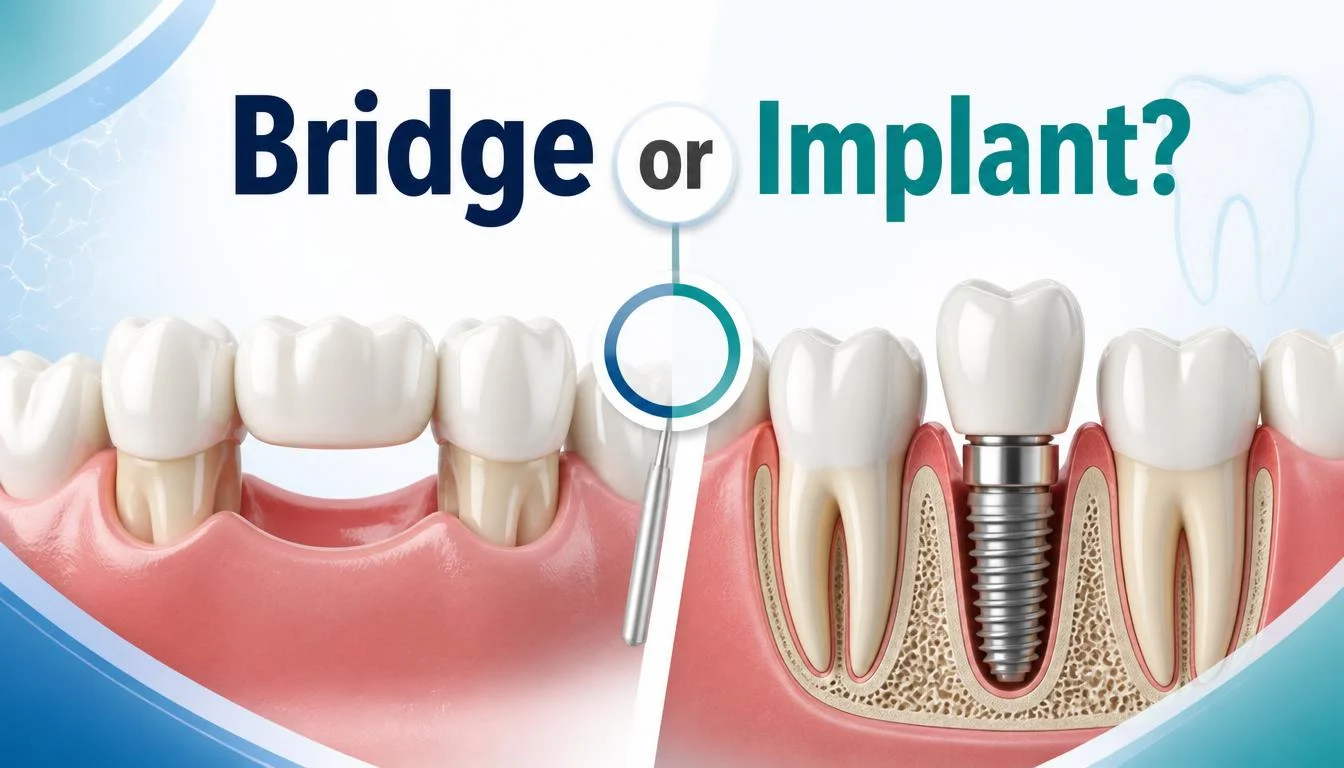
A bridge is a dental restoration that replaces one or more missing teeth by spanning the space where the teeth are absent. Traditional bridges often rely on crowns placed over nearby teeth for support.
An implant is a dental device placed into the jawbone to act as an artificial tooth root. A dental crown, bridge, or other restoration can later attach to the implant.
In simple terms, a bridge spans a gap, while an implant provides root-like support.
Explanation
The word bridge makes sense because the dental restoration connects two supporting areas across a gap. Think of a physical bridge crossing a space between two sides.
A traditional dental bridge usually contains an artificial tooth called a pontic. The pontic sits where the missing tooth would normally be. Supporting crowns, known as abutments, connect the replacement tooth to the surrounding structure.
An implant works differently. A dentist places an implant fixture into the jawbone. After the area heals and the implant integrates with the surrounding bone, an abutment can connect the implant to a crown or another restoration.
People sometimes use “implant” to describe the entire tooth replacement. In technical dental language, however, the implant itself refers specifically to the fixture placed in the jaw.
Usage
Bridge works as both a noun and a verb.
As a noun:
“The dentist suggested a bridge for the missing tooth.”
As a verb, bridge can mean to connect or close a gap:
“The treatment can bridge the space between the remaining teeth.”
In dental conversations, however, bridge most commonly appears as a noun.
Implant also works as both a noun and a verb.
As a noun:
“The implant supports the replacement tooth.”
As a verb:
“The dentist will implant the fixture into the jawbone.”
The noun form is especially common when discussing dental treatment.
Real-World Examples
Here are several natural examples:
- “I need a bridge because I have a missing molar.”
- “My dentist explained the difference between a bridge and an implant.”
- “The implant will support a new crown.”
- “A dental bridge can replace a missing tooth without placing an implant.”
- “The patient chose an implant after discussing the available options.”
- “The bridge uses neighboring teeth for support.”
These examples show why context matters. The correct word depends on the treatment or object you are describing.
Meaning of the Incorrect or Alternative Word
Incorrect
Neither bridge nor implant is incorrect when discussing tooth replacement.
The mistake occurs when someone uses the words as though they mean exactly the same thing. A person might say, “An implant is a bridge,” but that statement can create confusion because an implant and a bridge use different structures.
A bridge can sometimes be supported by implants. Therefore, the two concepts can appear together in one treatment plan.
Typo
Neither word normally appears as a typo for the other.
Common spelling errors can still occur. For example, people may accidentally write “imlant” instead of “implant.” They may also mistype “brigde” instead of “bridge.”
These are spelling mistakes, not alternative forms.
Slang
Neither bridge nor implant is dental slang.
Dentists and patients commonly use both words in everyday conversations about tooth replacement. Medical and dental professionals may use more specific terms when they need greater precision.
Regional Variation
The words bridge and implant do not represent a major American-versus-British spelling difference.
English speakers in different regions use both terms. The terminology may vary slightly in professional settings, but the basic meanings remain consistent.
Rare but Valid Usage
Both words have meanings outside dentistry.
A bridge can refer to a structure that crosses a river, road, or other obstacle. It can also describe a connecting part of an object or an action that connects separate things.
An implant can refer to something inserted into the body. In a broader sense, implant can also mean to establish an idea, belief, or thought in someone’s mind.
For example:
“The teacher’s story implanted an important idea in the students’ minds.”
The surrounding context tells readers which meaning applies.
Key Differences Between the Two Words
| Feature | Bridge | Implant |
|---|---|---|
| Spelling | Bridge | Implant |
| Meaning | A restoration that spans a missing-tooth gap | A fixture placed in the jawbone to support a restoration |
| Pronunciation | BRIDJ | im-PLANT |
| Grammar | Noun and verb | Noun and verb |
| Dental usage | Replaces missing teeth by spanning a gap | Provides artificial root support |
| Support | Often uses nearby teeth or implants | Uses the jawbone after placement and healing |
| Recognition | Common everyday dental term | Common everyday dental term |
| Main idea | Connects a gap | Replaces root-like support |
The biggest difference is conceptual. A bridge focuses on connecting a gap, while an implant focuses on supporting a replacement tooth from within the jaw.
For that reason, asking “bridge or implant?” is not really a spelling question. It is a question about two different dental options.
Bridge in a Sentence
“The dentist recommended a bridge to replace the missing tooth.”
Here, bridge identifies the restoration used to span the space.
Implant in a Sentence
“The patient received an implant to support a replacement crown.”
Here, implant refers to the artificial root-like fixture.
Can They Work Together?
Yes. A bridge and an implant can sometimes appear in the same treatment plan.
For example, an implant-supported bridge can replace multiple missing teeth. In this situation, implants provide support while the bridge carries the replacement teeth.
That example explains why people sometimes confuse the terms. A treatment can involve both an implant and a bridge without the words becoming synonyms.
Common Mistakes People Make
One common mistake involves treating bridge and implant as two names for the same procedure.
For example:
“I got a bridge, which is the same thing as an implant.”
This wording is misleading. A bridge and an implant use different approaches to replace missing teeth.
Another mistake involves assuming that every artificial tooth is an implant. A replacement tooth may be part of a bridge, a crown supported by an implant, a removable denture, or another restoration.
People also sometimes use implant when they specifically mean implant-supported crown. In casual conversation, that shorthand is common. However, precise writing should distinguish the implant fixture from the restoration attached to it.
Another frequent mistake involves the word bridge. Some readers assume that every bridge must attach directly to natural teeth. Dental bridges can use different support systems, including implants.
Spelling can also cause trouble. Remember:
- bridge, not “brigde”
- implant, not “imlant”
- bridged, not “bridgd”
- implanted, not “implantid”
Pronunciation can help reinforce the spelling. Bridge sounds like “BRIDJ,” while implant is commonly pronounced “im-PLANT.”
Correct Usage Examples
Casual Examples
“My dentist gave me two choices: a bridge or an implant.”
“I’m trying to understand whether a bridge or implant would replace my missing tooth.”
“She has an implant where she previously had a missing tooth.”
“My uncle has a dental bridge.”
These examples reflect the way people commonly discuss dental treatment.
Professional Examples
“The dentist discussed bridge and implant options during the consultation.”
“An implant may provide support for a replacement crown.”
“The proposed bridge would span the space left by the missing tooth.”
“The treatment plan includes an implant-supported restoration.”
Professional writing often uses additional terms because precision matters.
Educational Examples
“A dental bridge replaces a missing tooth by spanning the surrounding gap.”
“A dental implant can act as an artificial root for a replacement tooth.”
“The words bridge and implant describe different dental structures.”
“An implant-supported bridge combines features of both treatment types.”
These sentences work well in textbooks, educational articles, and classroom explanations.
Literary/Metaphorical Examples
The word bridge has a much wider metaphorical use than implant.
“The conversation became a bridge between two generations.”
“Music can bridge differences between people.”
“Her kindness helped bridge the distance between the two groups.”
Here, bridge means to connect or reduce a gap.
The verb implant can also work metaphorically:
“The experience implanted a lasting memory in his mind.”
“The story implanted doubt in her thoughts.”
In these examples, implant means to place or establish something deeply.
Word Origin / Etymology
The noun bridge has very old Germanic roots. English inherited it from Old English brycg, which referred to a structure used to cross a gap or body of water. Related forms appear in several Germanic languages.
Over time, bridge developed both literal and figurative meanings. A physical bridge connects two sides, so English speakers naturally extended the word to ideas such as connecting people, overcoming differences, or linking separate things.
Dental terminology later adopted bridge because the restoration spans the space created by missing teeth. The metaphor is straightforward: the dental structure crosses a gap.
The word implant has Latin roots. It comes from Latin implantare, meaning to plant or insert. The word combines the idea of placing something into a suitable location.
English later developed implant as both a noun and a verb. In medical language, it describes something placed inside the body. The dental meaning follows this broader concept because an implant fixture enters the jawbone.
The two words therefore developed from different ideas. Bridge centers on connection across a gap, while implant centers on placing something into a structure.
Why the Incorrect Version Became Popular
There is no truly incorrect version of bridge or implant. The apparent confusion comes from their close relationship in dental discussions.
Both treatments can replace missing teeth. Both can involve artificial teeth or crowns. Both may appear in the same conversation, consultation, or treatment plan.
Dental terminology also contains several related words. Patients may hear crown, bridge, implant, abutment, pontic, and implant-supported bridge during one appointment. Without a dental background, these terms can easily blur together.
Everyday speech adds another layer of confusion. People often shorten technical descriptions. Someone may say, “I got an implant,” even when they mean the complete implant-supported tooth replacement.
Likewise, someone may say, “I got a bridge,” without explaining whether the bridge uses natural teeth or implants for support.
The solution is simple: look at what the word describes. If the focus is the restoration that spans a missing-tooth space, bridge fits. If the focus is the fixture inserted into the jawbone, implant fits.
Easy Memory Tricks
A simple way to remember the difference is to picture two separate images.
Bridge = crosses a gap.
Think about a road bridge. It connects two sides across an empty space. A dental bridge follows the same basic idea by spanning the space created by missing teeth.
Implant = planted in the jaw.
Think about the word plant inside implant. Something gets placed into a structure. A dental implant is placed into the jawbone and can support a replacement tooth.
You can also remember this short rule:
Bridge the gap; implant the root.
This is not a complete description of every dental treatment, but it provides a useful language shortcut.
Another helpful clue comes from grammar. When you say “a bridge,” you usually name the restoration. When you say “an implant,” you usually identify the fixture or, in everyday speech, the implant-based replacement.
FAQs
Is bridge or implant the correct term?
Both are correct. They describe different dental treatments used to replace missing teeth.
Is a dental bridge the same as an implant?
No. A bridge spans a missing-tooth gap, while an implant is placed into the jawbone for support.
How do you pronounce bridge?
Bridge is pronounced like “BRIDJ.”
How do you pronounce implant?
As a noun, implant is commonly pronounced “im-PLANT,” with emphasis on the second syllable.
Can an implant support a bridge?
Yes. An implant-supported bridge can use implants as support for multiple replacement teeth.
Is “implant” a verb or a noun?
It can be both. As a noun, it refers to something placed in the body; as a verb, it means to place something into a suitable location.
Is “bridge” a verb or a noun?
It can also be both. A bridge can be a dental restoration or a structure, while the verb means to connect or span a gap.
Which word should I use for a missing tooth?
Use bridge when you mean a bridge restoration and implant when you mean an implant or implant-based treatment. The exact term depends on the procedure being discussed.
Conclusion
Bridge or implant is not a question of right versus wrong because both terms are correct and describe different dental concepts.A bridge spans a missing-tooth gap, while an implant provides artificial root like support within the jaw.Remember the simple distinction: bridge the gap, implant the root.When you understand the meaning behind each word, choosing the right term becomes much easier.
Read More Articles
- Plandid or Candid | Correct Spelling and Meaning Explained In 2026
- Pled or Pleaded | How to Use Each Form in a Sentence In 2026

Christopher Parker is a writer and blogger at GramScript.com, sharing thoughtful insights and engaging stories across a range of topics. His writing blends clarity, curiosity, and a distinctly human perspective.
2 thoughts on “Bridge or Implant | How These Two Tooth Replacement Options Compare In 2026”