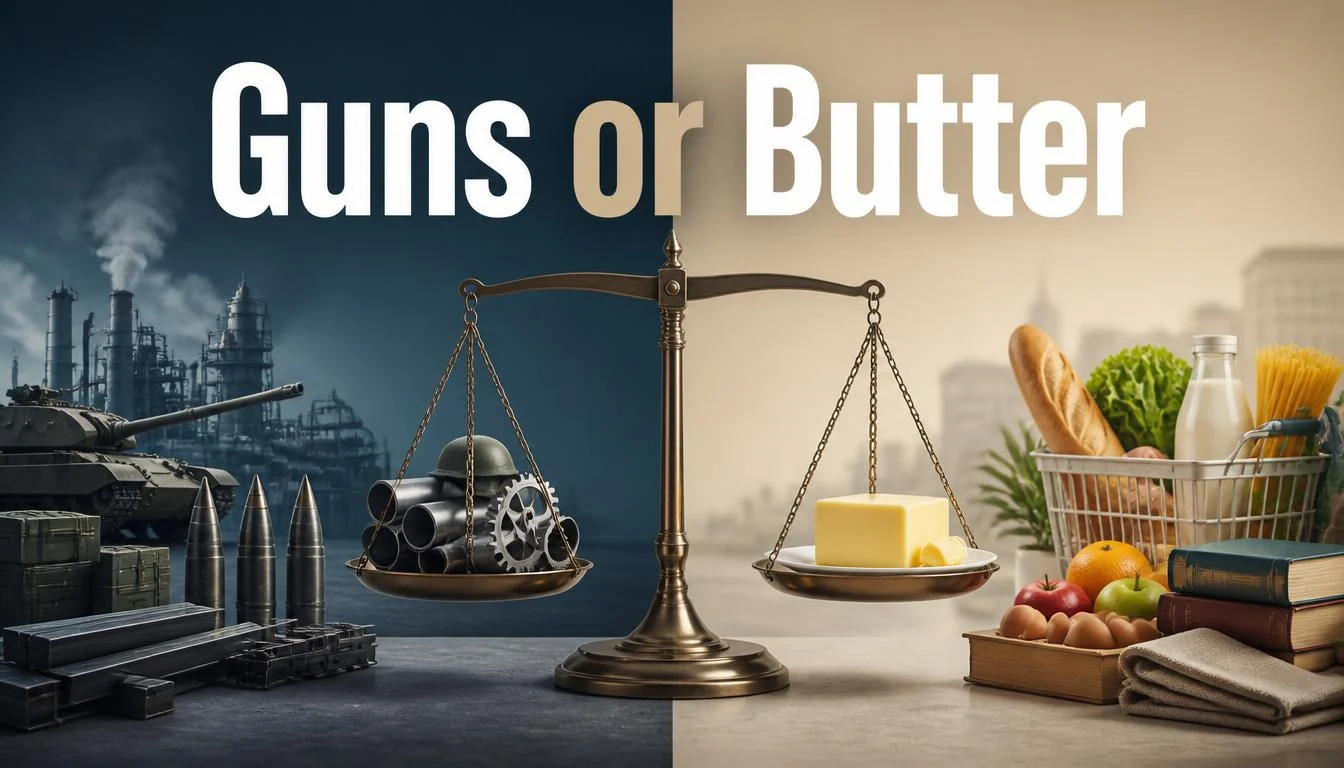
Quick Answer
“Guns or butter” is a valid economic expression that describes a choice between military spending and civilian needs. Neither word is incorrect; the phrase illustrates the idea of limited resources and competing priorities.
The phrase “guns or butter” describes a basic economic trade-off between military spending and civilian goods and services. “Guns” represent resources devoted to defense, weapons, and national security, while “butter” represents products and services that improve everyday life. The phrase helps explain a simple question: when resources are limited, how should a society decide where to spend them?
The concept also illustrates opportunity cost, because choosing more spending in one area can leave fewer resources available for another. For example, a government that increases defense spending may have less money available for healthcare, education, infrastructure, or other civilian needs. Understanding the meaning of guns or butter makes it easier to recognize how economic choices involve competing priorities and why every allocation of scarce resources can carry a cost.
Which One Is Correct?
Both “guns” and “butter” are correctly spelled English words, so this is not a normal spelling comparison.
The expression “guns or butter” is itself correct. It works as an economic metaphor for a trade-off between military priorities and civilian consumption or public welfare.
You may also see related expressions such as “guns and butter” and “guns versus butter.” These forms are also valid, but they can emphasize slightly different relationships.
- Guns or butter emphasizes a choice or trade-off.
- Guns and butter emphasizes two competing areas that an economy may need to support.
- Guns versus butter emphasizes the contrast between the two priorities.
The exact wording depends on the writer’s purpose.
Meaning of the Correct Word
Definition
“Guns or butter” refers to the economic choice between producing military goods and providing civilian goods or services.
In the phrase, guns symbolize defense and military production. Butter symbolizes civilian consumption and everyday economic needs.
The expression illustrates the principle of scarcity. An economy has limited labor, capital, raw materials, time, and other resources. Using more of those resources for one purpose can leave fewer resources for another.
Explanation
Imagine a country with a fixed amount of steel, workers, factories, and government money.
The country could direct more of those resources toward military equipment. In the metaphor, that means choosing more guns.
Alternatively, it could direct more resources toward consumer products and public needs. In the metaphor, that means choosing more butter.
The real choice is much broader than weapons and food. “Guns” can represent military aircraft, ships, defense technology, ammunition, and related infrastructure. “Butter” can represent food, housing, education, healthcare, consumer products, and other civilian priorities.
Economists use the expression to make the concept of opportunity cost easier to understand. If resources go toward one objective, society may give up some possible production in another area.
That does not mean every increase in defense spending automatically causes an equal decrease in civilian spending. Economies can grow, taxes can change, governments can borrow, and production can become more efficient. The phrase presents a simplified model of a broader resource-allocation problem.
Usage
You can use “guns or butter” when discussing:
- Government spending
- Military budgets
- Economic policy
- Resource allocation
- Opportunity cost
- Public priorities
- Wartime production
- Civilian consumption
- National defense
- Economic trade-offs
The expression usually appears in analytical or explanatory contexts rather than casual conversation.
For example:
The debate over the defense budget often becomes a question of guns or butter.
Here, the phrase means that policymakers face competing demands for limited resources.
Real-World Examples
A government might increase defense production during a major conflict. That decision could require factories and workers that might otherwise produce civilian goods.
A country might also face a budget decision between expanding military capabilities and increasing spending on education or healthcare.
An economist could use the phrase to explain why an economy cannot always maximize every objective at the same time.
In each case, “guns or butter” describes competing uses of scarce resources rather than a literal choice between a weapon and food.
Meaning of the Incorrect or Alternative Word
Incorrect
Neither “guns” nor “butter” is incorrect in the expression.
The important point is that “guns or butter” functions as a fixed economic metaphor. Treating one of the two words as a spelling mistake would misunderstand the phrase.
Typo
A typo can occur when someone writes the phrase incorrectly, such as changing butter to another similar-looking word. However, such a mistake does not create a recognized alternative expression.
The standard form is “guns or butter.”
Slang
The expression is not normally classified as slang. It is an established metaphor used in economics, public policy, history, and political discussion.
Its tone can range from academic to journalistic, depending on the context.
Regional Variation
There is no major American-versus-British spelling difference in “guns or butter.”
American and British English both use the same words and the same basic expression.
Rare but Valid Usage
You may encounter variations such as “guns and butter” or “guns versus butter.” These are not misspellings.
They are related formulations that change the emphasis.
For example, “guns and butter” can describe the simultaneous production of military and civilian goods. It often appears when discussing whether an economy can support both objectives.
Key Differences Between the Two Words
Although the words are not competing spellings, each has a distinct symbolic role in the expression.
| Feature | Guns | Butter |
|---|---|---|
| Spelling | Guns | Butter |
| Meaning | Military weapons or defense priorities | Civilian goods and consumption |
| Pronunciation | “gunz” | “BUHT-er” |
| Grammar | Plural noun | Uncountable noun |
| Usage in the phrase | Represents military production | Represents civilian production |
| Recognition | Common English word and economic symbol | Common English word and economic symbol |
| Economic idea | Defense spending and military resources | Consumer needs and civilian resources |
The contrast works because the two words represent different categories of economic priorities.
Guns belong to the military side of the comparison. They symbolize national defense, military equipment, and related spending.
Butter belongs to the civilian side. It symbolizes consumer goods and the everyday needs of an economy.
The words therefore create a simple visual contrast. Readers can understand the underlying economic choice without needing a complicated technical explanation.
Why “Or” Matters
The word “or” is especially important.
In ordinary English, “or” often presents alternatives. In “guns or butter,” it highlights the central idea of choosing between competing uses of resources.
However, the phrase does not always mean that a country must choose one completely and abandon the other. Real economies can produce both.
The expression simply emphasizes the tension created by scarcity and competing priorities.
“Guns or Butter” vs. “Guns and Butter”
These phrases are closely related but not identical.
“Guns or butter” focuses on a choice:
The government faced a guns-or-butter decision.
“Guns and butter” focuses on the combination:
The country wanted to maintain both guns and butter during the conflict.
The first highlights a trade-off. The second highlights the possibility or challenge of pursuing both goals.
Common Mistakes People Make
Mistake 1: Treating “guns” as a literal answer
The phrase rarely asks whether someone should literally buy guns instead of butter.
It is a metaphor for competing economic priorities.
Mistake 2: Assuming “butter” only means food
Butter represents civilian consumption in the economic model.
Depending on the context, it can symbolize many civilian goods and services rather than food alone.
Mistake 3: Thinking one word is grammatically incorrect
Both words are grammatically correct.
The phrase works because the words have symbolic meanings within an economic comparison.
Mistake 4: Confusing “or” with “and”
“Guns or butter” stresses alternatives and trade-offs.
“Guns and butter” stresses the combination of military and civilian production.
The distinction can change the meaning of a sentence.
Mistake 5: Using the phrase without explaining it
Readers unfamiliar with economics may not immediately understand the metaphor.
In formal writing, a short explanation can make your meaning clearer.
Mistake 6: Assuming the model describes every economy perfectly
The guns-versus-butter model simplifies economic reality.
Modern economies can expand production, import goods, borrow money, change taxes, and improve productivity. The metaphor remains useful because it illustrates scarcity and opportunity cost, not because it predicts every economic outcome.
Correct Usage Examples
Casual Examples
Here are some natural examples in less formal contexts:
Our budget feels like a guns-or-butter decision this month.
The city has to make a guns-or-butter choice between new security equipment and community programs.
The debate sounds like guns or butter, but the real issue is how to allocate limited funds.
These examples use the expression metaphorically rather than literally.
Professional Examples
The phrase also works in business, policy, and economic writing:
The budget debate reflects a classic guns-or-butter trade-off.
Policymakers must consider the opportunity cost behind every guns-or-butter decision.
The proposed spending plan raises a familiar guns-or-butter question about competing public priorities.
In professional writing, the phrase often appears alongside terms such as resource allocation, public spending, defense expenditure, and opportunity cost.
Educational Examples
Teachers and textbooks can use the phrase to introduce basic economic concepts:
The guns-or-butter model demonstrates the problem of scarcity.
Students can use the guns-or-butter example to understand opportunity cost.
A production possibilities curve can illustrate the trade-off between guns and butter.
The concept is especially useful when explaining a production possibilities frontier, often called a production possibilities curve in introductory economics.
Literary/Metaphorical Examples
Writers can also use the phrase outside strict economics:
The town’s debate became a modern guns-or-butter argument.
Every growing organization eventually faces its own version of guns or butter.
The manager’s decision was less about money than about choosing between competing priorities.
These uses extend the metaphor to situations where people must decide how to distribute limited resources.
Word Origin / Etymology
The individual words have very old histories.
Gun entered English through historical forms associated with weapons, eventually developing into the modern word for a firearm or artillery weapon. Over time, “gun” also gained figurative meanings connected with military power and armed force.
Butter has an ancient history and is related to words found across several Indo-European languages. English inherited the word through Old English forms connected with the familiar dairy product.
The economic metaphor developed from the obvious contrast between military production and civilian consumption. Guns require industrial resources, while butter represents an ordinary consumer good.
The broader economic idea behind the phrase connects to scarcity, choice, and opportunity cost. Economists use simple examples like this to show that resources have alternative uses.
The expression also became closely associated with discussions of national production, especially when governments had to balance military requirements with civilian consumption.
Economics textbooks later helped make the idea familiar to generations of students. The concept can appear alongside a production possibilities frontier, where producing more of one category can mean producing less of another when resources remain fixed.
Why the Incorrect Version Became Popular
There is no genuinely “incorrect version” of the phrase that competes with “guns or butter.” This is different from comparisons such as effect and affect, where one form may be wrong in a particular sentence.
Confusion usually comes from the related expressions “guns and butter” and “guns versus butter.”
These variations are easy to encounter because they describe similar economic ideas.
“Guns and butter” is particularly important because an economy can produce both military and civilian goods. The phrase can therefore describe the challenge of maintaining civilian consumption while also supporting defense production.
“Guns versus butter” uses “versus” to make the contrast more explicit. It sounds more direct and argumentative.
As a result, writers sometimes move between these expressions without recognizing the small difference in emphasis.
The key distinction is simple: “guns or butter” presents an alternative, “guns and butter” presents a combination, and “guns versus butter” presents a contrast.
Easy Memory Tricks
Remember the Two Sides
Think of:
Guns = military
Butter = civilian
This gives you the basic meaning immediately.
Remember “Or” as a Choice
The word “or” signals an alternative.
When you see “guns or butter,” think:
Which competing priority receives the available resources?
Connect It to Opportunity Cost
Remember the phrase with one simple sentence:
Choosing more of one thing can mean giving up some of another thing.
That is the central economic idea.
Picture a Factory
Imagine one factory with limited workers and materials.
If it produces more military equipment, it may have fewer resources available for civilian products.
That mental image makes the metaphor easier to remember.
Do Not Search for a Spelling Winner
Unlike color/colour or license/licence, “guns or butter” is not a spelling comparison.
Both words are correct. The phrase is about meaning and economic trade-offs, not spelling.
FAQs
Is “guns or butter” grammatically correct?
Yes. “Guns or butter” is a correct and established English expression used to describe competing economic priorities.
What does “guns or butter” mean?
It describes a trade-off between military spending or production and civilian goods, services, or consumption.
Is “guns or butter” an economic term?
It is an economic metaphor used to explain scarcity, resource allocation, and opportunity cost.
What does “butter” represent in the phrase?
“Butter” represents civilian goods and consumer needs rather than only the dairy product itself.
What does “guns” represent?
“Guns” represents military goods, defense production, and related national security spending.
Is “guns and butter” the same as “guns or butter”?
They are related but differ in emphasis. “Or” highlights a trade-off, while “and” highlights producing or supporting both.
How do you pronounce “guns or butter”?
It is pronounced roughly “gunz or BUHT-er.” The phrase sounds natural when spoken as one connected expression.
Can I use “guns or butter” in formal writing?
Yes. The phrase works well in economics, history, public policy, journalism, and academic explanations when its metaphorical meaning fits the context.
Conclusion
“Guns or butter” is a correct and established expression, not a spelling choice between two competing words.It illustrates the economic tension between military priorities and civilian needs when resources remain limited.Remember guns for defense, butter for civilian consumption, and “or” for the trade off between them.When resources compete, guns or butter provides a simple way to describe the choice and its opportunity cost.
Read More Articles
- Bridge or Implant | How These Two Tooth Replacement Options Compare In 2026
- 1099 or W2 | How to Tell the Difference Between Contractor and Employee Work In 2026

Jessica Morgan is a blogger and writer at GramScript.com, where she turns everyday ideas into engaging, relatable stories. Her writing blends a natural voice with fresh perspectives that keep readers coming back.
3 thoughts on “Guns or Butter | Meaning, Definition and the Economic Choice Explained In 2026”