Quick Answer
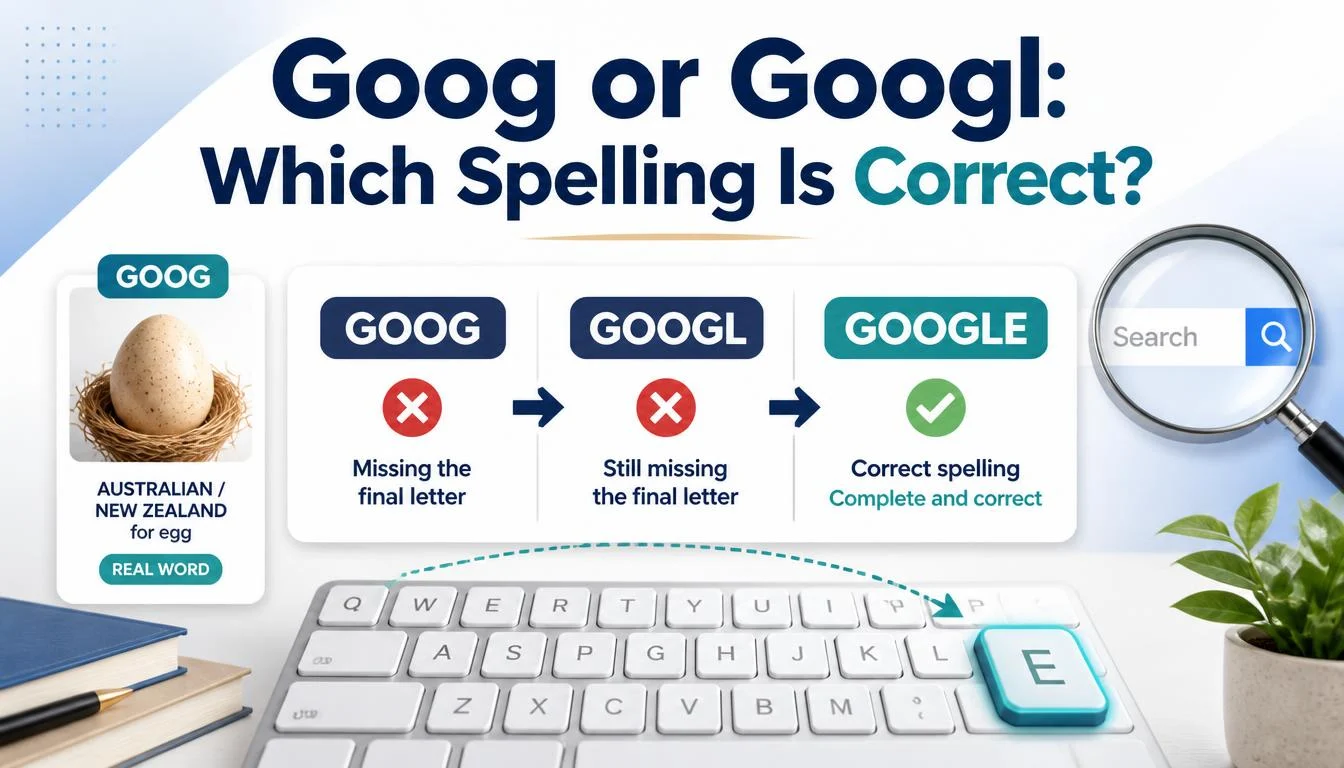
If you mean the search engine or company, Google is the correct spelling; “goog” is only an informal shorthand, while “googl” is generally a typo.The word goog also has separate dictionary meanings, especially in Australian English, where it means “egg.”
v bIf you have come across “goog” and “googl,” you may wonder whether they refer to the same thing or whether one spelling is more appropriate. The two forms look very similar, but their meaning and usage can depend on the context in which you see them. Understanding the difference can help you avoid confusion when writing, searching, or referring to a specific term.
In this guide, we will explain goog or googl, including what each form means, where it appears, and how to use it correctly. We will also look at common contexts and examples so you can quickly determine which spelling fits your intended meaning.
Which One Is Correct?
If you are referring to Google, the correct spelling is Google.
For example:
- I searched for the answer on Google.
- Google has several useful search tools.
- I found the address through Google.
Neither goog nor googl should replace the standard spelling Google in formal writing.
However, the situation becomes more interesting when goog has a meaning unrelated to Google. Oxford lists goog as an informal Australian and New Zealand English noun meaning “an egg.”
So the answer depends on what you mean:
| Form | Standard meaning or use |
|---|---|
| The company, search engine, or related proper name | |
| goog | An Australian/New Zealand informal word for “egg”; also informal shorthand in some contexts |
| googl | Usually a typo or incomplete spelling of “Google” |
If you are writing an email, article, school assignment, report, or business document, use Google when you mean the company or search engine.
Meaning of the Correct Word
Definition
Google is the standard spelling of the name of the well-known technology company and its search engine. The word also functions as a verb in English.
As a verb, to google means to search for information on the internet using a search engine. The noun and verb forms depend on context and capitalization.
For example:
I used Google to find the answer.
Here, Google refers to the search engine.
In:
I googled the address before leaving.
Googled functions as a verb.
Explanation
The spelling Google contains six letters:
G-O-O-G-L-E
The final e is part of the standard spelling. Removing it creates a different form.
That explains why googl is not the normal spelling of the company name. It contains the first five letters of Google, but it stops before the final e.
The form goog removes both l and e, so it is even farther from the official spelling.
Usage
Use Google when you refer to the company, its search engine, or a proper name containing Google.
Examples include:
- Google Search
- Google Maps
- Google Chrome
- Google Drive
- Google account
- Google search
When the word functions as a verb, lowercase google can appear in ordinary writing:
You can google the restaurant before you visit.
The exact capitalization can depend on whether you are using the trademarked company name or the genericized verb.
Real-World Examples
Here are several natural examples:
- I used Google to check the opening hours.
- You can google the address if you need directions.
- She found the article through a Google search.
- He opened Google Chrome and searched for the document.
- The teacher asked students to Google the historical term.
Notice that none of these sentences needs googl.
If someone writes:
I found it on googl.
The intended word is almost certainly Google.
Meaning of the Incorrect or Alternative Word
Incorrect
Googl is not the standard English spelling of the Google company or search engine.
If you intend to write the proper name, use Google.
For example:
Incorrect: I searched it on Googl.
Correct: I searched it on Google.
The missing e makes googl look incomplete.
Typo
The most common explanation for googl is a typing or spelling error.
A person may remember the beginning of Google but stop after googl. This can happen when someone types quickly, especially because the letters appear consecutively:
G-O-O-G-L-E
The form googl simply ends one letter too early.
Unlike a recognized spelling variant, googl does not represent a standard American English spelling of Google.
Slang
Goog can sometimes appear as informal shorthand for Google or a Google search.
Dictionary.com notes that goog can be used as shorthand for Google, especially in reference to its search engine.
You might therefore encounter an informal sentence such as:
Just do a quick goog and check the date.
This style is casual. It does not replace Google in formal writing.
There are also many user-created slang meanings for goog online. Such meanings can vary widely, so context matters. User-generated slang sources should not be treated as evidence of standard English usage.
Regional Variation
One important point separates goog from googl.
Goog is a genuine regional English word. Oxford describes it as Australian and New Zealand informal English meaning an egg.
For example:
He cooked a goog for breakfast.
This meaning has nothing to do with Google.
Collins likewise lists goog as an Australian informal noun meaning “an egg.”
Therefore, calling every use of goog a typo would be inaccurate.
Rare but Valid Usage
The uppercase form GOOG has another recognized use in finance.
GOOG is one of Alphabet’s stock ticker symbols. Dictionary.com specifically notes this financial use, along with the informal shorthand for Google.
That means you may see GOOG in financial articles, market reports, and stock discussions.
For example:
GOOG shares moved higher during the session.
This is not a spelling mistake. It is a ticker symbol.
Key Differences Between the Two Words
When people search for goog or googl, they usually want to know which spelling represents Google. In that context, neither is the standard spelling. Google is the correct form.
| Feature | Goog | Googl |
|---|---|---|
| Spelling | G-O-O-G | G-O-O-G-L |
| Meaning | Regional word, informal shorthand, or ticker-related form depending on context | Usually no standard English meaning |
| Pronunciation | Usually “GOOG” | Usually read as an incomplete form |
| Grammar | Can function as a noun in recognized uses | Not normally a standard English word |
| Usage | Informal, regional, financial, or context-dependent | Usually a typo |
| Recognition | Recognized in several specific contexts | Not a standard spelling of Google |
| Refers to Google? | Sometimes informally | Usually intended to mean Google but misspelled |
| Formal writing | Avoid when you mean Google | Avoid |
| Standard company spelling |
The Main Difference
The biggest difference is that goog has legitimate uses, while googl is generally an incomplete spelling.
Oxford records goog as an informal Australian and New Zealand word for an egg.
By contrast, googl is commonly encountered when someone has attempted to type Google but omitted the final e.
Why “Google” Matters
The distinction becomes simple when you identify the intended meaning.
If you mean the company:
If you mean the search engine:
If you mean an Australian informal word for an egg:
goog
If you mean the first five letters of Google:
googl may appear inside the name, but it is not the complete word.
Common Mistakes People Make
Mistake 1: Writing “Googl”
A common error is:
I searched it on Googl.
The correction is:
I searched it on Google.
Remember the final e.
Mistake 2: Treating “Goog” as the Standard Company Name
Some people shorten Google to Goog in casual conversation.
That does not make goog the official spelling.
Use Google in formal writing, professional communication, academic work, and published content.
Mistake 3: Confusing “Goog” With “Google”
The word goog has meanings that do not involve Google at all.
In Australian and New Zealand informal English, it can mean egg.
So context determines the meaning.
Mistake 4: Assuming Every Short Form Is a Spelling Variant
A shortened form is not automatically a spelling variant.
For example, a speaker might casually shorten a long word in conversation. That does not mean the shortened version belongs in formal writing.
Goog can work as informal shorthand in certain contexts, but Google remains the standard company name.
Mistake 5: Ignoring Capitalization
When referring to the company or brand, Google uses an uppercase G.
The verb google often appears in lowercase when writers use it as an ordinary verb:
I googled the restaurant.
This distinction helps readers understand whether the word refers specifically to the company or to the broader action of searching online.
Correct Usage Examples
Casual Examples
Here are examples where informal language can sound natural:
- I’ll just Google it.
- Give me a second; I’ll do a quick search.
- I found it with a Google search.
- You can google the recipe before dinner.
An informal goog may appear in very casual contexts:
I’ll do a quick goog and see what comes up.
This is understandable, but Google search or search is clearer for most readers.
Professional Examples
Professional writing should use the standard form:
- The report uses Google Search data as a reference.
- Please search Google for the official documentation.
- The company maintains several Google Workspace accounts.
- Employees can use Google Drive to access shared files.
Avoid replacing Google with goog or googl in formal documents.
Educational Examples
Teachers and students often encounter these forms when discussing internet research:
- Use Google to locate the original source.
- Google can help you find background information.
- Check multiple sources rather than relying on one search result.
- Record the source after finding the information online.
The correct company spelling remains Google.
Literary/Metaphorical Examples
Writers sometimes use technology-related words creatively.
For example:
Before asking anyone, he decided to Google the answer.
Here, Google works naturally as a verb.
A writer could also use goog as a deliberate informal expression:
One quick goog settled the argument.
That sentence has a conversational tone. It does not establish goog as the formal spelling of Google.
Word Origin / Etymology
The story behind Google is connected to the mathematical term googol, which refers to the number 1 followed by 100 zeros. The company name was created in connection with that idea of an enormous quantity of information.
The spelling goog has a separate history.
Oxford traces the Australian and New Zealand noun goog to googie, which came from the Scots dialect word goggie, a child’s word for an egg.
That means the regional noun goog did not originate as a shortened form of Google.
Collins dates the English word goog to around 1940–45 and describes its origin as uncertain.
This distinction is useful because the words look related on the page, but their histories are different.
Google → associated with googol
goog → regional word meaning egg
googl → generally an incomplete spelling of Google
The similar letters can therefore create a misleading connection.
Why the Incorrect Version Became Popular
The form googl is best understood as a natural typing error rather than a genuine alternative spelling.
The name Google has a simple sequence of letters:
goo + gle
When people type quickly, they may stop at googl and omit the final e. Search interfaces, autocomplete systems, usernames, domain names, and other digital contexts can also expose people to incomplete strings.
The form goog, meanwhile, can appear for different reasons.
Some writers use it informally as a shortened reference to Google. Dictionary.com recognizes this shorthand usage.
Financial readers may also see GOOG because it functions as a stock ticker associated with Alphabet.
There is also the older regional noun goog, meaning an egg. Oxford and Collins both document this usage.
These separate uses explain why goog can look more established than googl.
Easy Memory Tricks
Remember the Final “E”
If you mean the search engine or company, think:
Google = G + oo + gle
The final e completes the name.
Use “Googl” as a Warning Sign
When you see:
Googl
ask yourself:
“Did I forget the final e?”
In most cases, the answer is yes.
Remember “Goog” Has Other Meanings
Do not automatically assume that every occurrence of goog means Google.
In Australian and New Zealand informal English, goog means egg.
A Simple Three-Way Rule
Use this quick rule:
Google = company or search engine
goog = regional word, informal shorthand, or specific ticker context
googl = usually a typo for Google
This rule covers the most common situations without overcomplicating the spelling.
FAQs
Is “goog” the correct spelling of Google?
No. Google is the standard spelling of the company and search engine. Goog can appear as informal shorthand.
Is “googl” a word?
It is not the standard spelling of Google. In most contexts, googl is an incomplete or incorrect form of the name.
What does “goog” mean in Australian English?
In Australian and New Zealand informal English, goog means an egg.
How do you pronounce “goog”?
The regional word goog is commonly pronounced like “GOOG.” Oxford gives the pronunciation as “gooog” in its dictionary notation.
How do you spell the Google search engine?
The correct spelling is Google, with a capital G and a final e.
Can “goog” mean Google?
Yes. Goog can occur as informal shorthand for Google, but Google remains the standard form for formal writing.
What does GOOG mean in finance?
GOOG is a stock ticker associated with Alphabet and is commonly used in financial contexts.
Is “googl” an alternative spelling of Google?
No. Googl is generally not treated as a standard spelling variant. It usually results from leaving off the final e.
Conclusion
When you mean the search engine or company, Google is the correct spelling, not googl.Goog has separate informal and regional meanings, including “egg” in Australian and New Zealand English.Googl is usually an incomplete spelling caused by leaving out the final e.Remember the simple rule: Google is the name, goog has other uses, and googl needs an e.
Read More Articles
- Jewellery or Jewelry | Definition, Usage and Regional Differences In 2026
- Lisa or Lena | Meaning, Pronunciation, Origin and Differences In 2026

Andrew Cooper is a blogger and writer at Gramscript.com, turning everyday ideas into clear, engaging stories. His writing blends curiosity, insight and a genuinely human perspective.
2 thoughts on “Goog or Googl | Meaning, Spelling and Correct Usage In 2026”