Quick Answer
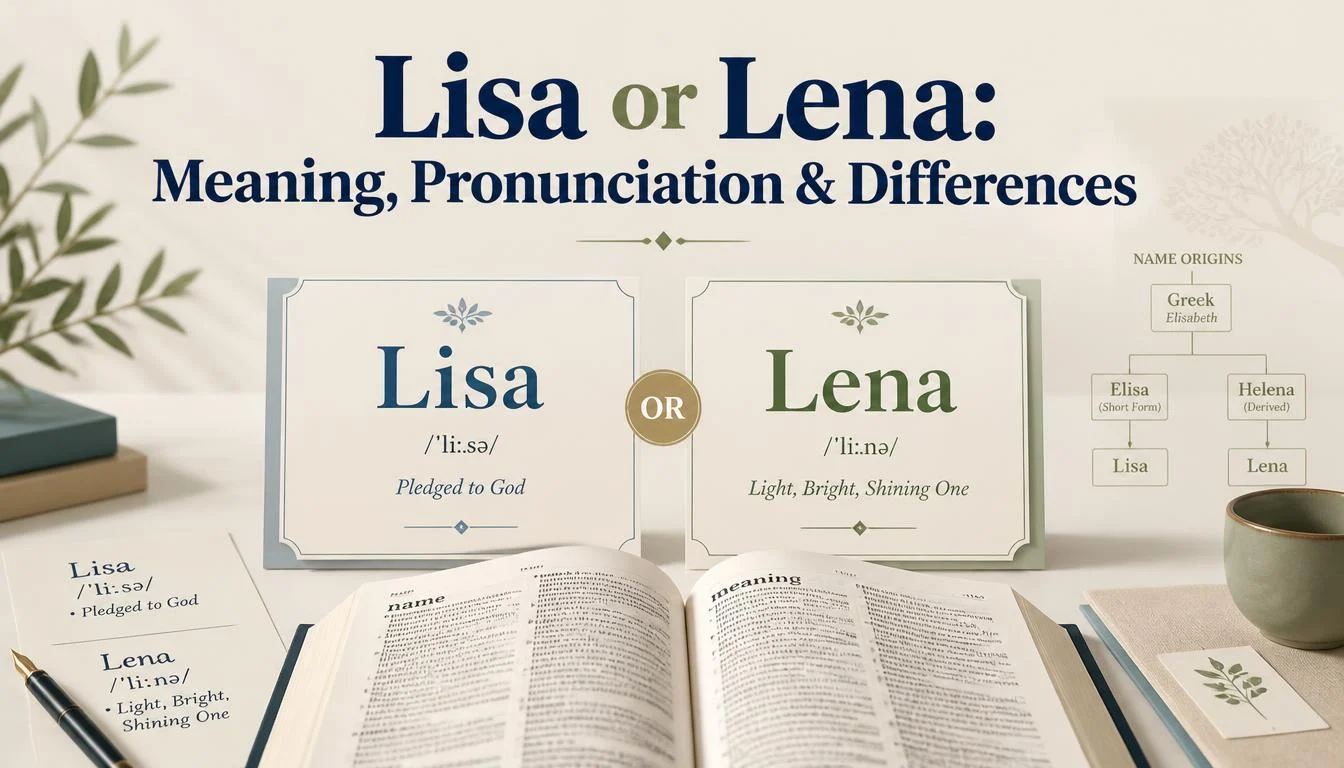
Lisa and Lena are both correct given names, but they have different origins, histories, and pronunciations. Lisa is commonly a short form of Elizabeth, while Lena can shorten names such as Helena, Magdalena, or Yelena.
Lisa or Lena may sound similar, but each name has its own history, meaning, pronunciation, and cultural background. Lisa is widely recognized as a familiar short form of Elisabeth or Elizabeth, while Lena can have several origins and may serve as a short form of names such as Helena, Magdalena, or other longer names depending on the language and tradition. Their shared simplicity gives them a similar modern feel, yet their histories can lead to very different naming stories.
Choosing between Lisa and Lena often comes down to more than sound. The meaning behind a name, its cultural roots, pronunciation, spelling, and overall style can all shape how it feels to parents and families. In this guide, we’ll compare Lisa or Lena closely, explore their origins and meanings, and highlight the key differences that can help you understand what makes each name distinctive.
Which One Is Correct?
Both Lisa and Lena are correct names.
The key point is that they are not two spellings of the same name. Lisa and Lena can have different etymological roots and can represent different full names.
Lisa is traditionally associated with Elizabeth and related forms. It became established as an independent given name in several languages.
- Lena has several naming connections. It is commonly described as a short form of names such as Helena, Magdalena, and Yelena. It is also widely used as an independent name.
- It changes the name. The same applies in reverse.
A Simple Rule
Use Lisa when the person’s name is Lisa.
Use Lena when the person’s name is Lena.
If you are unsure how someone’s name is spelled, check with the person rather than assuming one version is correct.
Meaning of the Correct Word
Since both names are valid, this section covers each name separately.
Definition
Lisa is a feminine given name that developed as a short form of Elizabeth and related names. It is used independently in English and several other languages.
Lena is a feminine given name used in numerous European languages. It often functions as a short form of names ending in -lena, including Helena, Magdalena, and Yelena.
The two names therefore have different naming histories, even though they share a short, two-syllable structure in common English pronunciation.
Explanation
The meaning associated with Lisa ultimately connects to Elizabeth. Elizabeth comes from the Hebrew Elisheva, commonly explained through the ideas of God and an oath or promise.
Because Lisa developed as a shortened form, its traditional meaning is often discussed through its connection with Elizabeth rather than as a completely separate ancient word.
Lena works differently. It can connect to several longer names. For example, Helena has ancient Greek roots, while Magdalena connects to Magdalene. Yelena is a form used in Slavic naming traditions.
This means that Lena does not have one single origin story for every person who carries the name.
Usage
Lisa has been used across English, German, Dutch, Scandinavian, and Italian naming traditions. It also became particularly prominent in the United States during the mid-20th century. Behind the Name records Lisa as a highly popular American name during the 1960s.
Lena has an especially broad international presence. It appears in Swedish, Norwegian, Danish, German, Dutch, Polish, Finnish, Russian, Ukrainian, Macedonian, English, Italian, Portuguese, Greek, Georgian, and Armenian usage, among others.
Real-World Examples
Here are natural examples showing how the names function:
- Lisa called her sister after work.
- Lena is meeting us for dinner tonight.
- Lisa and Lena are both common personal names.
- Please write Lena’s name exactly as she spells it.
- The invitation was addressed to Lisa.
Notice that neither name acts like a common noun. A person’s chosen or official spelling determines which form you should use.
Meaning of the Incorrect or Alternative Word
In this comparison, it is more accurate to call the second name an alternative name rather than an incorrect word.
Incorrect
Neither Lisa nor Lena is inherently incorrect.
If you are referring to a person named Lisa, however, writing Lena would be incorrect for that person. It would be a different name, not an alternate spelling.
For example:
Correct: Lisa joined the meeting.
If the person’s name is Lisa, this would not be an acceptable correction:
Incorrect for that person: Lena joined the meeting.
The issue comes from identity and spelling, not English grammar.
Typo
A typo can certainly turn Lisa into Lena.
This may happen when someone types quickly, remembers a name incorrectly, or relies on a sound rather than the written form. Autocorrect can also create unexpected names, although the two spellings are usually distinct enough that the mistake depends on context.
A typo does not make Lena an incorrect name. It simply means the writer used the wrong name for that particular person.
Slang
Neither Lisa nor Lena is normally classified as slang.
Both function as established given names. Their use does not depend on informal speech, internet language, or a particular social group.
Regional Variation
There is an international dimension to Lena that can make pronunciation especially confusing.
The name appears in many languages, and its pronunciation changes across regions. For example, English commonly uses a pronunciation similar to LEE-nuh, while Russian pronunciation differs. German and Scandinavian forms also have their own pronunciation patterns.
Lisa also varies across languages. English commonly uses LEE-suh, while German and Italian can use a pronunciation closer to LEE-zuh.
So pronunciation alone does not always tell you which spelling someone uses.
Rare but Valid Usage
Both names can appear independently rather than serving as nicknames.
Lisa is not required to be short for Elizabeth. Lena is not required to be short for Helena or Magdalena. Both can function as complete given names.
That distinction matters when discussing someone’s name. You should not automatically expand Lisa to Elizabeth or Lena to Helena unless the person has said that this is their full name.
Key Differences Between the Two Names
| Feature | Lisa | Lena |
|---|---|---|
| Spelling | L-I-S-A | L-E-N-A |
| Basic status | Established given name | Established given name |
| Common English pronunciation | LEE-suh | LEE-nuh |
| Main naming connection | Elizabeth | Helena, Magdalena, Yelena, and related forms |
| Traditional meaning connection | Connected to Elizabeth and the idea of an oath or devotion to God | Depends on the longer name or naming tradition |
| Grammar | Proper noun | Proper noun |
| Capitalization | Always capitalized as a name | Always capitalized as a name |
| Usage | Common across several Western European languages | Broad international and European usage |
| Alternative spelling of the other? | No | No |
| Can stand alone? | Yes | Yes |
Pronunciation Difference
In standard American English, Lisa is commonly pronounced LEE-suh.
Lena is commonly pronounced LEE-nuh in English. However, Lena has different pronunciations in other languages.
The middle consonant creates the clearest difference:
- Lisa → LEE-suh
- Lena → LEE-nuh
That one consonant changes the name completely.
Grammar Difference
There is no meaningful grammatical difference because both names function as proper nouns.
You write:
- Lisa is here.
- Lena is here.
- I spoke with Lisa.
- I spoke with Lena.
Both names can take possessive forms:
- Lisa’s book
- Lena’s book
They can also appear with titles:
- Dr. Lisa Morgan
- Ms. Lena Carter
The grammar stays the same. The spelling identifies the person.
Common Mistakes People Make
One of the most common mistakes involves assuming that similar-sounding names must be variants of the same name.
They are not.
Mistake 1: Treating Lena as a spelling of Lisa
Lisa and Lena differ by one consonant, but that does not make them spelling variants.
If someone’s name is Lena, do not “correct” it to Lisa.
Mistake 2: Assuming Lena Always Means Helena
Lena can be connected to Helena, but that is only one possible naming relationship.
It can also relate to Magdalena, Yelena, and other names ending in or connected with -lena. It can also stand independently.
Mistake 3: Assuming Lisa Always Means Elizabeth
Lisa is traditionally a short form of Elizabeth, but modern naming practices allow Lisa to function independently.
Therefore, calling every Lisa “Elizabeth” can incorrectly change the person’s actual name.
Mistake 4: Relying Only on Pronunciation
A listener might hear LEE-suh or LEE-nuh and still misunderstand the spelling.
Names can have language-specific pronunciations. Lena especially demonstrates this because its pronunciation varies across languages.
Mistake 5: Changing Someone’s Name Without Checking
Personal names deserve the same spelling accuracy as other identifying information.
If you are writing an email, invitation, certificate, article, or official document, verify the person’s preferred spelling first.
Correct Usage Examples
Casual Examples
Here are some everyday examples:
- Lisa is coming over after lunch.
- I texted Lena this morning.
- Have you seen Lisa today?
- Lena said she would call later.
- Lisa and Lena went shopping together.
These sentences use both names as ordinary proper nouns.
Professional Examples
Professional writing requires extra care with names.
- Dear Lisa, thank you for your message.
- Lena will lead the presentation tomorrow.
- I forwarded the report to Lisa.
- Please send the revised document to Lena.
- Lisa confirmed the appointment by email.
Changing a person’s name can appear careless in professional communication, even when the names look or sound similar.
Educational Examples
Teachers and students may encounter both names in reading exercises.
- Lisa completed the assignment early.
- Lena wrote a paragraph about her favorite book.
- The teacher asked Lisa to read the next sentence.
- Lena explained her answer to the class.
In grammar exercises, both names work as subjects or objects.
Literary/Metaphorical Examples
Authors can also use these names naturally in fiction:
- Lisa watched the rain from the kitchen window.
- Lena carried the old photograph in her coat pocket.
- Lisa remembered the promise she had made years earlier.
- Lena stood quietly beneath the evening sky.
The names themselves do not determine a character’s personality. Their associations come from the story and the writer’s characterization.
Word Origin / Etymology
The history of Lisa connects strongly to Elizabeth.
Elizabeth comes from the Hebrew name Elisheva. The name entered Greek as Elisabet and later developed into numerous forms across European languages. The traditional meaning is commonly connected with an oath or promise involving God.
Lisa developed as a short form of Elizabeth and related names. Over time, it became established as an independent given name. Behind the Name lists Lisa across English, German, Dutch, Swedish, Norwegian, Danish, and Italian usage.
The history of Lena is more varied.
Lena is described as a short form of names ending in -lena, including Helena, Magdalena, and Yelena. It has also become an independent given name.
Helena itself comes from the Greek Helene. Its traditional explanations include a connection with a torch, while another proposed connection relates the name to the Greek word for moon. The exact ancient etymology remains debated.
Magdalena has a separate biblical and geographical naming history connected with Magdalene. Yelena represents another linguistic path within Slavic naming traditions.
This variety explains why Lena cannot always be assigned one single ancient meaning.
Why the Incorrect Version Became Popular
Because neither name is actually incorrect, there is no single “incorrect version” that became popular.
Instead, confusion likely comes from their similar structure and sound.
Both names:
- Begin with L
- Have two syllables in common English pronunciation
- Are short feminine given names
- Appear across multiple languages
- Can function independently
- Have several international forms and related names
Lena also has a particularly broad international history. It appears in numerous European languages, while Lisa likewise has extensive European usage.
Another source of confusion comes from longer names. A person named Helena, Magdalena, or Yelena may use Lena as a short form. A person named Elizabeth may use Lisa. When names are shortened in different ways, listeners can sometimes remember the short form incorrectly.
The important distinction is simple: similar naming patterns do not make Lisa and Lena interchangeable.
Easy Memory Tricks
A simple visual trick can help you remember the difference.
Think “S” for Lisa
LiSA contains an S.
Remember:
Lisa → S
If you hear the name with an s sound in the middle, think Lisa.
Think “N” for Lena
LeNA contains an N.
Remember:
Lena → N
The middle consonant provides the easiest spelling clue.
Connect Lisa With Elizabeth
Think:
Lisa → Elizabeth
Lisa commonly developed as a short form of Elizabeth.
Connect Lena With Helena
Think:
Lena → Helena
Helena is one of the important longer names connected with Lena.
This trick does not mean every Lisa must be Elizabeth or every Lena must be Helena. It simply gives you a quick way to remember their different naming histories.
FAQs
Is Lisa a correct name?
Yes. Lisa is an established feminine given name and can be used independently or as a short form of Elizabeth.
Is Lena a correct name?
Yes. Lena is an established feminine given name used independently and as a short form of several longer names.
Is Lena another spelling of Lisa?
No. Lisa and Lena are separate names with different spelling, pronunciation, and naming histories.
Is Lisa short for Elizabeth?
Lisa is traditionally a short form of Elizabeth and related forms, although it can also be used as an independent name.
Is Lena short for Helena?
It can be. Lena is commonly connected with Helena, as well as Magdalena, Yelena, and other names ending in -lena.
How do you pronounce Lisa?
In American English, Lisa is commonly pronounced LEE-suh. Pronunciation can vary in other languages.
How do you pronounce Lena?
In American English, Lena is commonly pronounced LEE-nuh, although its pronunciation differs across languages.
Can Lisa and Lena be used as nicknames?
Yes. Both can function as shortened forms of longer names, but each can also be used as a complete given name.
Conclusion
Lisa and Lena are both valid names, but they are not interchangeable spellings of one name.Lisa connects closely with Elizabeth, while Lena can connect with Helena, Magdalena, Yelena, and related forms.Their pronunciation, spelling, and naming histories make each one distinct.When choosing between Lisa or Lena, use the spelling that belongs to the person you mean.
Read More Articles
- Tase or Taze |Meaning, Spelling and Usage Explained In 2026
- Cue or Que | Meaning, Differences and How to Use Each Word In 2026

Jessica Morgan is a blogger and writer at GramScript.com, where she turns everyday ideas into engaging, relatable stories. Her writing blends a natural voice with fresh perspectives that keep readers coming back.
2 thoughts on “Lisa or Lena | Meaning, Pronunciation, Origin and Differences In 2026”