Quick Answer
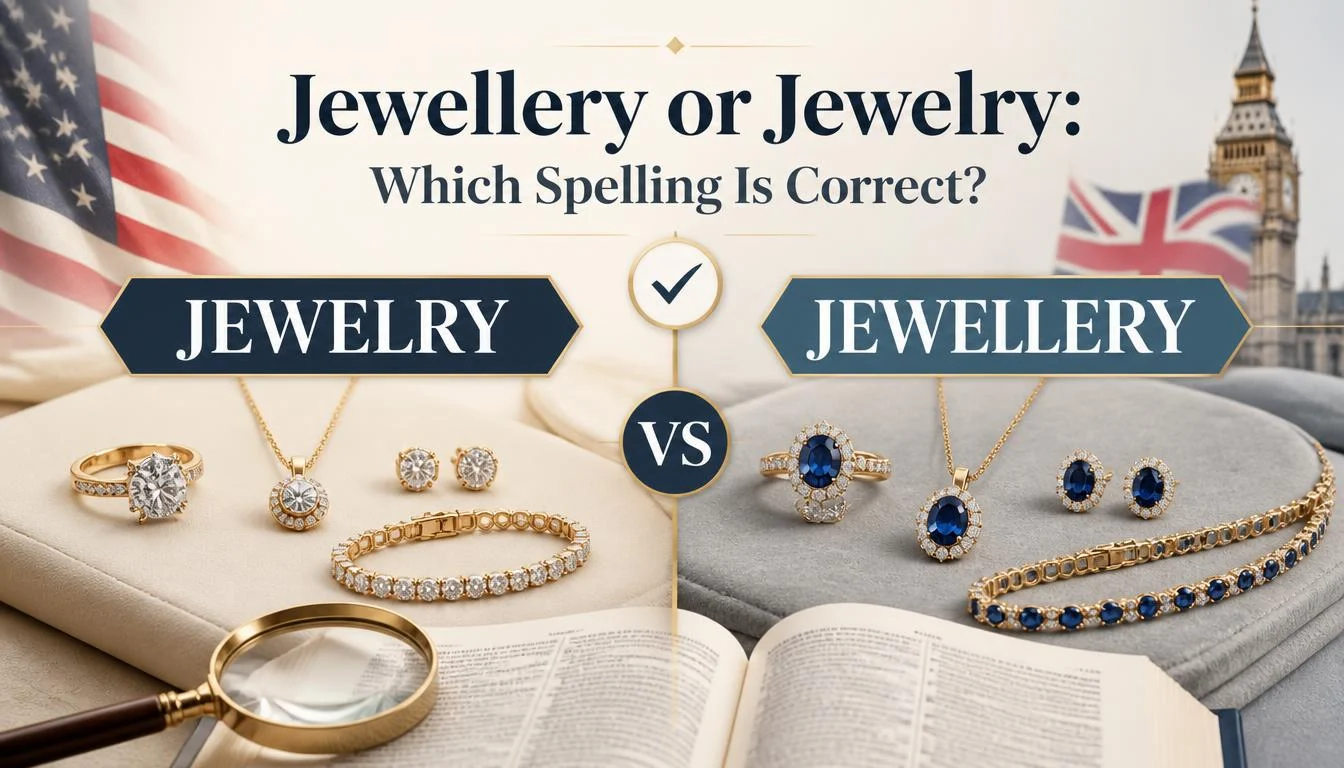
Jewelry is the standard American English spelling, while jewellery is the standard British English spelling.Both mean decorative items such as rings, necklaces, bracelets, and earrings; the difference is mainly regional spelling.
Jewellery or jewelry refers to decorative items such as rings, necklaces, bracelets, earrings, and other personal ornaments. The two spellings have the same meaning and pronunciation, but they follow different regional conventions. Jewellery is the standard spelling in British English, while jewelry is the preferred spelling in American English.
The difference can be confusing because neither spelling changes the word’s meaning. If you are writing for a US audience, jewelry is the natural choice. For British English and other varieties that follow British spelling conventions, jewellery is generally preferred. Understanding this small spelling difference can help you choose the right form for your audience and keep your writing consistent.
Which One Is Correct?
Both jewelry and jewellery are correct English spellings. The appropriate choice depends on the variety of English you are writing.
In American English, use jewelry:
She bought a beautiful piece of jewelry for her mother.
In British English, use jewellery:
She bought a beautiful piece of jewellery for her mother.
The difference is similar to other American and British spelling pairs, such as color/colour, favorite/favourite, and center/centre. The extra -l- in jewellery does not create a different meaning.
If you are writing for an American audience, jewelry is the natural spelling. If your audience follows British English, jewellery is appropriate.
Meaning of the Correct Word
Definition
Jewelry is a collective noun for decorative items worn on the body. Common examples include rings, necklaces, bracelets, earrings, brooches, pendants, and sometimes watches or other ornamental accessories.
The word can describe items made from precious metals, gemstones, pearls, or less expensive materials. Jewelry may serve decorative, cultural, sentimental, religious, ceremonial, or symbolic purposes.
Explanation
In American English, jewelry usually refers to the category as a whole rather than to one specific object.
For example:
- She collects antique jewelry.
- His jewelry includes several gold rings.
- The store sells handmade jewelry.
- She inherited some family jewelry.
When you mean one individual item, a piece of jewelry is a common expression.
He gave her a delicate piece of jewelry for her birthday.
You can also name the specific item:
She wore a silver necklace.
This distinction helps because jewelry usually works as an uncountable noun in American English.
Usage
American writers normally use jewelry when discussing the general category.
Common combinations include:
- jewelry store
- jewelry designer
- jewelry box
- jewelry collection
- jewelry maker
- fine jewelry
- costume jewelry
- handmade jewelry
- gold jewelry
- silver jewelry
- antique jewelry
- personalized jewelry
You can also use the word in compound nouns and descriptive phrases.
The jewelry designer created a collection inspired by nature.
The plural form is generally not needed when you mean jewelry as a category. Instead of saying jewelries, use pieces of jewelry when you need to count individual items.
Real-World Examples
Here are several natural examples in American English:
She wears simple jewelry every day.
The museum displayed a collection of ancient jewelry.
I need a safe place to keep my jewelry.
The jeweler repaired my grandmother’s necklace.
This necklace is my favorite piece of jewelry.
They specialize in custom jewelry made from recycled metals.
Notice that jewelry remains the same regardless of how many individual items you have.
Meaning of the Incorrect or Alternative Word
Incorrect
Jewellery is not incorrect English. It is the standard British spelling and appears in other varieties influenced by British English.
Calling it simply “wrong” would create a misleading distinction. The real difference is regional.
For American writing, however, jewellery is usually considered a British spelling rather than the standard American form.
Typo
For an American writer, jewellery can look like a spelling mistake if the writer normally follows American conventions. However, the spelling itself is not a typo.
The same situation occurs with colour. An American reader may expect color, but colour is still a valid English spelling in British usage.
Slang
Neither jewelry nor jewellery is slang. Both are standard nouns used in formal, informal, academic, commercial, and everyday writing.
The difference comes from spelling conventions, not from levels of formality.
Regional Variation
The clearest distinction is geographical.
| English variety | Common spelling |
|---|---|
| American English | jewelry |
| British English | jewellery |
| Canadian English | jewellery is common |
| Australian English | jewellery is common |
| New Zealand English | jewellery is common |
Actual usage can vary by publication, institution, brand, or individual writer. However, jewelry is the expected form in standard American English.
Rare but Valid Usage
Neither spelling has a separate rare meaning. They both refer to ornamental objects or accessories worn for decoration or symbolic purposes.
The spelling changes with regional convention, but the definition remains essentially the same.
Key Differences Between the Two Words
The most useful way to understand jewellery or jewelry is to compare their spelling and regional use directly.
| Feature | Jewelry | Jewellery |
|---|---|---|
| Spelling | Jewelry | Jewellery |
| Meaning | Decorative objects worn on the body | Same meaning |
| Pronunciation | Usually “JOO-uhl-ree” | Usually “JOO-uhl-ree” |
| Grammar | Usually an uncountable noun | Usually an uncountable noun |
| Main usage | American English | British English and related varieties |
| Recognition | Standard in the United States | Standard in Britain and several other regions |
| Meaning difference | None | None |
| Formality | Standard | Standard |
| Singular item | A piece of jewelry | A piece of jewellery |
The most visible difference is the spelling. Jewellery contains an additional -l-, while American English simplifies the ending to -elry.
Does the Pronunciation Change?
Usually, no.
Both forms are commonly pronounced approximately as JOO-uhl-ree. Regional accents can produce small differences, but the spelling does not create two separate words with different meanings.
This makes the pair different from words where spelling and pronunciation change significantly.
Does the Grammar Change?
No significant grammatical difference exists.
Both forms generally function as uncountable nouns:
She bought new jewelry.
She bought new jewellery.
When counting individual items, use expressions such as:
- a piece of jewelry
- two pieces of jewelry
- several pieces of jewelry
The same pattern works with jewellery.
Common Mistakes People Make
Treating Jewellery as Wrong
One common mistake is assuming that jewellery is misspelled. It is not. It is the established British spelling.
The better rule is simple: match the spelling to your intended variety of English.
Using Jewellery in American English Without a Reason
American readers will usually understand jewellery, but jewelry is the standard American spelling.
If your article, school assignment, website, or business communication follows American English, keep the American form consistent.
Using Jewelry in British English
The reverse can also happen. Jewelry is widely understood in Britain, but jewellery is the traditional standard spelling in British English.
Consistency matters more than treating one form as universally correct.
Writing Jewelries
Another frequent mistake involves the plural form.
Incorrect: The store sells many different jewelries.
A more natural version is:
The store sells many different pieces of jewelry.
Because jewelry normally functions as an uncountable noun, use pieces of jewelry when you need to count items.
Confusing Jewelry With Jewels
Jewelry refers to the category of decorative items. Jewels usually refers to individual valuable stones or, depending on context, treasured ornaments.
For example:
She keeps her jewelry in a wooden box.
But:
The crown contains several precious jewels.
The words are related, but they are not interchangeable in every sentence.
Correct Usage Examples
Casual Examples
These sentences show how people commonly use jewelry in everyday American English:
I left my jewelry at home.
She loves wearing simple jewelry.
Your new jewelry looks beautiful.
I need a bigger jewelry box.
He bought some jewelry while traveling.
Her favorite piece of jewelry is a silver bracelet.
These examples use natural everyday vocabulary and common noun patterns.
Professional Examples
The word also appears frequently in business and professional contexts:
The company designs handmade jewelry for customers across the United States.
Our jewelry collection features recycled gold and ethically sourced stones.
The designer specializes in custom jewelry for weddings and special events.
The jewelry store offers repair and cleaning services.
The brand recently introduced a collection of minimalist jewelry.
Here, jewelry works naturally in descriptions of businesses, products, services, and industries.
Educational Examples
You may also encounter the word in history, art, anthropology, and cultural studies:
Ancient Egyptian jewelry often carried cultural and symbolic meanings.
Archaeologists discovered jewelry among the burial objects.
Researchers studied the materials used to create prehistoric jewelry.
The exhibition explains how jewelry reflected social status in different periods.
The word therefore extends beyond fashion. Jewelry can provide information about technology, trade, culture, identity, and social customs.
Literary/Metaphorical Examples
Writers sometimes use jewelry-related language metaphorically:
The stars looked like tiny pieces of jewelry scattered across the night sky.
The necklace became a treasured symbol of family memory.
Her words were like small jewels of wisdom.
These uses rely on the visual or emotional qualities associated with precious objects.
Word Origin / Etymology
The history of jewelry reaches back through French and ultimately to Latin. The English word developed from forms related to jewel, which came into English through Old French.
The noun jewel traces to Old French jouel or related forms. Those forms are connected to the Latin jocale, meaning a plaything or object of enjoyment, from jocus, meaning “play” or “jest.”
Over time, English developed words for collections or articles made from jewels. The spelling and pronunciation changed through centuries of English and French influence.
The modern American jewelry and British jewellery forms reflect different spelling conventions that developed over time. The two spellings eventually became associated with different English varieties.
This history also explains why the word does not follow a simple spelling pattern based only on the modern word jewel. English inherited and reshaped the term rather than building it from scratch in modern times.
The related word jeweler follows the same American spelling preference. British English commonly uses jeweller, with the doubled l.
Why the Incorrect Version Became Popular
The phrase “incorrect version” needs some clarification here. Jewellery did not become popular because people started making a mistake. It became established through British spelling conventions.
British English often preserves doubled consonants in certain word endings. American English later developed spelling preferences that simplified some of these forms.
This difference appears in other word pairs:
- traveler / traveller
- canceled / cancelled
- jewelry / jewellery
- labeled / labelled
American spelling does not always remove a letter, and British spelling does not always add one. These are historical conventions rather than universal grammar rules.
The growth of American publishing, education, dictionaries, newspapers, and business communication helped establish jewelry as the normal American form.
Meanwhile, British institutions and publications continued using jewellery. Other English-speaking regions often retained British spelling conventions as well.
That is why both forms remain established today.
Easy Memory Tricks
Remember the American Form
Think of jewelry as the shorter American spelling.
Jewelry = American English
If your writing follows American English, choose the shorter form.
Remember the British Form
Think of jewellery as the spelling with the extra l.
Jewellery = British English
The extra letter can remind you of other British spellings that retain additional letters.
Use the Audience Rule
Ask yourself one question:
Who will read this?
If you are writing for an American audience, use jewelry.
If you are writing for a British audience, use jewellery.
This rule works better than trying to decide which spelling is “more correct.”
Remember the Counting Rule
When you need to count individual items, avoid jewelries.
Use:
one piece of jewelry
three pieces of jewelry
This rule applies equally to jewellery.
Keep Related Words Consistent
American English:
jewelry
jeweler
jewelry store
British English:
jewellery
jeweller
jewellery shop
Keeping related terms consistent makes your writing look polished and intentional.
FAQs
Is jewelry or jewellery correct?
Both are correct. Jewelry is the standard American spelling, while jewellery is the standard British spelling.
Do jewelry and jewellery mean the same thing?
Yes. Both words refer to decorative items such as rings, necklaces, bracelets, and earrings.
Is jewellery an American spelling?
No. Jewellery is primarily associated with British English and other varieties that follow British spelling conventions.
Is jewelry the American spelling?
Yes. Jewelry is the standard spelling in American English.
How do you pronounce jewelry?
It is commonly pronounced approximately JOO-uhl-ree. Regional accents may produce small variations.
Can I say jewelries?
Usually no. Use jewelry as an uncountable noun, or say pieces of jewelry when counting individual items.
Is jewellery more formal than jewelry?
No. The difference is regional, not formal. Both forms are standard in their respective English varieties.
Which spelling should I use in the United States?
Use jewelry for standard American English writing, including most U.S. academic, business, and general-purpose content.
Conclusion
When choosing between jewellery or jewelry, use jewelry for standard American English and jewellery for standard British English.Both spellings have the same meaning, pronunciation, and basic grammatical function.Remember that the difference reflects regional spelling conventions, not a difference in quality or correctness.For American readers, the simple choice is clear: jewelry is the standard spelling to remember.
Read More Articles
- Alter or Altar |Definitions, Examples and Easy Ways to Remember In 2026
- Coffee or Die | Meaning, Origin and What the Phrase Really Means In 2026

Andrew Cooper is a blogger and writer at Gramscript.com, turning everyday ideas into clear, engaging stories. His writing blends curiosity, insight and a genuinely human perspective.
2 thoughts on “Jewellery or Jewelry | Definition, Usage and Regional Differences In 2026”