Quick Answer
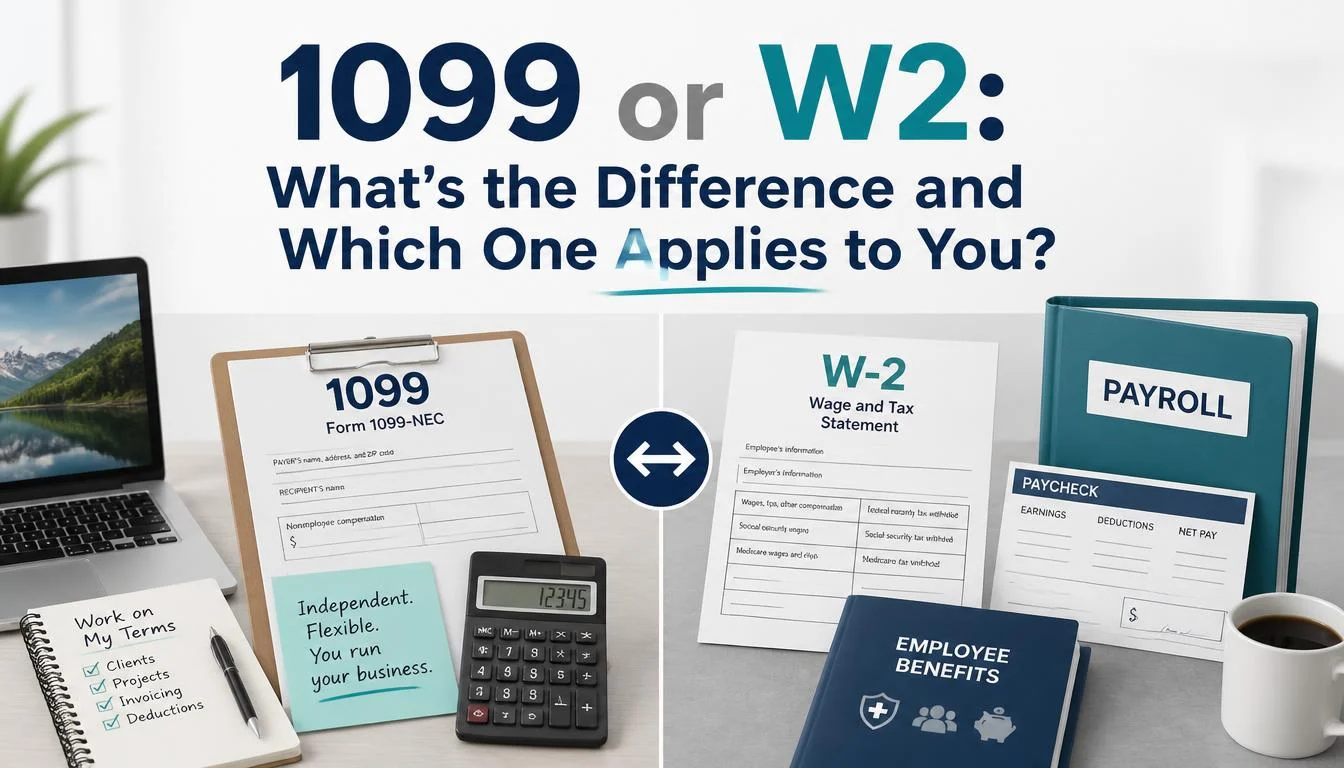
1099 and W-2 are both U.S. tax forms, but they apply to different worker relationships. A W-2 generally reports employee wages, while Form 1099-NEC generally reports payments to independent contractors.
Choosing between a 1099 and W-2 work arrangement can affect how you receive income, handle taxes, and access workplace benefits. A W-2 generally applies to employees whose employers withhold certain taxes from their paychecks, while a 1099 often relates to independent contractors who handle more of their own tax responsibilities. Understanding these differences can help you read your tax documents correctly and know what to expect from a job or contract.
The terms 1099 or W-2 describe different worker and tax-reporting situations, not simply two versions of the same form. Your classification can influence tax withholding, Social Security and Medicare taxes, benefits, business expenses, and how you report income. This guide explains the main differences between 1099 and W-2 work in clear language so you can understand how each arrangement works and what factors to consider.
Which One Is Correct?
Neither 1099 nor W-2 is inherently “correct” in every situation. They are different tax forms used for different types of income and work arrangements.
A W-2 generally applies when you are an employee. Your employer typically withholds federal income tax and your share of Social Security and Medicare taxes from your wages. The employer reports those wages and withholdings on Form W-2.
A 1099, particularly Form 1099-NEC, generally applies when a business pays a person who is not its employee for services. Independent contractors generally handle their own income tax and self-employment tax obligations.
The key point is simple: you do not normally choose W-2 or 1099 based only on preference. Worker classification depends on the actual relationship between the worker and the business.
The IRS considers factors such as behavioral control, financial control, and the relationship between the parties. How the company labels the worker does not, by itself, determine the classification.
Meaning of the Correct Word
Definition
A W-2 is the common name for Form W-2, Wage and Tax Statement. Employers use it to report wages, tips, and other compensation paid to employees.
A 1099 is a family of information returns. Different 1099 forms report different kinds of payments. For work performed by an independent contractor, Form 1099-NEC is generally the relevant form.
So, technically, saying “I am a 1099 worker” is informal. The more precise term is independent contractor, who may receive Form 1099-NEC.
Explanation
The difference starts with the working relationship.
An employee works within an employer-employee relationship. The employer generally has the right to control what the employee does and how the employee performs the work.
An independent contractor operates more independently. Generally, the business controls the result it wants but does not have the same right to control the details of how the contractor performs the work.
For example, imagine a restaurant hires a full-time manager. The restaurant sets the manager’s schedule, responsibilities, and workplace procedures. That relationship generally points toward employee status.
Now imagine a company hires a freelance graphic designer to create a logo. The company may specify the desired result, but the designer may control the methods and process used to create it. That arrangement may point toward independent contractor status.
Usage
You will often see these terms in job listings, employment discussions, tax questions, and business contracts.
Common phrases include:
- W-2 employee
- W-2 position
- 1099 contractor
- 1099 worker
- independent contractor
- 1099-NEC
- employee vs. independent contractor
- 1099 vs. W-2
- W-2 employment
- contract work
The phrase “1099 employee” appears in everyday conversation, but it can create confusion. A person who receives Form 1099-NEC for services is generally treated as a nonemployee rather than a W-2 employee for that work.
Real-World Examples
Example 1: W-2 employee
Maria works for a company from 9 a.m. to 5 p.m. Her employer provides her equipment, directs her daily work, and deducts taxes from her paycheck. She generally receives a W-2.
Example 2: 1099 contractor
David runs a freelance web-design business. A company hires him to build a website. He controls how he completes the project and operates his own business. The company may report his qualifying service payments on Form 1099-NEC.
Example 3: Different roles with one organization
A person can potentially have an employee relationship with an organization for one service and an independent contractor relationship for a separate service. The IRS provides examples of workers who have distinct employee and contractor roles.
Meaning of the Incorrect or Alternative Word
Incorrect
Neither 1099 nor W-2 is incorrect. The mistake occurs when someone uses the wrong form to describe a particular work relationship.
For example, calling every freelancer a W-2 employee would be inaccurate. Likewise, calling every worker who receives a paycheck a 1099 contractor would also be inaccurate.
The actual facts of the working relationship matter.
Typo
“W2” is a common informal way to type “W-2.” The official form name includes the hyphen.
Similarly, people often write “1099” when they really mean “1099-NEC.” That shorthand can be acceptable in casual conversation, but the exact form matters for tax reporting.
Slang
Terms such as “1099 worker” and “W-2 worker” are common informal expressions. They are useful in everyday discussions about employment.
However, formal tax documents use the specific form names and worker classifications. For precise writing, independent contractor and employee are often clearer than “1099 worker” and “W-2 worker.”
Regional Variation
This is not a U.S. regional spelling difference such as color and colour. W-2 and 1099 are U.S. federal tax forms.
Someone outside the United States may not use these forms at all. The terminology therefore depends on the U.S. tax system rather than American regional vocabulary.
Rare but Valid Usage
A worker can sometimes receive both a W-2 and a 1099 form from the same organization during the same year.
That situation does not automatically mean one form is wrong. The IRS explains that separate services, separate periods, or certain additional payments can create situations involving both forms. The underlying facts determine how the payments should be treated.
Key Differences Between the Two Words
The following comparison uses 1099 to mean the contractor-related reporting concept, particularly Form 1099-NEC.
| Feature | 1099 | W-2 |
|---|---|---|
| Full form | Usually Form 1099-NEC for contractor services | Form W-2, Wage and Tax Statement |
| Worker relationship | Generally independent contractor | Generally employee |
| Pronunciation | “ten ninety-nine” | “double-you two” |
| Income reported | Nonemployee compensation and other types of income, depending on the 1099 form | Employee wages, tips, and other compensation |
| Tax withholding | Generally no regular payroll withholding for an independent contractor | Employers generally withhold applicable payroll and income taxes |
| Self-employment tax | Generally applies to independent contractor earnings | Employee generally pays their share of Social Security and Medicare through payroll withholding |
| Employer control | Generally controls the desired result rather than the detailed method | Employer generally has greater control over how work is performed |
| Business expenses | Contractor may have business expenses connected with self-employment | Employee expenses follow different tax rules |
| Common term | 1099 contractor | W-2 employee |
| Recognition | Common U.S. tax and employment term | Common U.S. tax and employment term |
The IRS emphasizes that classification depends on the facts and circumstances, including behavioral control, financial control, and the relationship between the parties.
Taxes and Withholding
One of the biggest practical differences involves withholding.
An employee generally has taxes withheld from paychecks. The W-2 later reports wages and amounts withheld during the year.
An independent contractor generally does not have ordinary employee payroll withholding. Instead, the contractor may need to make estimated tax payments and pay self-employment tax.
That difference can affect how much money appears in each paycheck.
A contractor should not assume that receiving a larger payment means earning more after taxes. The contractor may have additional tax obligations and business expenses to consider.
Worker Classification
The label on a contract does not settle the classification question.
The IRS looks at the relationship itself. Relevant factors include who controls the work, who controls financial aspects of the relationship, and how the parties interact.
This means a company cannot necessarily turn an employee into a contractor simply by calling the person a “1099 worker.”
Common Mistakes People Make
Mistake 1: Treating 1099 as a Job Title
A 1099 is a tax form, not a job title.
Someone might say, “I got a 1099 job,” but the underlying position could be a freelance designer, consultant, driver, programmer, photographer, or another type of independent business activity.
Mistake 2: Calling a Contractor an Employee
The terms employee and independent contractor have different meanings.
An independent contractor generally operates a separate business and has more control over how the work gets completed. An employee generally works within the employer’s direction and control.
Mistake 3: Assuming the Worker Chooses the Form
Workers sometimes believe they can simply ask a company for a 1099 instead of a W-2.
That is not how classification normally works. The business relationship and applicable rules determine how payments should be reported.
Mistake 4: Thinking Every 1099 Is a Contractor Form
There are many types of 1099 forms.
For example, Form 1099-NEC covers nonemployee compensation, while other 1099 forms can report items such as interest, dividends, or certain other payments.
Therefore, “1099” alone does not identify one specific kind of income.
Mistake 5: Confusing Gross Pay With Take-Home Pay
A contractor may receive the full agreed payment without ordinary employee payroll withholding. That does not mean the entire amount is available for personal spending.
Independent contractors generally have their own federal tax responsibilities, including potential self-employment tax and estimated tax payments.
Mistake 6: Assuming Part-Time Means 1099
Part-time status does not automatically make someone an independent contractor.
Likewise, full-time status does not automatically make someone an employee. The IRS states that worker classification depends on the facts of the relationship, not simply whether the work is full-time or part-time.
Correct Usage Examples
Casual Examples
- “Is this position W-2 or 1099?”
- “The company hired me as a 1099 contractor.”
- “I received my W-2 from my employer.”
- “She does freelance work and receives 1099-NEC forms.”
- “Before accepting the offer, ask whether the position is W-2 employment.”
These examples use the terms as people commonly use them in everyday conversations.
Professional Examples
- “Please confirm whether this position is classified as employee or independent contractor work.”
- “The company reports qualifying nonemployee compensation on Form 1099-NEC.”
- “Employees generally receive Form W-2 for their wages.”
- “Worker classification depends on the facts of the relationship.”
- “The contractor is responsible for understanding applicable tax obligations.”
Professional writing should use Form W-2, Form 1099-NEC, employee, and independent contractor when precision matters.
Educational Examples
- “A W-2 generally reports wages paid to an employee.”
- “Form 1099-NEC generally reports qualifying payments for services to nonemployees.”
- “An independent contractor is generally self-employed.”
- “Employee and contractor classifications involve different tax responsibilities.”
Literary/Metaphorical Examples
Because these are tax forms rather than ordinary vocabulary words, metaphorical usage is uncommon.
Still, a writer might say:
“The W-2 relationship offered structure, while the 1099 arrangement offered independence.”
Here, W-2 and 1099 represent different work arrangements rather than simply pieces of paperwork.
Word Origin / Etymology
The terms 1099 and W-2 come from U.S. tax-form numbering rather than ordinary English vocabulary.
Form W-2 is officially titled Wage and Tax Statement. Employers use it to report employee wages, tips, and other compensation, along with relevant tax withholding information.
The 1099 series contains several information returns. The number identifies the broader family of forms rather than one single type of payment.
For contractor services, Form 1099-NEC means Nonemployee Compensation. The IRS uses it to report qualifying payments made in the course of a business to people who are not treated as employees.
The abbreviation W-2 therefore does not function like an English word with a traditional dictionary definition. It is a standardized tax-form designation.
Likewise, 1099 is not pronounced like a conventional word. In American English, people normally say it as “ten ninety-nine.”
Why the Incorrect Version Became Popular
There is no truly incorrect version of 1099 or W-2. Confusion usually comes from the informal language surrounding these forms.
People often shorten Form 1099-NEC to “1099.” They may then use “1099” as if it were a job category. This shorthand became common because businesses and workers frequently discuss tax forms when discussing contractor arrangements.
The phrase “1099 employee” can cause even more confusion. It combines two different classifications into one phrase. In formal terms, a person receiving Form 1099-NEC for services is generally treated as a nonemployee, while a person in an employee relationship generally receives a W-2.
The distinction matters because classification affects tax treatment and reporting responsibilities.
For current federal reporting, the IRS states that businesses generally use Form 1099-NEC for qualifying service payments to nonemployees and Form W-2 for employee wages.
Easy Memory Tricks
Remember “W” for Wages
Think:
W-2 = Wages
If you are an employee receiving wages through an employer’s payroll, W-2 is the form to associate with that relationship.
Remember “1099” for Nonemployee Income
Think:
1099-NEC = Nonemployee Compensation
The letters NEC provide the strongest clue. They stand for Nonemployee Compensation.
Use the Simple Question
When comparing 1099 or W2, ask:
“Am I an employee or an independent contractor?”
That question is more useful than asking which form you prefer.
Remember the Pronunciation
- 1099 = “ten ninety-nine”
- W-2 = “double-you two”
- 1099-NEC = “ten ninety-nine N-E-C”
These pronunciations are common in American workplace and tax conversations.
FAQs
Is 1099 or W-2 better?
Neither form is automatically better. They represent different worker classifications and tax arrangements.
Is a 1099 worker an employee?
Generally, a worker receiving Form 1099-NEC for services is treated as a nonemployee independent contractor for that work.
What does W-2 mean?
W-2 refers to Form W-2, Wage and Tax Statement, which employers use to report employee wages and related withholding information.
What does 1099 mean?
1099 refers to a family of U.S. information returns. Form 1099-NEC commonly reports qualifying nonemployee compensation for services.
Do 1099 workers pay more taxes?
Independent contractors generally have self-employment tax obligations and may need estimated tax payments, but individual tax outcomes vary.
Can I receive both a W-2 and a 1099?
Yes. A person can receive both when the payments relate to separate qualifying roles, services, periods, or circumstances.
Does part-time work mean 1099?
No. Full-time or part-time status alone does not determine whether someone is an employee or independent contractor.
Can an employer call me a 1099 contractor?
A label alone does not determine worker classification. The IRS considers the actual working relationship and relevant control factors.
Conclusion
When comparing 1099 or W2, remember that these forms serve different reporting purposes and usually reflect different work relationships.A W-2 generally relates to employee wages, while Form 1099-NEC generally relates to qualifying nonemployee compensation.The worker’s actual relationship with the business matters more than the label placed on the arrangement.
Remember: W-2 means wages, while 1099-NEC points to nonemployee compensation.
Read More Articles
- Tire or Tyre | Meaning, Spelling and Regional Usage In 2026
- Cowlick or Balding | How to Check Your Hairline and Crown In 2026

Jessica Morgan is a blogger and writer at GramScript.com, where she turns everyday ideas into engaging, relatable stories. Her writing blends a natural voice with fresh perspectives that keep readers coming back.
2 thoughts on “1099 or W2 | How to Tell the Difference Between Contractor and Employee Work In 2026”