Quick Answer
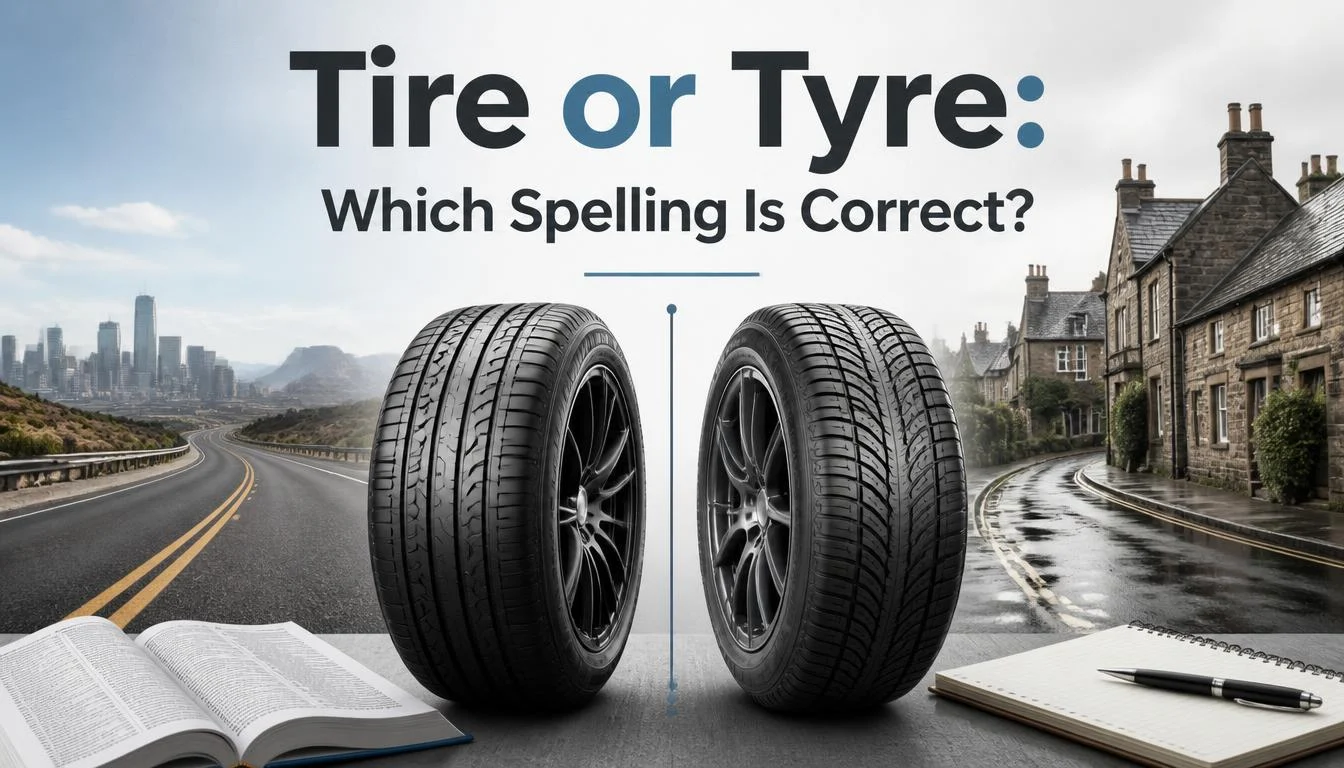
Tire is the standard American English spelling, while tyre is the standard British English spelling for a vehicle wheel covering.
Both are correct; the choice depends mainly on the variety of English you are using.
If you have ever wondered whether to write tire or tyre, you are not dealing with two different words in most cases. Both spellings refer to the rubber covering fitted around a wheel, but the preferred spelling depends on the variety of English you are using. Tire is the standard spelling in American English, while tyre is commonly used in British English and other varieties influenced by British usage.
The difference becomes especially useful when writing for an international audience, preparing academic work, or learning American and British English. In this guide, we will explain tire vs. tyre, show where each spelling is used, and provide clear examples so you can choose the right form for your writing.
Which One Is Correct?
Both tire and tyre are correct spellings when they mean the rubber covering fitted around a wheel.
The main difference is regional spelling:
- Tire standard in American English
- Tyre standard in British English
For example, an American writer would normally say, “My car needs new tires.” A British writer would usually write, “My car needs new tyres.”
The meaning does not change. The pronunciation does not normally change either. The spelling reflects the English variety used by the writer.
If you are writing for readers in the United States, use tire. If you are following British English conventions, use tyre.
Meaning of the Correct Word
Definition
In American English, a tire is the rubber covering around a vehicle’s wheel. It provides contact between the wheel and the road and helps with traction, handling, and comfort.
The word applies to many types of vehicles, including cars, trucks, motorcycles, bicycles, buses, and aircraft.
For example:
The front tire is losing air.
Here, tire refers to the physical rubber component fitted around the wheel.
Explanation
A tire does more than simply cover a wheel. Its tread helps the vehicle grip the road, while its structure supports the vehicle’s weight.
Modern tires come in different designs for different conditions. Drivers may choose all-season, winter, performance, or off-road tires depending on the vehicle and environment.
The word can also appear in compound terms such as:
- tire pressure
- tire tread
- tire shop
- tire repair
- tire replacement
- tire rotation
- spare tire
- winter tire
- tire valve
These expressions are especially common in American English.
Usage
American English uses tire as the standard noun for this meaning.
It can appear in singular or plural form:
- one tire
- two tires
- four tires
- a flat tire
- worn tires
The plural form is made by adding -s, just like many other regular nouns.
The word tire also has another unrelated meaning as a verb. It can mean to become tired or to make someone tired.
For example:
Long walks tire me out.
This second meaning uses the same spelling but has a different pronunciation from the noun in many varieties of English.
Real-World Examples
Here are several natural examples using tire:
- I need to replace one of my car tires.
- The mechanic checked the tire pressure.
- Her bicycle tire has a small hole.
- We keep a spare tire in the trunk.
- The rear tires have worn unevenly.
- Check your tires before a long road trip.
- The tire shop closes at six o’clock.
These examples reflect normal American English usage.
Meaning of the Incorrect or Alternative Word
Incorrect
Tyre is not incorrect. It is the standard British English spelling of the word that Americans spell tire.
Calling tyre wrong would ignore regional English conventions. The same applies in reverse: tire is not a misspelling simply because British English normally uses tyre.
Typo
In American English, tyre may look like a spelling error because tire is the expected form. However, it is not necessarily a typo.
If you see tyre in a British newspaper, British manual, or UK-based website, the spelling is intentional.
Slang
Tyre is not slang. It is a standard dictionary spelling used in formal and informal British English.
Likewise, tire is not slang in American English.
Regional Variation
The clearest distinction between the two forms is regional.
| English variety | Common spelling |
|---|---|
| American English | tire |
| British English | tyre |
| Canadian English | tire is common |
| Australian English | tyre |
| New Zealand English | tyre |
Regional preferences can vary in some places, but tire strongly aligns with American usage, while tyre strongly aligns with British usage.
Rare but Valid Usage
The noun tyre is fully valid outside British English contexts as well. You may encounter it in international companies, imported vehicle manuals, sports coverage, or websites that follow British spelling conventions.
Therefore, seeing tyre does not mean you have found an unusual or incorrect version. It simply signals a different spelling tradition.
Key Differences Between the Two Words
| Feature | Tire | Tyre |
|---|---|---|
| Spelling | Tire | Tyre |
| Meaning | Rubber covering around a wheel | Rubber covering around a wheel |
| Pronunciation | Usually “TY-er” | Usually “TY-er” |
| Grammar | Noun; also a verb with another meaning | Noun for the wheel covering |
| Main usage | American English | British English |
| Recognition | Standard in the United States | Standard in the United Kingdom |
| Plural | Tires | Tyres |
| Example | The tire is flat. | The tyre is flat. |
The most important point is that the two spellings have the same meaning when they describe a vehicle wheel covering.
Spelling Difference
Only one letter changes: tire uses i, while tyre uses y.
That small difference reflects a larger pattern in American and British spelling. English contains many words with regional spelling differences, such as color/colour, center/centre, and favorite/favourite.
Meaning Difference
There is no meaningful difference between tire and tyre in this context.
A tire and a tyre perform the same basic function. The distinction lies in spelling rather than the object itself.
Pronunciation Difference
When referring to a vehicle wheel covering, both words are normally pronounced like “TY-er.”
The spelling does not create a major pronunciation difference.
Remember, however, that tire can also function as a verb. In that use, it means to become exhausted or to cause exhaustion.
Grammar Difference
Both forms work as countable nouns:
The tire is damaged.
The tyres are worn.
The grammatical structure remains the same. Only the spelling changes.
Usage Difference
Choose the form that matches your intended English variety.
If your article, manual, or website follows American English, use tire. If it follows British English, use tyre.
Consistency matters. Avoid switching between the two spellings without a reason.
Recognition Difference
American readers are very familiar with tire, while British readers commonly expect tyre.
Both forms remain easy for English speakers to understand. The spelling mainly tells readers which regional convention the writer follows.
Common Mistakes People Make
Mistake 1: Assuming Tyre Is Always Wrong
Some American English learners see tyre and immediately mark it as incorrect.
That is not accurate. Tyre is the standard British spelling.
Mistake 2: Assuming Tire Is Always Wrong
The opposite mistake occurs when someone learns British English and assumes tire is incorrect.
American English uses tire as its standard spelling for the same object.
Mistake 3: Mixing Regional Styles
A writer may use tire in one paragraph and tyre in another without a clear reason.
This can make the writing look inconsistent. Pick one spelling system and maintain it throughout the piece.
Mistake 4: Confusing the Noun With the Verb
The word tire has another meaning as a verb:
The long journey began to tire him.
That meaning has nothing to do with a vehicle wheel.
The noun tire and the verb tire share the same spelling but represent different meanings.
Mistake 5: Changing the Spelling in a Quotation
If you are quoting a British source, keep its original spelling.
For example, if the source says tyre, do not automatically change it to tire unless your editorial rules require an adapted quotation.
Mistake 6: Treating Regional English as a Grammar Error
British and American English often use different spellings for the same word.
A regional spelling difference does not automatically indicate a grammar problem.
Correct Usage Examples
Casual Examples
Here are natural examples you might hear in everyday American English:
- My tire is flat.
- I think one of your tires is low.
- Can you check the tire pressure?
- We need to buy two new tires.
- I hit a pothole and damaged the tire.
- Where can I get a tire repaired?
In British English, these sentences would normally use tyre instead.
Professional Examples
Technical and business writing also follows regional spelling conventions.
The technician inspected all four tires before returning the vehicle.
Customers should check tire pressure regularly.
The company offers tire replacement and balancing services.
In British English, the equivalent wording would use tyres and tyre.
For professional writing, consistency matters more than choosing one spelling as universally correct.
Educational Examples
Teachers often use examples like these when explaining American and British spelling:
American English uses tire, while British English uses tyre.
Both words refer to the rubber covering fitted around a wheel.
The pronunciation remains essentially the same.
These examples help learners understand that English can have multiple accepted regional standards.
Literary/Metaphorical Examples
The noun tire can appear in descriptive writing:
The old tire rested beside the weathered garage.
The word can also appear in figurative writing through the verb tire:
She never seemed to tire of exploring new places.
Here, tire does not refer to a wheel. It means to become bored or exhausted.
This distinction depends on context.
Word Origin / Etymology
The history of tire and tyre is closely connected with the development of English spelling.
The word for a wheel covering developed from earlier forms associated with the idea of a circular band or covering. Over time, English speakers used different spellings for the word.
The spelling tyre became strongly associated with British English. Tire became the dominant American form.
The development also reflects a broader pattern in English. Spelling was not always standardized in the way it is today. Printers, writers, regions, and language communities often preferred different forms.
American English later developed its own spelling conventions. Some American forms became shorter or differed from established British spellings.
That history helps explain why tire and tyre coexist today. Neither spelling represents a modern mistake. Each belongs to a recognized regional tradition.
Why the Incorrect Version Became Popular
The so-called “incorrect” version became popular because it is not actually incorrect. Tyre became established as a British spelling, while tire became standard in American English.
Language changes through long periods of use. Different communities can settle on different spellings while keeping the same pronunciation and meaning.
American English also developed several spelling preferences that differ from British English. These differences appear in words such as color/colour, center/centre, and theater/theatre.
The same regional pattern applies to tire/tyre.
Modern dictionaries and style guides recognize these differences. The appropriate spelling depends on the English variety you are writing.
This is why context matters. A British automotive publication will naturally use tyre, while an American automotive publication will normally use tire.
Easy Memory Tricks
Think of “Tire” as the American Choice
If you are writing for an American audience, remember:
Tire = American English
For example:
My car needs four new tires.
Think of “Tyre” as the British Choice
For British English, remember:
Tyre = British English
For example:
My car needs four new tyres.
Match the Spelling System
If your writing already uses American forms such as color, center, and favorite, choose tire.
If your writing uses British forms such as colour, centre, and favourite, choose tyre.
This makes the choice easier because you are matching the spelling system rather than memorizing the word by itself.
FAQs
Is tire or tyre correct?
Both are correct. Tire is standard American English, while tyre is standard British English.
Is tyre British or American?
Tyre is primarily the British English spelling for the rubber covering around a vehicle wheel.
Do tire and tyre mean the same thing?
Yes. When referring to a vehicle wheel covering, they have the same meaning.
How do you pronounce tire and tyre?
Both are generally pronounced “TY-er” when they refer to a vehicle wheel covering.
Is tyre an American spelling?
No. American English normally uses tire for this meaning.
Is tire a British spelling?
It can be understood in British English, but tyre is the standard British spelling for the wheel covering.
Which spelling should I use in the United States?
Use tire for American English. Its plural form is tires.
Which spelling should I use in the UK?
Use tyre for British English. Its plural form is tyres.
Conclusion
When comparing tire or tyre, both spellings are correct, but they belong to different English conventions.American English uses tire, while British English generally uses tyre for the same wheel covering.Choose the spelling that matches your audience and keep it consistent throughout your writing.A simple rule to remember is: tire for American English, tyre for British English.
Read More Articles
- Afterwards or Afterward | When and How to Use Them In 2026
- Neighbor or Neighbour | Meaning, Spelling and Usage In 2026

Christopher Parker is a writer and blogger at GramScript.com, sharing thoughtful insights and engaging stories across a range of topics. His writing blends clarity, curiosity, and a distinctly human perspective.
2 thoughts on “Tire or Tyre | Meaning, Spelling and Regional Usage In 2026”