Quick Answer
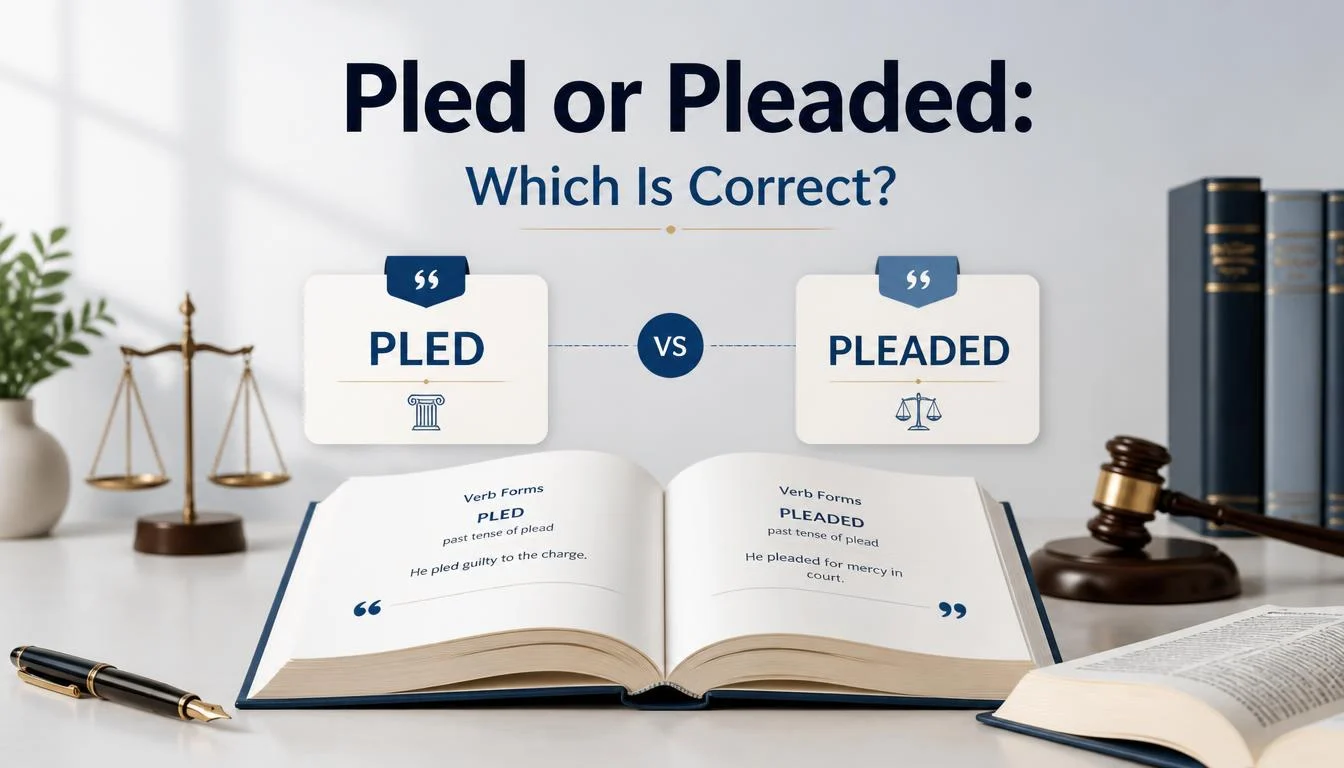
Pled and pleaded are both correct past-tense and past-participle forms of plead, but pled is especially common in American English.Use pleaded for a broadly accepted formal choice, while pled is also standard in U.S. usage, especially in legal contexts.
When you want to describe something that happened in the past, should you say pled or pleaded? Both forms come from the verb plead, but their usage can vary depending on context, style, and regional preference. This can make the choice confusing, especially in legal writing, formal English, and everyday conversation.
Pled and pleaded can both function as past forms of plead, but pleaded is widely recognized and often preferred in standard English, particularly when clarity matters. Pled also appears in modern usage, especially in legal contexts such as “pled guilty.” Understanding how each form works can help you choose the wording that sounds natural and appropriate for your sentence.
Which One Is Correct?
Both pled and pleaded are correct.
The important point is that they are forms of the same verb, plead. They do not have different meanings simply because their spellings differ.
| Form | Correct? | Common use |
|---|---|---|
| pleaded | Yes | General English, formal writing, broad international use |
| pled | Yes | Especially American English; common in legal contexts |
| plead | Yes | Present/base form |
| pleading | Yes | Present participle and gerund |
For example:
- She pleaded for another chance.
- She pled for another chance.
- The defendant pleaded guilty.
- The defendant pled guilty.
All four sentences can be grammatically sound when the tense and context are appropriate.
If you want the safest form for readers from different English-speaking backgrounds, pleaded is an excellent choice. However, calling pled incorrect would be inaccurate. Major dictionaries recognize it as a legitimate form, particularly in U.S. English.
Meaning of the Correct Word
Definition
Pleaded is the past tense and past participle of plead.
The verb plead commonly means to make an urgent request or to give an official answer in court. It can also mean to present a reason, excuse, or argument in support of someone or something.
For example:
She pleaded with him to stay.
Here, pleaded means she made an emotional or urgent request.
In a legal setting:
The defendant pleaded not guilty.
Here, pleaded means the defendant formally gave a legal response to the accusation.
Explanation
Pleaded follows the familiar -ed pattern used by many regular English verbs.
The basic forms are:
- Present: plead
- Past: pleaded
- Past participle: pleaded
- Present participle: pleading
The form pleaded works naturally in both everyday and formal writing.
It can describe an emotional request:
The child pleaded for another cookie.
It can also describe an argument:
The lawyer pleaded for more time.
And it can describe a legal response:
The accused pleaded guilty.
Usage
Use pleaded when you want a conventional, widely understood form of the past tense or past participle.
It works particularly well in formal writing, educational material, international communication, and contexts where you want to avoid regional variation.
Common structures include:
- Pleaded + for
She pleaded for forgiveness.
- Pleaded + with + person
He pleaded with his parents.
- Pleaded + to + verb
They pleaded with us to wait.
- Pleaded + guilty/not guilty
The defendant pleaded not guilty.
- Pleaded + noun
The attorney pleaded his case before the court.
These patterns help you recognize how the word behaves in real sentences.
Real-World Examples
Here are several natural examples:
- She pleaded for another opportunity.
- He pleaded with his brother to listen.
- The defendant pleaded guilty to the charge.
- They pleaded for help after the accident.
- The attorney pleaded his client’s case.
- She pleaded with the manager to reconsider.
- The students pleaded for more time to finish the assignment.
Notice that the meaning changes slightly with context, but the central idea involves an appeal, request, argument, or formal response.
Meaning of the Incorrect or Alternative Word
Incorrect
Pled is not incorrect.
This is one of the most important points in the entire comparison. In American English, dictionaries recognize pled as a legitimate past form of plead. Cambridge specifically labels it U.S. or Scottish English in its dictionary entry.
So this sentence is acceptable:
The defendant pled guilty.
And so is:
The defendant pleaded guilty.
The choice often depends on regional preference and style.
Typo
Pled can sometimes look like a typo because many learners expect every regular past-tense form to end in -ed.
That assumption can make pled seem unusual.
However, the spelling is established enough to appear in dictionaries and standard American usage. It should not automatically be corrected to pleaded.
Slang
Pled is not slang.
It may sound shorter or more informal to some readers, but it functions as a standard verb form.
Its especially strong presence in American legal language does not make it slang.
Regional Variation
Regional usage explains much of the confusion.
Cambridge lists pled as a U.S. or Scottish English form, while its general entry gives pleaded as the main form and pled as an American alternative.
This means American readers may encounter pled guilty frequently, particularly in reports about court cases.
Readers accustomed to British English may be more familiar with pleaded guilty.
Neither form changes the underlying meaning.
Rare but Valid Usage
Outside American English, pled can appear less frequently, but that does not make it grammatically invalid.
Historical evidence also shows that pled has been used for centuries. The Online Etymology Dictionary dates the alternative form to around 1716.
So pled is better described as a recognized alternative form rather than an error.
Key Differences Between the Two Words
The main difference involves form, regional preference, and style, not meaning.
| Feature | Pled | Pleaded |
|---|---|---|
| Spelling | P-L-E-D | P-L-E-A-D-E-D |
| Meaning | Past form of plead | Past form of plead |
| Pronunciation | “PLED” | “PLEE-did” |
| Grammar | Past tense and past participle | Past tense and past participle |
| Usage | Especially common in American English | Broadly accepted and widely used |
| Recognition | Standard U.S. form | Standard general form |
| Legal writing | Very common in U.S. contexts | Also very common |
| International clarity | Correct but regionally marked | Usually more universally familiar |
Pronunciation Difference
The two forms sound different.
Pled is pronounced like “pled.”
Pleaded is pronounced roughly like “PLEE-did.”
The difference becomes especially noticeable in spoken sentences:
He pled guilty.
versus:
He pleaded guilty.
The first is a single syllable. The second normally has two syllables.
Grammar Difference
Grammatically, both forms can serve as the past tense and past participle of plead.
Compare:
Simple past:
She pleaded with him.
She pled with him.
Present perfect:
She has pleaded for help.
She has pled for help.
Past perfect:
He had pleaded guilty.
He had pled guilty.
The grammar remains the same. Only the verb form changes.
Common Mistakes People Make
Mistake 1: Assuming “pled” is always wrong
This is the most common misunderstanding.
Because pleaded follows the familiar -ed pattern, learners sometimes assume pled must be a misspelling.
It is not.
Incorrect assumption: “Pled is never correct.”
Better understanding: “Pled is a recognized alternative, especially in U.S. English.”
Mistake 2: Confusing “plead” with “pledge”
The words plead and pledge look similar, but they are different verbs.
Plead means to appeal, request, argue, or formally answer a legal charge.
Pledge means to make a serious promise or commitment.
Compare:
She pleaded for help.
She pledged her support.
The first sentence describes an appeal. The second describes a promise.
Mistake 3: Writing “pled” when you mean “pledged”
This mistake can happen because the words look similar.
He pled guilty.
means he gave a legal response.
He pledged his support.
means he made a serious promise.
The two verbs have different meanings and different grammatical forms.
Mistake 4: Treating “pleaded” as more correct in every situation
Pleaded is broadly accepted, but that does not make pled wrong.
In American English, pled is an established form. Cambridge explicitly identifies it as a U.S. alternative.
Mistake 5: Using “pled” without checking your audience
Although pled is correct, regional expectations can affect how natural it sounds.
If you are writing for a broad international audience, pleaded may feel more familiar.
If you are writing American English, pled is entirely reasonable.
Correct Usage Examples
Casual Examples
I pleaded with my friend to stay.
I pled with my friend to stay.
She pleaded for another chance.
She pled for another chance.
Both versions can work, although the first form may feel more familiar to many readers.
Professional Examples
The employee pleaded for additional time to complete the project.
The attorney pleaded his client’s case before the judge.
The organization pleaded for financial support.
Professional writing benefits from clear context. If your audience includes international readers, pleaded can provide a familiar choice.
Educational Examples
The student pleaded with the teacher for an extension.
The textbook explains how the defendant pleaded not guilty.
The witness pleaded for protection.
These examples show that plead extends beyond courtroom language. It can describe emotional requests and persuasive appeals.
Literary/Metaphorical Examples
Writers often use pleaded to create emotional intensity.
The abandoned house seemed to plead for attention.
Her tired eyes pleaded for understanding.
The empty road pleaded with him to turn back.
In these examples, plead works metaphorically. An object or image appears to make an emotional appeal.
The same grammatical idea applies when the past form is needed:
The silent room seemed to have pleaded for someone to listen.
Word Origin / Etymology
The history of plead helps explain why its modern forms may seem unusual.
The verb dates to Middle English, with forms related to Anglo-French pleder and Old French plaidier, meaning to plead or argue in court. Those forms trace further to Medieval Latin placitare and Late Latin placitum.
The meaning gradually expanded beyond courtroom arguments.
By the middle of the 14th century, plead could refer to presenting something as evidence or support. Around 1400, it also developed the sense of making a request or begging.
The shorter past form pled appeared much later as an alternative form. The Online Etymology Dictionary dates it to around 1716 and suggests that its formation may have followed patterns found in verbs such as lead and read.
That history explains why pled is not simply a modern typo. It developed as an alternative past form and survived in English usage.
Why the Incorrect Version Became Popular
There is an important correction to make here: pled did not become popular because people repeatedly made a mistake.
It developed as an alternative form of plead and became established in certain varieties of English.
One likely reason for its appeal is its resemblance to other short past-tense forms. English contains several verbs whose past forms do not use the ordinary -ed ending.
For example:
- lead → led
- read → read
- plead → pled
The spelling pattern may have helped pled gain recognition as a natural-looking past form.
Its use also became especially noticeable in American English. Modern dictionaries continue to recognize it as a U.S. form.
Legal language has also helped keep pled highly visible. Phrases such as pled guilty occur frequently in American reporting and legal contexts.
At the same time, pleaded remains common and fully correct. The two forms have therefore continued side by side.
Easy Memory Tricks
Think “Plead Has Two Past Forms”
Remember this simple pattern:
Plead → pleaded / pled
You do not need to memorize one as right and the other as wrong.
Use “Pleaded” for the Broadest Audience
If you are unsure which form your readers expect, pleaded is an easy choice.
It is clear, conventional, and widely recognized.
Remember “Pled” Is Short
Think:
Plead → Pled
The shorter form drops the longer -eaded ending.
This can help you remember why pled appears in phrases such as pled guilty.
Do Not Confuse It With “Pledged”
Use this quick distinction:
- Pled = past form of plead
- Pledged = past form of pledge
So:
He pled guilty.
But:
He pledged his loyalty.
That one-letter difference can change the entire meaning.
FAQs
Is “pled” a correct word?
Yes. Pled is a recognized past-tense and past-participle form of plead, especially in American English.
Is “pleaded” or “pled” more correct?
Both are correct. Pleaded is broadly familiar, while pled is particularly common in American English.
Is “pled guilty” grammatically correct?
Yes. Pled guilty is a standard American English construction meaning that someone entered a guilty plea.
Is “pleaded guilty” correct?
Yes. Pleaded guilty is fully grammatical and widely used in English.
How do you pronounce “pled”?
Pled is pronounced like the word “pled” with one syllable.
How do you pronounce “pleaded”?
Pleaded is pronounced roughly “PLEE-did.”
Is “pled” British or American English?
It is especially associated with American English, though Cambridge also identifies it with Scottish English.
Should I use “pled” in formal writing?
Yes, especially in American English. If you want the form most likely to feel familiar across international audiences, pleaded is a straightforward alternative.
Conclusion
When choosing between pled or pleaded, remember that both forms are correct past forms of plead.Pled is especially common in American English, while pleaded offers a broadly familiar choice.Use either form according to your audience, context, and preferred style.The key takeaway is simple: pleaded is correct, pled is correct too
Read More Articles
- Leary or Leery | Which One Should You Use In 2026
- Appendicitis or Gas | How to Know What Your Abdominal Pain Means In 2026

Andrew Cooper is a blogger and writer at Gramscript.com, turning everyday ideas into clear, engaging stories. His writing blends curiosity, insight and a genuinely human perspective.
1 thought on “Pled or Pleaded | How to Use Each Form in a Sentence In 2026”