Quick Answer
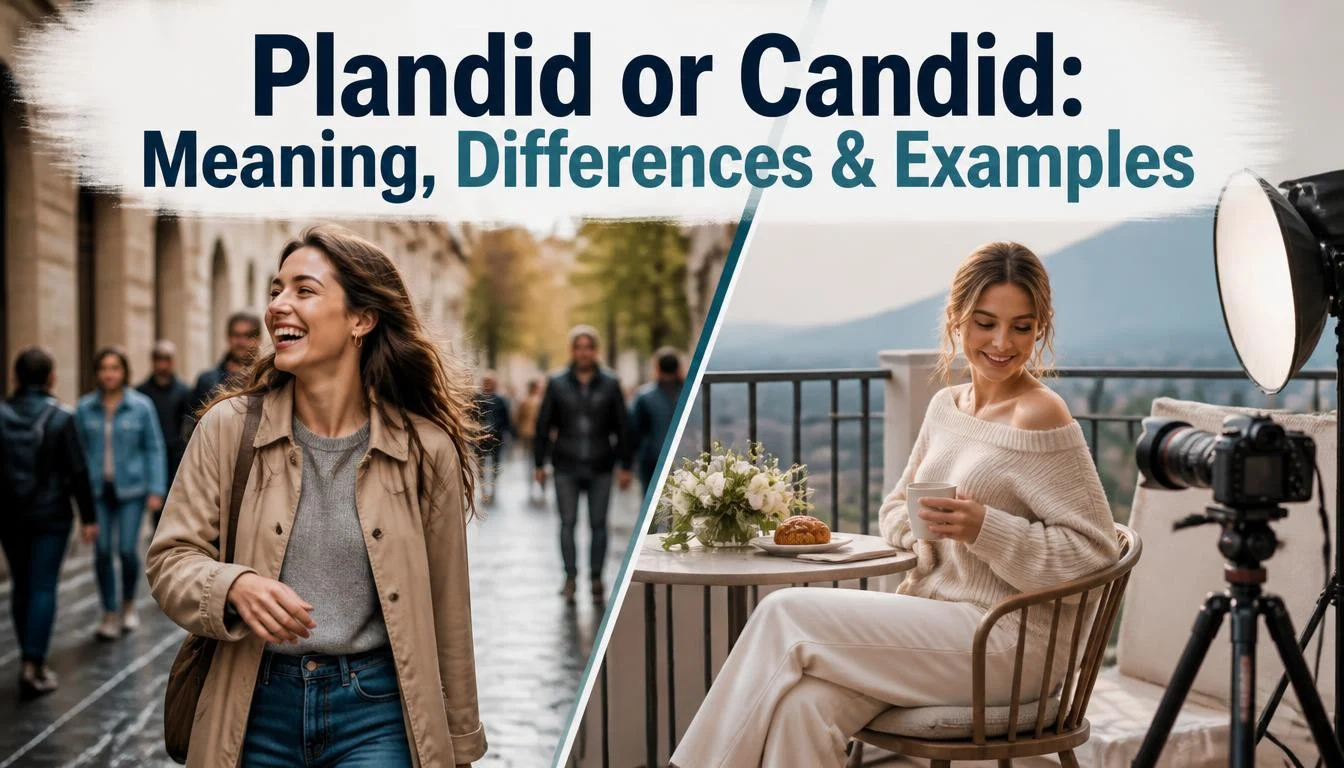
Candid is the standard English word for something honest, open, or naturally unplanned, especially a photograph. Plandid is an informal blend of “planned” and “candid” for a photo that looks spontaneous but was actually arranged.
If you are unsure whether the correct word is plandid or candid, you are not alone. These words can look similar at a glance, but they do not have the same status or meaning in standard English. Candid is an established English word that commonly describes someone who speaks honestly and openly, while plandid has a different and more limited use.
Understanding the difference between plandid and candid can help you choose the right word for your writing and everyday conversations. In this guide, we’ll explain what each term means, where it comes from, and how people use it in real sentences. You’ll also see clear examples that make the distinction easier to remember.
Which One Is Correct?
Candid is the standard English word. It can describe a natural photograph, an honest conversation, an open opinion, or a person who speaks frankly.
Plandid is also an established informal term, but it does not function as a normal replacement for candid. It belongs mainly to casual photography and social media vocabulary. Dictionaries and language references describe it as a blend of planned and candid.
So, neither word is simply a misspelling of the other.
If you mean something honest, frank, or spontaneous, use candid. If you specifically mean a photograph that was planned to look candid, plandid can express that idea.
Meaning of the Correct Word
Definition
Candid is an adjective that commonly means honest, frank, open, or natural. In photography, it describes a picture taken without a deliberate pose or obvious preparation.
For example:
She gave a candid answer during the interview.
Here, candid means honest and direct.
In another sentence:
The photographer captured a candid photo of the children playing.
Here, candid means natural and unposed.
The word therefore has more than one related meaning. Context tells you which sense applies.
Explanation
When you call someone candid, you usually mean that the person speaks openly. They do not hide their true opinion or carefully soften every statement.
For example:
Mark was candid about the problems with the project.
This sentence suggests that Mark spoke honestly about the situation.
The photography meaning works slightly differently. A candid photograph captures a person during a natural moment rather than during a formal pose.
A person might laugh, walk, read, talk, or react without deliberately looking at the camera. The photographer captures that moment as it happens.
However, real-life photography can involve gray areas. A person may know that a photographer is nearby without deliberately posing. The key idea remains natural behavior rather than a carefully arranged appearance.
Usage
Candid works in many situations beyond photography.
You can use it for:
- candid photographs
- candid conversations
- candid answers
- candid opinions
- candid interviews
- candid discussions
- candid feedback
- candid reactions
- candid remarks
- candid observations
For example:
I appreciate your candid feedback.
Here, candid means honest and straightforward.
You can also use it with nouns describing communication:
The manager had a candid conversation with the team.
That sentence does not involve photography at all.
Real-World Examples
Here are several natural examples:
- Photography:
The photographer captured a candid shot of the guests laughing. - Conversation:
We had a candid conversation about our plans. - Opinion:
She gave me a candid opinion about my presentation. - Interview:
The actor gave a candid interview about his career. - Feedback:
His candid feedback helped me improve the report. - Reaction:
The camera caught her candid reaction to the surprise.
These examples show why candid has a much wider range of uses than plandid.
Meaning of the Incorrect or Alternative Word
Incorrect
Plandid is not simply an incorrect spelling of candid. It is a deliberately created blend with its own informal meaning.
The term combines planned and candid. It describes a photograph that was planned or staged but designed to look spontaneous. Wiktionary lists it as slang, while Collins Dictionary records it as a submitted new-word suggestion and describes its photographic meaning.
Therefore, calling plandid “wrong” can be misleading.
It is better to call it informal, specialized, or slang vocabulary. It has a recognizable meaning, but it does not replace candid in standard writing.
Typo
A writer may type plandid when they actually mean candid. That would be a mistake.
For example:
❌ She gave a plandid answer during the meeting.
If the writer means “honest and direct,” the correct word is:
✅ She gave a candid answer during the meeting.
The word plandid only makes sense when the writer intends its special photography-related meaning.
Slang
Plandid is commonly treated as informal slang or internet vocabulary.
Its meaning developed around the idea of making a planned photograph look spontaneous. The term appeared in online usage before becoming more visible in social media photography discussions.
That makes it suitable for casual conversations about photographs, captions, social media posts, and photography trends.
For formal writing, a clearer phrase is often better:
The photographer staged the scene to create a natural-looking image.
That sentence communicates the idea without relying on slang.
Regional Variation
Plandid is not primarily a regional spelling variation.
You should not think of it as an American version of candid or a British alternative. It is a separate informal blend.
Similarly, candid keeps the same basic spelling and meaning across major varieties of English.
Rare but Valid Usage
Although plandid remains informal, it has a specific and understandable use.
For example:
The photographer asked us to walk naturally through the park for a plandid.
The photograph was planned, but the final image was supposed to look spontaneous.
The plural form is plandids.
You may also encounter plandid used more broadly to describe an arranged performance or moment that imitates spontaneity. However, photography remains its clearest and most common context.
Key Differences Between the Two Words
| Feature | Candid | Plandid |
|---|---|---|
| Spelling | C-A-N-D-I-D | P-L-A-N-D-I-D |
| Meaning | Honest, open, natural, or unposed | Planned to look candid |
| Pronunciation | CAN-did | PLAN-did |
| Grammar | Standard adjective; also used as a noun in photography | Informal noun or adjective |
| Usage | Everyday, professional, academic, and photographic contexts | Mainly casual photography and online contexts |
| Recognition | Widely recognized standard English | Informal blend with specialized meaning |
| Main idea | Natural or honest | Planned but natural-looking |
| Example | a candid photograph | a plandid photograph |
The simplest distinction is natural versus deliberately natural-looking.
A candid photograph aims to capture a genuine moment. A plandid photograph aims to create the appearance of that kind of moment.
Candid Can Describe More Than Photos
One major difference is the range of candid.
You can say:
She was candid about her concerns.
You cannot normally replace candid with plandid in that sentence.
Likewise, phrases such as candid feedback, candid discussion, and candid answer are standard English expressions.
Plandid Focuses on Appearance
The word plandid focuses on the relationship between planning and appearance.
A photographer might select the location, lighting, clothing, timing, and composition. The subject may perform a simple action, such as walking or looking away.
The finished picture can look spontaneous even though several details were arranged beforehand.
Common Mistakes People Make
Mistake 1: Treating Plandid as a Misspelling
Some people assume that plandid is simply a typo for candid.
That is not always true. The two words have different meanings.
If someone writes about a planned photograph that looks natural, they may intentionally use plandid.
Mistake 2: Using Plandid for Honest Speech
This is one of the clearest usage errors.
❌ He gave a plandid explanation.
If you mean honest or straightforward, use:
✅ He gave a candid explanation.
Plandid does not normally mean “honest.”
Mistake 3: Assuming Every Natural-Looking Photo Is Candid
A natural appearance does not automatically make a photo candid.
A photographer can carefully arrange a scene and still make it look spontaneous.
That is exactly where the informal term plandid becomes useful.
Mistake 4: Calling Every Posed Photo Plandid
A regular posed photo is not necessarily a plandid.
If someone clearly stands in front of the camera and poses, the image is simply a posed photograph.
A plandid usually tries to hide or minimize the appearance of posing.
Mistake 5: Using Plandid in Formal Writing Without Explanation
Readers who have never encountered the term may not understand it immediately.
If your audience expects formal or academic language, describe the idea directly:
The photograph was deliberately staged to appear spontaneous.
That wording is clear and widely understood.
Correct Usage Examples
Casual Examples
These examples fit conversations about photographs and social media:
That picture looks candid, but I think it was planned.
We took a few plandid shots while walking around downtown.
Her candid photo turned out better than the posed ones.
That looks like a plandid to me.
I prefer candid pictures because they feel more natural.
In casual settings, plandid can add a playful tone because the word itself highlights the contradiction between planning and spontaneity.
Professional Examples
Professional writing usually benefits from clear, standard vocabulary.
The photographer captured several candid images during the event.
The client requested natural-looking photographs rather than formal portraits.
The campaign used carefully staged scenes that appeared spontaneous.
The photographer wanted the subjects to interact naturally.
These sentences communicate the same general concept without depending on informal terminology.
If you are writing for a business, publication, report, or professional portfolio, explain the technique rather than assuming everyone knows plandid.
Educational Examples
Teachers and students can use candid in many standard language exercises.
The journalist asked for a candid response.
The documentary includes several candid photographs.
Her candid remarks made the discussion more productive.
If you are teaching vocabulary, plandid can also provide an interesting example of word formation.
The term demonstrates how English speakers can combine parts of existing words to create new expressions.
Literary/Metaphorical Examples
Candid also works well in descriptive and literary contexts.
His candid confession changed the mood of the room.
She offered a candid glimpse into her childhood.
The photograph preserved a candid moment of ordinary life.
Plandid is less common in literary writing because it carries a modern, informal tone.
Still, a writer could use it deliberately:
The perfect smile looked candid, but the whole scene was a carefully planned plandid.
The sentence works because the unusual word draws attention to the contrast between appearance and preparation.
Word Origin / Etymology
Candid has a much older history than plandid.
The English word comes through French from Latin candidus, meaning “white” or “bright.” Over time, its figurative sense became associated with openness, purity, and straightforwardness. That development helped produce the modern meaning of being frank or honest.
The photography sense developed from the broader idea of natural or unguarded behavior. A candid photograph shows someone without the formal appearance of a portrait.
Plandid, by contrast, is a modern blend of planned and candid. The word formation is straightforward: part of planned combines with candid to create a compact term for a planned candid-looking image.
Online records show the term in use by at least the early 2010s, while its visibility increased during the rise of social media photography.
This type of word creation is called a blend or portmanteau. English contains many such formations, especially in informal and digital communication.
Why the Incorrect Version Became Popular
Calling plandid an “incorrect version” does not fully explain its popularity. The term became popular because it names a specific situation that can be awkward to describe with ordinary vocabulary.
A photograph can look spontaneous while involving considerable preparation. A creator might select a location, arrange lighting, choose clothing, direct movement, and decide exactly when to take the picture.
The final image may show someone apparently doing something ordinary, such as drinking coffee, walking down a street, or laughing with friends.
Traditional vocabulary already had words such as staged, posed, and candid. Yet none of them perfectly captures the combination of planning and natural appearance.
That gap encouraged playful language.
Social media also helped spread the concept. Photography became closely connected with personal branding, lifestyle images, and carefully selected everyday moments. Researchers discussing selfie culture have used plandid to describe carefully choreographed images that borrow the visual style of candid photography.
The word therefore became useful because it was short, memorable, and slightly humorous.
Still, popularity does not automatically make an informal word suitable for every context. The safest choice depends on what you want to communicate and who will read it.
Easy Memory Tricks
Use this simple rule:
Candid = caught naturally.
Plandid = planned to look natural.
You can also remember the first parts of the words:
- Candid → think camera + natural moment
- Plandid → think planned + candid
Another useful test is to ask yourself:
Was the scene planned to look spontaneous?
If yes, plandid may describe the photograph.
If no, and the moment happened naturally, candid is the better word.
For general writing, there is an even easier rule:
Use candid for standard English. Use plandid only when you specifically mean a planned candid-looking photo.
FAQs
Is plandid a real English word?
Yes. Plandid is an informal blend of planned and candid, mainly used for planned photographs that look spontaneous.
Is candid the correct word?
Yes. Candid is the standard English word for something honest, open, natural, or unposed.
What does plandid mean?
Plandid describes a photo that was planned or staged but designed to look candid and spontaneous.
How do you pronounce plandid?
It is commonly pronounced PLAN-did, with the stress on the first syllable.
How do you pronounce candid?
Candid is pronounced CAN-did, with the stress on the first syllable.
Can I use plandid in formal writing?
You can, but it may sound informal. For formal readers, “planned to look candid” is often clearer.
Is every posed photo plandid?
No. A normal posed photo openly shows that the subject is posing. A plandid tries to create the appearance of spontaneity.
Can candid describe a person?
Yes. A candid person speaks honestly and openly rather than hiding their opinions.
Conclusion
Understanding plandid or candid becomes simple when you focus on planning and natural appearance.Candid is the standard word for honest, open, or genuinely unposed situations.Plandid is an informal blend for a planned photograph designed to look candid.Remember: candid happens naturally, while plandid is planned to look natural.
Read More Articles
- exFAT or NTFS | Compatibility, Performance and File Size Explained In 2026
- Were or Was | Meaning, Grammar Rules and Real Examples In 2026
Jessica Morgan is a blogger and writer at GramScript.com, where she turns everyday ideas into engaging, relatable stories. Her writing blends a natural voice with fresh perspectives that keep readers coming back.
2 thoughts on “Plandid or Candid | Correct Spelling and Meaning Explained In 2026”