Quick Answer
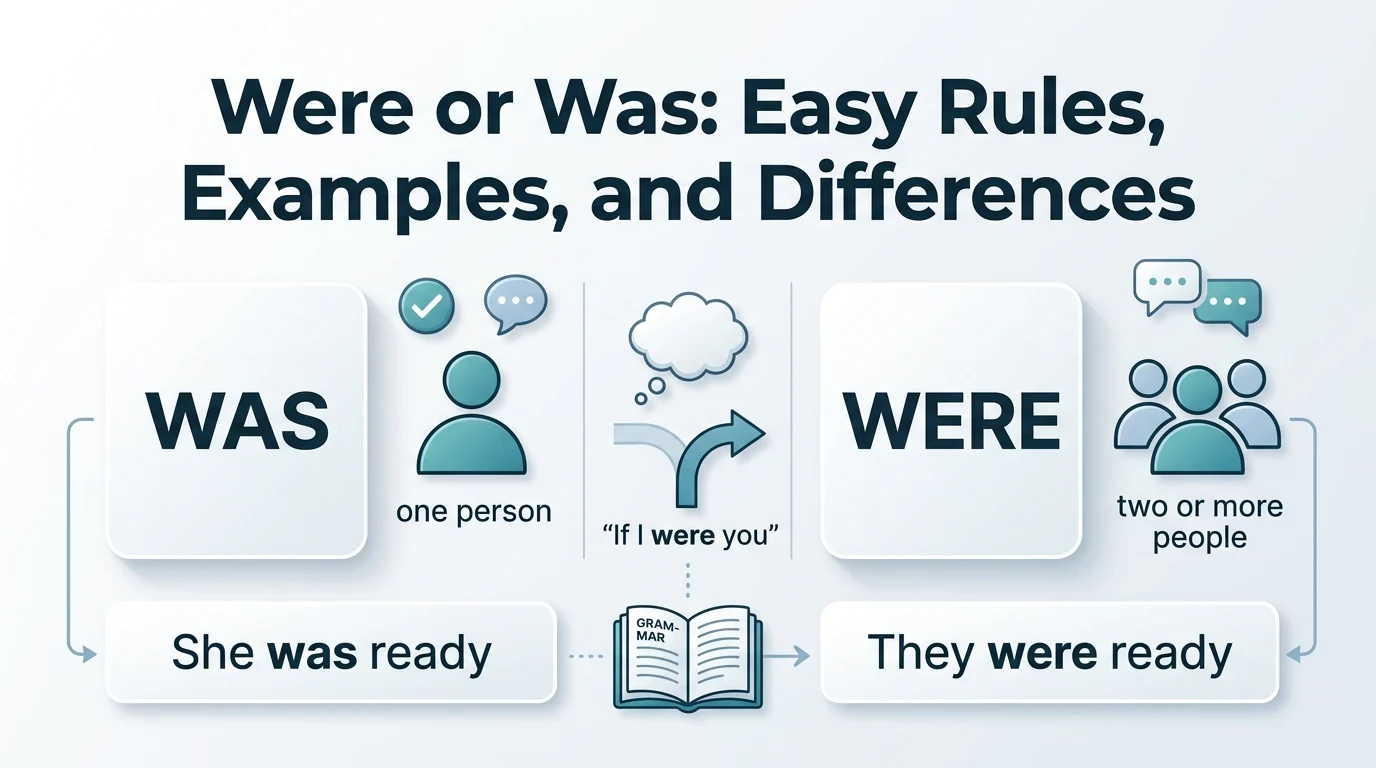
Were and was are both correct forms of the verb be, but they serve different grammatical purposes. Use was with singular subjects in most past-tense statements, and were with plural subjects and with you.
Choosing between were or was can seem confusing, especially when a sentence involves different subjects, questions, or hypothetical situations. Both words are forms of the verb “to be,” but they do not work in exactly the same way. The correct choice usually depends on the subject of the sentence, the tense, and the type of statement you are making. Learning a few simple rules can make the difference much easier to recognize.
In everyday English, was usually goes with singular subjects such as “I,” “he,” “she,” and “it,” while were commonly goes with plural subjects such as “we,” “you,” and “they.” However, English has some important exceptions, especially in hypothetical or unreal situations, where “were” can appear with singular subjects. This guide explains were or was with clear rules, examples, and common mistakes so you can choose the correct form with confidence.
Which One Is Correct?
Both was and were are correct English words. Neither one is universally more correct than the other.
The correct choice depends on the subject and the type of sentence.
| Subject | Typical past-tense form | Example |
|---|---|---|
| I | was | I was tired. |
| You | were | You were tired. |
| He | was | He was tired. |
| She | was | She was tired. |
| It | was | It was cold. |
| We | were | We were tired. |
| They | were | They were tired. |
There is also a special use of were called the subjunctive mood. In sentences about unreal, imagined, or hypothetical situations, were can appear with singular subjects.
For example:
- If I were you, I would wait.
- If she were here, she would help us.
- I wish he were more careful.
So, the question is not simply whether was or were is correct. You need to look at the subject and the meaning of the sentence.
Meaning of the Correct Word
Definition
Was and were are past-tense forms of the verb be.
The verb be can describe a condition, identity, location, existence, or situation. Its past-tense forms include was and were.
For example:
- She was happy.
- They were happy.
- I was at home.
- We were at home.
The words do not have completely different dictionary meanings. Instead, they are different grammatical forms of the same verb.
Explanation
Use was mainly with singular subjects in ordinary past-tense statements.
Common combinations include:
- I was
- he was
- she was
- it was
- the dog was
- my friend was
- the house was
Use were with plural subjects and with you.
Common combinations include:
- you were
- we were
- they were
- the dogs were
- my friends were
- the houses were
The important exception involves hypothetical or unreal conditions. In formal standard English, were often appears after singular subjects in this type of sentence.
Compare these examples:
I was at the office yesterday.
This describes a real past event.
If I were at the office, I would help you.
This describes an imagined situation.
That difference helps explain why both forms can appear with I.
Usage
Use was when you describe a real past condition involving a singular subject.
Examples:
- I was busy yesterday.
- Maria was at school.
- The movie was interesting.
- My phone was on the table.
Use were for plural subjects and you.
Examples:
- We were busy yesterday.
- The students were at school.
- You were right.
- My friends were at the restaurant.
Use were in many hypothetical expressions.
Examples:
- If I were you, I would apologize.
- If he were older, he could drive.
- I wish it were easier.
Real-World Examples
Consider how the subject changes the verb:
- The child was asleep.
- The children were asleep.
- My sister was at work.
- My sisters were at work.
- I was nervous before the interview.
- You were nervous before the interview.
Now compare a factual sentence with a hypothetical one:
- I was sick last week.
- If I were sick today, I would stay home.
The first sentence describes an actual past situation. The second imagines a possible situation.
Meaning of the Incorrect or Alternative Word
Incorrect
Neither was nor were is inherently incorrect. The problem occurs when a speaker uses the wrong form for the grammatical context.
For example:
They was late.
In standard American English, this is incorrect because they takes were in the past tense.
The correct sentence is:
They were late.
Likewise:
She were happy.
is incorrect in an ordinary past-tense statement.
The correct version is:
She was happy.
Typo
A person may accidentally type was instead of were, or vice versa. This often happens during fast writing or editing.
For example:
We was planning to leave early.
A writer may simply have selected the wrong verb form. The intended sentence is:
We were planning to leave early.
A quick subject check can catch this mistake.
Slang
In some dialects and informal varieties of English, speakers may use forms such as we was or they was. These patterns occur in real speech and can have social or regional significance.
However, they are not the standard forms expected in formal American English writing.
For school assignments, professional emails, reports, applications, and other formal contexts, use the standard agreement:
- We were
- They were
Regional Variation
English dialects vary in how speakers use was and were. Some nonstandard dialects use was more broadly, even with plural subjects.
That does not make those dialects meaningless or random. Dialect grammar follows patterns of its own.
Still, learners who are writing in standard American English should follow conventional subject-verb agreement. In that variety, plural subjects normally take were.
Rare but Valid Usage
The most important unusual-looking use of were occurs in hypothetical or contrary-to-fact statements.
For example:
If I were taller, I could reach the shelf.
The subject I is singular, yet were is correct in this formal subjunctive construction.
You may also see:
I wish she were here.
This expresses a wish about a situation that is not true at the moment.
In everyday conversation, some speakers use was in similar sentences. For formal standard English, however, were remains the traditional and widely recommended choice for unreal or hypothetical situations.
Key Differences Between the Two Words
The main difference between was and were comes from subject-verb agreement and mood.
| Feature | Was | Were |
|---|---|---|
| Spelling | was | were |
| Basic meaning | Past form of be | Past form of be |
| Pronunciation | Usually “wuz” | Usually “wur” |
| Grammar | Singular subjects in ordinary past statements | Plural subjects and you |
| Special use | Ordinary past statements | Hypothetical or unreal situations |
| Recognition | Standard English | Standard English |
| Example | She was ready. | They were ready. |
| Hypothetical example | If I was there… | If I were there… |
Subject-Verb Agreement
Subject-verb agreement means that the verb form should match the subject.
Compare:
- He was tired.
- They were tired.
The subject he is singular, so standard past-tense agreement calls for was. The subject they is plural, so it takes were.
The same pattern applies to nouns:
- The car was outside.
- The cars were outside.
The Special Case of “You”
One reason learners find were confusing is the word you.
In modern English, you takes were in the past tense whether it refers to one person or multiple people.
For example:
- You were right.
- You were late.
- You were very helpful.
This differs from some older stages of English, where pronoun forms showed clearer differences between singular and plural you.
The Subjunctive “Were”
The phrase If I were you is one of the best examples to remember.
You would normally say:
I was at home yesterday.
But you would say:
If I were you, I would stay home.
The first sentence describes a real past event. The second presents an imaginary perspective.
The same pattern appears in:
- If he were here, we could ask him.
- If she were available, she would join us.
- I wish it were different.
This use is often called the past subjunctive or irrealis were. It signals that the situation is hypothetical, wished for, or contrary to fact.
Common Mistakes People Make
Mistake 1: Using “was” With a Plural Subject
Incorrect:
The students was ready.
Correct:
The students were ready.
The plural subject students requires were.
Mistake 2: Using “were” With a Singular Subject
Incorrect:
My brother were tired.
Correct:
My brother was tired.
In an ordinary past statement, my brother is singular, so use was.
Mistake 3: Forgetting That “You” Takes “Were”
Incorrect:
You was very helpful.
Correct:
You were very helpful.
This rule applies whether you are speaking to one person or a group.
Mistake 4: Treating “I” as Always Taking “Was”
In ordinary past statements, I takes was:
I was nervous.
However, hypothetical statements often use were:
If I were nervous, I would take a break.
The meaning and sentence structure matter.
Mistake 5: Confusing Real and Hypothetical Situations
Compare:
If I was rude yesterday, I apologize.
This can refer to uncertainty about a real past event.
Now compare:
If I were rude, people would avoid me.
This presents a hypothetical situation.
The distinction can depend on the intended meaning, context, and style.
Mistake 6: Choosing Based Only on Sound
Some speakers pronounce was and were quickly in connected speech. This can make the words difficult to distinguish by ear.
Instead of relying only on pronunciation, identify the subject first. Then check whether the sentence describes a real past situation or a hypothetical one.
Correct Usage Examples
Casual Examples
Here are some natural everyday sentences:
- I was tired after work.
- You were really funny yesterday.
- She was at the grocery store.
- We were hungry after the game.
- They were outside all afternoon.
- If I were you, I would call him.
These examples reflect common conversations about people, places, feelings, and decisions.
Professional Examples
Professional writing still follows the same basic rules.
- The manager was available after lunch.
- The employees were ready for the meeting.
- I was pleased with the results.
- You were included in the final report.
- The documents were submitted on time.
- If I were responsible for the project, I would review the schedule.
In workplace writing, correct subject-verb agreement helps keep sentences clear and polished.
Educational Examples
Students often encounter these forms in grammar exercises.
- The teacher was absent yesterday.
- The students were prepared.
- The lesson was difficult.
- The examples were helpful.
- If the question were easier, more students might answer it.
Teachers may also use was and were to introduce verb agreement and the subjunctive mood.
Literary/Metaphorical Examples
Authors can use was and were when describing imagined worlds or hypothetical ideas.
- The castle was silent beneath the moon.
- The travelers were exhausted after the long journey.
- If she were a bird, she would fly beyond the mountains.
- I wish the night were longer.
The grammatical rules remain the same even when the writing becomes creative.
Word Origin / Etymology
Was and were come from the verb be, one of the oldest and most irregular verbs in English.
The modern verb be developed from several different forms in Old English and earlier Germanic languages. Unlike many regular verbs, its present and past forms come from different historical roots.
Old English used forms such as wæs for a singular past form and wǣron for a plural form. Over centuries, sound changes and grammatical developments produced the modern forms was and were.
The irregular nature of be explains why English learners cannot simply add a standard past-tense ending and predict every form.
Modern English contains:
- am
- is
- are
- was
- were
- be
- been
- being
These forms belong to the same verb, but their shapes vary according to tense, subject, and grammatical construction.
The word were also retained a special role in hypothetical expressions. This historical grammatical pattern developed into the modern subjunctive use found in sentences such as If I were you.
Why the Incorrect Version Became Popular
What looks like an incorrect form can sometimes come from natural language change rather than simple carelessness.
English has always developed through regional speech, social interaction, sound changes, and contact between different varieties. Speakers do not always follow the same grammatical patterns.
In some English dialects, was can appear with plural subjects. You may hear expressions such as we was or they was in particular varieties of English.
These forms can be meaningful features of a dialect, even though they differ from standard written American English.
There is also variation in hypothetical sentences. In everyday speech, many speakers use was where traditional formal grammar recommends were:
If I was you…
Standard formal usage generally prefers:
If I were you…
This variation reflects the fact that spoken English often changes faster than formal writing conventions.
For learners, the safest approach is straightforward: use standard subject-verb agreement in formal writing, and remember were for standard hypothetical constructions such as If I were you.
Easy Memory Tricks
Remember “Was = One”
Think of was as the form that usually goes with one person or thing.
- He was
- She was
- It was
- The dog was
- My friend was
The word I is also paired with was in ordinary past statements:
I was tired.
Remember “Were = You, We, They”
A simple pattern is:
You, we, they → were
Examples:
- You were
- We were
- They were
This rule covers many everyday sentences.
Use “If I Were” as a Fixed Pattern
The phrase If I were you is worth memorizing as a complete expression.
It means you are imagining yourself in another person’s situation.
If I were you, I would wait.
Once you remember this phrase, many similar hypothetical sentences become easier:
- If she were here…
- If he were older…
- If it were possible…
Ask One Simple Question
When you are unsure, ask:
Is this a normal past statement or a hypothetical situation?
For a normal singular past statement, choose was:
She was happy.
For a normal plural statement or a sentence with you, choose were:
They were happy.
- For a formal hypothetical statement, choose were:
If she were happy, she would stay.
FAQs
Is “was” or “were” correct?
Both are correct. Was usually follows singular subjects, while were follows plural subjects and you.
Should I say “I was” or “I were”?
Use I was for ordinary past statements. Use I were mainly in hypothetical or unreal constructions, such as “If I were you.”
Is “you was” grammatically correct?
Not in standard American English. The standard past-tense form is you were, whether you refers to one person or several.
Is “they was” correct?
Not in standard American English. Use they were in formal and standard writing.
Why do people say “If I were you”?
If I were you uses the subjunctive form for a hypothetical situation. It means you are imagining yourself in another person’s position.
Can “was” be used in an “if” sentence?
Yes. Was can appear when the sentence refers to a possible real past situation. For example, “If I was mistaken, I apologize.”
Is “if I was” always wrong?
No. “If I was” can be appropriate when discussing uncertainty about an actual past event. “If I were” usually signals a hypothetical or contrary-to-fact situation.
How do you pronounce “was” and “were”?
Was is commonly pronounced like “wuz,” while were is commonly pronounced like “wur” in American English.
Conclusion
Choosing were or was depends mainly on the subject and the meaning of the sentence.Use was with singular subjects in ordinary past statements, and were with plural subjects and you.Remember that were also works with singular subjects in many hypothetical expressions, especially “If I were you.”When in doubt, check the subject first, then ask whether the situation is real or imagined.
Read More Articles
- Hung or Hanged | Grammar Rules, Examples and Usage In 2026
- Leary or Leery | Which One Should You Use In 2026

Christopher Parker is a writer and blogger at GramScript.com, sharing thoughtful insights and engaging stories across a range of topics. His writing blends clarity, curiosity, and a distinctly human perspective.
1 thought on “Were or Was | Meaning, Grammar Rules and Real Examples In 2026”