Quick Answer
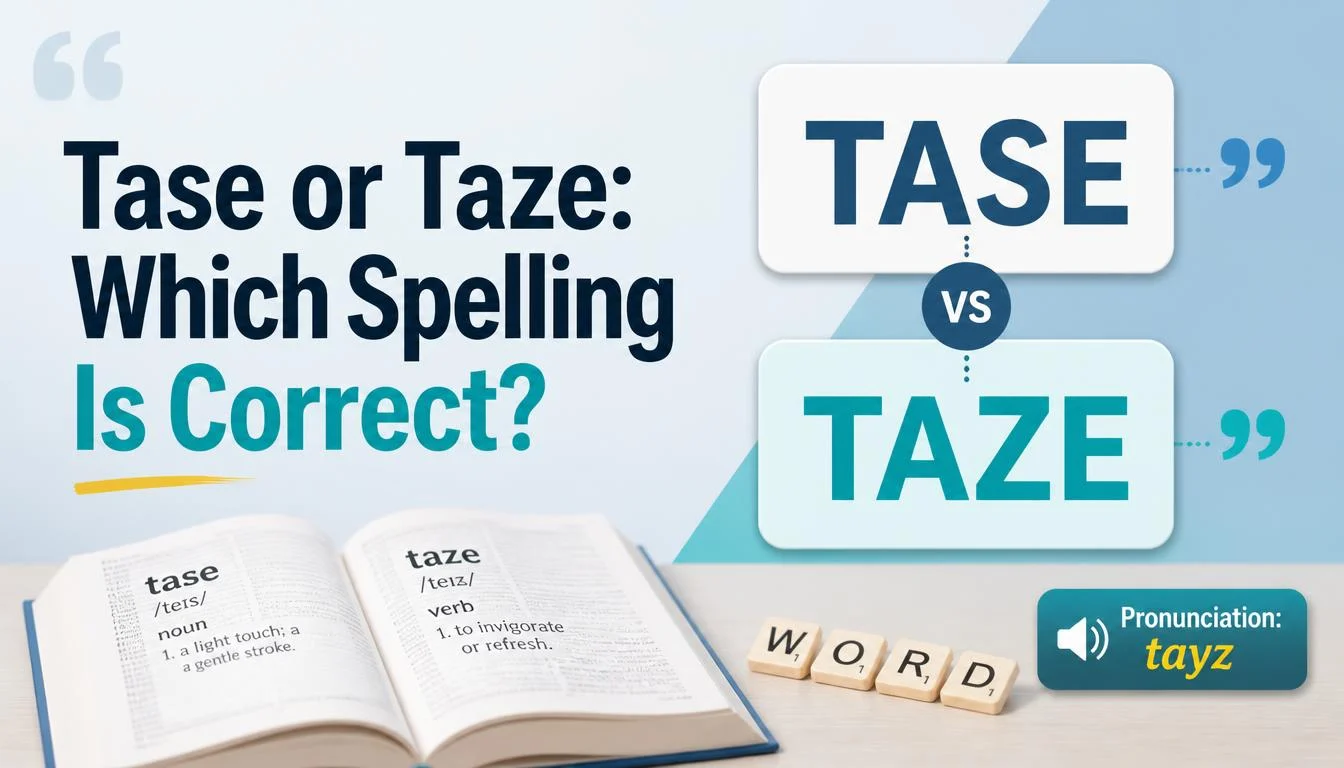
Tase is the standard and more established spelling, while taze is a recognized variant with the same meaning.Both mean to stun someone with a Taser or similar device, but tase is the safer choice for standard writing.
If you are unsure whether the correct spelling is tase or taze, you are not alone. These two forms look and sound similar, but they do not have the same status in standard English. The confusion often comes from the way people hear or spell the word in casual writing. Understanding which form appears in dictionaries and established usage can help you choose the right spelling with confidence.
In this guide, we’ll explain tase or taze, including what the word means, which spelling is generally recognized, and how to use it correctly in a sentence. You’ll also see examples that make the difference easier to understand, so you can avoid common spelling mistakes in everyday and formal writing.
Which One Is Correct?
Tase is the primary spelling used in major American English dictionaries. It means to electrically stun someone or a living target with a Taser or similar device. Dictionary.com identifies tase as the main form and lists taze as an alternative spelling.
However, calling taze simply “wrong” would be inaccurate. American Heritage lists taze as a variant of tase, while Collins also recognizes taze as an American English verb.
So, the practical rule is simple:
- Tase = standard, established spelling
- Taze = recognized spelling variant
- Tased = past tense of tase
- Tazed = past tense of taze
- Tasing = present participle of tase
- Tazing = present participle of taze
For most edited American English, choose tase.
Meaning of the Correct Word
Definition
Tase is a verb meaning to electrically stun or shock someone using a Taser or similar electrical weapon. Dictionary.com defines it as electrically stunning a living target with a Taser or similar device.
The word usually describes an action rather than the device itself.
For example:
The officer threatened to tase the suspect.
Here, tase describes what the officer might do.
Explanation
The word tase developed from Taser, the name associated with an electrical weapon. Dictionaries describe tase as a back-formation from Taser.
A back-formation occurs when speakers create a new word by removing a part that looks like a suffix. In this case, the noun-like brand name Taser helped produce the verb tase.
Over time, the verb became familiar enough to appear in dictionaries and ordinary English usage.
It is worth separating the verb tase from the brand name TASER. Axon identifies TASER as a trademark and gives specific rules for using the brand name. The company says the trademark should remain capitalized and should be used with a generic noun such as “TASER device” or “TASER energy weapon.”
Usage
Tase normally works as a transitive verb. That means it commonly takes a direct object.
For example:
The officer tased the suspect.
You can also use it in an infinitive:
The officer decided to tase the attacker.
Its forms follow regular English verb patterns:
| Form | Example |
|---|---|
| Base form | tase |
| Third-person singular | tases |
| Past tense | tased |
| Present participle | tasing |
The pronunciation stays close to “tayz.”
Real-World Examples
Here are several natural examples:
The officer warned that he might tase the man if he continued resisting.
The report states that the individual was tased during the confrontation.
The video appears to show an officer preparing to tase the suspect.
The training course explains when an officer may deploy an electrical weapon.
The final example avoids the verb tase and uses more technical language. That approach may suit formal or specialized writing.
Meaning of the Incorrect or Alternative Word
Incorrect
Taze is not best described as an outright spelling error. Major dictionaries recognize it as a variant of tase. American Heritage specifically lists taze as a variant, and Collins records it as an American English verb.
Still, if you need the most established spelling for general American English, tase is the safer choice.
Typo
Taze can sometimes appear because a writer is unsure about the spelling. Since the pronunciation is “tayz,” the letter z may feel natural.
However, if you are editing formal text and the intended word is the verb meaning “to stun with a Taser,” changing taze to tase will usually give you the more conventional spelling.
Slang
Collins labels both tase and taze as slang in its dictionary entries.
The words are common enough to be understood by many English speakers, but they can sound informal in technical or legal contexts.
In formal writing, a phrase such as “use an electrical weapon” or a more specific technical term may fit the context better.
Regional Variation
Taze is not primarily a British-versus-American spelling difference. Both forms are associated with American English usage.
The difference is mainly one of spelling preference and lexical variation. American dictionaries recognize tase as the main form and taze as an alternative.
Rare but Valid Usage
Taze is valid when a writer intentionally uses the variant spelling.
For example:
The article used the spelling “taze” throughout.
In that sentence, taze is being discussed as a word rather than used to describe an action.
This distinction matters. A variant does not become a typo simply because another spelling has stronger dictionary recognition.
Key Differences Between the Two Words
| Feature | Tase | Taze |
|---|---|---|
| Spelling | T-A-S-E | T-A-Z-E |
| Meaning | To electrically stun someone | To electrically stun someone |
| Pronunciation | “tayz” | “tayz” |
| Grammar | Verb | Verb |
| Past tense | tased | tazed |
| Present participle | tasing | tazing |
| Usage | Main or standard form | Recognized variant |
| Recognition | Widely recognized by dictionaries | Recognized as a variant |
| Best choice for polished writing | Usually yes | Acceptable, but less conventional |
The biggest difference is therefore spelling, not meaning.
Both words have the same basic pronunciation. Both can serve as verbs. Both describe the same general action.
The important editorial difference is that tase has stronger status as the main dictionary form. Dictionary.com presents tase as the principal entry and identifies taze as an alternative. American Heritage follows a similar pattern.
Pronunciation Difference
There is essentially no pronunciation difference in this pair.
Both are pronounced approximately:
tase — “tayz”
taze — “tayz”
The spelling with s does not make the word sound like “tays.” The final s represents the same /z/ sound heard in words such as raise or phase.
Grammar Difference
There is also no major grammatical difference.
Both forms function as verbs:
They tase people.
They taze people.
The same grammatical structure works with both.
The difference appears in their spelling and conventional status rather than in sentence structure.
Common Mistakes People Make
One common mistake is assuming that taze must be wrong because tase looks more familiar. Dictionaries show that this is too simple. Taze has recognized dictionary status as a variant.
Another mistake involves the past tense.
The correct past form of tase is:
tased
Not:
taseed
Likewise, the past form of taze is:
tazed
Not:
tazeeed
Writers also sometimes confuse the verb with the brand name.
For example:
The officer TASERed the suspect.
This creates a trademark and usage problem. The brand owner, Axon, states that TASER is a trademark and provides guidelines for using it as a brand name.
When you need a general verb, tase is the straightforward choice.
Another mistake is treating tase and taze as two words with different meanings. In ordinary English, they refer to the same basic action.
Finally, writers may use tase when a more technical term would be clearer. Legal, medical, academic, or scientific documents may need terminology that precisely identifies the type of device or action being discussed.
Correct Usage Examples
Casual Examples
Don’t tase him unless it is absolutely necessary.
He joked that the security guard was going to tase him.
The character threatened to tase anyone who came closer.
Someone shouted, “Please don’t tase me!”
Casual conversation often favors short, familiar vocabulary. In that setting, tase is easy to understand.
Professional Examples
The report states that the officer tased the individual during the incident.
The department reviewed the circumstances surrounding the use of the device.
The witness said the officer threatened to tase the suspect.
Investigators examined body-camera footage of the incident.
Professional writing requires more than correct spelling. Writers should also choose terminology that matches the level of precision required.
Educational Examples
The verb tase means to stun someone with a Taser or similar device.
The past tense of tase is tased.
Taze is a recognized variant spelling of tase.
Both words are pronounced approximately “tayz.”
These examples work well for students because they show both meaning and grammar.
Literary/Metaphorical Examples
Writers sometimes use electrical imagery metaphorically, but tase itself normally refers to an actual electrical stunning action.
For example:
The sudden shock tased his senses into awareness.
This is creative and metaphorical rather than ordinary usage.
For formal prose, a clearer metaphor may work better:
The unexpected sound jolted him back to attention.
Using tase metaphorically can sound humorous or exaggerated because the word has a strong connection with electrical weapons.
Word Origin / Etymology
The history of tase helps explain why the spelling looks unusual.
American Heritage and Dictionary.com identify tase as a back-formation from Taser.
A back-formation develops when speakers create a shorter word from an existing word. English has many examples of this process.
The name TASER became associated with a particular brand of electrical weapon. As people began describing the action performed with such a device, English speakers formed the verb tase.
The verb eventually developed its own regular grammatical forms:
- tase
- tases
- tased
- tasing
The spelling taze developed as a phonetic-style variant. Because the final sound is pronounced like z, some speakers naturally represented that sound with the letter z.
That explains why the two spellings look different but sound the same.
The brand distinction remains relevant. Axon currently identifies TASER as a trademark and instructs users to capitalize it and pair it with a generic noun when referring to the branded product.
Why the Incorrect Version Became Popular
The word taze became understandable because English spelling does not always match pronunciation perfectly.
When people hear tase, they hear a final sound similar to the z sound in raise. A writer who focuses on sound may therefore spell the verb taze.
This is called a phonetic influence. The spelling reflects how the word sounds rather than how the established dictionary form is normally written.
There is also a visual reason. Many English verbs ending in a sound like “z” use the letter z in their spelling. A person unfamiliar with the word’s history may therefore expect taze.
Online communication can reinforce such variants. Informal writing often spreads spellings through repetition rather than through dictionary or editorial standards.
Once enough people use a variant, readers begin recognizing it automatically. That does not necessarily make it the primary spelling, but it can give the alternative a stable place in the language.
That is what happened with taze. It is now recognized in dictionaries rather than being treated only as a random misspelling.
Easy Memory Tricks
The easiest way to remember tase vs. taze is to connect tase with Taser.
Think:
Taser → tase
The s in tase helps you remember the connection to Taser.
Another trick is to remember that taze is the alternative spelling.
You can also use this simple rule:
Use Taser as the brand name and tase as the ordinary verb.
For example:
The officer used a TASER device.
The officer tased the suspect.
Axon’s trademark guidance supports keeping TASER as a branded term rather than treating it as an ordinary generic verb.
If you are writing for school, work, or publication, choosing tase will usually keep your spelling aligned with major dictionary entries.
FAQs
Is tase or taze correct?
Tase is the primary spelling, while taze is a recognized variant. Both refer to the same action.
Is taze a real word?
Yes. Major dictionaries recognize taze as a variant of tase.
What does tase mean?
Tase means to electrically stun someone using a Taser or similar device.
How do you pronounce tase?
Tase is pronounced approximately “tayz.”
What is the past tense of tase?
The past tense is tased. For example: “The officer tased the suspect.”
What is the past tense of taze?
The past tense of taze is tazed.
Is tase a verb or noun?
Tase is a verb. It describes the action of electrically stunning someone.
Is taze slang?
Collins labels taze as American English slang, while other dictionaries recognize it as a variant of tase.
Should I use Taser or tase?
Use Taser/TASER when referring to the brand or branded device, and tase when you need the ordinary verb. Axon identifies TASER as a trademark.
Do tase and taze mean the same thing?
Yes. In ordinary English usage, both spellings describe the same basic action.
Conclusion
When choosing between tase or taze, remember that tase is the primary and more established spelling.Taze is still a recognized variant, so it is not simply an invented or meaningless word.For polished American English, use tase, especially in formal or edited writing.The easiest rule to remember is simple: Taser is the brand, while tase is the standard verb.
Read More Articles
- exFAT or NTFS | Compatibility, Performance and File Size Explained In 2026
- Were or Was | Meaning, Grammar Rules and Real Examples In 2026

Andrew Cooper is a blogger and writer at Gramscript.com, turning everyday ideas into clear, engaging stories. His writing blends curiosity, insight and a genuinely human perspective.
1 thought on “Tase or Taze |Meaning, Spelling and Usage Explained In 2026”