Quick Answer
A cowlick is a natural patch of hair that grows in a different direction, while balding means progressive hair loss or thinning.Neither term is incorrect, but they describe very different hair conditions.
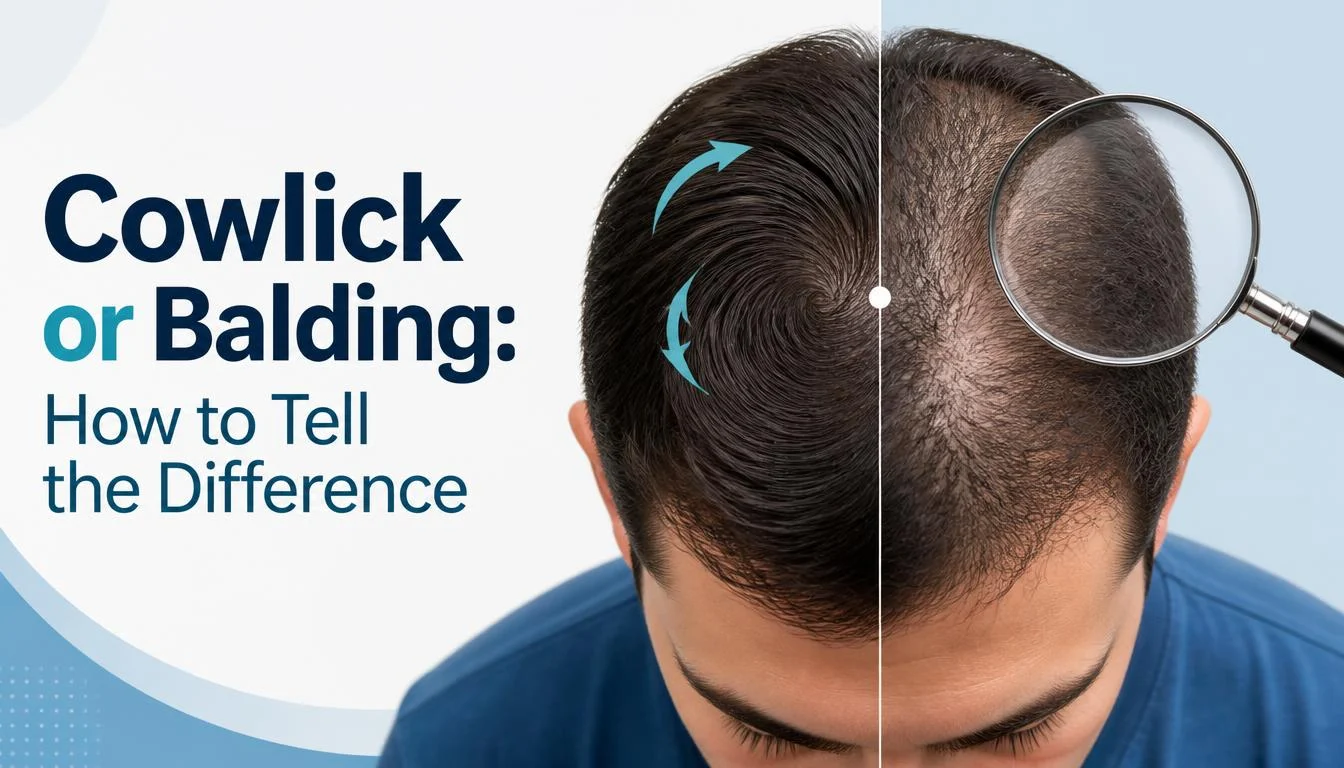
A cowlick can make a small area of your hair look thinner or more exposed, especially around the crown or hairline. Because the hair grows in a different direction, the scalp may become easier to see when the hair is short, wet, or styled a certain way. This can sometimes look similar to hair loss, even when your hair density has not changed.
Balding usually involves a gradual change in hair density or a receding hairline rather than simply having hair that grows in an unusual pattern. Knowing the difference between a cowlick or balding can help you understand what you are seeing and what signs to watch over time. In this guide, we’ll compare their appearance, common patterns, and the clues that can help you distinguish a natural cowlick from possible hair thinning.
Which One Is Correct?
Both cowlick and balding are correct English words. They are not alternative spellings of the same word, and one is not a misspelling of the other.
The key difference lies in what they describe:
- Cowlick refers to the direction or pattern of hair growth.
- Balding refers to hair loss or thinning.
- A cowlick can make the scalp look more visible without causing hair loss.
- Balding can create visibly thinner areas because fewer hairs remain there.
For example, someone can have a strong cowlick at the crown and still have thick, healthy hair. Likewise, someone can experience balding without having a noticeable cowlick.
So, if you are asking, “Is it a cowlick or balding?” the answer depends on whether the issue involves hair direction or hair density.
Meaning of the Correct Word
Definition
A cowlick is a section of hair that grows in a different direction from the surrounding hair. This pattern can cause the hair to stick up, swirl, separate, or resist styling.
Cowlicks often appear near the front hairline, crown, or back of the head. However, they can occur in other areas too.
Explanation
A cowlick does not mean that the hair in that area is disappearing. Instead, the hair follicles grow at an angle or follow a different growth pattern.
Imagine brushing all your hair in one direction. Most of it may follow the brush, but one small section keeps moving the opposite way. That stubborn section may be a cowlick.
The area can sometimes look thinner when the hair separates. The scalp may become more visible because the strands spread apart. This visual effect can make a cowlick look like early hair loss.
Lighting can make the effect even stronger. Bright overhead light may reveal more scalp between the separated strands.
Usage
The word cowlick works as a noun.
You can say:
- “I have a cowlick at the crown.”
- “His cowlick makes his hair stick up.”
- “She styles her bangs around her cowlick.”
- “My cowlick becomes more noticeable when my hair is short.”
You would not normally use cowlick as a verb in standard American English.
The adjective cowlicked can describe hair affected by a cowlick, although everyday speakers usually say “hair with a cowlick.”
Real-World Examples
A cowlick can affect hairstyles in several ways.
Someone with a frontal cowlick may find that bangs naturally separate. A person with a crown cowlick may notice a small spiral that exposes the scalp. Short hair can make the pattern especially obvious because there is less length to weigh the strands down.
Hairdressers often work with cowlicks instead of trying to completely eliminate them. Changing the haircut, drying direction, or styling method can make the pattern easier to manage.
Meaning of the Incorrect or Alternative Word
Incorrect
Balding is not incorrect. In fact, it is a standard English word.
It simply does not mean the same thing as cowlick. Calling a natural hair-growth pattern “balding” can therefore be inaccurate if no actual hair loss is occurring.
Typo
Balding is not a typo for cowlick, and cowlick is not a typo for balding. They come from different words and describe separate concepts.
A person might confuse them because both can involve a visible patch of scalp. The visual similarity does not make the terms interchangeable.
Slang
Neither word is primarily slang.
Cowlick is a standard everyday noun. Balding is also standard English and commonly appears in conversations about hair loss, grooming, and health.
Regional Variation
There is no major American-versus-British spelling distinction between these terms.
American English uses cowlick and balding, while British English also uses these words. Other expressions for hair loss may vary by region, but the basic distinction remains the same.
Rare but Valid Usage
The word balding can describe a person, process, or appearance associated with becoming bald.
For example:
“He noticed that he was balding at the temples.”
It can also function as a present participle related to the verb bald.
The noun baldness refers to the condition itself, while balding often emphasizes the process or visible progression of hair loss.
Key Differences Between the Two Words
| Feature | Cowlick | Balding |
|---|---|---|
| Spelling | Cowlick | Balding |
| Meaning | A section of hair that grows in a different direction | Progressive hair loss or thinning |
| Pronunciation | KOW-lik | BAWL-ding |
| Grammar | Noun | Present participle/adjective |
| Main focus | Hair direction and pattern | Hair density and loss |
| Scalp visibility | May appear more visible because hair separates | Often increases because hair becomes thinner |
| Usually permanent? | The growth pattern is generally natural and persistent | Hair loss may progress, depending on its cause |
| Common location | Hairline, crown, or back of the head | Hairline, temples, crown, or broader scalp |
| Recognition | Usually recognized by hair direction | Usually recognized by reduced density or recession |
| Interchangeable? | No | No |
The most useful distinction is simple: cowlicks change how hair sits, while balding changes how much hair is present.
A cowlick can create a swirl or part. Balding can create a widening part, receding hairline, or thinning crown. Still, appearance alone does not always provide a definite answer.
Common Mistakes People Make
Mistake 1: Calling Every Visible Scalp a Bald Spot
Seeing some scalp does not automatically mean that hair loss is occurring.
A cowlick can separate strands and create a small area where the scalp shows through. This effect can become more noticeable after swimming, showering, sweating, or applying a styling product.
Mistake 2: Assuming a Crown Cowlick Means Balding
The crown is a common place for natural hair whorls. A strong whorl can expose the scalp in the center.
Balding can also affect the crown, so the location alone cannot tell you what is happening. Look at the overall hair density and whether the pattern has changed over time.
Mistake 3: Confusing a Hair Part With Hair Loss
A deliberate or natural part can expose the scalp. A wider-looking part may sometimes result from reduced density, but it can also look different because of hairstyle, lighting, or hair texture.
Comparing the area over time gives more useful information than judging it from one photograph.
Mistake 4: Thinking a Cowlick Causes Balding
A cowlick is a growth pattern. It does not automatically cause hair loss.
The hair may grow in a direction that makes the area look unusual, but that does not mean the follicles are disappearing.
Mistake 5: Using “Balding” for Any Difficult Hair
Hair that sticks up, separates, or refuses to stay in place may simply have a cowlick.
For example, “My hair is balding because it will not lie flat” does not make sense. A better description would be, “I have a cowlick that makes my hair stick up.”
Mistake 6: Judging Hair Loss From One Day
Hair can look different from day to day. Wet hair, styling products, harsh lighting, and different hairstyles can all change how much scalp you see.
A noticeable change in density over time carries more meaning than a single bad hair day.
Correct Usage Examples
Casual Examples
- “I have a cowlick right at the front of my hair.”
- “My cowlick always sticks up after I wake up.”
- “I think my hair is starting to look thinner.”
- “His cowlick makes that hairstyle difficult to manage.”
- “The crown looks different, but it may just be my cowlick.”
These examples fit ordinary conversations about grooming and appearance.
Professional Examples
- “The client has a prominent cowlick near the crown.”
- “The haircut was adjusted to work with the natural cowlick.”
- “The patient reported gradual thinning around the temples.”
- “The pattern appears different from the client’s usual hair growth.”
- “Hair density should be considered when evaluating visible scalp.”
In professional writing, precise terms matter. Cowlick describes a pattern, while balding describes hair loss.
Educational Examples
- “A cowlick results from the natural direction of hair growth.”
- “Balding refers to a reduction in hair density or visible hair loss.”
- “A cowlick may expose the scalp without causing baldness.”
- “Hair direction and hair density are separate characteristics.”
- “A crown whorl does not automatically indicate balding.”
These sentences work well when explaining the difference to English learners.
Literary/Metaphorical Examples
Cowlick can also appear in descriptive writing when an author wants to show a character’s appearance.
- “A stubborn cowlick rose above his forehead.”
- “Her cowlick gave her otherwise neat hairstyle a playful edge.”
- “The wind exaggerated the cowlick at the crown.”
Balding can also appear in descriptive writing:
- “His once-thick hair was slowly thinning.”
- “The character noticed the early signs of a receding hairline.”
These uses describe appearance without treating the two words as synonyms.
Word Origin / Etymology
The word cowlick has an interesting connection to cattle. The term compares a patch of human hair with the hair pattern that can appear after a cow licks its coat.
The idea comes from the way a cow’s tongue can leave a section of hair standing in a different direction. English speakers eventually used this visual comparison for stubborn areas of human hair.
The word combines cow with lick, creating a memorable image of hair that looks as though an animal has licked it.
Balding has a different linguistic history. It comes from bald, a much older English word associated with having little or no hair on the head. The form balding developed from the verb bald, meaning to become bald or lose hair.
The two terms therefore have completely different origins. Their meanings do not overlap simply because both can describe something noticed on the scalp.
Why the Incorrect Version Became Popular
There is no genuine “incorrect version” in this comparison. Cowlick and balding are both established words.
The confusion usually comes from visual appearance rather than spelling. A cowlick can spread hair apart and reveal the scalp. Someone unfamiliar with the pattern may interpret that exposed area as hair loss.
The confusion can become stronger when a cowlick occurs near the crown. The crown is also a common location where people notice thinning. As a result, a person may use “balding” when they really mean that their hair has a noticeable swirl.
Online discussions can add to the confusion. People often describe their appearance using informal phrases such as “my hair looks bald here” or “this spot looks thin.” Those descriptions do not necessarily identify the underlying cause.
The safest language distinction is therefore straightforward: use cowlick when discussing hair direction, and use balding when discussing ongoing hair loss or thinning.
If you are unsure whether a change represents normal hair growth or actual hair loss, appearance alone cannot establish the cause. A qualified healthcare professional or dermatologist can assess persistent or concerning changes.
Easy Memory Tricks
Think “Direction” for Cowlick
Remember:
Cowlick = hair goes its own way.
If the hair is present but refuses to follow the surrounding direction, think cowlick.
Think “Decrease” for Balding
Remember:
Balding = less hair over time.
If the main issue involves thinning, recession, or reduced hair density, think balding.
Use the “Amount vs. Direction” Test
Ask yourself one simple question:
Is the problem about where the hair grows, or how much hair remains?
- Where it grows → cowlick
- How much remains → balding
This distinction works in everyday conversations and formal explanations.
Remember the Image
Picture a cow licking one section of its coat. The hair would point differently from the surrounding hair.
That mental image makes cowlick easy to remember.
FAQs
Is a cowlick the same as balding?
No. A cowlick is a natural hair-growth pattern, while balding involves hair loss or thinning.
Does having a cowlick mean I am balding?
No. A cowlick does not automatically indicate hair loss. It can simply make the scalp easier to see.
Is “cowlick” the correct word?
Yes. Cowlick is a standard English noun for a section of hair that grows in a different direction.
Is “balding” a correct English word?
Yes. Balding is standard English and describes the process or appearance of becoming bald or losing hair.
How do you pronounce cowlick?
Cowlick is pronounced KOW-lik, with the first syllable sounding like “cow.”
How do you pronounce balding?
Balding is pronounced BAWL-ding, with the first syllable sounding like “bald.”
Can a cowlick make you look bald?
Yes. A cowlick can separate hair and expose part of the scalp, which may create the appearance of a small bald spot.
Can a cowlick turn into balding?
A cowlick itself does not turn into balding. However, someone can naturally have a cowlick and separately experience hair loss.
Conclusion
Understanding cowlick or balding becomes easier when you focus on hair direction versus hair loss.A cowlick describes a natural growth pattern, while balding describes thinning or progressive loss of hair.Neither word is incorrect, but they should not be used interchangeably because their meanings are different.Remember: cowlick changes direction, while balding changes density.
Read More Articles
- Comma or Semicolon | When to Use a Comma and When to Use a Semicolon In 2026
- Omelette or Omelet | Correct Spelling, Meaning and Usage In 2026

Andrew Cooper is a blogger and writer at Gramscript.com, turning everyday ideas into clear, engaging stories. His writing blends curiosity, insight and a genuinely human perspective.