Quick Answer
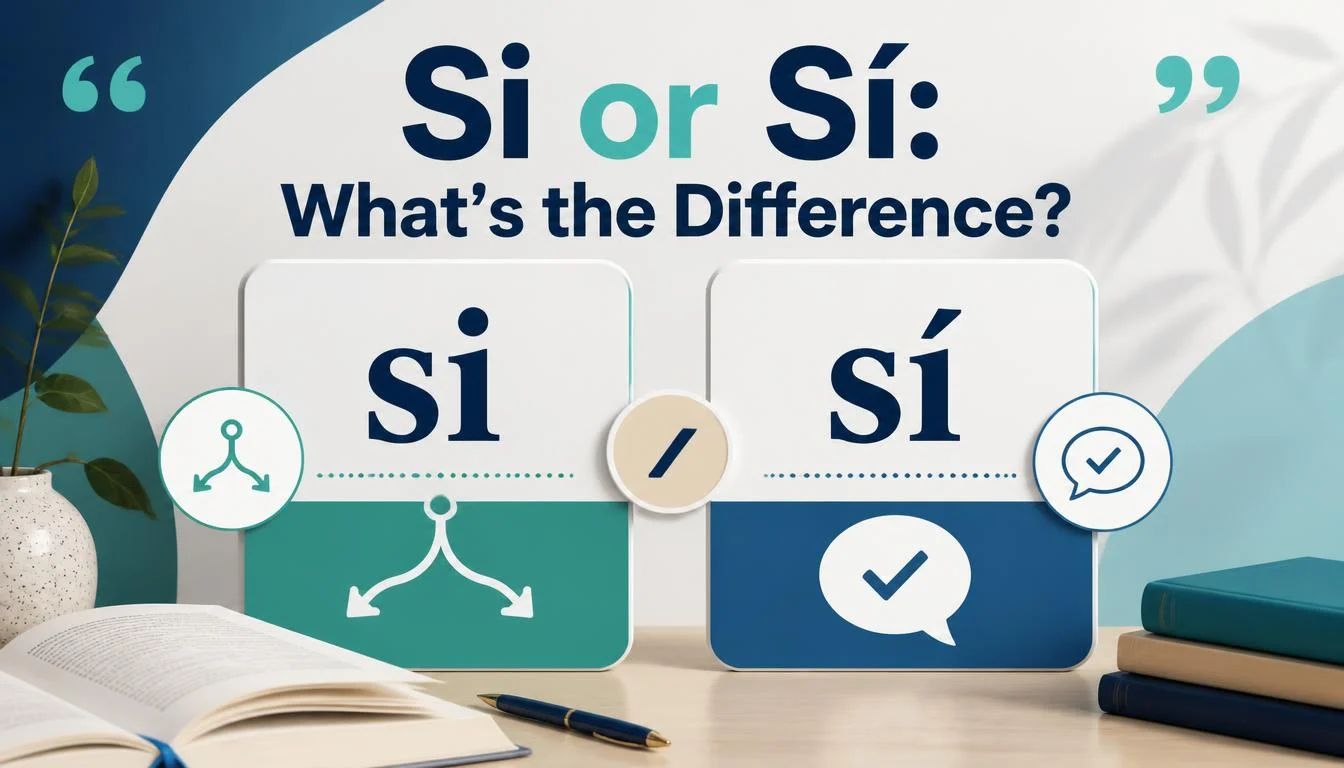
Si means “if” and introduces a condition, while sí usually means “yes” and expresses agreement.
The accent on sí changes its grammatical function, so the two forms should not be used interchangeably.
The difference between si or sí may look small, but the accent mark changes the meaning and grammatical role of the Spanish word. Si usually means “if” and introduces a condition, while sí commonly means “yes” or “self” in certain expressions. Because the two forms look almost identical, learners often confuse them when writing or reading Spanish.
Understanding si or sí becomes much easier once you know what each word does in a sentence. This guide explains their meanings, grammatical uses, and key differences with clear examples. You will also learn how the accent mark works and how to choose the correct form when writing Spanish.
Which Form Should You Use?
Both spellings are correct Spanish words. The right choice depends on what you want to say.
Use the unaccented form when you mean “if” or introduce an indirect question:
Si tienes tiempo, ven conmigo.
If you have time, come with me.
Use the accented form when you mean “yes”:
Sí, tengo tiempo.
Yes, I have time.
This difference is grammatical rather than regional. Spanish speakers throughout the Spanish-speaking world use these forms according to their function.
A useful beginner rule is:
si = if
sí = yes
That simple connection solves most everyday cases.
Understanding the Unaccented Form
Definition
Si is a Spanish conjunction that commonly means “if.” It introduces a condition and connects that condition with another idea.
For example:
Si estudias, aprenderás.
If you study, you will learn.
The first part gives the condition. The second part gives the possible result.
How It Works in a Sentence
Conditional sentences often contain two connected ideas. The first describes a situation, and the second explains what happens because of it.
Consider:
Si llueve, nos quedaremos en casa.
The sentence means:
If it rains, we will stay home.
The conjunction introduces the possibility of rain. It does not express agreement or confirmation.
The same word can also introduce an indirect question:
No sé si María viene.
This means:
I don’t know if María is coming.
Here, the word does not describe a condition in the usual sense. Instead, it introduces an embedded question.
Common Grammatical Uses
You will frequently encounter this form in:
- Conditional sentences
- Hypothetical statements
- Instructions
- Warnings
- Indirect questions
- Everyday conversations
Examples include:
Avísame si necesitas ayuda.
Si quieres, podemos empezar.
No sé si está abierto.
Dime si necesitas algo.
The surrounding sentence usually makes the meaning clear.
Real-World Examples
Here are some natural examples:
Si tienes hambre, hay comida en la cocina.
If you’re hungry, there is food in the kitchen.
Si terminamos temprano, iremos al cine.
If we finish early, we will go to the movies.
Si quieres aprender español, practica todos los días.
If you want to learn Spanish, practice every day.
No sé si Juan está en casa.
I don’t know if Juan is home.
Avísame si cambia el horario.
Let me know if the schedule changes.
In every example, the conjunction connects ideas rather than giving an affirmative answer.
Understanding the Accented Form
Definition
Sí usually means “yes.” It functions as an affirmative adverb and appears when someone agrees, confirms something, or gives a positive answer.
For example:
¿Quieres café?
Sí.
The answer means:
Yes.
The accent is essential in this meaning.
Affirmative Responses
This word commonly appears at the beginning of an answer:
Sí, quiero ir.
Sí, entiendo.
Sí, es correcto.
Sí, podemos hacerlo mañana.
It can also appear with other words:
Sí, claro.
Sí, por supuesto.
Sí, estoy de acuerdo.
These expressions are common in both casual and formal Spanish.
A Second Grammatical Function
The accented form has another use that learners sometimes miss. It can act as a reflexive pronoun after certain prepositions.
For example:
Lo compró para sí.
He or she bought it for himself or herself.
Ella habló de sí misma.
She spoke about herself.
In these sentences, the word does not mean “yes.” It refers back to the subject.
This use appears more often in formal writing than in basic conversation, but it is worth recognizing.
Si vs. Sí: Key Differences
| Feature | si | sí |
|---|---|---|
| Accent | None | Accent over í |
| Main meaning | If | Yes |
| Grammar | Conjunction | Adverb or reflexive pronoun |
| Main function | Introduces conditions or indirect questions | Gives an affirmative response |
| Pronunciation | Roughly “see” | Roughly “SEE” |
| English equivalent | If / whether | Yes |
| Example | Si vienes, hablamos. | Sí, voy. |
| Standard usage | Common | Common |
The biggest difference is grammatical function.
Compare these two sentences:
Si quieres venir, puedes entrar.
Sí, quiero venir.
The first sentence describes a condition. The second confirms something.
The Role of the Accent Mark
Spanish uses accent marks for several reasons. In some cases, an accent indicates where stress falls. In others, it helps distinguish words that otherwise look identical.
The distinction here is especially useful because si and sí have different meanings despite their similar appearance.
Think of the written accent as a signal for the reader:
- si → conditional or indirect-question meaning
- sí → affirmative or reflexive meaning
This makes written communication clearer.
Common Mistakes Spanish Learners Make
Forgetting the Accent in an Affirmative Answer
A common error is:
Si, quiero ir. ❌
The correct sentence is:
Sí, quiero ir. ✅
The speaker is saying “yes,” so the accent belongs on the vowel.
Adding an Accent to a Conditional Clause
The opposite mistake also occurs:
Sí estudias, aprenderás. ❌
Correct:
Si estudias, aprenderás. ✅
The sentence means “If you study, you will learn.” It introduces a condition, so no accent appears.
Treating Accent Marks as Optional
Learners sometimes omit accents while typing because the keyboard makes them inconvenient. However, accents can distinguish separate words and meanings.
For this reason, it is useful to develop the habit of checking accent marks when proofreading Spanish writing.
Confusing Similar-Looking Words
Short words can create disproportionate confusion because there are fewer visual clues.
When you see the two forms, do not ask only:
“How does this sound?”
Ask:
“What job is this word doing?”
If it introduces a condition, choose the unaccented form. If it gives an affirmative response, choose the accented form.
Assuming Context Does Not Matter
Context often determines which spelling makes sense.
Compare:
Si quieres, ven.
with:
Sí, quiero.
The first statement depends on a condition. The second gives an answer.
Understanding the sentence structure is more reliable than memorizing pronunciation alone.
Correct Usage in Different Situations
Casual Conversations
In everyday conversations, the distinction appears constantly.
¿Vienes con nosotros?
Sí, voy.
Si quieres, podemos caminar.
¿Te gusta esta película?
Sí, mucho.
Si estás cansado, podemos irnos.
These short examples show why the accent matters even in simple speech.
Professional Communication
Formal Spanish also follows the same distinction.
Sí, hemos recibido su mensaje.
Si necesita más información, puede llamarnos.
Sí, confirmamos la cita.
Si tiene alguna pregunta, estaremos disponibles para ayudarle.
Notice how the affirmative response and conditional statement use different spellings.
Educational Contexts
Teachers often use both forms when explaining Spanish grammar.
Si practicas diariamente, mejorarás.
Sí, entiendo la explicación.
Si no conoces la palabra, consulta el diccionario.
Sí, esa respuesta es correcta.
These examples help students connect spelling with grammatical function.
Formal and Literary Writing
The distinction also appears in more sophisticated writing.
Si el tiempo lo permite, continuaremos mañana.
Sí, todavía recuerdo aquella tarde.
The first sentence presents a condition. The second gives a strong affirmative response.
The reflexive use can also appear in formal prose:
El autor habló de sí mismo.
Here, the accented form refers back to the subject.
Pronunciation Guide
How to Pronounce the Unaccented Form
For beginners, si can be approximated as “see.”
The pronunciation is short and simple.
How to Pronounce the Accented Form
Sí is also roughly pronounced “SEE.”
The main distinction is not a dramatic difference in sound. Instead, stress, context, and written accent marks help identify the intended meaning.
This explains why beginners can understand the difference more easily in writing than in speech.
Why Listening Can Be Tricky
When someone speaks quickly, you may not notice the difference immediately. Native speakers rely heavily on the surrounding words and sentence structure.
That means you should learn both spelling and grammar together rather than trying to distinguish the words by sound alone.
Word Origin and Etymology
The two forms have different historical roots.
The conditional conjunction si comes from Latin sī, which carried a conditional meaning similar to “if.”
The affirmative sí developed through Latin forms associated with affirmation, particularly sic, meaning “thus” or “in this way.”
The reflexive pronoun sí has a separate history connected with the Latin reflexive pronoun sibi.
These different origins explain why modern Spanish treats the forms as separate words. Their similar appearance does not mean they developed from the same modern grammatical function.
Why Learners Often Confuse the Two Forms
Several factors make this distinction challenging.
First, both forms are extremely short. A single accent mark creates the visible difference.
Second, their pronunciation is very similar. Learners cannot always depend on hearing the word alone.
Third, English uses completely different words for the meanings. English speakers see if and yes, so the relationship between the Spanish forms may feel unfamiliar.
Finally, Spanish learners often focus on vocabulary before mastering accent patterns. Once they understand how accent marks can distinguish words, this pair becomes much easier.
Easy Ways to Remember the Difference
Think of “If” First
Whenever the sentence describes a condition, think:
if → si
Si llueve, me quedaré en casa.
If it rains, I will stay home.
Think of “Yes” First
Whenever someone answers positively, think:
yes → sí
Sí, me gusta.
Yes, I like it.
Use the Condition Test
Ask:
Does the sentence contain a condition?
If the answer is yes, the word will usually be si.
Si estudias, mejorarás.
Use the Answer Test
Ask:
Is this word answering a question with “yes”?
If so, use sí.
¿Quieres venir? Sí.
Remember the Accent as a Signal
You can think of the accent as a visual flag that says:
This word is not the conditional conjunction.
That mental association makes proofreading easier.
FAQs
What does the unaccented Spanish form mean?
It usually means “if.” It can also introduce an indirect question, such as “I don’t know if she is coming.”
What does the accented version mean?
It usually means “yes.” It can also work as a reflexive pronoun after certain prepositions.
Is the accent mark really necessary?
Yes. In standard written Spanish, the accent distinguishes the affirmative word from the conditional conjunction.
Are both spellings correct?
Yes. Both are standard Spanish words, but they have different meanings and grammatical functions.
Do the two forms sound different?
They sound very similar. Context and grammar usually provide the clearest distinction in spoken language.
How do I remember which one means “if”?
Remember si = if. Use the unaccented spelling when introducing a condition.
How do I remember which one means “yes”?
Remember sí = yes. The accented spelling normally appears in affirmative answers.
Can the accented form refer to a person?
Yes. In expressions such as para sí or de sí misma, it can function as a reflexive pronoun meaning “oneself” or referring back to the subject.
Conclusion
The two Spanish forms have different meanings even though they look and sound almost identical.Use si for conditions and indirect questions, while sí usually expresses agreement or affirmation.The accent mark provides an important written clue and should not be treated as optional.Remember si = if and sí = yes, and this small Spanish grammar distinction becomes much easier to use correctly.
Read More Articles
- Coffee or Die | Meaning, Origin and What the Phrase Really Means In 2026
- Tase or Taze |Meaning, Spelling and Usage Explained In 2026

Andrew Cooper is a blogger and writer at Gramscript.com, turning everyday ideas into clear, engaging stories. His writing blends curiosity, insight and a genuinely human perspective.
1 thought on “Si or Sí | Spanish Grammar, Meaning and Examples In 2026”