Quick Answer
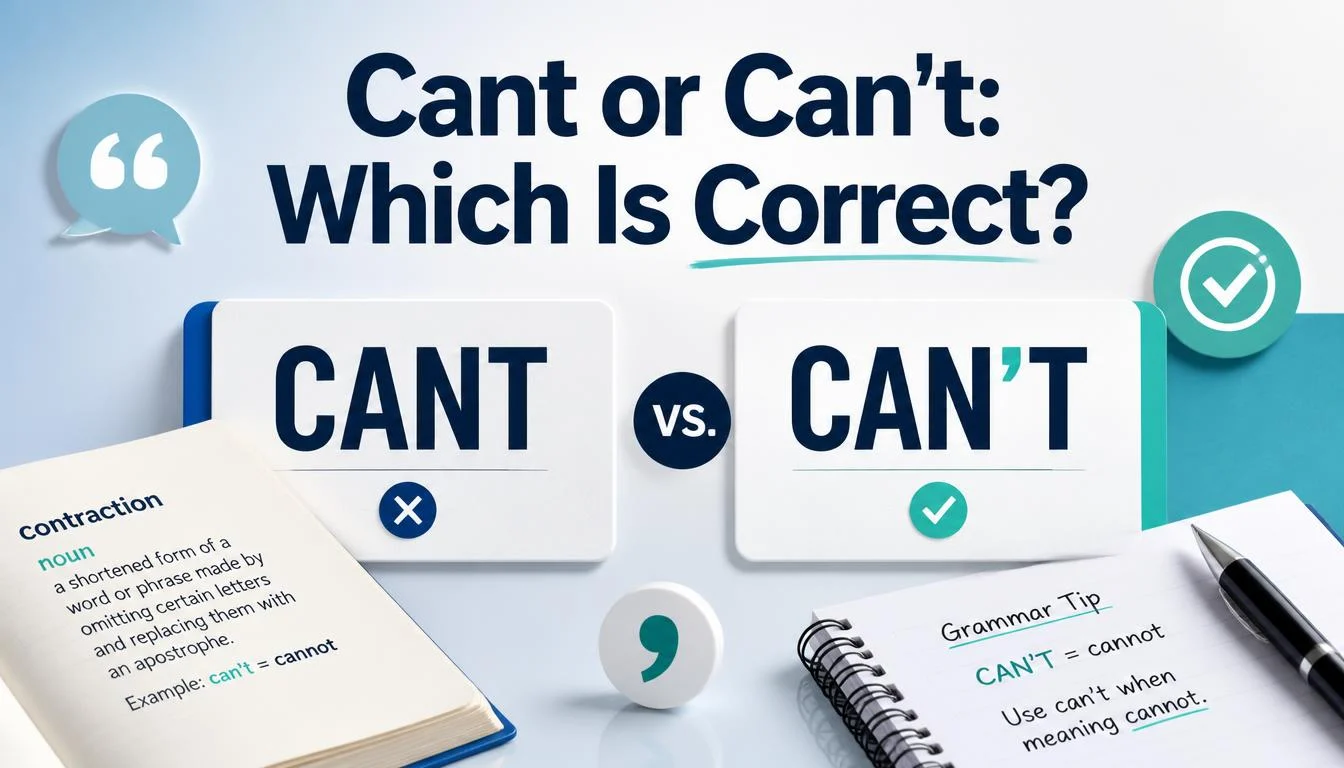
Can’t is the contraction of cannot and means “cannot” or “is not able to.”Cant is also a real English word, but it has different meanings and is not a replacement for can’t.
Cant or can’t may look almost identical, but the two forms have different meanings and grammatical functions. Can’t is the contraction of cannot and commonly expresses inability, impossibility, or refusal, as in “I can’t swim” or “She can’t attend the meeting.” Cant, without the apostrophe, is a separate word with a much less common use. It can refer to a particular type of language or jargon, and it can also describe a slanting or tilted position in certain contexts.
The apostrophe in can’t matters because it signals the shortened form of cannot. If you are writing about something you are unable to do, can’t is normally the correct choice. Cant belongs to different contexts and should not replace can’t in everyday sentences. Understanding this small spelling difference can help you avoid a common mistake and choose the right form with confidence.
Which One Is Correct?
Both cant and can’t are correct English words, but they do not mean the same thing.
Can’t is a contraction of cannot. It expresses inability, impossibility, prohibition, or refusal depending on the context.
- I can’t swim.
- She can’t attend the meeting.
- You can’t park here.
- We can’t ignore the problem.
Cant, without an apostrophe, is a separate word. It has several less common meanings. It can describe insincere moral language, specialized vocabulary, or a sloping surface or position in certain technical contexts.
Therefore, neither spelling is universally “wrong.” The correct choice depends on what you want to say.
A useful rule is simple: If you mean “cannot,” write “can’t.”
Meaning of the Correct Word
Definition
Can’t is a contraction of cannot. It usually means that someone is unable to do something or that something is not possible.
It can also express a rule or prohibition:
You can’t enter this room.
Here, can’t means that entering is not allowed.
The word can also express disbelief:
That can’t be true.
In this sentence, the speaker believes that something is impossible or highly unlikely.
Explanation
Can’t contains an apostrophe because it combines two words into a shorter form:
cannot → can’t
The apostrophe signals missing letters. In standard English, can’t functions as a modal verb.
The base verb follows can’t without to:
- I can’t drive.
- She can’t come.
- They can’t agree.
- We can’t wait.
Not:
- I can’t to drive.
- She can’t to come.
The negative form changes the meaning of the sentence. Compare:
- I can help.
- I can’t help.
The first sentence shows ability or possibility. The second denies it.
Usage
Can’t appears frequently in everyday conversation, informal writing, emails, messages, and ordinary professional communication.
It commonly expresses:
Inability
I can’t lift this box alone.
Impossibility
That can’t be the right address.
Prohibition
You can’t use your phone during the exam.
Lack of permission
Visitors can’t enter this area.
Strong disbelief
He can’t be serious.
Practical limitation
I can’t finish the report before noon.
In formal writing, writers sometimes prefer cannot instead of can’t, especially when they want a more formal tone.
Real-World Examples
Here are several natural examples:
- I can’t find my keys.
- Marcus can’t join us tonight.
- We can’t afford to delay the project.
- You can’t leave your car here.
- She can’t believe the news.
- This device can’t connect to the network.
- I can’t remember his name.
- They can’t accept applications after Friday.
Notice that each sentence could use cannot instead:
I cannot find my keys.
The meaning stays almost identical, but the tone becomes more formal.
Meaning of the Incorrect or Alternative Word
Incorrect
Cant is not inherently incorrect. It becomes incorrect when you use it where can’t should appear.
For example:
I cant understand this sentence.
If the intended meaning is “I cannot understand this sentence,” the sentence needs an apostrophe:
I can’t understand this sentence.
Without the apostrophe, cant becomes a different word.
Typo
Cant often appears as a typo when someone types quickly and forgets the apostrophe.
This mistake is especially common in text messages, social media posts, comments, and informal digital writing.
For example:
I cant come tonight.
The intended form is almost certainly:
I can’t come tonight.
Spell-checkers may catch some instances, but they cannot always identify the problem. Since cant is a legitimate English word, a writing program may recognize it as correctly spelled.
Slang
Cant is not simply a slang version of can’t.
Some people may omit apostrophes in casual digital writing, but that does not create a standard alternative spelling. Writing cant when you mean can’t is normally an error or an informal omission.
Standard English uses the apostrophe in can’t.
Regional Variation
The difference between cant and can’t is not primarily a US-versus-UK spelling issue.
Both forms exist in American English and British English. Can’t is the standard contraction of cannot in both varieties.
The word cant also exists independently in both varieties, although some of its specialized meanings are uncommon in everyday conversation.
Rare but Valid Usage
Cant has several dictionary-recognized meanings.
One meaning refers to insincere, affected, or sanctimonious speech:
The politician’s speech was dismissed as empty cant.
Another meaning refers to specialized language or jargon associated with a particular group.
In technical contexts, cant can also refer to a slope, tilt, or angle. For example, engineers, railway specialists, and other technical writers may use the term in specialized contexts.
These meanings are legitimate, but they are far less common than can’t.
Key Differences Between the Two Words
| Feature | Cant | Can’t |
|---|---|---|
| Spelling | No apostrophe | Contains an apostrophe |
| Meaning | Jargon, insincere speech, or a technical slope/tilt | Cannot; is unable to |
| Pronunciation | Usually “kant” | Usually “kant” |
| Grammar | Noun or verb, depending on meaning | Modal verb contraction |
| Usage | Relatively uncommon | Extremely common |
| Recognition | A valid independent word | A standard contraction |
| Example | His speech sounded like cant. | I can’t attend. |
| Common mistake | Used instead of “can’t” | Apostrophe omitted accidentally |
The most important difference is grammatical.
Can’t works as a negative modal verb:
She can’t drive.
Cant does not perform that function:
She cant drive.
That second sentence does not normally mean “She cannot drive.” It creates confusion because cant has a separate meaning.
Pronunciation can make the problem harder. In most standard American English speech, cant and can’t sound very similar. Some speakers may distinguish them more clearly than others, but spelling provides the reliable distinction in writing.
Common Mistakes People Make
Forgetting the Apostrophe
The most common error occurs when writers type cant instead of can’t.
Incorrect:
I cant stay long.
Correct:
I can’t stay long.
The apostrophe matters because it identifies the contraction.
Confusing Can’t With Cannot
Some writers assume can’t and cannot have different meanings.
They generally express the same negative idea:
I can’t help you.
I cannot help you.
The main difference is tone and style. Cannot can sound more formal or emphatic, while can’t sounds natural and conversational.
Using Cant as a Negative Verb
A common mistake is treating cant as though it were a standard spelling of can’t.
Incorrect:
We cant accept this offer.
Correct:
We can’t accept this offer.
The first sentence uses the wrong form if the intended meaning is “We cannot accept this offer.”
Adding “To” After Can’t
Because can’t is followed by a base verb, do not add to.
Incorrect:
I can’t to attend the meeting.
Correct:
I can’t attend the meeting.
This rule applies to other modal verbs too:
- can go
- can’t go
- should go
- must go
- might go
Using Can’t in a Formal Context Without Considering Tone
Can’t is grammatically correct in professional writing. Still, cannot may sound more formal in some situations.
For example:
We can’t process your request without additional information.
This is perfectly acceptable.
A more formal version is:
We cannot process your request without additional information.
Choose according to the tone and audience rather than assuming can’t is grammatically wrong.
Correct Usage Examples
Casual Examples
Casual conversation frequently uses can’t.
I can’t make it tonight.
I can’t find my phone.
Sorry, I can’t stay for dinner.
I can’t believe you did that!
We can’t wait any longer.
These examples sound natural in everyday American English.
Professional Examples
Can’t also works in workplace communication when the tone remains conversational.
I can’t attend the meeting at 9 a.m., but I can join at 10.
We can’t complete the project without the updated files.
I can’t approve the request until the manager reviews it.
For formal letters, contracts, reports, or official notices, writers may prefer cannot.
The company cannot accept incomplete applications.
The choice depends on the level of formality, not grammatical correctness.
Educational Examples
Teachers and students often use can’t when explaining ability or rules.
You can’t use a calculator during this section of the test.
A young child can’t always understand complex instructions.
You can’t change the answer after the exam ends.
In grammar lessons, can’t often appears as the negative form of can.
Compare:
I can swim.
I can’t swim.
The first sentence expresses ability. The second denies that ability.
Literary/Metaphorical Examples
Writers can use can’t to create emphasis, disbelief, or emotional impact.
I can’t forget the sound of that old piano.
You can’t outrun your own memories.
The heart can’t always explain what the mind understands.
These sentences use the ordinary grammatical meaning of can’t, but context can give the statement a stronger emotional or metaphorical effect.
By contrast, cant can appear in literary or historical writing when an author refers to hypocritical speech or specialized language:
The character rejected the moral cant of the age.
Here, cant has nothing to do with inability.
Word Origin / Etymology
The history of can’t connects directly to cannot. English has used negative forms of can for centuries. Over time, spoken English developed shortened forms that became common in writing.
The apostrophe in can’t represents omitted letters from the longer expression. Modern English therefore treats can’t as a contraction rather than as an entirely separate word.
The history of cant is more complicated because English has several related and unrelated uses of the word.
One historical sense of cant developed around singing, chanting, or a particular manner of speech. Its history connects with Latin cantare, meaning “to sing,” through historical forms of French and English. From ideas of singing or distinctive speech, the word developed additional senses involving specialized or affected language.
Another use of cant refers to an angle, tilt, or slope. That sense has a different historical development and appears particularly often in specialized or technical contexts.
This distinction explains why cant can be a legitimate dictionary word even though it cannot replace can’t.
Why the Incorrect Version Became Popular
The main reason people write cant instead of can’t is simple: the apostrophe is easy to miss.
Typing habits make this especially common. When people write quickly on phones or keyboards, they may leave out punctuation. Apostrophes are also less noticeable than letters, so a missing apostrophe can easily escape attention.
Pronunciation adds another challenge. In many varieties of American English, cant and can’t sound extremely similar. A listener usually depends on context to understand the intended meaning.
Digital writing has also made apostrophe omission more visible. Text messages, usernames, search queries, captions, and informal comments often contain simplified punctuation.
However, omitting the apostrophe does not make cant a standard spelling of can’t. In careful writing, use the form that matches the intended meaning.
Easy Memory Tricks
Think “Cannot”
If you can replace the word with cannot, use can’t.
I can’t go.
Becomes:
I cannot go.
The meaning still works, so can’t is correct.
Look for the Verb
If the word is followed by a base verb, you probably need can’t.
- can’t swim
- can’t drive
- can’t sleep
- can’t understand
- can’t remember
This quick test works in many everyday sentences.
Remember the Apostrophe
Think of the apostrophe as a small sign that letters have been removed:
can + not → can’t
The apostrophe reminds you that the word is a shortened form.
Give Cant Its Own Meaning
Do not think of cant as a damaged version of can’t.
Instead, remember that cant is its own word.
For example:
His argument was filled with moral cant.
That sentence uses cant as a noun meaning insincere or affected moral language.
Once you give cant its own identity, the spelling difference becomes easier to remember.
FAQs
Is “cant” correct English?
Yes. Cant is a legitimate English word with meanings such as insincere speech, specialized language, and technical slope or tilt.
Is “can’t” short for “cannot”?
Yes. Can’t is the standard contraction of cannot.
Do “cant” and “can’t” sound the same?
They usually sound very similar, and many American English speakers pronounce them alike in ordinary speech.
Should I write “I cant” or “I can’t”?
Write I can’t when you mean I cannot.
Is “cant” a slang spelling of “can’t”?
No. Cant is not a standard slang replacement for can’t. Omitting the apostrophe is usually an informal writing error.
Is “can’t” acceptable in formal writing?
Yes. It is grammatically correct, although cannot may sound more formal in some professional or official contexts.
Can “cant” be a noun?
Yes. Cant can be a noun referring to insincere or affected speech, specialized jargon, or certain technical concepts.
What is the easiest way to remember “cant” vs. “can’t”?
If you can replace the word with cannot, choose can’t. If you mean a separate noun or technical term, cant may be correct.
Conclusion
The difference between cant or can’t becomes simple once you focus on meaning rather than pronunciation.Use can’t when you mean “cannot,” especially before a base verb.Use cant only when you mean the separate noun or technical term.When in doubt, remember: if you mean cannot, don’t forget the apostrophe in can’t.
Read More Articles
- Cue or Que | Meaning, Differences and How to Use Each Word In 2026
- Publicly or Publically | Meaning, Spelling and Usage In 2026

Christopher Parker is a writer and blogger at GramScript.com, sharing thoughtful insights and engaging stories across a range of topics. His writing blends clarity, curiosity, and a distinctly human perspective.
2 thoughts on “Cant or Can’t | Meaning, Grammar Rules and Sentence Examples In 2026”