Quick Answer
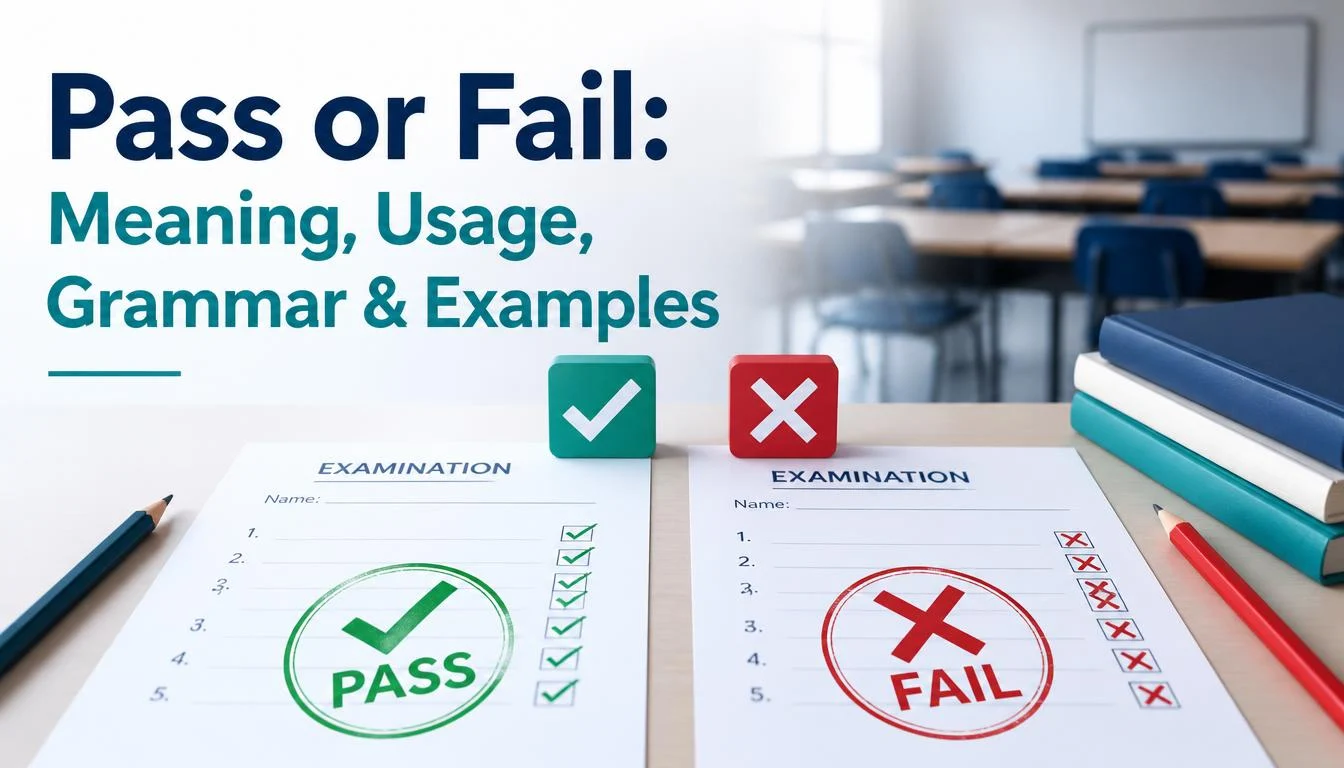
Pass or fail is a standard English phrase used when someone must succeed or not succeed in a test, exam, task, or requirement.Pass means to meet the required standard, while fail means not to meet it.
Pass or fail is a simple expression used to describe the outcome of a test, exam, assessment, requirement, or evaluation. When someone meets the required standard, they pass; when they do not meet it, they fail. Although the phrase looks straightforward, its meaning can change slightly depending on the context, such as education, work, driving tests, or everyday situations.
Understanding pass or fail can help you communicate results clearly and avoid confusion when discussing performance or requirements. In this guide, you will learn what pass and fail mean, how they differ, how to use them naturally in sentences, and which contexts commonly use these terms. Real-life examples will also make the difference easier to understand.
Which One Is Correct?
Both pass and fail are correct English words. Neither one is an incorrect version of the other.
The phrase pass or fail is also completely correct when you are describing two possible outcomes. For example:
You will find out tomorrow whether you pass or fail.
Here, pass means to achieve the required result, while fail means to fall below the required standard.
The word pass can function as a verb or noun, while fail can also function as a verb or noun. The conjunction or connects the two alternatives.
So, there is no spelling choice between pass and fail. They have different meanings and serve as opposites in many contexts.
Meaning of the Correct Word
Definition
Pass means to succeed in a test, examination, assessment, or requirement by reaching the necessary standard.
As a verb, pass describes successful completion:
She passed her driving test.
As a noun, pass can refer to a successful result:
He received a pass in mathematics.
The exact meaning depends on context. In everyday English, pass can also mean to move past something, hand something to another person, or spend time.
Explanation
When pass relates to an exam or assessment, it indicates that the person’s performance met the minimum standard.
For example, imagine a test requires 70 points. A student who earns 75 points passes the test. A student who earns 60 points does not pass.
The required standard can vary. Some exams use a fixed score, while others consider several requirements. A person may therefore pass because they achieved the necessary score, completed all required tasks, or met specific conditions.
The opposite result is fail.
Usage
Use pass when someone succeeds in an examination, test, course, inspection, or similar requirement.
Common patterns include:
- pass an exam
- pass a test
- pass a course
- pass a driving test
- pass an inspection
- pass an assessment
- pass the required standard
- pass with a high score
In American English, pass is normally followed directly by the object when discussing an examination.
I passed the exam.
The form I passed in the exam does not normally express this idea in standard American English.
Real-World Examples
Here are several natural examples:
Maria passed her final exam on the first attempt.
The vehicle passed the safety inspection.
Did you pass the certification test?
He studied every evening because he wanted to pass the course.
The applicant passed all required assessments.
Notice that pass does not always refer to school. It can describe any formal or informal requirement that someone successfully meets.
Meaning of the Incorrect or Alternative Word
Incorrect
Fail is not an incorrect word. It is the opposite outcome of pass when discussing a test, exam, assessment, or requirement.
For example:
I passed the exam.
means that I met the required standard.
I failed the exam.
means that I did not meet the required standard.
Therefore, calling fail an “incorrect word” would be misleading. It is correct when the situation describes an unsuccessful result.
Typo
Neither pass nor fail is normally a typo for the other. They contain different letters and express opposite outcomes.
A typo might occur when someone accidentally writes fasl instead of fail or pas instead of pass. Such errors are spelling mistakes, not alternative forms.
Slang
Neither pass nor fail is slang in this context. Both are standard English words used in education, employment, government, business, and everyday conversation.
The informal expression pass or fail may appear in casual speech, but the words themselves remain standard.
Regional Variation
There is no major American-versus-British spelling difference between pass and fail.
Both forms are standard in American English and British English.
Some educational systems use different grading systems or terminology. However, the basic distinction between passing and failing remains widely understood.
Rare but Valid Usage
The words have many meanings beyond examination results.
For example, pass can mean to move from one place to another:
The train passed the station.
It can also mean to hand something to someone:
Please pass me the salt.
Fail can also describe something that does not work:
The machine failed during testing.
These meanings are valid, but they do not change the meaning of pass or fail when the phrase describes an outcome.
Key Differences Between the Two Words
| Feature | Pass | Fail |
|---|---|---|
| Spelling | Pass | Fail |
| Meaning | Meet the required standard | Not meet the required standard |
| Pronunciation | “pass” | “fail” |
| Grammar | Verb and noun | Verb and noun |
| Exam usage | Indicates success | Indicates an unsuccessful result |
| Usage | Positive outcome in this context | Negative outcome in this context |
| Recognition | Standard English | Standard English |
| Opposite | Fail | Pass |
The biggest difference is meaning. Pass indicates that a person or thing meets the required condition. Fail indicates that the required condition has not been met.
Pronunciation
Pass is pronounced like “pass.” It has a short vowel sound, similar to the vowel in class for many American English speakers.
Fail is pronounced “fayl.” It rhymes with words such as sale, mail, and tail.
The phrase pass or fail sounds like:
“pass or fayl”
Clear pronunciation matters because the two words have very different sounds and meanings.
Grammar
Both words can act as verbs.
I passed the exam.
I failed the exam.
They can also function as nouns in certain contexts.
She received a pass.
The project was considered a fail.
The noun fail is more informal in some uses, especially when describing a mistake or unsuccessful attempt. In formal academic contexts, institutions often use terms such as failure, unsatisfactory result, or a specific grade instead.
Common Mistakes People Make
Treating Pass and Fail as Spelling Variants
One common mistake involves assuming that pass and fail are competing spellings for the same idea.
They are not. They express opposite outcomes.
Correct: I hope I pass the exam.
Correct: I hope I don’t fail the exam.
Using “Pass in” Incorrectly
Learners sometimes write:
I passed in the exam.
In standard American English, the more natural construction is:
I passed the exam.
However, pass in can appear in other grammatical structures with different meanings.
She passed in front of the building.
Here, passed means moved past something. It does not describe an exam result.
Confusing “Fail” With “Failed”
The base form fail follows modal verbs and certain auxiliary structures.
You may fail the test.
The past form is failed.
I failed the test yesterday.
The same distinction applies to pass because its simple past form is passed.
I pass the test.
I passed the test.
Forgetting the Object
When discussing an exam, pass often takes a direct object.
I passed the exam.
She passed the test.
You can also use the verb without an object when the context already makes the meaning clear:
I studied hard, and I passed.
Both structures are natural.
Using “Passed” When You Mean “Past”
This mistake is especially common because passed and past sound similar.
Passed is usually a verb form.
She passed the exam.
Past can function as a preposition, adjective, noun, or adverb.
We walked past the school.
The two words are not interchangeable.
Confusing “Fail” With “Failure”
Fail is usually the verb:
I failed the test.
Failure is the noun:
The failure surprised everyone.
Using the correct grammatical form makes your sentence clearer.
Correct Usage Examples
Casual Examples
I really hope I pass this test.
Did you pass your driving exam?
I thought I would fail, but I passed.
If I fail, I’ll take the test again.
We don’t know yet if she passed or failed.
These examples fit everyday conversations between friends, classmates, and family members.
Professional Examples
Professional settings often use pass or fail when describing assessments, inspections, certifications, and compliance requirements.
Employees must pass the required safety assessment.
The equipment will undergo a pass-or-fail inspection.
Candidates must pass all sections of the certification examination.
The application may be rejected if the applicant fails to meet the minimum requirements.
In formal writing, clarity matters more than complicated vocabulary. The simple terms pass and fail often communicate the result most directly.
Educational Examples
Schools and colleges commonly use these words when discussing exams and courses.
Students must pass the final examination to complete the course.
She passed all of her classes this semester.
He failed the mathematics exam but passed the other subjects.
The instructor explained the pass or fail requirements before the test.
The phrase can also describe a grading system.
This course uses a pass-or-fail grading system.
Here, pass-or-fail acts as a compound adjective before grading system. The hyphens help connect the words as one modifier.
Literary/Metaphorical Examples
The words can also appear metaphorically.
The new product was a pass-or-fail moment for the company.
The interview felt like a pass-or-fail test of her confidence.
These expressions do not necessarily involve an official examination. Instead, they compare a difficult situation to a test with two possible outcomes.
However, writers should avoid using the expression so often that it becomes vague. In formal writing, specify the actual condition whenever possible.
The inspection determined whether the building met safety requirements.
This sentence gives more information than simply saying the inspection was pass or fail.
Word Origin / Etymology
The history of pass and fail reaches back through older forms of English and French.
Pass entered English through Old French passer, meaning “to go,” “to move,” or “to pass.” Its history connects to the Latin passus, related to the idea of a step or pace. Over time, English developed many meanings for pass, including moving by, handing something over, spending time, and successfully completing an examination.
The examination meaning developed later from the broader idea of getting through or moving beyond a required stage. If a student successfully moved through an examination or requirement, the person could be said to have passed it.
Fail also entered English through Old French, from faillir, meaning “to fail,” “to be lacking,” or “to fall short.” Its deeper history connects to Latin fallere, associated with deceiving, disappointing, or failing.
The modern meanings became closely connected to performance and requirements. Today, pass and fail commonly form a natural pair because they describe opposite results.
Why the Incorrect Version Became Popular
There is no incorrect version of pass or fail in standard English. The apparent confusion usually comes from treating two opposite words as if they were spelling alternatives.
Learners may encounter phrases such as pass/fail, pass-or-fail, and pass or fail. These forms look different, but they can all be correct in suitable contexts.
Pass or fail is the ordinary phrase when the words function as alternatives.
You will receive your result whether you pass or fail.
Pass/fail often appears in compact labels, forms, charts, and grading descriptions.
Pass/Fail: Complete the assessment by Friday.
Pass-or-fail is useful when the entire expression modifies another noun.
The company uses a pass-or-fail assessment.
The punctuation depends on grammar and context. The words themselves do not change.
Easy Memory Tricks
A simple way to remember the difference is:
Pass = meet the standard.
Fail = miss the standard.
Think of a finish line. If you reach the required point, you pass. If you do not reach it, you fail.
Another useful trick is to connect pass with permission to move forward.
Pass → move forward.
Connect fail with falling short.
Fail → fall short.
You can also remember the basic sentence pattern:
I passed the test.
means you succeeded.
I failed the test.
means you did not succeed.
When you see pass or fail, think of two doors: one represents meeting the requirement, and the other represents not meeting it.
FAQs
Is “pass or fail” grammatically correct?
Yes. Pass or fail is a standard phrase that presents two possible outcomes.
Is pass the opposite of fail?
Yes. When discussing exams, tests, or requirements, pass means meeting the standard, while fail means not meeting it.
Should I write “pass or fail” or “pass/fail”?
Both can be correct. Use pass or fail in ordinary sentences and pass/fail in compact labels or grading descriptions.
Should “pass or fail” have hyphens?
Usually, no. Use pass or fail when it functions normally in a sentence. Use pass-or-fail when it works as a compound adjective before a noun.
Is “I passed the exam” correct?
Yes. I passed the exam is the natural standard construction in American English.
Is “I failed the exam” correct?
Yes. I failed the exam correctly states that you did not meet the required standard.
What does “pass or fail” mean?
It means that there are two possible outcomes: meeting the required standard or not meeting it.
Is “pass or fail” formal or informal?
It works in both formal and informal English. Formal documents may also use more specific terms such as successful, unsuccessful, or meets requirements.
Conclusion
Pass or fail is a correct and widely used English phrase for two opposite outcomes.Pass means meeting the required standard, while fail means falling below it.Use pass or fail, pass/fail, or pass-or-fail according to the sentence structure and context.
Remember: when you meet the standard, you pass; when you fall short, you fail.
Read More Articles
- Cant or Can’t | Meaning, Grammar Rules and Sentence Examples In 2026
- Guns or Butter | Meaning, Definition and the Economic Choice Explained In 2026

Christopher Parker is a writer and blogger at GramScript.com, sharing thoughtful insights and engaging stories across a range of topics. His writing blends clarity, curiosity, and a distinctly human perspective.
1 thought on “Pass or Fail |Meaning, Differences and How to Use Each Correctly In 2026”