Quick Answer
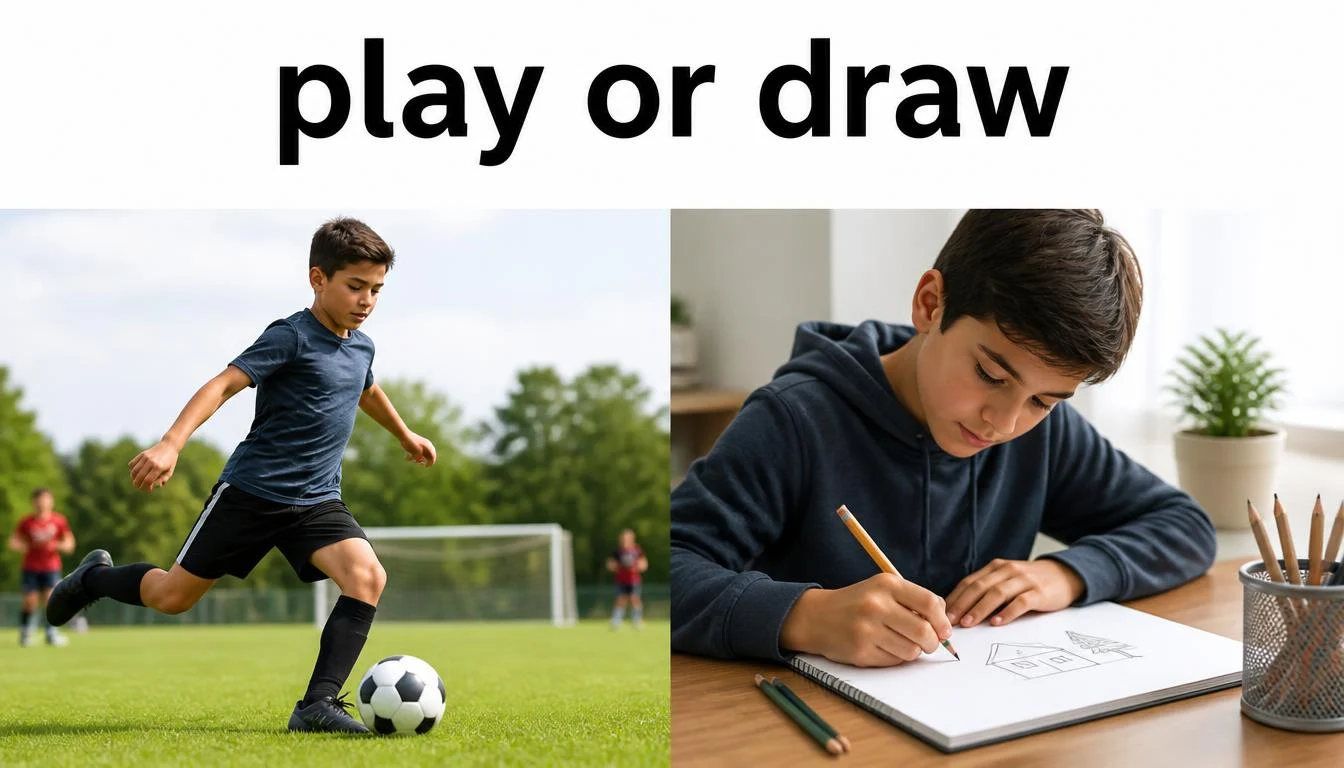
Play or draw compares two different verbs with very different meanings. Play means to take part in a game or sport, while draw can mean to sketch something or to finish a game with no winner. For example, “The children play soccer,” but “The artist will draw a tree.”
The phrases play or draw can have different meanings depending on the situation and the context in which they appear. “Play” commonly refers to taking part in a game, sport, or activity, while “draw” can describe creating a picture, producing an equal result in a game, or pulling something toward you. Because both words have several meanings, choosing the right one depends on what you want to express.
Understanding the difference between play or draw becomes especially useful when talking about games, sports, art, or everyday actions. In this guide, we’ll explain what each word means, show how it works in different contexts, and provide clear examples to help you use play and draw naturally and correctly.
Why People Confuse Them
People can confuse play and draw because both words appear in conversations about games, sports, art, and entertainment. However, they describe different actions.
The confusion becomes stronger when draw refers to a tied game. In sports such as soccer, a team can play a match and then draw the match. Therefore, both words can appear naturally in the same sentence.
For example, “The two teams played well and drew 2–2.” Here, played describes participation, while drew describes the result.
The words also have several meanings outside sports. Play can describe acting, using a musical instrument, or spending time for enjoyment. Draw can describe making a picture, pulling something, attracting attention, or reaching a conclusion.
Meaning of Play
Definition
Play is a verb that commonly means to take part in a game, sport, or activity for enjoyment or competition.
It can also mean to perform music, act in a theatrical production, or use something for entertainment.
As a noun, play can refer to a game, recreational activity, or theatrical performance.
Parts of Speech and Forms
| Form | Word |
|---|---|
| Base verb | play |
| Third-person singular | plays |
| Past tense | played |
| Past participle | played |
| -ing form | playing |
| Noun | play |
The verb play is regular. Therefore, its past tense and past participle both use -ed.
Examples
- The children play outside after school.
- Maria played tennis with her cousin yesterday.
- James is playing the piano at the concert.
- The actors played their roles with confidence.
The meaning depends on context. For example, play the piano means to perform music, while play tennis means to participate in a sport.
Meaning of Draw
Definition
Draw is a verb with several meanings. It can mean to create a picture, pull something toward you, attract attention, or end a competition without a winner.
As a noun, draw can mean a tied result in a game or competition. It can also refer to an attraction that brings people toward something.
Parts of Speech and Forms
| Form | Word |
|---|---|
| Base verb | draw |
| Third-person singular | draws |
| Past tense | drew |
| Past participle | drawn |
| -ing form | drawing |
| Noun | draw |
Unlike play, draw is an irregular verb. Its past tense is drew, while its past participle is drawn.
Examples
- Leo likes to draw animals in his notebook.
- She drew a map for her friend.
- The artist has drawn several portraits this month.
- The soccer match drew after both teams scored twice.
Notice the different forms. You should say drew, not drawed, for the simple past.
Pronunciation
Play and draw are not homophones. They have different spellings, sounds, and meanings.
| Word | IPA | Simple pronunciation | Homophone? |
|---|---|---|---|
| play | /pleɪ/ | “play” | No |
| draw | /drɔː/ | “draw” | No |
In many American English accents, draw can sound close to words such as drall, although the exact vowel varies by accent.
Merriam-Webster and Cambridge both list play and draw as separate words with different pronunciations.
Play or Draw: Side-by-Side Comparison
| Feature | Play | Draw |
|---|---|---|
| Main meaning | Take part in a game or activity | Make a picture, pull, attract, or tie |
| Part of speech | Verb and noun | Verb and noun |
| Pronunciation | /pleɪ/ | /drɔː/ |
| Past tense | played | drew |
| Past participle | played | drawn |
| -ing form | playing | drawing |
| Sports meaning | Participate in a game | Finish without a winner |
| Art meaning | Perform or act | Create a picture |
| Example | We played basketball. | She drew a flower. |
The key difference is simple: play usually describes an activity, while draw describes an action or result depending on context.
For example, a player can play a soccer match and draw the match. So, the two words can work together without having the same meaning.
Common Phrases and Idioms
- Common Phrases With Play
- play a game participate in a game
- play sports take part in sports
- play music perform music
- play a role act as a character or perform a function
- play fair follow the rules honestly
- Common Phrases With Draw
- draw a picture create an image with lines
- draw a conclusion reach a conclusion
- draw attention make people notice something
- draw a line mark a boundary or limit
- draw a game finish a competition with equal scores
These phrases show why context matters. For example, draw a conclusion has nothing to do with drawing a picture.
Common Mistakes
| Wrong sentence | Corrected sentence | Why? |
|---|---|---|
| She drawed a picture yesterday. | She drew a picture yesterday. | Draw has the irregular past form drew. |
| The teams played 1–1. | The teams drew 1–1. | A tied result is a draw. |
| He drew basketball every weekend. | He played basketball every weekend. | Sports participation uses play. |
| She played a picture of a house. | She drew a picture of a house. | Creating an image uses draw. |
| They drawn the match yesterday. | They drew the match yesterday. | Drew is the simple past form. |
| He has drew three portraits. | He has drawn three portraits. | Drawn is the past participle. |
One common mistake deserves special attention: drew and drawn are not interchangeable.
Use drew for simple past:
“She drew a landscape yesterday.”
Use drawn after auxiliary verbs such as has, have, or had:
“She has drawn a landscape.”
[INTERNAL LINK: drew vs drawn → Drew vs Drawn: Meaning, Difference and Examples]
Word Origin
Origin of Play
The English word play comes from Old English plegian, meaning to exercise, move quickly, or engage in a game or activity.
Over time, its meaning expanded. It came to describe games, recreation, musical performance, theatrical acting, and other forms of activity.
The modern word therefore has a long history in English and developed several related senses.
Origin of Draw
Draw comes from Old English dragan, meaning to pull or drag.
That original idea of pulling helps explain several modern meanings. For example, to draw something can mean to pull it toward you.
The artistic sense developed from the idea of producing lines by moving a pen or similar tool across a surface. The word later developed other meanings, including attracting people and ending a competition equally.
Easy Memory Tricks
Think “Play = Participate”
Remember:
Play = participate in an activity.
You play soccer, tennis, chess, or a musical instrument.
Think “Draw = Create or Pull”
Remember:
Draw = create a picture or pull something.
You draw a face, draw a curtain, or draw attention.
Use the Sports Result Trick
When talking about a match, remember:
Play = the action.
Draw = the result.
For example:
“The teams played for 90 minutes and drew 1–1.”
[INTERNAL LINK: play vs game → Play vs Game: Meaning, Difference and Examples]
Mini Quiz
Choose play, draw, drew, or drawn to complete each sentence.
- The children ______ soccer every Saturday.
- Emma ______ a beautiful landscape yesterday.
- The match ended in a ______.
- Daniel has ______ three pictures today.
- We ______ chess after dinner last night.
Answers
- play
- drew
- draw
- drawn
- played
FAQs
Is it correct to say “play a draw”?
Usually, no. Say “play a match” and “draw a match” when describing the activity and its tied result.
What is the past tense of draw?
The past tense of draw is drew. The past participle is drawn.
Is “drawed” a word?
No, drawed is not the standard past tense of draw. The correct form is drew.
What is the difference between play and draw in sports?
Play means to participate in a game. Draw means to finish the game with no winner.
Can you use play and draw in the same sentence?
Yes. For example, “The teams played well but drew 2–2.”
Is play a regular verb?
Yes. Its past tense and past participle are both played.
Conclusion
Play or draw can both appear in sports, but they have different meanings.Use play for participation and draw for creating, pulling, attracting, or tying a game.Remember that drew is the past tense of draw, while drawn is its past participle.Keep the simple rule in mind: you play the game, but you may draw the result.
Read More Articles
- Redmond or Weather | Understanding the Correct Word and Its Meaning In 2026
- Pass or Fail |Meaning, Differences and How to Use Each Correctly In 2026

Andrew Cooper is a blogger and writer at Gramscript.com, turning everyday ideas into clear, engaging stories. His writing blends curiosity, insight and a genuinely human perspective.
1 thought on “Play or Draw | Definition, Usage and Everyday Examples In 2026”