Quick Answer
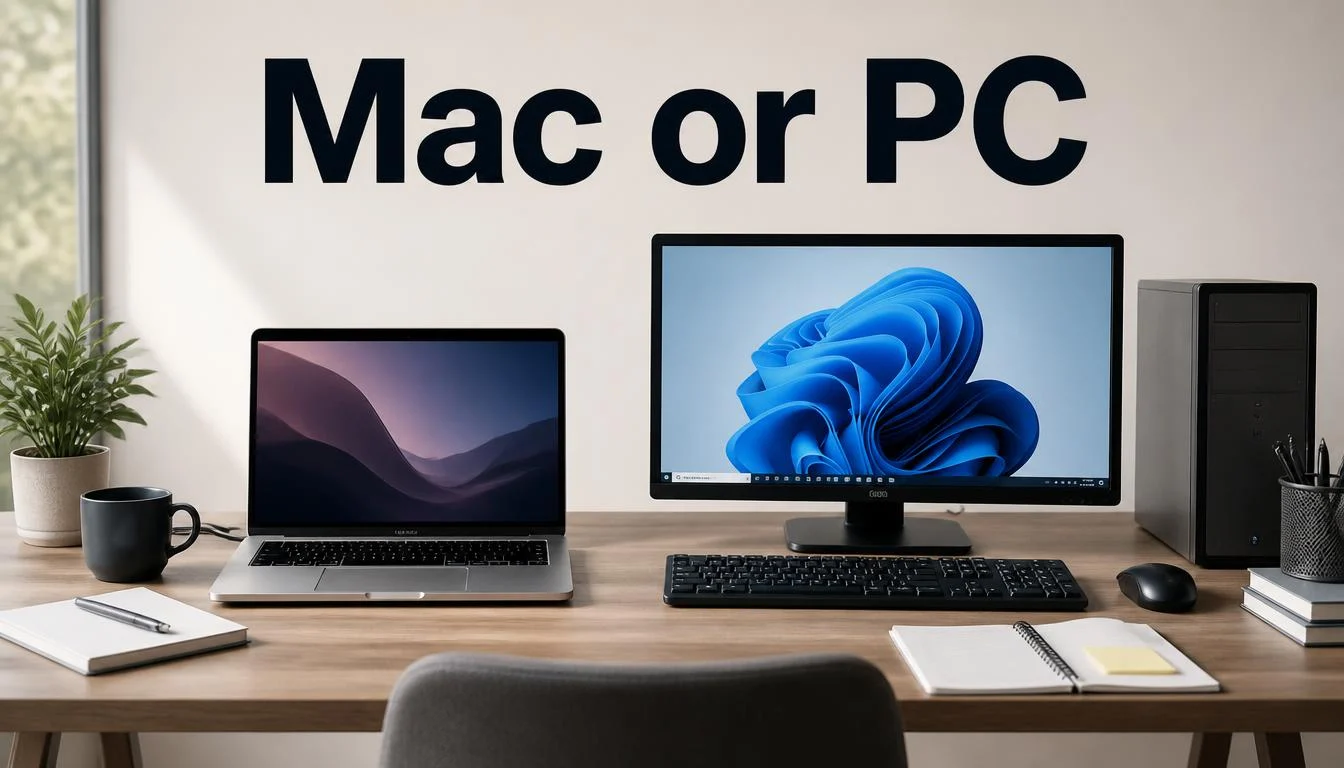
Mac or PC compares two types of personal computers, but the terms are not exact opposites: a Mac is itself a personal computer. In everyday use, Mac usually means an Apple computer, while PC often means a Windows-based computer.For example, “I use a Mac for graphic design” refers to an Apple computer, while “I bought a PC for gaming” usually means a Windows computer.
Choosing between a Mac or PC can feel confusing, especially when both offer powerful features for work, study, entertainment, and everyday tasks. A Mac runs Apple’s macOS, while a PC usually refers to a Windows computer from brands such as Dell, HP, Lenovo, or ASUS. The right choice depends on more than brand preference, since price, performance, software compatibility, gaming, security, and ease of use can all affect your decision.
In this guide, we’ll compare Mac or PC across the areas that matter most to everyday users. You’ll learn how they differ in performance, operating systems, software support, gaming, customization, security, and overall value. Whether you need a computer for professional work, college, creative projects, gaming, or general use, this comparison will help you understand which option may suit your needs best.
Why People Confuse Them
People often treat Mac and PC as two completely separate computer categories. That usage is common, but it is technically a little misleading.
The word Mac is short for Macintosh, Apple’s brand name for its computers. Cambridge lists Mac as a trademark and a common type of computer.
PC means personal computer. In its broadest sense, the term can describe a computer designed for individual use. However, everyday English often uses “PC” to mean a Windows computer rather than a Mac.
So, the confusion comes from technical meaning versus common usage. A Mac is a personal computer, but people often use “Mac” and “PC” as contrasting labels.
Meaning of Mac
Definition
Mac is the common short form of Macintosh, Apple’s computer brand. It can refer to Apple desktop computers and laptops.
Cambridge gives Mac as a noun and identifies it as a trademark for a common type of computer.
Parts of Speech and Forms
| Form | Type | Meaning |
|---|---|---|
| Mac | Proper noun / noun | An Apple computer |
| Macs | Plural noun | More than one Mac |
| Macintosh | Proper noun | The full historical brand name |
Unlike a regular verb, Mac does not have past, past participle, or -ing forms.
Examples
- “My Mac runs smoothly even with several apps open.”
- “She uses a MacBook for her university projects.”
- “The designer saved the finished file on his Mac.”
- “Their office recently replaced several older Macs.”
The capital M is normally used when referring to Apple’s computer brand.
Meaning of PC
Definition
PC is an abbreviation for personal computer. Cambridge defines it as an abbreviation for a personal computer and gives the computer sense as a noun.
In everyday American English, however, PC commonly refers to a computer that runs Windows or follows the traditional PC platform. That meaning developed strongly through the popularity of IBM-compatible computers.
Parts of Speech and Forms
| Form | Type | Meaning |
|---|---|---|
| PC | Noun | A personal computer |
| PCs | Plural noun | More than one PC |
| personal computer | Noun phrase | A computer intended for individual use |
The plural is normally written PCs, without an apostrophe.
Examples
- “My PC has enough storage for my video files.”
- “He built a powerful PC for gaming.”
- “The company provided every employee with a PC.”
- “Several PCs need software updates this week.”
The abbreviation PC can have other meanings in English. For example, Cambridge also lists meanings connected with police work and “politically correct.” Context determines which meaning applies.
Pronunciation
Mac and PC are not homophones. They have completely different pronunciations.
| Word | IPA | Simple pronunciation | Syllables |
|---|---|---|---|
| Mac | /mæk/ | “mack” | 1 |
| PC | /ˌpiːˈsiː/ | “pee-SEE” | 2 |
Cambridge gives Mac as /mæk/ in both British and American English.
For PC, Cambridge gives /ˌpiːˈsiː/ in both British and American English.
Therefore, pronunciation does not explain the confusion between these terms. Their relationship comes from computer terminology and common usage.
Mac or PC: Side-by-Side Comparison
| Feature | Mac | PC |
|---|---|---|
| Meaning | Apple computer | Personal computer; often a Windows computer |
| Part of speech | Noun | Noun |
| Pronunciation | /mæk/ | /ˌpiːˈsiː/ |
| Simple pronunciation | “mack” | “pee-SEE” |
| Plural | Macs | PCs |
| Brand connection | Apple | No single brand |
| Operating system | macOS | Commonly Windows |
| Example | “I use a Mac.” | “I use a PC.” |
The most important point is that Mac identifies a particular Apple computer platform, while PC is a broader technical term.
In everyday conversation, though, people often say Mac or PC when they really mean Apple computer or Windows computer. This distinction explains why both terms appear as opposites in casual discussions.
[OUTBOUND LINK: Cambridge Dictionary → source]
Common Phrases and Idioms
These expressions appear frequently in conversations about computers:
- Mac user someone who uses an Apple Mac.
- PC user someone who uses a personal computer, often a Windows machine.
- MacBook Apple’s laptop computer line.
- desktop PC a personal computer designed for desk use.
- PC gaming playing computer games on a PC.
- Mac software software designed for macOS.
- PC software software designed for a PC platform.
- Mac and PC a common phrase comparing the two platforms.
- switch from PC to Mac change from a Windows-style computer to a Mac.
- Mac-compatible designed to work with a Mac.
These phrases usually depend on context. For example, “PC software” may refer specifically to Windows software in a consumer technology discussion.
Common Mistakes
| Wrong sentence | Corrected sentence | Why |
|---|---|---|
| “I bought a new Macs.” | “I bought a new Mac.” | Use the singular form for one computer. |
| “I have two Mac’s.” | “I have two Macs.” | The plural does not need an apostrophe. |
| “She uses a PC’s at work.” | “She uses PCs at work.” | Use PCs for the plural. |
| “A Mac is not a personal computer.” | “A Mac is a type of personal computer.” | Mac computers fit the broad definition of a personal computer. |
| “My PC runs macOS.” | “My Mac runs macOS.” | In ordinary usage, macOS is associated with Mac computers. |
| “I use a PC” when discussing Apple hardware. | “I use a Mac.” | Mac is the clearer term for Apple’s computer platform. |
One common mistake deserves special attention: PC does not technically mean “Windows computer.” The abbreviation means personal computer. The narrower meaning comes from common usage and the historical dominance of the IBM-compatible PC platform.
Word Origin
Mac
Mac comes from Macintosh, the original name of Apple’s computer line. The Macintosh project began at Apple under Jef Raskin, who envisioned an easy-to-use personal computer. The Computer History Museum documents Raskin’s role in starting the Macintosh project.
Apple launched the Macintosh in January 1984.
The short form Mac developed naturally from the longer brand name.
PC
PC is an abbreviation of personal computer.
The term describes a computer intended for individual use rather than a large centralized computing system. The Computer History Museum notes that personal computers existed before IBM’s machine, but the 1981 IBM Personal Computer had a major effect on how the term was understood.
IBM introduced its Personal Computer in 1981, formally known as the IBM Model 5150. Its success helped establish the modern PC market and encouraged compatible systems from other manufacturers.
Easy Memory Tricks
Think Apple for Mac
Remember:
Mac → Macintosh → Apple
When you see Mac, think of Apple’s computer platform.
Think Personal Computer for PC
Remember:
PC → Personal Computer
This also helps you understand why a Mac can technically be a PC in the broadest sense.
Remember the Practical Difference
For everyday conversations, use this shortcut:
Mac = Apple computer
PC = usually Windows computer
This is not the complete technical definition, but it matches common usage in most consumer technology discussions.
Mini Quiz
Fill in each blank with Mac, Macs, PC, or PCs.
- Maria bought a new ______ for editing photos.
- The office has twenty Windows ______.
- My two ______ are both running macOS.
- He built a powerful ______ for gaming.
- A ______ is technically a type of personal computer.
Answers
- Mac
- PCs
- Macs
- PC
- Mac
FAQs
Is a Mac a PC?
Yes. In the broad technical sense, a Mac is a personal computer. However, people often use “PC” to mean a Windows-based computer.
Is Mac or PC grammatically correct?
Both Mac and PC are correct terms. They identify different computer platforms in common usage.
What does PC stand for?
PC stands for personal computer. It refers broadly to a computer designed for individual use.
Is Mac short for Macintosh?
Yes. Mac is the common short form of Macintosh, Apple’s computer brand.
Do you write PCs or PC’s?
Use PCs for the plural. PC’s is normally incorrect unless the apostrophe shows possession.
Are Mac and PC pronounced the same?
No. Mac is pronounced /mæk/, while PC is pronounced /ˌpiːˈsiː/. They are not homophones.
- [INTERNAL LINK: MacBook vs laptop → MacBook vs Laptop: What’s the Difference?]
- [INTERNAL LINK: laptop vs notebook → Laptop vs Notebook: Meaning, Difference and Examples]
- [INTERNAL LINK: desktop vs laptop → Desktop vs Laptop: Which One Should You Choose?]
Conclusion
When comparing Mac or PC, remember that both terms can describe personal computers in a broad sense.In everyday usage, Mac usually means an Apple computer, while PC commonly means a Windows computer.Use Macs and PCs for their correct plural forms, without apostrophes.The easiest rule is simple: Mac means Apple, while PC usually means the Windows-style personal computer platform.
Read More Articles
- Short or Tall | How to Describe Height Clearly and Correctly In 2026
- Wholistic or Holistic | How to Spell and Use the Word In 2026

Christopher Parker is a writer and blogger at GramScript.com, sharing thoughtful insights and engaging stories across a range of topics. His writing blends clarity, curiosity, and a distinctly human perspective.
1 thought on “Mac or PC | Performance, Compatibility, Security and Cost Compared In 2026”