Quick Answer
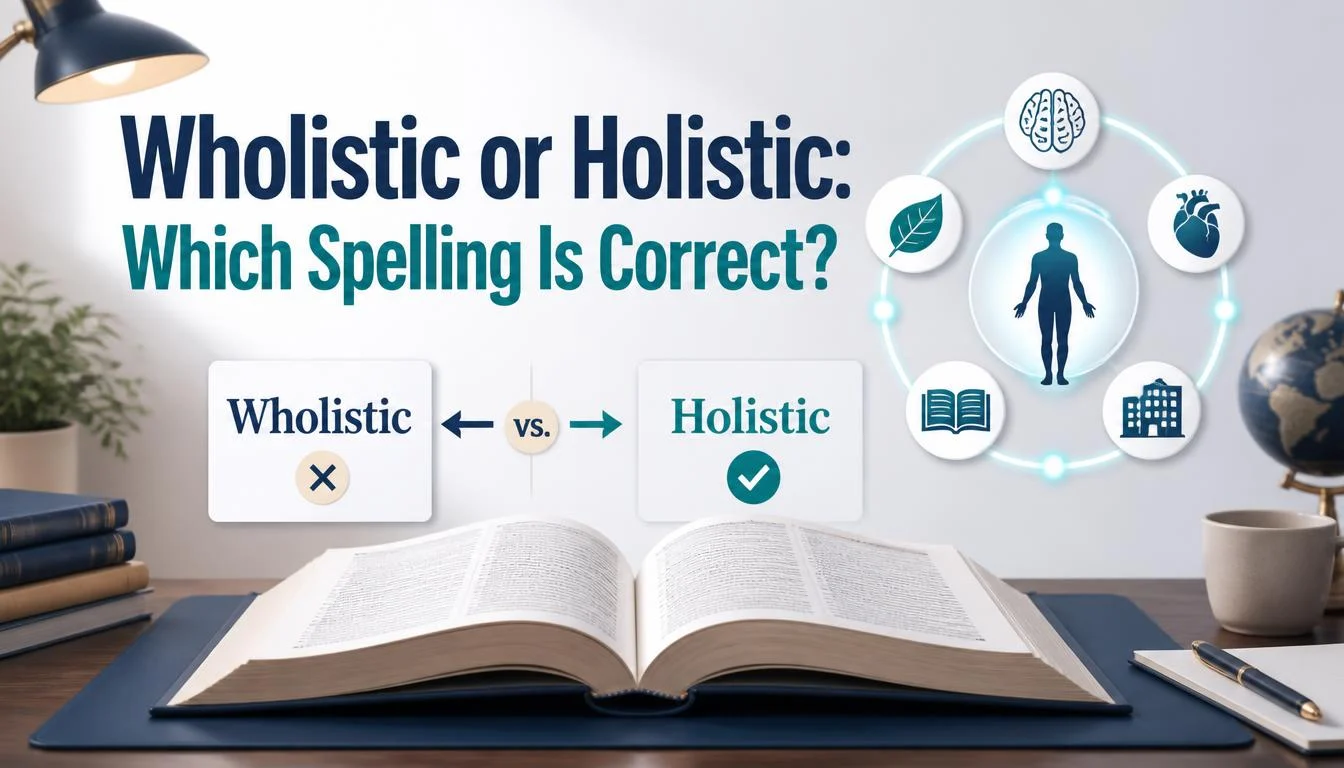
Holistic is the standard and widely accepted spelling for something that considers the whole system or person.Wholistic is a less common variant, but holistic is the safer choice in formal and professional writing.
Choosing between wholistic or holistic can be confusing because both spellings appear in English writing. The two words share the same basic idea: looking at a person, subject, or situation as a complete whole rather than focusing on only one part. However, holistic is the standard and widely accepted spelling in modern English, while wholistic is a less common variant.
Understanding the difference helps you choose the right word for academic writing, professional communication, healthcare discussions, and everyday sentences. In this guide, we’ll explain what holistic means, where wholistic comes from, how the two forms are used, and which spelling is generally the better choice in formal writing. We’ll also provide clear examples so you can use the word confidently and naturally.
Which One Is Correct?
Holistic is the standard form and the best choice for most situations.
The word describes an approach that considers a person, system, problem, or subject as a whole. It often emphasizes how different parts interact rather than examining each part separately.
For example:
A holistic approach considers a student’s academic, social, and emotional needs.
The spelling holistic is especially common in established expressions such as:
- holistic approach
- holistic health
- holistic care
- holistic education
- holistic view
- holistic treatment
- holistic development
- holistic perspective
Wholistic also appears in English and can carry the same meaning. Some dictionaries recognize it as a variant spelling. However, it remains much less common than holistic and may look unusual to many readers.
So, if you are choosing between the two forms, holistic is the conventional choice.
Meaning of the Correct Word
Definition
Holistic means considering something as a complete whole rather than examining its parts separately.
It can describe an approach that takes physical, emotional, social, environmental, practical, or other connected factors into account.
For example, a doctor using a holistic approach may consider more than a patient’s immediate symptom. The doctor may also consider lifestyle, environment, habits, and other relevant factors.
Explanation
The central idea behind holistic is completeness.
Imagine a company struggling with low employee productivity. A narrow approach might focus only on work hours. A holistic approach could also consider workload, communication, workplace conditions, management practices, training, and employee well-being.
The goal is not simply to collect more information. Instead, the approach tries to understand how different elements work together.
That makes holistic useful across many fields. You can use it when discussing health, education, business, psychology, environmental planning, design, research, and personal development.
Usage
Holistic usually works as an adjective.
Common patterns include:
- a holistic approach
- a holistic assessment
- a holistic view
- a holistic model
- holistic care
- holistic development
- holistic thinking
- holistic education
The word normally comes before a noun:
The school promotes holistic development.
It can also appear after a linking verb:
Her approach to teaching is holistic.
The related noun holism refers to the idea or practice of considering wholes rather than isolated parts.
Real-World Examples
Health:
The clinic takes a holistic approach to patient care.
This suggests that the clinic considers more than one isolated health issue.
Education:
The program supports the holistic development of children.
Here, holistic suggests development across several connected areas.
Business:
Leaders need a holistic view of the company’s challenges.
The sentence encourages leaders to consider multiple connected factors.
Environment:
The project uses a holistic approach to water management.
The focus extends beyond one individual water source or problem.
Personal development:
She follows a holistic approach to maintaining a balanced lifestyle.
The approach considers several areas of life together.
Meaning of the Incorrect or Alternative Word
Incorrect
Wholistic is not simply meaningless or automatically wrong. It appears in real English and is recognized by some dictionaries as a variant of holistic.
However, it is less common and less conventional than holistic. Some style guides, editors, teachers, and readers may treat it as a misspelling or nonstandard form.
For that reason, calling wholistic the standard spelling would be misleading.
If you want the form that readers are most likely to recognize immediately, choose holistic.
Typo
Sometimes wholistic occurs because writers naturally connect the spelling with whole.
That mistake is understandable. The meaning involves considering something as a whole, so wholistic looks logical at first glance.
For example, someone might write:
We need a wholistic solution.
In formal writing, changing it to:
We need a holistic solution.
gives you the more established form.
Slang
Wholistic is not normally considered slang.
It functions as an adjective and can appear in serious writing. Its main issue is frequency and standard usage, not slang status.
Regional Variation
Wholistic is not best understood as a simple American-versus-British spelling difference.
You may encounter it in different varieties of English, but holistic remains the widely established form across standard English usage.
Therefore, changing between holistic and wholistic is not like changing color to colour. The latter reflects a recognized regional spelling distinction, while wholistic is generally a less common variant.
Rare but Valid Usage
Wholistic can be described as a rare or less common variant of holistic.
That distinction matters. Saying that wholistic is always “wrong” oversimplifies the evidence.
If you encounter wholistic in published material, the intended meaning is usually clear. However, writers who want conventional, widely recognized English should normally use holistic.
Key Differences Between the Two Words
| Feature | Holistic | Wholistic |
|---|---|---|
| Spelling | Standard and widely preferred | Less common variant |
| Meaning | Considering something as a whole | Generally the same meaning |
| Pronunciation | Usually pronounced “hoh-LIS-tik” | Usually pronounced “hoh-LIS-tik” |
| Grammar | Adjective | Adjective |
| Usage | Very common in formal and professional contexts | Uncommon |
| Recognition | Widely recognized | May be mistaken for a spelling error |
| Best choice | Recommended for most writing | Use only when the context specifically calls for it |
The biggest practical difference is acceptance and frequency, not meaning.
Spelling Difference
The words differ by one noticeable element:
- holistic
- wholistic
The w in wholistic makes the word visually resemble whole. That spelling feels intuitive, but the established form is holistic.
Meaning Difference
In ordinary use, there is little or no meaningful difference.
Both forms can describe an approach that considers a complete system or person rather than isolated elements.
Pronunciation Difference
In normal English usage, both forms are generally pronounced similarly:
holistic: hoh-LIS-tik
wholistic: hoh-LIS-tik
The added w does not normally create a separate pronunciation.
Grammar Difference
Both forms function as adjectives.
You can say:
The therapist uses a holistic approach.
The alternative form can appear in the same grammatical position:
The therapist uses a wholistic approach.
The difference lies primarily in spelling and conventionality.
Usage Difference
This is where the distinction becomes most important.
Holistic appears frequently in established professional expressions. You will see it in discussions about health, education, management, sustainability, psychology, and other subjects.
Wholistic appears much less often. Some readers may pause because they expect holistic.
Recognition Difference
A reader is far more likely to recognize holistic immediately.
That matters when you want your writing to sound polished and familiar. Unusual spellings can distract readers even when they understand the intended meaning.
Common Mistakes People Make
Mistake 1: Assuming “whole” requires a W
The most common reasoning is simple:
whole → wholistic
That connection looks logical, but English spelling does not always follow the most obvious word association.
The standard form is:
whole → holistic
Mistake 2: Treating the two forms as completely unrelated words
They are closely connected in meaning.
Wholistic generally expresses the same concept as holistic. The distinction concerns standardness and frequency more than definition.
Mistake 3: Calling wholistic universally incorrect
This goes too far.
Because wholistic appears in actual English usage and receives dictionary recognition as a variant in some references, it is more accurate to call it less common or nonstandard in many formal contexts, rather than universally invalid.
Mistake 4: Using holistic when you mean comprehensive
Although holistic and comprehensive can overlap, they are not always interchangeable.
Comprehensive usually means covering a broad or complete range.
Holistic emphasizes understanding something as an interconnected whole.
For example:
The report provides a comprehensive review of the evidence.
This focuses on coverage.
The program takes a holistic approach to student development.
This emphasizes the relationship between different aspects of development.
Mistake 5: Assuming holistic always means alternative medicine
The word often appears in health discussions, including complementary and alternative medicine. However, its meaning is much broader.
You can discuss:
- holistic education
- holistic design
- holistic management
- holistic planning
- holistic research
- holistic development
- holistic environmental policy
The word itself does not automatically describe a particular medical practice.
Correct Usage Examples
Casual Examples
I try to take a holistic view of my daily routine.
We need to look at the problem from a holistic perspective.
She takes a holistic approach to personal growth.
A holistic plan can help connect all these goals.
These examples use holistic naturally in everyday communication.
Professional Examples
The company adopted a holistic strategy for improving employee engagement.
Our team needs a holistic understanding of the customer’s needs.
The consultant recommended a holistic review of the organization’s processes.
The policy requires a holistic assessment of environmental and economic factors.
In professional writing, holistic is generally the safer and more polished choice.
Educational Examples
The school focuses on holistic student development.
Teachers can use holistic assessment alongside traditional testing.
The curriculum takes a holistic approach to language learning.
Parents often value programs that support holistic development.
In education, holistic commonly refers to development across multiple areas rather than academic performance alone.
Literary/Metaphorical Examples
She viewed the old house through a holistic lens, seeing its history as part of its character.
The writer presents the city as a holistic world shaped by thousands of connected lives.
A holistic understanding of the story reveals details that a narrow reading can miss.
These examples use the word more creatively while preserving its central meaning.
Word Origin / Etymology
The history of holistic explains why the standard spelling does not contain a w.
The word comes from holism, which is associated with the Greek word holos, meaning “whole.” The concept emphasizes the importance of understanding an entire system rather than reducing it to isolated parts.
The modern term holism became associated with the philosopher and statesman Jan Smuts, who developed the concept in his 1926 work Holism and Evolution.
From this tradition, holistic developed as the adjective describing something related to holism.
The spelling therefore reflects the Greek-derived form rather than the modern English spelling of whole.
This history also explains why holistic may look less intuitive to English learners. Its spelling comes through a classical word family rather than directly from the everyday word whole.
Why the Incorrect Version Became Popular
The popularity of wholistic is easy to understand.
English speakers naturally connect the concept with the word whole. When people hear that something considers the “whole” person or “whole” system, adding -istic to whole can seem like a straightforward way to create an adjective.
That produces:
whole → wholistic
However, the established word developed through holism, producing:
holism → holistic
This kind of spelling influence happens frequently in English. Speakers sometimes reshape unfamiliar words to make them resemble familiar words.
The spelling wholistic can therefore feel more transparent to some writers. It visually communicates the idea of “whole” very clearly.
Still, frequency and established usage favor holistic.
If you are writing an academic paper, business document, school assignment, professional report, or general informational article, holistic is the conventional option.
Easy Memory Tricks
Think “Holos Means Whole”
Remember the Greek root holos, meaning “whole.”
That gives you:
holos → holistic
You do not need to add the w from whole.
Remember the Common Phrase
Think of the familiar expression:
holistic approach
You will often see these two words together. Memorizing this phrase makes the spelling easier to recall.
Use “Holistic” as Your Default
When you are unsure, choose holistic.
It is the widely recognized form and works naturally in formal and everyday writing.
Connect It With “Holism”
Another useful chain is:
holism → holistic
Both words share the same hol- beginning.
That connection helps prevent the temptation to insert a w.
FAQs
Is holistic the correct spelling?
Yes. Holistic is the standard and widely preferred spelling in modern English.
Is wholistic a real word?
Yes. Wholistic appears in English and is recognized as a variant in some dictionaries, but it is much less common.
Is wholistic grammatically wrong?
Not necessarily. It can function correctly as an adjective, but holistic is the more conventional choice.
How do you pronounce holistic?
Holistic is commonly pronounced hoh-LIS-tik.
Does wholistic mean the same as holistic?
Generally, yes. Both words describe an approach that considers something as a whole.
Why does holistic not have a W?
The word comes through holism, which is connected to the Greek holos, meaning “whole.” It did not develop directly from the English spelling whole.
Should I use holistic in formal writing?
Yes. Holistic is the safer choice for academic, professional, educational, and formal writing.
Is holistic only used for health?
No. It can describe approaches to education, business, planning, development, research, management, and many other subjects.
Conclusion
When comparing wholistic or holistic, choose holistic as the standard and widely recognized form.Wholistic can appear as a less common variant, but it may look unusual to many readers.Both forms generally express the idea of considering something as a complete and connected whole.When in doubt, remember: holism leads to holistic, so the W can stay away.
Read More Articles
- Si or Sí | Spanish Grammar, Meaning and Examples In 2026
- Cant or Can’t | Meaning, Grammar Rules and Sentence Examples In 2026

Andrew Cooper is a blogger and writer at Gramscript.com, turning everyday ideas into clear, engaging stories. His writing blends curiosity, insight and a genuinely human perspective.
1 thought on “Wholistic or Holistic | How to Spell and Use the Word In 2026”