Quick Answer
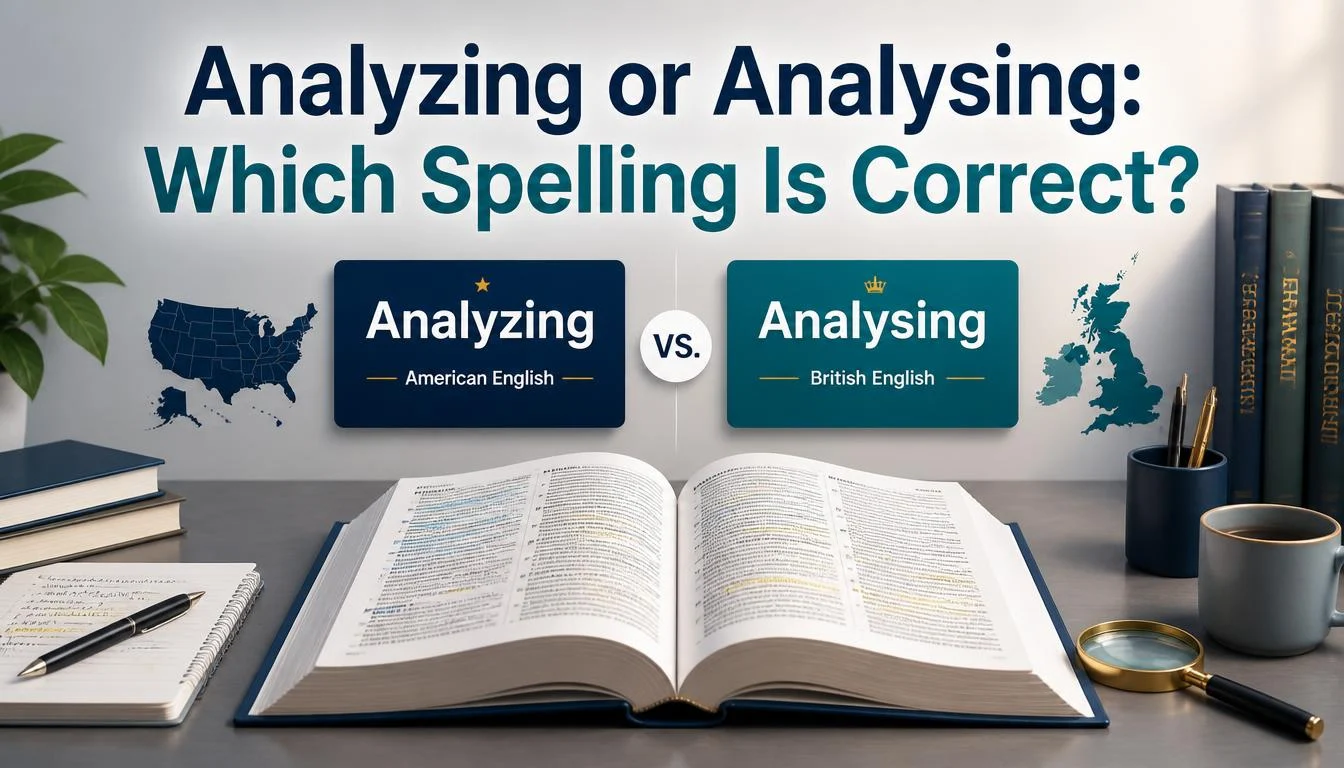
Analyzing is the standard American English spelling, while analysing is the standard British English spelling.Both mean the same thing: examining something carefully to understand it.
Analyzing or analysing can look confusing because both spellings are correct, but they belong to different varieties of English. Analyzing is the standard spelling in American English, while analysing is commonly used in British English and other varieties that follow British spelling conventions. Both forms come from the verb analyze, meaning to examine something carefully and understand its different parts or details.
The difference is mainly a matter of regional spelling, not meaning or pronunciation. For example, an American writer might say, “She is analyzing the data,” while a British writer would typically write, “She is analysing the data.” Once you know which English variety your audience expects, choosing the right form becomes straightforward. In this guide, we’ll compare analyzing and analysing, explain where each spelling is preferred, and show you how to use both naturally in sentences.
Which One Is Correct?
Both analyzing and analysing are correct spellings.
The choice depends mainly on the variety of English you are following:
- American English: analyzing
- British English: analysing
- Canadian English: analysing is common, although usage can vary
- Australian English: analysing
- New Zealand English: analysing
For American readers and American-style writing, use analyzing.
For British-style writing, use analysing.
The difference is not related to meaning, grammar, or pronunciation. It is primarily a regional spelling difference.
For example:
The scientist is analyzing the results.
This follows American English spelling.
The scientist is analysing the results.
This follows British English spelling.
Neither sentence changes the action being described. In both cases, the scientist is examining the results carefully.
Meaning of the Correct Word
Definition
Analyzing means examining something carefully and systematically to understand its parts, meaning, structure, causes, or effects.
It is the present participle of analyze.
The word can describe many kinds of careful examination. People can analyze data, arguments, problems, poems, conversations, trends, financial records, or scientific results.
For example:
The researcher is analyzing the survey responses.
Here, the researcher is studying the responses to identify useful information or patterns.
Explanation
Analyzing involves more than simply looking at something.
When you analyze an object, idea, or situation, you usually break it into smaller parts. You then examine those parts and consider how they relate to one another.
A student might analyze a poem by examining its imagery, tone, structure, and themes.
A business might analyze sales data to identify customer trends.
A doctor might analyze test results to help understand a patient’s condition.
The exact process changes with the subject, but the central idea remains careful examination.
Usage
Analyzing functions as the present participle or gerund form of analyze.
Common structures include:
- analyzing data
- analyzing information
- analyzing a problem
- analyzing the results
- analyzing an argument
- analyzing a situation
- analyzing customer behavior
- analyzing a text
- analyzing market trends
- analyzing evidence
You can also use it after certain verbs:
She is analyzing the report.
It can function as part of a continuous verb phrase:
They are analyzing the evidence.
It can also act like a noun:
Analyzing complex data requires patience.
Real-World Examples
Here are some natural examples of analyzing in American English:
The team is analyzing customer feedback before launching the product.
Researchers are analyzing samples collected during the study.
The teacher asked students to practice analyzing the poem.
We are analyzing the financial report for unusual changes.
The journalist spent several hours analyzing the interview.
Engineers are analyzing the damage after the storm.
These examples show how widely the word can be used in everyday, academic, professional, and technical contexts.
Meaning of the Incorrect or Alternative Word
Incorrect
Analysing is not incorrect in English.
It is the standard spelling used in British English and several other varieties of English. It becomes the less appropriate choice when you are specifically following American English spelling conventions.
For an American English article, use analyzing.
For British English writing, analysing is normally preferred.
Typo
Analysing is not a typo simply because it looks unfamiliar to American readers.
However, accidentally switching between analyzing and analysing in the same document can create an inconsistent spelling style.
For example, an American English document should generally avoid:
The researcher is analyzing the data and analysing the results.
A consistent version would be:
The researcher is analyzing the data and analyzing the results.
Slang
Neither analyzing nor analysing is slang.
Both forms belong to standard written English. You can use them in formal writing, academic work, professional documents, journalism, and everyday communication.
Regional Variation
The main distinction is regional.
American English favors the -ize spelling in words such as:
- analyze
- analyzing
- analyzed
- analyzes
British English commonly uses:
- analyse
- analysing
- analysed
- analyses
This pattern also appears in other related words, although English spelling conventions can vary by country and individual style guide.
Rare but Valid Usage
Neither spelling is rare.
Analyzing is common in American English, while analysing is common in British English and other varieties that follow similar spelling conventions.
You may encounter both forms in international publications. That does not mean one has a different meaning.
Key Differences Between the Two Words
| Feature | Analyzing | Analysing |
|---|---|---|
| Spelling | American English | British English |
| Meaning | Examining carefully | Examining carefully |
| Pronunciation | uh-NYE-zing | uh-NYE-zing |
| Grammar | Present participle/gerund of analyze | Present participle/gerund of analyse |
| Usage | Standard in American English | Standard in British English |
| Recognition | Very common internationally | Very common internationally |
| Base verb | analyze | analyse |
| Past form | analyzed | analysed |
| Common setting | U.S. writing | U.K., Australian, and related varieties |
The most important difference is the letter z versus s.
American English writes:
analyze → analyzing
British English writes:
analyse → analysing
The pronunciation does not change simply because the spelling changes.
Pronunciation Difference
Both words are generally pronounced uh-NYE-zing.
The spelling difference does not create a meaningful pronunciation difference between the two forms.
The first syllable sounds like a relaxed uh, while the stressed middle sound resembles NYE.
The final part sounds like zing.
You can remember the sound as:
uh-NYE-zing
This pronunciation remains essentially the same in American and British English.
Grammar Difference
There is no grammatical difference in meaning between the two forms.
Both are present participles of their respective verbs.
American English:
analyze → analyzing
British English:
analyse → analysing
Both can appear in continuous tenses:
She is analyzing the report.
She is analysing the report.
Both can also function as gerunds:
Analyzing the evidence takes time.
Analysing the evidence takes time.
The grammar stays the same. Only the regional spelling changes.
Common Mistakes People Make
Treating “Analysing” as Always Wrong
One of the most common mistakes is assuming that analysing is simply misspelled.
That is not true.
British English uses analysing as its standard form. Calling it incorrect ignores the difference between English varieties.
Using Both Spellings in One Article
Another problem occurs when writers mix regional conventions.
For example:
The researcher is analyzing the results before analysing the report.
This mixture is unnecessary if the document follows one spelling system.
Choose one convention and use it consistently.
Confusing the Base Verbs
Writers sometimes remember the two forms but accidentally combine them.
Incorrect:
analyseing
Correct American form:
analyzing
Correct British form:
analysing
The ending does not contain -e after the base verb.
Adding an Extra Letter
Another frequent error is writing:
analyzsing
or:
analyseing
Neither form is standard.
The correct forms are:
analyzing
analysing
Assuming “S” Always Means British English
The spelling pattern can help, but English contains many exceptions and variations.
It is better to learn the complete word family:
American English: analyze, analyzes, analyzed, analyzing
British English: analyse, analyses, analysed, analysing
This makes the spelling pattern easier to remember.
Changing the Spelling Midway Through a Sentence
The problem becomes especially noticeable in long academic or professional documents.
If your document follows American English, keep analyze/analyzing/analyzed consistent.
If it follows British English, use analyse/analysing/analysed consistently.
Consistency makes your writing look polished and intentional.
Correct Usage Examples
Casual Examples
I’m analyzing what happened before I make a decision.
She is analyzing the situation from every angle.
We spent the evening analyzing the movie.
He keeps analyzing every little detail.
These examples sound natural in everyday American English.
Professional Examples
The marketing department is analyzing customer responses.
Our team is analyzing the latest sales figures.
The engineers are analyzing the system for possible weaknesses.
The company is analyzing its operating costs.
Professional writing often uses analyzing when the writer follows American English conventions.
Educational Examples
Students are analyzing the author’s use of imagery.
The class is analyzing the causes of the historical event.
Researchers are analyzing the data collected during the experiment.
The professor asked students to practice analyzing primary sources.
In academic American English, analyzing is the expected spelling.
Literary/Metaphorical Examples
The word can also describe thoughtful examination of less concrete subjects.
She was analyzing every silence in their conversation.
He spent the afternoon analyzing the meaning behind the painting.
The novel invites readers to analyze the choices made by its characters.
We are analyzing the hidden tensions within the story.
These examples show that analyzing does not always involve numbers or scientific data. It can describe close interpretation of ideas, language, behavior, and art.
Word Origin / Etymology
The English verb analyze ultimately traces back to the Greek word analyein, meaning to break up, loosen, or undo.
The Greek word combines elements associated with separation and loosening. Over time, the idea developed into the concept of breaking something down so it could be examined.
English acquired analyze through historical borrowing and influence from Latin and French forms.
The spelling later developed differently across English-speaking regions.
American English generally retained or favored the -ize ending in words such as analyze.
British English commonly adopted the -ise spelling for this group of words.
As a result, modern English has two established forms:
analyze → analyzing
analyse → analysing
The historical difference does not create a difference in meaning.
Why the Incorrect Version Became Popular
The so-called “incorrect” version became popular because it is not actually incorrect across all varieties of English.
Analysing developed and remained established in British English and related spelling traditions. Meanwhile, American English standardized analyzing as the preferred form.
English has many regional spelling differences. Examples include:
- color / colour
- organize / organise
- realize / realise
- center / centre
- traveled / travelled
The analyzing/analysing distinction fits into this broader pattern.
American spelling often favors -ize, while British spelling frequently uses -ise in this group of words.
That is why both forms remain visible today.
A writer working for an American audience may naturally choose analyzing, while a writer following British conventions may choose analysing.
The important point is consistency rather than declaring one form universally correct.
Easy Memory Tricks
Remember “Z” for American
If you are writing American English, connect the Z in analyzing with the American spelling pattern:
analyze → analyzing
Think:
American = analyze = analyzing
Remember “S” for British
For British English, remember:
analyse → analysing
The S stays in the spelling.
Learn the Whole Word Family
Instead of memorizing only one word, learn these pairs:
| American English | British English |
|---|---|
| analyze | analyse |
| analyzes | analyses |
| analyzed | analysed |
| analyzing | analysing |
This method helps you avoid creating accidental forms such as analyseing or analyzsing.
Use Your Audience as a Guide
Ask yourself one simple question:
Which spelling system does this document follow?
If you are writing for a U.S. audience, choose analyzing.
If you are following British English, choose analysing.
That single decision usually solves the problem.
FAQs
Is “analyzing” correct in American English?
Yes. Analyzing is the standard American English spelling of the present participle of analyze.
Is “analysing” grammatically correct?
Yes. Analysing is the standard British English spelling of the same word.
Do analyzing and analysing mean the same thing?
Yes. Both mean examining something carefully to understand it.
How do you pronounce analyzing?
It is commonly pronounced uh-NYE-zing.
Is analyzing or analysing preferred in the United States?
Analyzing is preferred in standard American English.
Is analysing or analyzing preferred in the United Kingdom?
Analysing is generally preferred in standard British English.
Can I use analyzing in British English?
Readers will understand it, but analysing usually matches British spelling conventions better.
Can I use analysing in American English?
Readers will understand it, but analyzing is the standard American spelling.
Conclusion
When choosing analyzing or analysing, use analyzing for standard American English and analysing for British English.
Both spellings describe the same process of carefully examining information, ideas, evidence, or situations.The difference comes from regional spelling conventions, not meaning or grammar.Remember the simple rule: American English uses analyzing, while British English uses analysing.
Read More Articles
- Blankie or Blanky | Definition, Usage and Common Differences In 2026
- CCed or CC’d | The Correct Way to Write It In 2026

Jessica Morgan is a blogger and writer at GramScript.com, where she turns everyday ideas into engaging, relatable stories. Her writing blends a natural voice with fresh perspectives that keep readers coming back.