Quick Answer
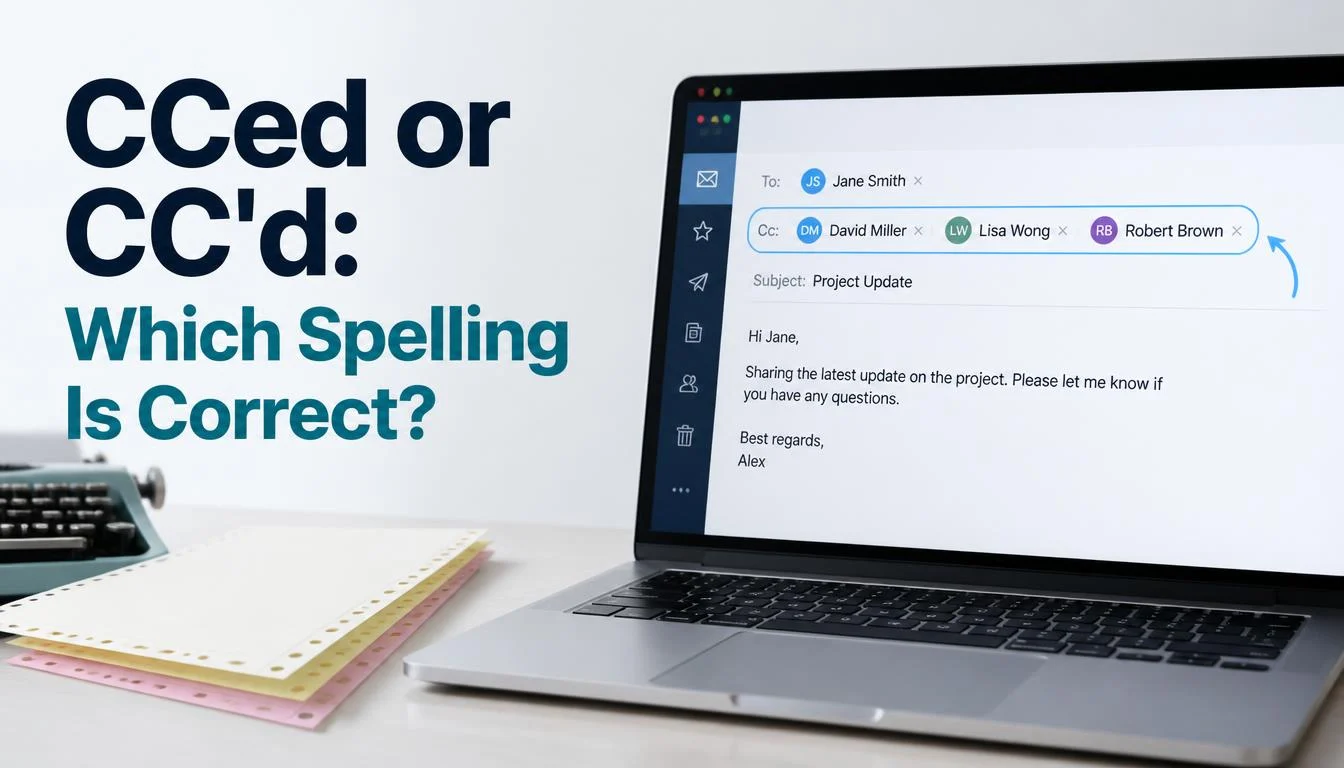
CC’d is the clearest and most widely recognized form for the past tense of CC, meaning someone received a copy of an email. CCed also appears in some writing, but CC’d is usually easier to read and recognize.
When writing about email communication, you may wonder whether CCed or CC’d is the correct way to describe something that happened in the past. The confusion comes from the abbreviation CC, which means “carbon copy,” combined with the need to form a past-tense verb. Unlike regular verbs that simply take -ed, abbreviations can have more than one accepted written form, especially in informal and professional communication.
Both CCed and CC’d appear in English writing, but their use can depend on style, clarity, and the conventions a writer follows. Understanding how each form works can help you choose wording that looks natural and professional in emails, workplace messages, and other written communication. This guide explains the difference between CCed and CC’d, shows how to use them in sentences, and offers practical examples so you can confidently choose the appropriate form.
Which One Is Correct?
CC’d is the clearest standard form when CC is used as a verb in the past tense.
For example:
I CC’d Maria on the email.
Here, CC’d means that Maria received a copy of the email.
You may also see CCed or CC’ed. These forms are understandable, and some style systems and organizations use them. However, CC’d remains especially clear because the apostrophe separates the abbreviation from the past-tense ending.
The main distinction is practical:
| Form | Status | Typical use |
|---|---|---|
| CC’d | Standard and widely recognized | Past tense of CC |
| CCed | Used by some writers | Alternative past-tense spelling |
| CC’ed | Also used | Alternative with an apostrophe before -ed |
| CCd | Uncommon and unclear | Usually best avoided |
| cced | Informal/nonstandard-looking | Less clear in polished writing |
If you are writing a professional email, CC’d offers a simple and immediately recognizable choice.
Meaning of the Correct Word
Definition
CC’d is the past-tense and past-participle form of the verb CC. It means that someone was sent a copy of an email or other message.
For example:
I CC’d my manager on the message.
This means the manager received a copy of the message.
The abbreviation CC originally refers to a carbon copy. In modern email, the term describes a recipient who receives a copy of a message while not necessarily being the main recipient.
Explanation
The verb CC means to send a copy of a message to another person.
The basic forms work like this:
- Present: I CC John.
- Past: I CC’d John.
- Present participle: I am CCing John.
- Past participle: I have CC’d John.
The apostrophe in CC’d helps preserve the identity of the abbreviation. It also makes the added ending easier to recognize.
Compare these sentences:
I CC John on important emails.
I CC’d John yesterday.
The first sentence describes a present action or habit. The second describes an action that has already happened.
Usage
Use CC’d when you are describing a completed action involving an email or message.
It commonly appears in workplace communication:
I CC’d the accounting team for reference.
It can also appear in casual messages:
I CC’d you so you can see the updates.
The verb normally takes a direct object. That object is usually the person who receives the copy.
She CC’d her supervisor.
They CC’d everyone on the project.
You can also use CC’d with email-related expressions:
I CC’d him on the latest update.
She was CC’d on the original email.
We have CC’d the client for visibility.
Real-World Examples
Here are several natural examples:
- I CC’d David on the final report.
- She CC’d me on the scheduling email.
- We CC’d the finance department for reference.
- He was CC’d on every message in the thread.
- I accidentally CC’d the wrong person.
- The assistant CC’d the entire project team.
- Please make sure I am CC’d on future updates.
- They CC’d our supervisor before sending the proposal.
In each example, CC’d indicates that the copying action happened in the past.
Meaning of the Incorrect or Alternative Word
Incorrect
Cced is not necessarily meaningless, but it is a less clear form of the past tense of CC. In polished American English, many writers prefer CC’d because it clearly separates the abbreviation from the past-tense ending.
The problem with cced is visual. A reader may briefly wonder how the letters should be pronounced or whether the spelling represents a separate word.
For professional writing, clarity matters more than saving one punctuation mark.
Typo
cced can also appear simply because a writer applies the normal -ed rule to the abbreviation.
For example:
I cced James yesterday.
The writer may have reasoned:
CC + ed = cced
That approach is understandable. However, abbreviations often require punctuation or capitalization choices that ordinary words do not.
For this reason, CC’d is generally easier to read.
Slang
CCed is not slang in the same sense as a highly informal expression. It is better described as an alternative spelling used for an abbreviated verb.
You may encounter it in internal workplace messages, software documentation, or informal digital communication.
Its meaning remains the same:
I CCed you on the message.
The reader understands that the person was copied on the email.
Regional Variation
There is no major US-versus-UK spelling distinction comparable to color and colour.
American and British writers both use CC in email communication. However, individual style guides, companies, publications, and writers may choose different forms when adding -ed.
You may therefore encounter:
- CC’d
- CC’ed
- CCed
These forms can coexist without representing different meanings.
Rare but Valid Usage
CCed can function as a readable alternative when a writer wants to avoid an apostrophe.
For example:
I CCed the legal team on the message.
This construction is understandable and appears in real-world writing. However, it may look less familiar than CC’d.
Likewise, CC’ed adds an apostrophe before the ending:
I CC’ed the director on the email.
This form is also clear, although many writers find CC’d more compact.
The important point is that these alternatives generally describe the same action. The difference concerns spelling style and readability rather than meaning.
Key Differences Between the Two Words
The most useful distinction between cced and cc’d concerns how clearly each form presents the abbreviation and its past-tense ending.
| Feature | CC’d | CCed |
|---|---|---|
| Spelling | CC + apostrophe + d | CC + ed |
| Meaning | Sent a copy to someone | Sent a copy to someone |
| Pronunciation | “see-seed” | Usually “see-seed” |
| Grammar | Past tense/past participle | Past tense/past participle |
| Usage | Very common and clear | Used as an alternative |
| Recognition | Immediately recognizable | Understandable but less familiar |
| Professional clarity | High | Generally clear |
| Punctuation | Uses an apostrophe | No apostrophe |
The two forms communicate the same basic idea. The choice largely depends on writing style.
CC’d has an advantage because the apostrophe visually marks the added ending. Readers can immediately see the abbreviation CC before the d.
Why the Apostrophe Helps
Consider these forms:
CC’d
CCed
The first clearly shows CC + ‘d. The second combines the letters into one unit.
Because CC is an abbreviation, the apostrophe can make the grammatical change easier to recognize.
This pattern appears with other abbreviations as well. Writers sometimes add apostrophes when attaching grammatical endings to abbreviations or shortened forms.
Common Mistakes People Make
Treating CC Like a Normal Word
A common mistake is to automatically add -ed without considering readability:
I cced you yesterday.
The intended meaning is clear, but the spelling looks less polished.
A clearer version is:
I CC’d you yesterday.
Using CC’d for a Present Action
CC’d describes a completed action. Do not use it when describing something happening now.
Incorrect:
I CC’d Sarah on this email now.
Better:
I am CCing Sarah on this email now.
Or:
I will CC Sarah on this email.
Confusing CC With BCC
CC and BCC are not identical.
CC means other recipients can generally see that the copied person received the message. BCC, or blind carbon copy, hides that recipient from the other recipients.
For example:
I CC’d Tom.
Tom is copied openly.
I BCC’d Tom.
Tom receives the message without appearing in the visible recipient list.
Writing “CC’d To”
Writers sometimes say:
I CC’d the report to Maria.
This is understandable, but CC someone on an email is often more natural.
For example:
I CC’d Maria on the report.
You can also simply say:
I CC’d Maria.
The context makes the action clear.
Forgetting the Apostrophe in Professional Writing
Writing cced may not prevent understanding, but professional communication benefits from familiar forms.
Instead of:
I cced the client yesterday.
Use:
I CC’d the client yesterday.
The second version is easier to scan.
Using “Carbon Copied” in the Wrong Context
The historical meaning of CC relates to carbon copies. Modern email does not normally involve carbon paper.
So, when you say:
I CC’d Alex.
You usually mean that you sent Alex a copy of an electronic message, not that you physically created a carbon copy.
Correct Usage Examples
Casual Examples
Casual communication often uses CC’d naturally:
Hey, I CC’d you on that email.
I CC’d Mike so he knows what happened.
I think I forgot to CC’d you.
The last sentence contains a common grammatical error. After didn’t, use the base form:
I think I forgot to CC you.
Similarly:
Did you CC Sarah?
Not:
Did you CC’d Sarah?
Professional Examples
Professional emails frequently use CC’d when documenting communication:
I CC’d the project manager for visibility.
We have CC’d the finance team on this request.
The client was CC’d on the latest update.
I CC’d our legal department so they can review the issue.
The passive form was CC’d or were CC’d works when the recipient is the subject.
For example:
Maria was CC’d on the email.
This means someone included Maria as a copied recipient.
Educational Examples
Teachers and students may also use the verb in academic communication:
I CC’d my professor on the email.
The department administrator was CC’d on the request.
Please CC your instructor when submitting the revised document.
In formal academic writing, you may want to spell out the action instead:
Please send your instructor a copy of the email.
That version can be clearer for readers unfamiliar with email abbreviations.
Literary/Metaphorical Examples
CC’d rarely appears in literary writing because it describes a specific digital communication action.
Still, it can appear in contemporary fiction or personal essays:
By Friday morning, everyone who mattered had been CC’d.
Here, the word can suggest that information has spread through a group.
Another example:
She CC’d the entire office, turning a private complaint into a public conversation.
The verb retains its literal email meaning while contributing to the larger situation.
Word Origin / Etymology
The abbreviation CC comes from the phrase carbon copy.
Before digital communication, people could create duplicate typed documents by placing carbon paper between sheets of paper. Pressure from a typewriter transferred the writing onto the sheet underneath.
The duplicate was called a carbon copy.
Over time, cc became a familiar abbreviation for this process. The term later carried over into electronic mail, even though email does not use carbon paper.
Email systems adopted the idea of sending copies to additional recipients. As a result, the CC field became a standard part of email interfaces.
The noun eventually developed into a verb.
For example:
Please send me a CC.
uses CC as a noun.
But:
Please CC me.
uses CC as a verb.
Once CC became a verb, writers needed ways to express its past tense. That produced forms such as CC’d, CCed, and CC’ed.
The spelling CC’d preserves the abbreviation while adding a shortened -ed ending. The apostrophe signals that the word has been modified rather than treating CC as an ordinary lexical word.
Why the Incorrect Version Became Popular
The popularity of CCed is easy to understand.
English usually forms regular past-tense verbs by adding -ed:
- email → emailed
- call → called
- copy → copied
- forward → forwarded
When writers encounter CC, they may naturally apply the same pattern:
CC + ed = CCed
There is nothing difficult about understanding the intended grammar. The challenge is visual style.
English contains many abbreviations that become verbs. Writers do not always agree about how to attach grammatical endings to them.
Technology has also accelerated this process. Email, texting, messaging, and workplace software constantly turn abbreviations into verbs.
People now routinely say:
- DM’d
- PM’d
- emailed
- texted
- CC’d
- BCC’d
As digital communication became more common, informal spellings naturally appeared.
Another factor is typing convenience. Some writers prefer CCed because it resembles the normal -ed pattern and requires no apostrophe. Others prefer CC’d because the punctuation makes the structure immediately obvious.
Neither form changes the underlying meaning. The main issue is consistency and clarity.
Easy Memory Tricks
Think “CC + D”
The easiest way to remember CC’d is to see it as:
CC + ‘d = CC’d
The ‘d represents the past-tense ending.
So:
I CC’d her.
means:
I copied her on the email.
Remember the Email Action
Think of CC’d as something that has already happened.
Today: I will CC you.
Right now: I am CCing you.
Yesterday: I CC’d you.
This three-part pattern makes the tense easier to remember.
Use the Clearer Professional Form
When you are unsure between cced or cc’d, choose CC’d for polished American English.
The apostrophe makes the abbreviation easier to identify:
CC + ‘d → CC’d
Do Not Add “Did” and “-ed” Together
Remember that did already marks the past.
Correct:
Did you CC him?
Incorrect:
Did you CC’d him?
Likewise:
I didn’t CC her.
Not:
I didn’t CC’d her.
FAQs
Is CC’d grammatically correct?
Yes. CC’d is a widely recognized past-tense and past-participle form of the verb CC.
Is CCed correct?
CCed is used by some writers and style systems. However, CC’d is often clearer and more immediately recognizable.
Should I write CC’d or CC’ed?
Both forms can be understood, but CC’d is concise and widely familiar. Use one style consistently within the same document.
How do you pronounce CC’d?
CC’d is pronounced approximately “see-seed.”
What does CC’d mean in an email?
It means someone received a copy of an email while being included as a copied recipient.
Is CC a noun or a verb?
It can be both. You can CC someone as a verb or refer to a CC as a noun.
What is the past tense of CC?
CC’d is a common past-tense form. CCed and CC’ed are also encountered as alternative spellings.
Is CC’d the same as BCC’d?
No. CC’d means the recipient is openly copied, while BCC’d means the recipient is hidden from the other visible recipients.
Conclusion
When choosing between cced or cc’d, CC’d is the clearest and most familiar choice for polished American English.
Use CC’d when describing someone who received a copy of an email or message.Forms such as CCed and CC’ed can also appear, but they follow different style preferences.Remember the simple pattern: CC now, CCing currently, CC’d when the action is complete.
Read More Articles
- True or Flase | Correct Usage, Meaning and Practical Examples In 2026
- Weather Keizer OR | Complete Local Forecast and Weather Updates In 2026

Andrew Cooper is a blogger and writer at Gramscript.com, turning everyday ideas into clear, engaging stories. His writing blends curiosity, insight and a genuinely human perspective.