Quick Answer
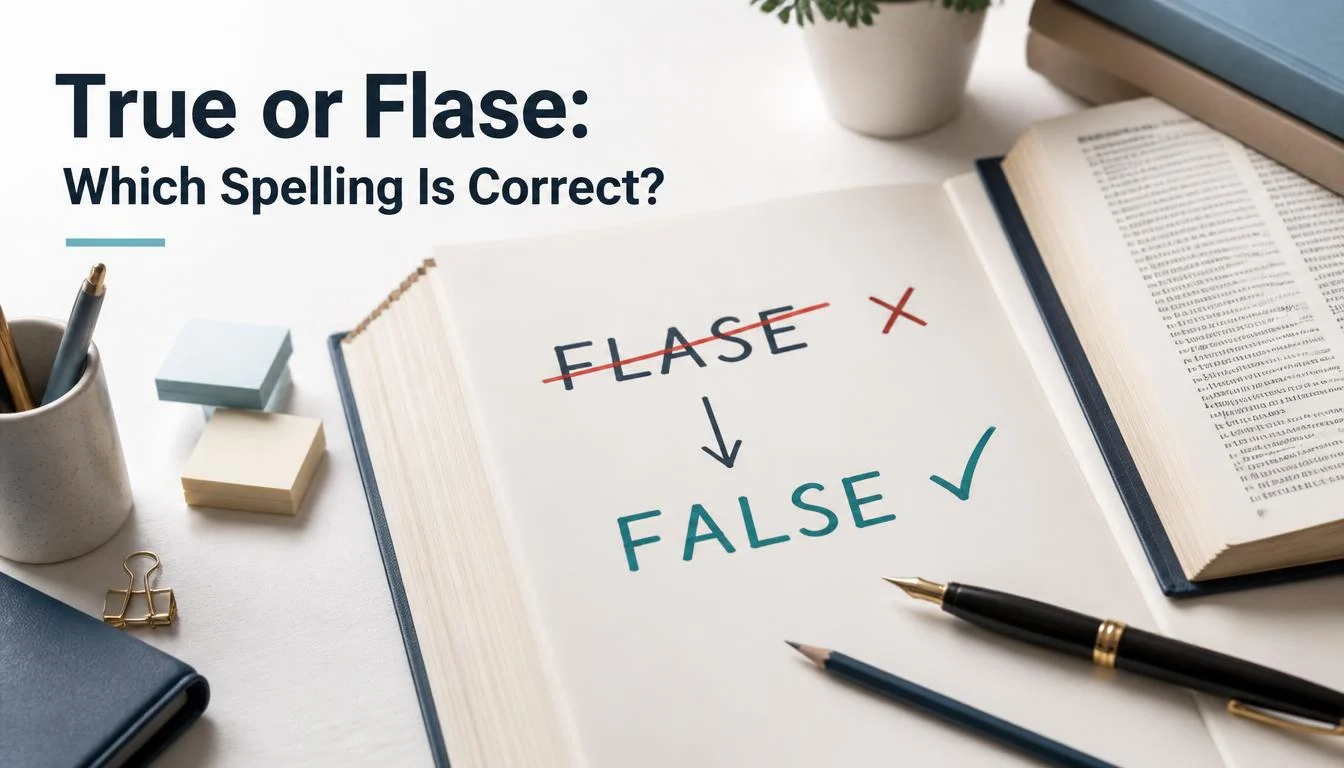
True or false is the correct spelling; flase is a common typing mistake.“False” means not true, while “flase” has no standard meaning in English.
The phrase true or false is commonly used when someone needs to determine whether a statement is correct or incorrect. You will often see it in quizzes, classroom exercises, tests, surveys, and everyday conversations. The meaning is simple: “true” means the statement is correct or accurate, while “false” means it is incorrect or untrue. Even though the phrase looks straightforward, understanding how it works in different contexts can make your English clearer and more precise.
In this guide, we’ll explain true or false in simple English, explore its meaning and common uses, and look at practical examples. You’ll also learn how the phrase works in questions and statements, so you can recognize and use it confidently in both casual and formal situations.
Which One Is Correct?
The correct expression is true or false.
True and false are opposite terms used to describe whether something agrees with reality, facts, or a stated condition. The word false is spelled with the letters f-a-l-s-e.
The spelling flase is incorrect in standard English. It is not an accepted alternative spelling of false. If you see flase in a sentence, it is almost certainly a typographical or spelling error.
| Form | Correct? | Explanation |
|---|---|---|
| true or false | Yes | Standard English expression |
| true or flase | No | “Flase” is a spelling mistake |
| true / false | Yes | Common shortened form |
| True/False | Yes | Common in quizzes and tests |
So, when writing a question, statement, quiz, or formal document, always use true or false.
Meaning of the Correct Word
Definition
False is an adjective that describes something that is not true, accurate, genuine, or based on fact.
For example:
The statement “The sun rises in the west” is false.
Here, false means that the statement does not match reality.
The word can also describe something that is deliberately untruthful. A person may give a false answer, make a false claim, or provide false information.
Explanation
The meaning of false depends on context.
- In questions about facts, false means incorrect or untrue.
- In descriptions of objects, it can mean not genuine or artificial.
- In statements about behavior, it can suggest dishonesty or insincerity.
Consider these examples:
- A false statement is not true.
- A false alarm signals danger when there is no real danger.
- False information contains incorrect or misleading details.
- False teeth are artificial teeth.
- A false identity is an identity that is not genuine.
This makes false a versatile word. Its core idea remains connected to something that does not match what is real, accurate, or genuine.
Usage
False commonly appears after linking verbs and before nouns.
Examples include:
- The statement is false.
- That information is false.
- She made a false claim.
- The report contained false information.
- The alarm turned out to be false.
It also appears in the familiar phrase true or false.
For example:
Choose whether each statement is true or false.
This construction is especially common in educational settings, quizzes, examinations, surveys, and fact-checking.
Real-World Examples
Here are several natural examples of false in everyday English:
- The rumor about the company was false.
- The teacher marked the answer false.
- That statement is completely false.
- The website published false information.
- The security system produced a false alarm.
- He gave a false name at the hotel.
- The claim was later proven false.
- The quiz contains ten true or false questions.
These examples show that false works in both casual and formal communication.
Meaning of the Incorrect or Alternative Word
Incorrect
Flase is incorrect in standard English.
It does not have a recognized dictionary meaning as an alternative spelling of false. The correct spelling is false.
If you are writing an essay, test answer, email, article, or professional document, use false.
Typo
The most likely explanation for flase is a typing or spelling error.
The correct sequence is:
F-A-L-S-E
A person writing quickly may accidentally produce:
F-L-A-S-E
The difference is small, but the result is still incorrect.
This type of mistake is especially easy to make on a keyboard because the letters a, l, and s occur close together in the word.
Slang
Flase is not standard English slang.
You may occasionally encounter it online as a humorous typo, username, informal error, or accidental spelling. That does not make it an accepted English word.
In ordinary writing, treat flase as a mistake rather than a slang form.
Regional Variation
Flase is not a regional spelling used in American, British, Canadian, or Australian English.
English-speaking regions may differ in some spellings, such as color and colour. However, false does not have a regional spelling called flase.
The standard spelling remains false.
Rare but Valid Usage
There is no standard English usage in which flase functions as the accepted spelling of false.
If you find it online, the context may involve a username, a typo, an informal post, or another language. In standard English, it should not replace false.
Key Differences Between the Two Words
The main difference is simple: false is a valid English word, while flase is not.
| Feature | True | False | Flase |
|---|---|---|---|
| Spelling | T-R-U-E | F-A-L-S-E | F-L-A-S-E |
| Meaning | Correct or factual | Incorrect or untrue | No standard meaning |
| Pronunciation | troo | FAWLSS | No standard pronunciation |
| Grammar | Adjective, noun, verb | Adjective, noun, adverb | Not a standard word |
| Usage | Common | Common | Incorrect |
| Recognition | Widely recognized | Widely recognized | Not recognized as standard English |
| Opposite | False | True | — |
The phrase true or false presents two opposing possibilities. A statement can be accurate and therefore true, or inaccurate and therefore false.
Why the Spelling Matters
A single misplaced letter can change a correct word into an error.
Compare:
- false correct
- flase incorrect
Although most readers can understand what flase was intended to mean, they may notice the mistake immediately. In professional or academic writing, repeated spelling errors can also make the writing appear less polished.
Common Mistakes People Make
The most common mistake is switching the a and l in false.
Writing “flase”
Incorrect:
The answer is flase.
Correct:
The answer is false.
The letters should appear in this order:
F → A → L → S → E
Confusing “False” With “Falsy”
Another possible source of confusion comes from programming terminology.
In some programming languages, false is a Boolean value. Developers may also use terms such as falsy, which describes values treated as false in certain contexts.
However, falsy does not make flase correct. The spelling false remains unchanged.
Misspelling It in “True or False”
Because the expression is so familiar, people sometimes type it quickly and accidentally produce:
True or flase
The correct form is:
True or false
This matters especially in quiz titles, worksheets, classroom materials, and online forms.
Assuming Every Familiar Typo Is a Variant
Frequent online mistakes can sometimes look like accepted alternatives. That is not how standard spelling works.
A word can appear thousands of times because people repeatedly make the same mistake. Frequency alone does not make an incorrect spelling standard.
Correct Usage Examples
Casual Examples
In everyday conversation, false is usually straightforward.
- That rumor is false.
- No, that story is false.
- I thought the answer was true, but it was false.
- The message contained false information.
- That claim sounds false to me.
These sentences use false naturally without requiring formal language.
Professional Examples
Professional writing often uses false when discussing claims, reports, records, or information.
- The report contained several false statements.
- The company denied the false allegations.
- The system generated a false warning.
- The investigation found the claim to be false.
- Employees should not knowingly provide false information.
In professional contexts, accuracy is especially important. Use the standard spelling false rather than the typo flase.
Educational Examples
The phrase true or false is extremely common in education.
- Read each statement and select true or false.
- The teacher included five true or false questions.
- Students must decide whether each statement is true or false.
- Mark each answer as true or false.
- The final section contains a true-or-false exercise.
Notice that true and false work together as opposite choices.
Literary/Metaphorical Examples
False can also appear in figurative or descriptive language.
- The calm smile hid a false sense of confidence.
- The mirror created a false impression of distance.
- He rejected the false promise of easy success.
- The quiet afternoon gave a false impression of safety.
Here, false can suggest something misleading, deceptive, artificial, or not what it first appears to be.
Word Origin / Etymology
The English word false has a long history.
It entered Middle English through Old French forms related to fals, which ultimately trace back to Latin falsus, meaning “deceived,” “deceptive,” or “untrue.” The Latin verb fallere carried the idea of deceiving or misleading.
Over centuries, the word developed into the modern English false.
Its meanings expanded beyond simply “not true.” Modern English uses it for inaccurate statements, deceptive claims, artificial objects, mistaken impressions, and situations that appear genuine but are not.
For example, false alarm does not mean an alarm that is “lying.” It means an alarm caused by a situation that does not represent a real emergency.
Likewise, false teeth are not naturally occurring teeth. They are artificial replacements.
This historical development explains why false now appears in many expressions with related meanings.
Why the Incorrect Version Became Popular
The spelling flase does not have a separate historical development in standard English. Its popularity comes mainly from human error.
The word false contains a letter sequence that is easy to rearrange:
F-A-L-S-E
When typing quickly, someone may accidentally move the L before the A:
F-L-A-S-E
Because the resulting form still looks visually similar to the intended word, the mistake can go unnoticed.
Digital typing makes this especially common. People often type quickly, rely on spell-checking, or write short messages without reviewing them. A typo can then spread through copied text, comments, documents, or messages.
Another reason is visual familiarity. Readers can often understand a misspelled word from context. If someone writes flase in the sentence “The statement is flase,” the intended meaning is obvious.
However, being understandable does not make a spelling standard.
The safest approach is simple: remember the correct letter order and proofread important writing.
Easy Memory Tricks
Remembering false becomes easier when you focus on its middle letters.
Think “FA-LSE”
Break the word into two parts:
FA + LSE = FALSE
The important point is that A comes before L.
Do not let the letters become:
FL + ASE
Instead, remember:
F-A-L-S-E
Link It With “False Alarm”
Think of the familiar phrase false alarm.
Say it slowly:
false alarm
The word false comes first, and its spelling stays fixed.
Pair “True” and “False”
Remember the standard pair:
TRUE ↔ FALSE
If you see true or, the natural opposite is false.
For example:
Is the statement true or false?
This association makes the correct spelling easier to recall.
Use the “A Before L” Rule
A quick visual trick is:
False has A before L.
When writing the word, check those two letters first. If you wrote FL, stop and switch them to FA-L.
FAQs
Is “true or flase” correct?
No. True or false is the correct expression. Flase is a spelling mistake.
What is the correct spelling of false?
The correct spelling is F-A-L-S-E: false.
What does false mean?
False means not true, accurate, genuine, or factual, depending on the context.
Is flase a word?
No. Flase is not a standard English word or an accepted spelling of false.
Why do people write flase instead of false?
It is usually a typing error caused by switching the positions of A and L.
How do you pronounce false?
False is pronounced approximately FAWLSS.
Is false the opposite of true?
Yes. In many contexts, true and false are direct opposites.
Can flase be used informally online?
You may see it as a typo or username, but it is not standard English and should not be used in formal writing.
Conclusion
When choosing between true or flase and true or false, always use true or false in standard English.False means untrue, inaccurate, or not genuine, while flase is simply a spelling mistake.Remember the letter order: F-A-L-S-E, with A before L.
When in doubt, think true ↔ false and you will have the correct spelling every time.
Read More Articles
- Majorca vs Mallorca | Meaning, Spelling and Usage Explained In 2026
- Hight or Height | Learn the Correct Word to Use In 2026

Andrew Cooper is a blogger and writer at Gramscript.com, turning everyday ideas into clear, engaging stories. His writing blends curiosity, insight and a genuinely human perspective.
1 thought on “True or Flase | Correct Usage, Meaning and Practical Examples In 2026”