Quick Answer
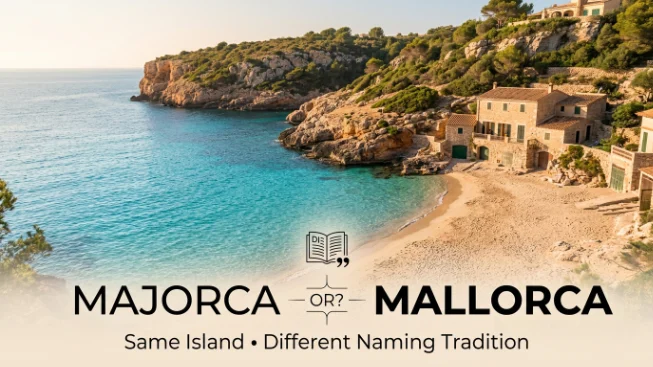
Majorca vs Mallorca Both refer to the same Spanish island. Mallorca is the modern Spanish/Catalan name, while Majorca is the traditional English form.
If you’ve ever searched for a trip to Spain’s beautiful Balearic Islands, you may have noticed two names for the same destination: Majorca and Mallorca. This can be confusing, especially when travel websites, maps, airlines, and guidebooks seem to use both spellings. The good news is that Majorca and Mallorca are not two different islands. They are simply two versions of the island’s name, with “Mallorca” being the Spanish name and “Majorca” being the traditional English form.
The difference becomes more useful to understand when you’re booking flights, searching for hotels, reading travel guides, or planning a holiday. Mallorca is the name you’ll most commonly see in Spain and in official Spanish contexts, while Majorca remains widely recognized in English-language travel writing. In this guide, we’ll explain Majorca vs Mallorca, where each name comes from, whether one is more correct, and which version you should use depending on your audience and context. Whether you’re planning a Mediterranean getaway or simply curious about the island’s name, this simple comparison will clear up the confusion.
Which One Is Correct: Majorca or Mallorca?
Both are correct but Mallorca is the modern local form
The most important point is that Majorca is not simply a misspelling of Mallorca.
Mallorca is the modern Spanish and Catalan name of the island. Majorca is an established English form. Major English dictionaries recognize Majorca as the name of the island, while also identifying Mallorca as its Spanish name.
This means you should not automatically mark “Majorca” as wrong when proofreading an English sentence.
For example:
We spent a week in Majorca.
This is grammatically and lexically acceptable English.
Likewise:
We spent a week in Mallorca.
This is also correct and is the spelling you are more likely to encounter in modern official tourism material.
Which spelling should you use?
For most modern writing, use Mallorca.
That is especially true when you are:
- Writing about Spain
- Referring to the island by its local name
- Writing a travel article
- Describing current tourism
- Using modern maps or official sources
- Writing for an international audience
- Following the terminology used by local institutions
Use Majorca when an established English convention, publication style, quotation, historical source, or audience specifically calls for it.
The important thing is consistency. If you choose Mallorca, do not randomly switch between Mallorca and Majorca throughout the same article unless you are specifically discussing the difference.
What Does Mallorca Mean?
Mallorca is the name of an island in the Mediterranean Sea and the largest of Spain’s Balearic Islands.
It is located in the western Mediterranean and is known for destinations such as Palma, beaches, mountain landscapes, historic towns, and the Serra de Tramuntana. Official tourism information uses Mallorca as the island’s name and describes Palma as a gateway to the island.
In a sentence, Mallorca is a proper noun because it identifies a specific geographical place.
Examples
- Mallorca is one of Spain’s best-known Mediterranean destinations.
- We are planning a trip to Mallorca in September.
- She spent her summer vacation in Mallorca.
- Palma is the capital of Mallorca.
- The Serra de Tramuntana stretches across Mallorca.
Because Mallorca is a proper place name, it is normally capitalized.
Related words
You may also encounter words connected with the island, including:
- Mallorcan relating to Mallorca or its people
- Mallorcan cuisine food associated with the island
- Mallorcan culture cultural traditions of the island
- Mallorcan landscape the island’s natural environment
- Mallorcan architecture architectural styles and buildings associated with Mallorca
For example:
We tried several traditional Mallorcan dishes during our visit.
The adjective Mallorcan is derived from Mallorca and is commonly used when discussing the island’s culture, people, food, and traditions.
What Does Majorca Mean?
Majorca refers to exactly the same island as Mallorca.
The difference is not geographical. It is primarily a matter of language, spelling tradition, and usage.
Collins lists Majorca as an English noun meaning the largest of the Balearic Islands and identifies Mallorca as its Spanish name.
Dictionary.com likewise defines Majorca as the Spanish island and lists Mallorca as the Spanish name.
So this sentence is valid:
We booked a hotel in Majorca.
And so is this one:
We booked a hotel in Mallorca.
The reader understands the same destination.
Is Majorca old-fashioned?
It can sound more traditional or distinctly English in some contexts, but it is not automatically obsolete.
The continued appearance of Majorca in English dictionaries and contemporary English-language usage shows that it remains a recognized English form.
However, Mallorca has become increasingly prominent in modern international communication, particularly because it matches the island’s Spanish and Catalan name and is the form used by official tourism organizations.
Majorca vs. Mallorca: Key Differences
| Feature | Mallorca | Majorca |
| Refers to | Same island | Same island |
| Language tradition | Spanish/Catalan | English |
| Status | Current local name | Established English alternative |
| Meaning | The island of Mallorca | The same island |
| Proper noun | Yes | Yes |
| Spelling | M-a-l-l-o-r-c-a | M-a-j-o-r-c-a |
| Common in official local tourism | Very common | Less typical |
| Common in English | Very common | Still recognized |
| Is it a typo? | No | No |
| Recommended for modern international writing | Yes | Acceptable depending on style |
The key difference is therefore not meaning.
It is naming convention.
Spelling Difference: Why Is There an “ll” in Mallorca?
The most obvious visual difference is the middle of the word:
- Mallorca
- Majorca
Mallorca contains “ll”, while Majorca contains “j.”
This difference developed through the history of the name as it moved through Latin, Romance languages, and English usage.
The name ultimately traces back to Latin maior, meaning “larger” or “greater.” Etymological sources connect the island’s name with the idea of the “larger” island.
The modern form Mallorca developed through Spanish and Catalan linguistic history, while Majorca became an established English form.
Therefore, the spelling difference is historical and linguistic not a random spelling variation.
Pronunciation: Majorca vs. Mallorca
Pronunciation is another area that can cause confusion.
How to pronounce Majorca
In American English, Majorca is commonly pronounced approximately like:
muh-JOR-kuh
or
muh-YOR-kuh
Dictionary sources give both pronunciation patterns in American English. Collins, for example, lists pronunciations beginning with /məˈdʒɔr-/ and /məˈjɔr-/.
How to pronounce Mallorca
In English, Mallorca may be pronounced approximately as:
muh-YOR-kuh
or with a pronunciation closer to the Spanish/Catalan form depending on the speaker.
The exact sound can vary by language and regional accent. Dictionary sources record several English pronunciations for Mallorca, while Spanish pronunciation differs from typical English pronunciation.
Does pronunciation change the meaning?
No.
Whether someone says Majorca or Mallorca, they are referring to the same island.
The pronunciation mainly reflects the speaker’s language and accent.
Is Mallorca More Correct Than Majorca?
This is where the answer needs some nuance.
It would be misleading to say:
“Mallorca is correct and Majorca is incorrect.”
A more accurate statement is:
Mallorca is the modern Spanish and Catalan name, while Majorca is a recognized English form.
Official tourism sources strongly favor Mallorca in contemporary English-language communication. For example, Visit Palma’s English-language website consistently refers to the island as Mallorca.
At the same time, major English dictionaries continue to recognize Majorca as an English word.
So the choice depends on context.
For a modern travel website
Mallorca is usually the better choice.
For an English dictionary explanation
Both forms can be discussed.
For a historical English quotation
Keep Majorca if that is the spelling used by the original source.
For Spanish or Catalan contexts
Use Mallorca.
Is Majorca a Typo?
No. Majorca is not a typo.
This is one of the most common misunderstandings.
A typo is an accidental error, such as writing:
Mallroca
or
Majroca
Those forms are simply misspellings.
Majorca, however, is an established English geographical name.
English dictionaries explicitly list it as the name of the island.
Therefore, if you see “Majorca” in an English text, you should not automatically correct it to “Mallorca.”
Instead, consider the context and the style being followed.
Why Do People Use Majorca Instead of Mallorca?
There are several reasons.
1. English has its own geographical naming traditions
English frequently uses established exonyms names for places that differ from the local name.
For example, English uses:
- Germany instead of Deutschland
- Florence instead of Firenze
- Munich instead of München
- Rome instead of Roma
Similarly, Majorca became an established English form of Mallorca.
2. Historical English usage
Majorca has been used in English for a long time, which helped establish it as a recognizable English place name.
Once a geographical name becomes familiar in a language, it can remain in use even when the local name becomes more common internationally.
3. Travel and tourism language
Older English-language travel materials frequently used Majorca. That history means many English speakers still recognize it immediately.
4. Familiarity
Some speakers learned the island as “Majorca” and continue to use that spelling.
This is similar to how people continue using familiar traditional place names even when modern official terminology differs.
Why Is Mallorca More Common in Modern International Writing?
The growing use of Mallorca reflects a broader preference for local and official geographical names.
Modern tourism organizations, maps, businesses, airlines, hotels, and destination authorities frequently use Mallorca. The official Visit Palma website, for example, consistently uses Mallorca in its English-language tourism material.
There is also a practical reason.
Using the local name reduces ambiguity and aligns your writing with how the destination officially presents itself.
If you are writing:
Welcome to Mallorca.
you are using the island’s current local name.
That does not make:
Welcome to Majorca.
wrong. It simply reflects a different English naming tradition.
Grammar: How Do You Use Mallorca in a Sentence?
Because Mallorca is a proper noun, it is usually used without an article.
Correct
We visited Mallorca last summer.
- Correct
- Correct
Usually unnecessary
We visited the Mallorca last summer.
The second version sounds unnatural when Mallorca is being used simply as the island’s name.
However, the can appear when Mallorca is part of a longer noun phrase or when a particular construction requires it.
For example:
the island of Mallorca
Here, “the” belongs to island, not to Mallorca itself.
Similarly:
the history of Mallorca
is perfectly natural.
Mallorca as a Proper Noun
Remember that Mallorca names one specific geographical location.
Therefore, capitalize it:
- Mallorca
- Majorca
- Spain
- Mediterranean Sea
- Balearic Islands
- Palma
Do not write:
mallorca
in standard English prose.
Instead:
Mallorca
The same capitalization rule applies to Majorca.
Correct Usage Examples
Casual examples
We are thinking about visiting Mallorca this summer.
Have you ever been to Majorca?
My friends spent a week in Mallorca.
I found some beautiful beaches in Majorca.
Professional examples
The company is organizing a conference in Mallorca.
Tourism plays an important role in Mallorca’s economy.
The report examines the development of tourism in Majorca.
Our research focuses on cultural heritage in Mallorca.
Educational examples
Mallorca is the largest island in the Balearic Islands.
Majorca is an established English name for Mallorca.
The two spellings refer to the same island.
Travel examples
Palma is a popular starting point for exploring Mallorca.
We rented a car to explore northern Mallorca.
The hotel offers tours throughout the island of Mallorca.
Literary or descriptive examples
Beyond the crowded resorts, Mallorca reveals quiet villages and rugged mountain landscapes.
The Mediterranean light over Majorca gave the landscape an almost dreamlike quality.
Majorca or Mallorca in Common Phrases
Both versions can appear in English phrases.
With Mallorca
- Mallorca travel
- Mallorca holidays
- Mallorca hotels
- Mallorca beaches
- Mallorca weather
- Mallorca airport
- Mallorca tourism
- Mallorca vacation
- Mallorca attractions
- Mallorca travel guide
- Mallorca itinerary
- Mallorca resorts
With Majorca
- Majorca travel
- Majorca holidays
- Majorca hotels
- Majorca beaches
- Majorca weather
- Majorca airport
- Majorca tourism
- Majorca vacation
- Majorca travel guide
- Majorca resorts
The important distinction is that Majorca and Mallorca do not identify separate destinations.
Mallorca vs. Majorca for SEO
If you are writing online, the spelling decision becomes slightly more strategic.
A modern travel or grammar article should generally use Mallorca as the main form when referring to the island by its current local name.
However, Majorca should not be ignored because it remains a recognized English term and appears in searches, older content, and everyday English usage.
A natural SEO strategy is therefore:
Primary term: Mallorca
Related terms:
- Majorca
- Mallorca or Majorca
- Majorca or Mallorca
- Mallorca spelling
- Majorca spelling
- is Majorca the same as Mallorca
- is Mallorca the same as Majorca
- Mallorca English name
- Majorca English name
- Mallorca pronunciation
- Majorca pronunciation
- Mallorca Spain
- Majorca Spain
- Mallorca travel
- Majorca travel
The goal is not to repeat the two names in every paragraph. Instead, use them where they genuinely help answer the reader’s question.
Common Mistakes People Make
Mistake 1: Saying Majorca is always wrong
Incorrect assumption:
Majorca is a spelling mistake.
Why it is wrong: Majorca is a recognized English name for the island.
Mistake 2: Assuming Majorca and Mallorca are different islands
They are not.
Both names refer to the same island.
Mistake 3: Treating Mallorca as an English translation of Majorca
The relationship is more complicated than a simple translation.
Mallorca is the Spanish/Catalan form, while Majorca is an established English form.
Mistake 4: Randomly switching spellings
For polished writing, consistency matters.
If your article uses Mallorca, continue using Mallorca unless there is a specific reason to mention Majorca.
Mistake 5: Lowercasing the name
Write:
Mallorca
not:
mallorca
Mistake 6: Assuming pronunciation must be identical
English and Spanish/Catalan pronunciation can differ.
The spelling difference is connected to linguistic history, so different pronunciation patterns are unsurprising.
Word Origin and Etymology of Mallorca
The history of the name is particularly interesting.
The name is ultimately connected with the Latin word maior, meaning “larger” or “greater.” Etymological sources connect Majorca with the Latin idea of the “larger” island.
Another historical form is Maiorica, which developed into later forms including Mallorca.
The name makes sense in relation to Menorca, the neighboring Balearic island whose name is associated with the idea of being smaller.
In simplified terms:
Latin maior → Maiorica → Mallorca / Majorca
The actual linguistic history is more complex than this simplified sequence, but it explains why the modern forms look related.
The official tourism history of Palma also documents earlier forms such as Madina Mayurqa during the Islamic period and the later development of the Kingdom of Mallorca.
This long history helps explain why several forms of the name exist across languages and historical periods.
Why Did the Spelling Change?
Geographical names often change as they move between languages.
A place name can be:
- Borrowed from another language.
- Adapted to local pronunciation.
- Spelled according to the receiving language’s writing system.
- Preserved in an older form even after the original name changes.
That is essentially what happened with Majorca and Mallorca.
Mallorca reflects the modern Spanish/Catalan naming tradition.
Majorca reflects an established English adaptation.
Neither form was invented randomly.
Is “Majorcan” or “Mallorcan” Correct?
This is another useful distinction.
Both Majorcan and Mallorcan can be found in English, but they follow the two naming traditions.
Majorcan
This is the adjective/noun derived from Majorca.
Example:
Majorcan artists have contributed to the island’s cultural heritage.
Collins lists Majorcan as a derived form of Majorca.
Mallorcan
This form is derived from Mallorca and is widely used in modern contexts.
Example:
We enjoyed traditional Mallorcan cuisine.
If your writing primarily uses Mallorca, then Mallorcan is usually the more natural matching adjective.
Easy Memory Trick
Here is a simple way to remember the difference:
Think “local name = Mallorca”
Mallorca has the LL, making it visually distinct from the traditional English form.
Remember:
Mallorca = modern local form
And:
Majorca = established English form
Another useful shortcut is:
Mallorca → Spanish/Catalan
Majorca → English tradition
Neither means a different island.
Which One Should You Use in Formal Writing?
For formal modern writing, Mallorca is usually the safest choice.
Use Mallorca when:
- Writing a travel guide
- Writing an academic article
- Referring to current Spanish geography
- Describing the island in a professional context
- Writing for an international audience
- Following official local terminology
- Creating modern website content
Use Majorca if:
- A publication’s style guide requires it
- You are quoting an older source
- You are discussing historical English usage
- Your audience specifically uses the traditional English form
- You are maintaining the terminology of an existing document
The important principle is not that one spelling must eliminate the other.
It is that the spelling should match your context and remain consistent.
Majorca or Mallorca: A One-Sentence Rule
If you need a quick rule, remember this:
Mallorca is the modern Spanish and Catalan name; Majorca is a recognized English alternative for the same island.
That single sentence resolves most spelling questions.
FAQs
1. Is Mallorca the same as Majorca?
Yes. Mallorca and Majorca are two names for the same island in Spain’s Balearic Islands. Mallorca is the modern Spanish and Catalan form, while Majorca is an established English form.
2. Which is correct, Majorca or Mallorca?
Both are correct in the appropriate context. Mallorca is the current local Spanish/Catalan name and is generally preferable in modern international writing. Majorca remains a recognized English form.
3. Is Majorca an incorrect spelling?
No. Majorca is not a spelling mistake. English dictionaries recognize it as an English name for the island.
4. Why do some people say Majorca instead of Mallorca?
Majorca is an established English adaptation of the island’s name. Historical English usage helped preserve the form, so many English speakers continue to use it.
5. Is Mallorca the official name?
Mallorca is the modern Spanish and Catalan name used by local institutions and official tourism organizations. Visit Palma, for example, uses Mallorca throughout its current English-language tourism material.
6. How do you pronounce Mallorca?
In English, Mallorca is commonly pronounced approximately like muh-YOR-kuh, although pronunciation varies by speaker and language. Spanish and Catalan pronunciations differ from typical English pronunciation.
7. How do you pronounce Majorca?
In American English, Majorca can be pronounced approximately muh-JOR-kuh or muh-YOR-kuh. British English pronunciation can differ as well.
8. Should I write Mallorca or Majorca on a travel website?
Mallorca is generally the stronger modern choice, especially if you want to match local and official usage. You can still mention Majorca naturally because it remains a recognized English term.
Conclusion
Majorca and Mallorca refer to the same beautiful Spanish island. Mallorca is the island’s Spanish name, while Majorca is the traditional English form. Both names are correct and widely understood, but Mallorca is generally preferred for modern and official use. Whether you say Majorca or Mallorca, you are referring to the same stunning Mediterranean destination known for its beautiful beaches, charming villages, and vibrant culture.

Christopher Parker is a writer and blogger at GramScript.com, sharing thoughtful insights and engaging stories across a range of topics. His writing blends clarity, curiosity, and a distinctly human perspective.
4 thoughts on “Majorca vs Mallorca | Meaning, Spelling and Usage Explained In 2026”