Quick Answer
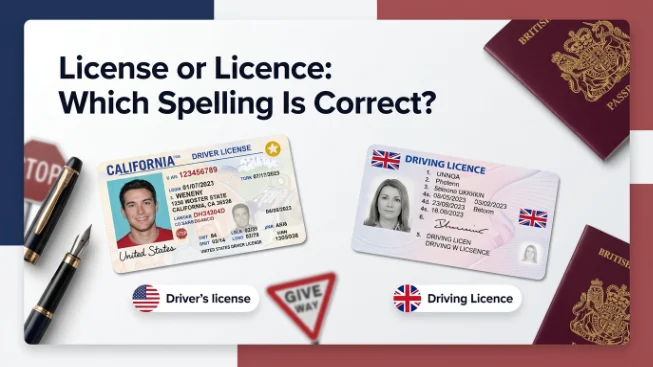
License is the standard spelling in American English, while British English uses licence as a noun and license as a verb. Both forms are correct; the choice depends mainly on the variety of English.
License or licence is a common spelling question, especially when comparing American and British English. Both forms are correct, but the preferred spelling depends on the variety of English you are using. In American English, license is the standard spelling for both the noun and verb. In British English, licence is generally used as a noun, while license is used as a verb.
Understanding this small spelling difference can help you write more accurately and avoid confusion in formal documents, academic writing, professional communication, and everyday English. Whether you are talking about a driver’s license, a business permit, or the act of giving someone official permission, this guide explains when to use license and licence, with clear examples to make the distinction easy to remember.
Which One Is Correct?
Both “License” and “Licence” Are Correct
The answer to license or licence depends on where and how you are writing.
In American English, license is used for both the noun and the verb.
For example:
- “I renewed my driver’s license.”
- “The state will license the business.”
- “She has a fishing license.”
- “The company is licensed to operate.”
In British English, the usual distinction is different:
- licence = noun
- license = verb
For example:
- “I renewed my driving licence.”
- “The company applied for a broadcasting licence.”
- “The council will license the business.”
- “The restaurant is licensed to sell alcohol.”
So neither spelling should automatically be called wrong.
The most important rule is this:
American English: license for both noun and verb. British English: licence for the noun, license for the verb.
Why the Difference Matters
This distinction is especially important in formal writing. If you are writing for an American audience, license will normally be expected in every grammatical role.
If you are writing in British English, using license as a noun may look unusual or incorrect to readers who follow traditional British spelling conventions.
For example:
American English:
“My driver’s license expires next month.”
British English:
“My driving licence expires next month.”
The meaning is essentially the same. Only the spelling convention changes.
Meaning of “License”
License as a Noun
As a noun, license means an official document, permission, or authorization that allows someone to do something.
In American English, the noun is spelled license.
Examples include:
- driver’s license
- business license
- fishing license
- professional license
- marriage license
- hunting license
- liquor license
- software license
A license usually indicates that an individual, company, or organization has received formal permission from an authority.
For example:
“She received her driver’s license after passing the test.”
Here, license is a noun because it names the official document or authorization.
License as a Verb
License can also be a verb.
As a verb, it means to give someone official permission to do something or to authorize an activity.
Examples:
- “The agency licenses medical professionals.”
- “The government licensed the new facility.”
- “The company is licensed to provide the service.”
In these sentences, license describes an action.
The verb form does not change to licence in standard British English. This is one of the most useful distinctions to remember.
Everyday Uses of “License”
The noun appears in many everyday situations.
You might need a license to:
- drive a vehicle
- operate certain businesses
- practice a regulated profession
- hunt
- fish
- sell particular goods
- use certain intellectual property
- operate specific types of equipment
The exact legal requirements vary by country, state, province, or industry.
Meaning of “Licence”
Licence as a British English Noun
Licence is the traditional British English spelling when the word functions as a noun.
For example:
“He applied for a driving licence.”
Here, licence names the official document.
Other examples include:
- “Her licence was renewed last week.”
- “You need a fishing licence.”
- “The company obtained a broadcasting licence.”
- “His professional licence is still valid.”
The word means the same thing as American English license.
Licence Does Not Have a Different Meaning
It is important not to think that licence and license represent two completely different ideas.
They usually carry the same meaning.
The distinction is primarily related to English variety and grammatical function.
Compare:
| Variety | Noun | Verb |
|---|---|---|
| American English | license | license |
| British English | licence | license |
This table captures the main rule.
What About “Licence” as a Verb?
In traditional British English, licence is generally not used as the verb.
Instead, the verb is license.
Correct:
“The authority will license the company.”
Not the traditional British form:
“The authority will licence the company.”
This noun-versus-verb distinction is one of the most common points of confusion.
Key Differences Between License and Licence
Spelling
The clearest difference is the final letter.
- license ends in -se
- licence ends in -ce
This difference is small but meaningful when following a particular spelling system.
Meaning
The basic meaning is the same.
Both words can refer to official permission or authorization.
The spelling changes according to the English variety and, in British English, according to whether the word is being used as a noun or verb.
Pronunciation
License and licence are pronounced the same in standard English.
They are commonly pronounced approximately as:
LY-sens
The final s sound is important.
Unlike the spelling difference, there is normally no pronunciation difference between the two forms.
This makes the words homophones in common usage: they sound alike but are spelled differently.
Grammar
Grammar is where the difference becomes especially useful.
In American English:
- noun: license
- verb: license
- adjective/participle: licensed
In British English:
- noun: licence
- verb: license
- adjective/participle: licensed
Examples:
American English:
“The restaurant has a license.”
“The government will license the restaurant.”
British English:
“The restaurant has a licence.”
“The government will license the restaurant.”
Recognition
Both spellings are widely recognized by English speakers.
However, readers often associate:
- license with American English
- licence with British English
If you switch between the two forms without a reason, your writing may appear inconsistent.
Usage
Your audience should guide your choice.
Use license throughout when following American English conventions.
Use licence for the noun and license for the verb when following traditional British English conventions.
Consistency is more important than choosing one form as universally correct.
License or Licence in American English
The American Rule
American English has simplified the distinction by using license for both noun and verb.
Examples:
“You need a business license.”
“The state will license the business.”
“She lost her driver’s license.”
“The board licenses qualified professionals.”
American dictionaries and style conventions generally follow this -se spelling for both grammatical roles.
Common American Expressions
You may commonly encounter:
- driver’s license
- learner’s license
- professional license
- business license
- fishing license
- marriage license
- software license
- liquor license
For American readers, writing driving licence or business licence can look distinctly British.
That does not make the British spelling inherently wrong. It simply belongs to another spelling convention.
Licence in British English
The British Rule
British English traditionally uses licence when the word is a noun.
Examples:
“I need to renew my driving licence.”
“She applied for a marriage licence.”
“The company holds a valid operating licence.”
When the word is a verb, British English uses license.
Examples:
“The council can license the premises.”
“The authority licenses several operators.”
This creates a useful -ce / -se pattern.
A Simple British English Pattern
Think:
-ce = thing
-se = action
So:
- driving licence = the document
- to license = the action of granting permission
This pattern is similar to another familiar British spelling distinction involving advice and advise, although the pronunciation patterns are not identical.
Common Mistakes People Make
Mistake 1: Calling “Licence” Incorrect
It is incorrect to assume that licence is simply a misspelling.
It is a standard British English noun spelling.
For example:
“She renewed her driving licence.”
This is perfectly appropriate in British English.
Mistake 2: Using “Licence” as the British Verb
Traditional British English uses license as the verb.
Correct:
“The authority will license the company.”
The noun is:
“The company received a licence.”
The grammatical role changes the spelling.
Mistake 3: Mixing American and British Forms
A sentence such as:
“I renewed my driving licence in California.”
may look inconsistent because driving licence is associated with British English, while California uses American English conventions.
For American writing, driver’s license is the natural form.
Mistake 4: Thinking the Words Sound Different
They generally do not.
License and licence are pronounced alike.
The difference appears in writing, not ordinary pronunciation.
Mistake 5: Assuming One Form Is More Formal
Neither spelling is automatically more formal.
License is not more professional than licence, and licence is not more sophisticated than license.
The appropriate choice depends on the English variety you are using.
Mistake 6: Forgetting the Plural
The plural forms are:
- licenses
- licences
American English uses licenses.
Traditional British English uses licences for plural nouns.
Examples:
“The company holds several licenses.”
“The company holds several licences.”
Again, the difference follows the spelling system.
Correct Usage Examples
Casual Examples
- “I need to renew my driver’s license.”
- “Have you got your driving licence?”
- “My license expires next year.”
- “She finally received her licence.”
- “He forgot to bring his license.”
The appropriate spelling depends on the variety of English.
Professional Examples
- “All employees must hold a valid professional license.”
- “The organization applied for a new operating licence.”
- “The agency is authorized to license qualified providers.”
- “Each business must obtain the appropriate licence before opening.”
Educational Examples
- “A driver’s license allows a person to drive legally.”
- “In British English, licence is normally used as a noun.”
- “The verb license is used in both American and British English.”
- “The spelling depends on the grammatical role and regional variety.”
Legal and Administrative Examples
- “The applicant submitted a copy of their license.”
- “The company must renew its operating licence.”
- “The authority may revoke the license if regulations are violated.”
- “The premises were properly licensed by the local authority.”
Literary or Figurative Examples
The word can also have a broader meaning beyond an official document.
License can sometimes mean freedom or permission to behave in a particular way.
For example:
“The success gave him a license to experiment.”
Here, license does not refer to a physical document. It means a kind of freedom or permission.
Another example is:
“The poet took artistic license with the historical details.”
Artistic license means deliberately departing from strict factual accuracy for creative effect.
This expression is common in both American and British English.
License as Permission
Official Permission
The most familiar meaning involves formal authorization.
For example:
“The company needs a license to operate.”
This means the company needs official permission.
Freedom to Act
The word can also describe permission in a broader sense.
For example:
“His position gave him a license to speak openly.”
Here, the word means freedom or permission rather than a government-issued document.
Artistic License
Artistic license is a well-known expression.
It describes the creative freedom to change, simplify, exaggerate, or rearrange facts for artistic purposes.
For example:
“The movie takes some artistic license with the historical events.”
The phrase does not suggest that the filmmaker received an actual government permit.
License, Licence, and Related Words
Licensed
Licensed is the standard past participle and adjective form.
Examples:
- licensed driver
- licensed professional
- licensed business
- licensed operator
Both American and British English use licensed.
For example:
“The restaurant is licensed to serve alcohol.”
Licensing
The -ing form is licensing.
Examples:
- licensing agreement
- licensing authority
- software licensing
- licensing requirements
The spelling remains licensing, not licencing, in the standard British and American forms of the verb license.
This is another useful point because the noun spelling licence does not control the spelling of the verb’s derived forms.
Licensee
A licensee is a person or organization that receives a license.
For example:
“The licensee must follow all applicable regulations.”
The word is spelled licensee, even in British English, because it derives from the verb license.
Licensor
A licensor is the person or organization that grants a license.
For example:
“The licensor retains ownership of the intellectual property.”
Again, the spelling uses license as the base.
Software License or Licence?
American English
In American English, you will normally see:
software license
For example:
“Read the software license before installing the program.”
British English
British English may use:
software licence
when the word is being used as a noun.
For example:
“The software licence allows installation on two devices.”
The underlying meaning does not change.
This distinction appears frequently in technology, publishing, business, and legal writing.
Driver’s License or Driving Licence?
American English
The standard American term is:
driver’s license
For example:
“You must show your driver’s license.”
British English
The standard British term is:
driving licence
For example:
“You must carry your driving licence.”
There is also a difference in the phrase itself, not just the spelling.
American English commonly uses driver’s license, while British English commonly uses driving licence.
So translating word for word between the two varieties is not always enough.
License or Licence in Canada and Other Varieties
- Canadian English
- Canadian English can be more complicated because it combines features associated with British and American usage.
- Canadian usage generally uses licence as the noun and license as the verb, following the traditional distinction.
For example:
- driver’s licence
- business licence
- to license
However, spelling practices can vary by institution and context, so a particular Canadian organization may have its own style preferences.
Australian and New Zealand English
Australian and New Zealand English generally follow the British distinction:
- licence = noun
- license = verb
For example:
“You need a valid driver’s licence.”
“The authority can license the operator.”
If you are writing for an international audience, it is useful to identify which variety you are following.
Word Origin and Etymology
Where Does “License” Come From?
The history of license goes back to Latin.
The Latin word licentia meant freedom, permission, or liberty. It was related to licere, meaning “to be allowed” or “to be permitted.”
The word passed into French and then into English, where it developed meanings connected with permission, authorization, and freedom.
This historical connection explains why the modern word can refer both to an official permit and to broader freedom to act.
Where Does “Licence” Come From?
Licence has the same historical origin as license.
The two spellings are not separate words with unrelated histories. They developed from the same linguistic source.
The spelling difference emerged through English usage and regional spelling conventions.
So when you see license and licence, you are looking at two written forms of the same underlying word rather than two unrelated terms.
Why Did Two Spellings Develop?
British Spelling Conventions
British English developed a pattern in which some noun forms ending in a sound like -s were distinguished from related verbs ending in -se.
This pattern can be seen in:
- licence / license
- practice / practise
In traditional British usage:
- licence = noun
- license = verb
And:
- practice = noun
- practise = verb
This convention helps readers identify the grammatical role from spelling.
American Spelling Simplification
American English developed different spelling preferences.
In the case of license, American usage generally uses the -se spelling for both the noun and verb.
This makes the written form simpler:
license = noun
license = verb
The difference is therefore largely a matter of spelling tradition rather than meaning.
Easy Memory Tricks
Think “C for Certificate”
If you are using British English, remember:
licence = noun
You can associate the C with a certificate or document.
A driving licence is a document.
Think “S for Saying the Action”
For the verb, remember:
license = verb
The S can remind you of the action of granting permission.
For example:
“The authority will license the company.”
American English Has One Main Form
If you are writing in American English, keep it simple:
license = noun and verb
You do not need to switch to licence.
Look at the Sentence
When you are unsure, ask:
Am I naming a document or permission?
If yes, you need the noun.
In British English:
“She has a driving licence.”
If you are describing the action of granting permission:
“The authority will license her business.”
This quick test works in most cases.
License or Licence: Side-by-Side Examples
| Meaning | American English | British English |
|---|---|---|
| Official driving document | driver’s license | driving licence |
| Business authorization | business license | business licence |
| Permission document | license | licence |
| Grant permission | license | license |
| Give official authorization | license | license |
| Person receiving permission | licensee | licensee |
| Process of granting permission | licensing | licensing |
| Past participle | licensed | licensed |
The biggest difference appears in the noun.
The verb remains license in both varieties.
How to Choose the Right Form
For American Writing
Use license in all normal contexts.
Examples:
“He renewed his license.”
“The state licenses professionals.”
“The business needs a license.”
For British Writing
Use:
- licence for nouns
- license for verbs
Examples:
“She renewed her licence.”
“The authority will license the company.”
“The business has a valid licence.”
For International Writing
If your readers come from different English-speaking countries, either spelling may be understood.
Still, consistency matters.
If the rest of your writing follows American spelling, use license.
If you are following British spelling, use licence for the noun and license for the verb.
Do not switch randomly between forms.
Final Comparison
| Feature | License | Licence |
|---|---|---|
| Basic meaning | Permission or authorization | Permission or authorization |
| American English noun | Yes | No |
| American English verb | Yes | No |
| British English noun | No | Yes |
| British English verb | Yes | No |
| Pronunciation | LY-sens | LY-sens |
| Historical origin | Same | Same |
| Common US usage | Very common | Unusual |
| Common UK noun usage | Less common | Standard |
| Is it a typo? | No | No |
| Can both be correct? | Yes | Yes |
The simplest way to remember everything is to focus on variety plus grammar.
If you are writing American English, license works for both the noun and verb.
If you are writing British English, use licence for the noun and license for the verb.
FAQs
Is “license” or “licence” correct?
Both are correct. License is the standard form in American English for both nouns and verbs. In British English, licence is normally the noun, while license is the verb.
What is the difference between license and licence?
The main difference is spelling and regional usage. In American English, license is used for both noun and verb. In British English, licence is used as a noun and license as a verb.
Is “licence” British or American?
Licence is primarily the British English spelling when the word is used as a noun. American English normally uses license for the noun.
Is “license” a noun or a verb?
License can be both a noun and a verb. American English uses the same spelling for both. British English uses licence for the noun but license for the verb.
How do you pronounce license and licence?
They are normally pronounced the same: approximately LY-sens. The spelling changes, but the pronunciation generally does not.
Is it “driver’s license” or “driving licence”?
Driver’s license is the common American English form. Driving licence is the common British English form. Both refer to official permission to drive.
Is “licence” a misspelling?
No. Licence is a standard British English spelling when used as a noun. It is not simply an error or typo.
Is the verb “license” or “licence” in British English?
The traditional British English verb is license. For example: “The authority will license the company.” The noun is licence.
Conclusion
When deciding between license or licence, remember that both spellings are correct in the right context. American English uses license for both nouns and verbs, while British English uses licence as a noun and license as a verb. The words have the same origin, meaning, and pronunciation, so the main difference is regional spelling and grammatical use. Choose the form that matches your variety of English and keep it consistent throughout your writing.
Read More Articles
Majorca vs Mallorca | Meaning, Spelling and Usage Explained In 2026
Dependent or Dependant | Meaning, Spelling, and Usage Explained In 2026
Parent or Guardian | Understanding the Right Term for Every Situation In 2026

Andrew Cooper is a blogger and writer at Gramscript.com, turning everyday ideas into clear, engaging stories. His writing blends curiosity, insight and a genuinely human perspective.
1 thought on “License or Licence | How to Spell and Use the Word Correctly In 2026”