Quick Answer
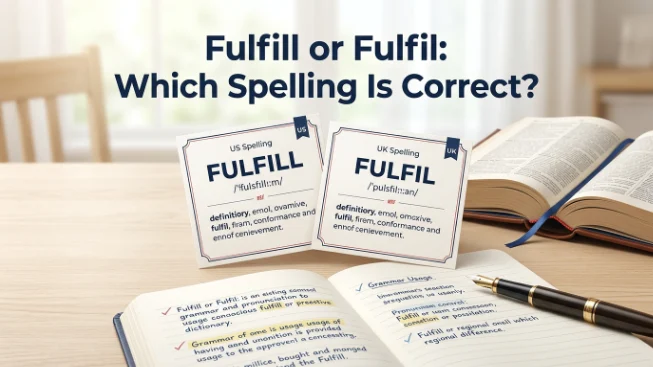
Fulfill is the standard American English spelling, while fulfil is the standard British English spelling. Both are correct; the main difference is regional spelling.
When you come across “fulfill” and “fulfil,” it is easy to wonder whether one of them is a spelling mistake. In fact, both spellings are correct. The main difference is regional: “fulfill” is the standard spelling in American English, while “fulfil” is commonly used in British English and other varieties that follow British spelling conventions. Both words have the same meaning and can describe completing something, meeting a requirement, satisfying a need, or carrying out a promise or duty.
Choosing between fulfill or fulfil usually depends on the type of English you are writing. If your audience uses American English, fulfill is generally the better choice. For British English, fulfil is preferred. Understanding this small spelling difference can help you keep your writing consistent and avoid unnecessary confusion, especially in professional, academic, and online content.
Which One Is Correct?
Both fulfill and fulfil are correct spellings. The choice depends mainly on the variety of English you are using.
If you are writing in American English, use fulfill.
The company aims to fulfill its customers’ needs.
If you are writing in British English, use fulfil.
The company aims to fulfil its customers’ needs.
The distinction becomes especially important in formal writing. Once you choose a spelling system, it is best to remain consistent throughout the same document.
| Variety of English | Preferred spelling |
|---|---|
| American English | fulfill |
| British English | fulfil |
| Canadian English | fulfill is common, though fulfil also occurs |
| Australian English | fulfil is common |
| New Zealand English | fulfil is common |
So, neither spelling is inherently wrong. Fulfill is not a misspelling of fulfil, and fulfil is not an error simply because American English uses a double l.
Meaning of the Correct Word
Definition
Fulfill means to complete something successfully, satisfy a requirement, carry out a promise, or achieve something that was expected or desired.
The British spelling, fulfil, has the same meaning.
The word can describe duties, promises, requirements, dreams, expectations, orders, goals, and personal ambitions.
Explanation
The meaning of fulfill changes slightly according to context, but the central idea remains the same: something is completed, satisfied, or made real.
For example, you can fulfill a promise by keeping your word. You can fulfill a requirement by meeting a stated condition. You can fulfill a dream by turning an important goal into reality.
The word can also describe a person’s emotional experience.
Volunteering at the shelter fulfilled her desire to help others.
Here, fulfilled means that the experience satisfied something meaningful inside her.
The noun fulfillment commonly describes the feeling of satisfaction that comes from achieving something meaningful or worthwhile.
Usage
Fulfill is a transitive verb, so it normally takes an object.
Common combinations include:
- fulfill a promise
- fulfill a requirement
- fulfill a responsibility
- fulfill an obligation
- fulfill a goal
- fulfill a dream
- fulfill an ambition
- fulfill an order
- fulfill expectations
- fulfill a need
- fulfill a contract
- fulfill a commitment
The word also appears in several grammatical forms:
| Form | Example |
|---|---|
| Base form | fulfill |
| Third-person singular | fulfills |
| Present participle | fulfilling |
| Past tense | fulfilled |
| Past participle | fulfilled |
| Noun | fulfillment |
Notice an important spelling point: fulfill has two ls at the end, but forms such as fulfilled and fulfilling contain additional spelling changes.
Real-World Examples
- In everyday communication, you might say:
I want to fulfill my promise to my family.
- In business:
The warehouse will fulfill the order within two days.
- In education:
Students must fulfill all course requirements before graduation.
- In personal development:
She finally fulfilled her lifelong dream of becoming a writer.
- In professional communication:
The applicant must fulfill the eligibility requirements.
These examples show why fulfill is such a flexible word. It can describe practical duties as well as personal achievements.
Meaning of the Incorrect or Alternative Word
Incorrect
Fulfil is not incorrect in general. It is the standard spelling in British English and is widely used in other English varieties.
It becomes incorrect only when it conflicts with the spelling convention required by a particular context. For example, if an American publication requires American spelling, fulfil may be marked as a spelling variation or edited to fulfill.
Likewise, an American writer should not assume that fulfil is universally wrong.
Typo
Fulfil can be treated as a typo if an American English writer accidentally leaves out an l.
For example:
The organization will fulfil its mission.
In American English, this would normally be edited to:
The organization will fulfill its mission.
The reverse can happen in British English. A British editor may change fulfill to fulfil to maintain the publication’s preferred spelling.
Slang
Neither fulfill nor fulfil is slang.
Both are standard dictionary words used in formal, academic, professional, and everyday English.
Regional Variation
The biggest distinction between the two forms is regional.
Fulfill is the normal American spelling.
Fulfil is strongly associated with British English and is also common in countries where British spelling conventions have had a major influence.
This is similar to other spelling differences, such as color/colour, favorite/favourite, and organize/organise, although spelling preferences can vary by country and individual style guide.
Rare but Valid Usage
Neither form is merely a rare alternative. Both are established spellings.
The important point is not whether one is valid and the other invalid. The important point is which English variety you are following.
Key Differences Between the Two Words
| Feature | Fulfill | Fulfil |
|---|---|---|
| Spelling | fulfill | fulfil |
| Meaning | Complete, satisfy, or achieve | Complete, satisfy, or achieve |
| Pronunciation | fəl-FIL | fəl-FIL |
| Grammar | Verb | Verb |
| Usage | Standard American English | Standard British English |
| Recognition | Very common internationally | Very common internationally |
| Past tense | fulfilled | fulfilled |
| Present participle | fulfilling | fulfilling |
| Noun | fulfillment | fulfilment |
The pronunciation does not normally distinguish the two forms. Both are commonly pronounced fəl-FIL, with the main stress on the second syllable.
The major difference is therefore visual rather than grammatical.
Spelling Is the Main Difference
The simplest way to remember the distinction is the final spelling:
American English: fulfill
British English: fulfil
American English uses the double l before the final vowel-less ending. British English normally uses one l in the base form.
Meaning Does Not Change
There is no meaningful difference in definition.
She fulfilled her ambition.
and
She fulfilled her ambition.
These sentences have the same meaning. The spelling difference appears in the base form, while the past-tense form is generally fulfilled in both systems.
Pronunciation Does Not Change
Both forms are generally pronounced fəl-FIL.
The extra l in fulfill does not create an extra syllable. Therefore, you should not pronounce fulfill as though it had three syllables.
Grammar Does Not Change
Both words function as verbs.
You can use either one with the same grammatical structures:
He fulfilled his responsibility.
He fulfilled his responsibility.
The tense, sentence structure, and meaning remain the same.
Recognition Depends on the Audience
An American reader will immediately recognize fulfil, but may see it as a British spelling.
A British reader will recognize fulfill, but may identify it as an American spelling.
Neither spelling usually causes serious comprehension problems. However, consistency makes polished writing easier to read and edit.
Common Mistakes People Make
Assuming One Spelling Is Always Wrong
The most common mistake is believing that only fulfill or only fulfil can be correct.
That is not true. The spelling depends on the English variety.
Mixing Spelling Systems
Another common problem is inconsistent spelling.
For example, an article might use color, favorite, and fulfil in the same text. While readers can understand it, the combination may look inconsistent.
If you are writing for an American audience, choose American spellings throughout.
Adding an Extra Letter to the Wrong Place
Some writers become uncertain when changing the word into other forms.
The correct forms include:
- fulfill
- fulfills
- fulfilling
- fulfilled
Avoid forms such as fulfilling with only one l in American English.
Confusing Fulfill With Complete
Although fulfill can mean “complete,” the two words are not always interchangeable.
Complete often focuses on finishing something.
Fulfill can emphasize satisfying a condition, promise, duty, expectation, or desire.
Compare:
She completed the assignment.
She fulfilled the requirements.
The first sentence focuses on finishing an activity. The second focuses on meeting stated conditions.
Using Fulfill Without an Object
Because fulfill is normally transitive, it generally needs something to fulfill.
Instead of:
He fulfilled.
write:
He fulfilled his promise.
or:
He fulfilled the requirements.
The exact construction can vary, but beginners should remember that the verb normally acts on a specific goal, duty, condition, or expectation.
Correct Usage Examples
Casual Examples
Here are some natural examples from everyday English:
I promised to help, and I intend to fulfill that promise.
She worked hard to fulfill her dream.
We need to fulfill our plans before summer ends.
He finally fulfilled his childhood ambition.
The experience helped fulfill her desire for adventure.
In American English, each example uses fulfill. In British English, the base form would normally be fulfil.
Professional Examples
The word is especially common in business and workplace writing.
The supplier must fulfill the terms of the agreement.
Our team works hard to fulfill customer expectations.
The company cannot fulfill the request without additional information.
Employees are expected to fulfill their professional responsibilities.
The department must fulfill all legal requirements.
In commercial contexts, fulfill can also refer specifically to processing and completing customer orders.
For example:
The distribution center fulfills online orders throughout the week.
Here, fulfillment involves preparing and sending an order to the customer.
Educational Examples
Students may encounter the word in academic policies and assignments.
Applicants must fulfill the admission requirements.
The student fulfilled all graduation requirements.
This course helps learners fulfill their academic goals.
Candidates must fulfill the conditions listed in the application.
The British equivalent would use fulfil in the base form:
Applicants must fulfil the admission requirements.
Literary/Metaphorical Examples
Fulfill also works well in personal and literary contexts.
She spent years trying to fulfill her deepest ambition.
His journey fulfilled a promise he had made to his younger self.
The quiet evening fulfilled her need for solitude.
The discovery fulfilled his lifelong curiosity about the past.
These examples show that fulfillment does not always involve paperwork or formal obligations. It can describe emotional satisfaction and the realization of something deeply desired.
Word Origin / Etymology
The history of fulfill goes back to the combination of the ideas full and fill.
The older English expression developed from the sense of making something full or complete. Over time, the word acquired broader meanings connected with completing a task, carrying out an obligation, satisfying a condition, or bringing an expectation to reality.
The modern English forms reflect the same historical word.
British English settled on fulfil, while American English commonly developed and standardized fulfill.
The underlying meaning has remained remarkably stable: something that was incomplete, expected, required, or desired is brought to completion or satisfaction.
The related noun fulfillment carries the same central idea. It can refer either to the act of fulfilling something or to the satisfaction that comes from having something fulfilled.
Why the Incorrect Version Became Popular
Calling one version “the incorrect version” can be misleading because both spellings are legitimate.
The difference developed through regional spelling traditions rather than because one form replaced a genuinely wrong spelling.
English spelling has never been completely uniform. British and American English gradually developed different preferences for several words. American English often adopted or standardized spellings that differed from British conventions.
The spelling fulfill became the established American form, while fulfil remained common in British English and related varieties.
This explains why you may see:
fulfill, fulfillment
in American publications, but:
fulfil, fulfilment
in British publications.
The same regional pattern appears in related vocabulary. A reader familiar with colour may naturally expect fulfil, while an American reader accustomed to color may be more comfortable with fulfill.
Neither audience needs to “correct” the other unless a particular style guide requires a specific spelling system.
Easy Memory Tricks
Think “American = Double L”
If you are writing American English, remember:
fulfill = full + fill
The visual connection with full can help you remember the double l.
Think “British = Shorter Base Form”
For British English, remember:
fulfil
It has one l in the final part of the base word.
Use the Audience Test
Ask yourself one simple question:
Who will read this?
If the audience follows American English, use fulfill.
If the audience follows British English, use fulfil.
Remember the Past Tense
One useful trick is that the past tense is normally written:
fulfilled
in both varieties.
So, if you see fulfilled, you do not need to choose between two regional spellings in the same way you do with the base form.
FAQs
Is fulfill or fulfil correct?
Both are correct. Fulfill is standard American English, while fulfil is standard British English.
Is fulfill American or British?
Fulfill is the standard American spelling. British English generally prefers fulfil.
Is fulfil a spelling mistake?
No. Fulfil is a standard British English spelling and is also used in several other English varieties.
How do you pronounce fulfill and fulfil?
Both are generally pronounced fəl-FIL, with the stress on the second syllable.
What is the past tense of fulfill?
The past tense is fulfilled. The same spelling is commonly used in both American and British English.
Is fulfillment spelled with one L or two?
American English uses fulfillment with two ls. British English commonly uses fulfilment with one l.
Which should I use in American English?
Use fulfill in American English, along with related forms such as fulfilled and fulfilling.
Which spelling is better for formal writing?
Neither is inherently better. Use fulfill for American English and fulfil for British English, then keep your spelling consistent.
Conclusion
When choosing between fulfill or fulfil, remember that both spellings are correct in their appropriate English varieties.
Use fulfill for American English and fulfil for British English, while keeping your spelling consistent.
Both forms mean to complete, satisfy, achieve, or carry out something expected or required.
The easiest rule to remember is simple: American English fulfills, while British English fulfils.
Read More Articles
Curtsy or Curtsey | Correct Spelling and Meaning Explained In 2026
Cacoon or Cocoon | Definition, Examples and Correct Usage In 2026

Christopher Parker is a writer and blogger at GramScript.com, sharing thoughtful insights and engaging stories across a range of topics. His writing blends clarity, curiosity, and a distinctly human perspective.
1 thought on “Fulfill or Fulfil|British and American English Differences In 2026”