Quick Answer
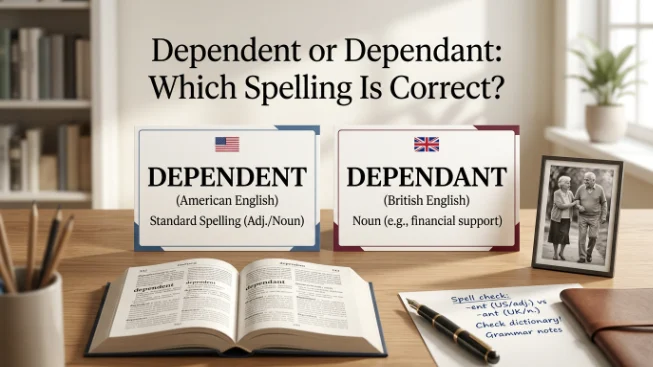
Dependent is the standard spelling in American English and can be used as both a noun and an adjective; dependant is mainly used as a noun in British English.Both spellings are correct, but your choice depends on the type of English and the role the word plays in the sentence.
Dependent or dependant can be confusing because both spellings are correct, but their use depends largely on the variety of English and, in some cases, the grammatical role of the word. In American English, dependent is the standard spelling for both the adjective and the noun. In British English, dependent is normally used as an adjective, while dependant is commonly used as a noun for someone who relies on another person for financial or practical support. This small spelling difference can cause uncertainty, especially when writing for an international audience.
Knowing when to use dependent and dependant helps you avoid common spelling and grammar mistakes. For example, you might write that a child is dependent on their parents, while British English may use dependant when referring to a person who receives financial support. This guide explains the meanings, grammatical differences, regional preferences, and real-world examples so you can confidently choose the right form for your sentence.
Which One Is Correct?
Dependent and Dependant Are Both Correct
Neither dependent nor dependant is simply a misspelling. Both forms have a legitimate place in English.
The important difference is how and where they are used.
In American English, dependent is the preferred spelling for both meanings:
- An adjective describing something that relies on something else
- A noun describing a person who relies on another person for financial or other support
For example:
The child is dependent on her parents.
Here, dependent is an adjective.
You can also write:
He listed his son as a dependent on his tax return.
Here, dependent is a noun.
British English makes a clearer distinction in traditional usage. Dependent is generally the adjective, while dependant is generally the noun.
For example:
The child is dependent on her parents.
But:
She has two dependants.
The difference is easy once you connect the final letter with the grammatical role.
The Main Rule to Remember
A useful rule is:
American English: dependent = adjective + noun
British English: dependent = adjective; dependant = noun
However, modern British usage is not completely rigid. Dependent as a noun is also increasingly seen, particularly under American influence and in some institutional contexts.
So, if you are writing for an American audience, dependent is the safest choice in almost every situation.
If you are following traditional British conventions, use dependant when referring to a person who relies on someone else.
Meaning of Dependent
Dependent as an Adjective
Dependent means relying on someone or something for support, help, money, information, or another necessary condition.
The word often describes a relationship in which one person, thing, or situation cannot function fully without another.
Consider this example:
Young children are dependent on adults for many of their basic needs.
The children rely on adults, so dependent describes their relationship with those adults.
Another example is:
The project is dependent on government funding.
Here, the project relies on funding. The word does not describe a person. It describes a condition or relationship.
Common Meanings of Dependent
The adjective dependent can be used in several related ways.
Relying on Someone for Support
The elderly man is dependent on his daughter for daily assistance.
This means he relies on his daughter for help.
Relying on Something for Success
The final result is dependent on accurate data.
The result relies on accurate data.
Controlled or Influenced by Something Else
The price is dependent on supply and demand.
The price changes according to those factors.
Unable to Function Independently
The plant is dependent on regular watering.
Without sufficient water, it cannot grow normally.
Dependent in Grammar
The word dependent also appears in grammar.
A dependent clause is a group of words containing a subject and a verb that cannot normally stand alone as a complete sentence.
For example:
Because it was raining
This has a subject and verb, but it does not express a complete thought by itself.
It becomes complete when connected to an independent clause:
We stayed inside because it was raining.
In this grammatical sense, dependent means that the clause relies on another clause to complete its meaning.
Meaning of Dependant
Dependant as a Noun
Dependant is primarily used in British English as a noun meaning a person who depends on another person for financial or practical support.
For example:
She has three dependants.
This means three people rely on her for support.
A dependant might be:
- A child
- A spouse
- A family member who cannot support themselves
- Another person receiving financial support
The exact meaning can vary according to the situation.
Dependant Is Not Simply an Incorrect Spelling
It is important not to label dependant as wrong.
In traditional British English, it is a standard noun.
For example:
The employee receives additional benefits for each dependant.
In American English, the same idea would normally be written:
The employee receives additional benefits for each dependent.
The meaning remains essentially the same. The spelling changes according to the variety of English being used.
Why This Causes Confusion
The confusion comes from the fact that American English does not usually separate the noun and adjective by spelling.
An American writer may use:
My daughter is dependent on me.
and:
My daughter is my dependent.
The spelling stays dependent.
A British writer following the traditional distinction may write:
My daughter is dependent on me.
and:
My daughter is my dependant.
The pronunciation remains almost identical, so the difference is visible mainly in writing.
Key Differences Between Dependent and Dependant
Spelling Difference
The most obvious difference is the final vowel.
- Dependent ends in -ent
- Dependant ends in -ant
The difference is only one letter, but it can signal a difference in grammatical function or regional convention.
Meaning Difference
The meanings overlap because both words come from the same underlying idea of reliance.
Dependent as an adjective means:
Relying on someone or something.
Dependent as a noun in American English means:
A person who relies on another person for support.
Dependant as a noun in British English means:
A person who relies on another person for support.
So the major distinction is not really the basic meaning. It is the part of speech and regional spelling convention.
Pronunciation Difference
In most varieties of English, dependent and dependant are pronounced the same or almost the same.
They are commonly pronounced approximately as:
dependent: dih-PEN-duhnt
dependant: dih-PEN-duhnt
The stress falls on the second syllable.
Because the pronunciation is so similar, listening will not usually help you decide which spelling to use. You need to consider the sentence and the variety of English.
Grammar Difference
This is one of the most useful distinctions.
Dependent can function as:
- An adjective
- A noun
Dependant is traditionally used as:
- A noun, particularly in British English
Examples:
The outcome is dependent on several factors.
- Here, dependent is an adjective.
His wife is his dependent.
- Here, dependent is a noun in American English.
His wife is his dependant.
- Here, dependant is a noun in traditional British English.
Regional Usage Difference
The clearest regional pattern is:
| Variety | Adjective | Noun |
|---|---|---|
| American English | dependent | dependent |
| British English | dependent | dependant |
| Canadian English | dependent is widely used | dependent/dependant may vary |
| Australian English | dependent | dependant is traditionally used as a noun |
Regional conventions can change over time, so modern usage does not always follow a strict dividing line.
Recognition Difference
Dependent is generally the more widely recognized spelling internationally.
It appears frequently in American English, British English, academic writing, technical writing, and general communication.
Dependant is also well established, but readers are more likely to associate it with British usage and the noun meaning “a person who depends on another.”
Common Mistakes People Make
Using Dependant as an Adjective
A common mistake is writing:
The result is dependant on the weather.
Traditional British English uses dependent here because the word is an adjective.
Correct:
The result is dependent on the weather.
The noun form dependant is normally reserved for a person who relies on someone else.
Assuming Dependant Is Always Wrong
This is the opposite mistake.
A British writer may correctly write:
The form asks for the number of dependants in the household.
Calling this spelling incorrect would ignore an established British convention.
Mixing Conventions in One Document
Another issue is inconsistency.
Suppose a British document uses:
The applicant has two dependants.
Later, it says:
Each dependent must provide identification.
The second sentence may reflect a different convention.
Consistency is usually preferable. If you are following British English and using the traditional noun distinction, dependant is a sensible choice for the noun throughout the document.
Confusing Dependent With Dependency
These words are related but not interchangeable.
Dependent describes someone or something that relies on another.
Dependency refers to the state or condition of relying on something or someone.
Compare:
The child is dependent on her parents.
Financial dependency can create difficulties.
Confusing Dependent With Dependable
The two words look similar but have very different meanings.
Dependent means relying on someone or something.
Dependable means reliable or trustworthy.
Compare:
The child is dependent on his parents.
His father is dependable and always keeps his promises.
A person can be dependent and dependable at the same time, but the words do not mean the same thing.
Correct Usage Examples
Casual Examples
My younger brother is still dependent on our parents.
She has two dependants living at home.
The plan is dependent on the weather.
His children are listed as dependents.
We cannot make a decision yet because everything is dependent on the final approval.
Professional Examples
The company’s expansion is dependent on market conditions.
Employees must provide accurate information about their dependants.
The benefit is available to eligible dependents.
The final schedule is dependent on the client’s approval.
The applicant must identify all financial dependants.
Educational Examples
A dependent clause cannot normally stand alone as a complete sentence.
The student’s progress was dependent on regular practice.
Children are often financially dependent on their parents.
The number of dependants in a household may affect certain benefits.
Literary and Metaphorical Examples
The adjective can also be used in more abstract writing.
His confidence was dependent on the approval of others.
The fragile agreement was dependent on mutual trust.
Their friendship was not dependent on distance.
The small village became dependent on the river.
In these examples, dependent describes reliance rather than financial support specifically.
Dependent on or Dependent Upon?
Dependent on Is the More Natural Choice
The phrase dependent on is extremely common and natural in modern English.
For example:
Success is dependent on preparation.
The final decision is dependent on the available evidence.
Dependent upon is also correct, but it can sound more formal.
The outcome is dependent upon several conditions.
In most everyday and professional writing, dependent on is the simpler choice.
Does Dependent Take “On” or “Upon”?
Both can follow dependent.
- dependent on
- dependent upon
The meaning is generally the same.
- Dependent on is more common in ordinary communication.
- Dependent upon may appear in formal, legal, or deliberately elevated writing.
Dependent vs. Dependence vs. Dependency
Dependent
An adjective or noun.
The child is dependent on his parents.
The child is a dependent.
Dependence
A noun describing the state of relying on something or someone.
His dependence on public transportation increased.
Dependency
A noun that can describe reliance, especially a condition of dependence, and can have specialized meanings in different fields.
The country reduced its dependency on imported fuel.
All three words come from the same basic idea, but they serve different grammatical purposes.
Is Dependent a Noun or an Adjective?
Dependent as an Adjective
Yes.
She is dependent on her family.
Here, dependent describes the subject.
The decision is dependent on several factors.
Here, it describes the relationship between the decision and the factors.
Dependent as a Noun
Yes, especially in American English.
He claimed his daughter as a dependent.
Here, dependent refers to a person who relies on someone else for support.
In traditional British English, dependant is often preferred for this noun.
Word Origin and Etymology
Where Does Dependent Come From?
Dependent ultimately traces back to Latin dependere, meaning “to hang from” or “to hang down.”
The Latin word combines the idea of hanging with the prefix de-, creating the sense of something hanging from or relying upon something else.
The word entered English through French and developed into the modern idea of relying on or being determined by something else.
This original image is actually useful for understanding the modern meaning.
Imagine one object hanging from another. The lower object cannot remain in the same position without the thing supporting it.
That is the basic idea behind dependent:
One thing relies on another.
Why Do Dependent and Dependant Both Exist?
The difference developed through English spelling traditions.
English has many pairs in which -ent and -ant endings appear in related words. Over time, British usage developed a conventional distinction between the adjective dependent and the noun dependant.
American English did not maintain that distinction as strongly. As a result, dependent became the standard form for both grammatical roles.
This is one reason the two spellings exist today without one being universally wrong.
Why Did the “Dependant” Version Become Popular?
Historical Spelling Patterns
The ending -ant has historically appeared in many English words derived through French or Latin.
Words such as:
- assistant
- servant
- participant
- occupant
- applicant
show how common the ending can be in nouns.
The spelling dependant therefore fits an older pattern that developed naturally in English.
British Usage Preserved the Distinction
British dictionaries and style traditions have long recognized dependant as a noun.
That distinction makes the grammatical role visually clear:
dependent = adjective
dependant = noun
American English gradually favored the simpler spelling dependent for both uses.
Modern Language Is Always Changing
Language conventions are not frozen.
American media, international business, education, software, and online communication have increased exposure to American spelling. As a result, dependent is now familiar to readers across many English-speaking regions.
At the same time, dependant remains perfectly legitimate in contexts that follow traditional British usage.
Easy Memory Tricks
Trick 1: Think “E for Everything”
If you use American English, remember:
Dependent with E works for everything.
It can be an adjective:
The child is dependent on her parents.
And it can be a noun:
The child is a dependent.
Trick 2: Think “A for a Person”
For traditional British usage, remember:
Dependant with A = a person who depends on someone.
She has two dependants.
This is not an absolute rule for every variety of English, but it is a helpful memory aid.
Trick 3: Look at the Word Before It
Ask yourself:
Am I describing reliance, or am I naming a person?
If you are describing something that relies on something else:
dependent
If you are naming a person in traditional British English:
dependant
Trick 4: Remember the Simple American Rule
If your audience uses American English, you usually do not need to think twice:
Use dependent.
That spelling covers both the adjective and noun.
A Simple Comparison Chart
| Feature | Dependent | Dependant |
|---|---|---|
| Adjective | Yes | Usually no |
| Noun | Yes, especially American English | Yes, especially British English |
| Meaning | Relying on someone or something; a person who relies on support | A person who relies on another |
| American English | Standard | Uncommon |
| British English | Standard adjective; also increasingly used as noun | Traditional noun form |
| Pronunciation | Usually dih-PEN-duhnt | Usually dih-PEN-duhnt |
| Example | “The child is dependent on her parents.” | “She has two dependants.” |
| Best general choice | Yes | Use when following British noun conventions |
How to Choose the Right Form
For American English
Use dependent in both situations.
The child is dependent on his parents.
His child is listed as a dependent.
This is the easiest rule.
For Traditional British English
Use dependent as an adjective.
The child is dependent on his parents.
Use dependant as a noun.
His child is listed as a dependant.
For International Readers
If your writing is intended for readers from several countries, dependent is usually the safest and most widely understood form.
However, if you are writing an official British document, academic work that follows British conventions, or material for a specific British institution, follow that institution’s preferred style.
Final Tips for Using Dependent and Dependant
Before choosing the spelling, ask three simple questions:
- What variety of English am I using?
- Is the word an adjective or a noun?
- Does my document follow a particular style guide?
These questions solve most cases immediately.
If you are writing American English, dependent is the straightforward choice.
If you are writing traditional British English and referring to a person who relies on another, dependant may be the preferred noun form.
Most importantly, do not treat dependant as a spelling error in every situation. It is a genuine English word with an established use.
FAQs
Is dependent or dependant correct?
Both are correct. Dependent is the standard form in American English for both noun and adjective. Dependant is traditionally used as a noun in British English.
What is the difference between dependent and dependant?
The main difference is grammatical and regional. Dependent is an adjective and can also be a noun, especially in American English. Dependant is traditionally a noun in British English referring to a person who relies on another for support.
Is dependant British or American?
Dependant is mainly associated with British English, particularly when it is used as a noun. American English generally uses dependent for the same noun meaning.
Should I use dependent or dependant in American English?
Use dependent. It is the standard American spelling whether the word functions as an adjective or a noun.
Should I use dependant in British English?
You can use dependant as a noun in traditional British English. For example, “The employee has two dependants.” As an adjective, use dependent, as in “The employee is dependent on the benefit.”
Are dependent and dependant pronounced differently?
Usually, no. In most varieties of English, they have the same or nearly the same pronunciation. The difference is mainly visible in spelling and usage.
Is dependent an adjective or a noun?
It can be both. As an adjective, it means relying on someone or something. As a noun, particularly in American English, it means a person who relies on another for support.
What is the easiest way to remember dependent and dependant?
For American English, simply use dependent for both forms. For traditional British English, remember dependent for the adjective and dependant for the noun referring to a person who relies on someone else.
Conclusion
Dependent and dependant are both correct, but their use depends on regional English and grammatical function.
American English normally uses dependent for both the adjective and noun, while traditional British English uses dependant as a noun.
The pronunciation is almost the same, so the spelling is what you need to watch.
When in doubt, choose dependent unless you are following a British convention that specifically uses dependant.

Christopher Parker is a writer and blogger at GramScript.com, sharing thoughtful insights and engaging stories across a range of topics. His writing blends clarity, curiosity, and a distinctly human perspective.
1 thought on “Dependent or Dependant | Meaning, Spelling, and Usage Explained In 2026”