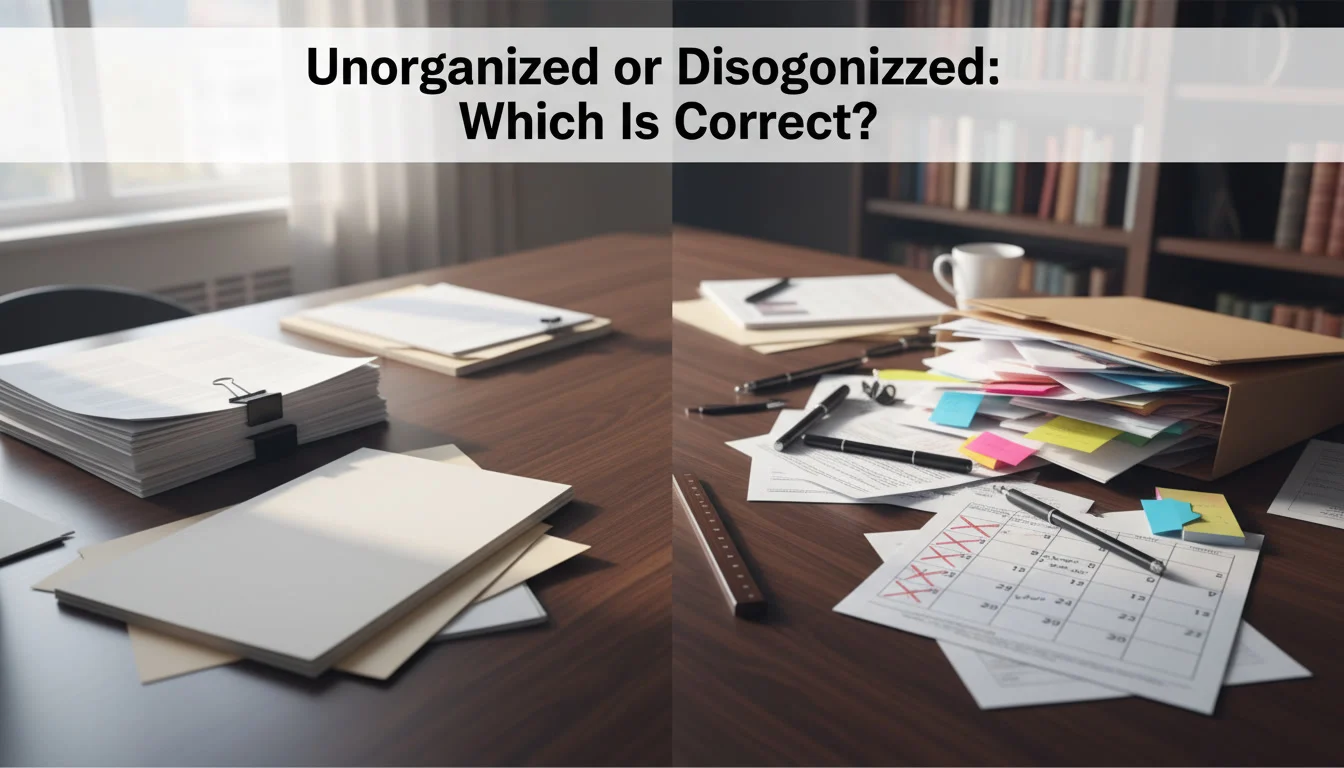
Quick Answer
Both unorganized and disorganized are correct English words, but they have slightly different meanings and usage.
Unorganized means not organized, while disorganized often suggests a lack of order, structure, or efficiency.
When describing something messy, poorly arranged, or lacking a clear structure, you may wonder whether “unorganized” or “disorganized” is the better word. Both terms are used in English, and they can sometimes describe the same situation. However, they are not always interchangeable. Understanding the difference can help you choose the word that sounds most natural and accurately expresses what you mean.
Disorganized is generally the more common choice when talking about a person, plan, system, room, or activity that lacks order or structure. Unorganized can also mean not organized, but it is often used to emphasize the absence of organization rather than a state of disorder. In this guide, we’ll compare unorganized and disorganized, explain their meanings and differences, and provide clear examples to show when each word works best.
Which One Is Correct?
Both unorganized and disorganized are grammatically correct in standard American English.
The better choice depends on the meaning you want to express. Unorganized generally means that something has not been organized or lacks organization. It can describe a simple absence of structure without strongly suggesting chaos.
Disorganized usually carries a stronger sense of poor organization. It can describe something messy, confusing, inefficient, or badly arranged.
For example:
- The files are unorganized.
This simply says the files are not organized. - The files are disorganized.
This suggests the files are poorly arranged and may be difficult to use.
The words can overlap, especially in casual conversation. Still, disorganized is often the more natural choice when describing a person, workplace, schedule, system, room, or process that lacks effective order.
It is important not to call unorganized incorrect. It is a legitimate English adjective with established usage.
Meaning of the Correct Word
Because both words are correct, it is more useful to understand the meaning of each one rather than label one as right and the other as wrong.
Definition
Unorganized is an adjective meaning not organized, not arranged, or lacking a clear system of organization.
It describes something that does not have an established structure. The word can refer to physical objects, information, groups, activities, or plans.
For example:
The documents were unorganized and difficult to sort.
Here, unorganized tells us that the documents lacked a clear arrangement.
Explanation
The prefix un commonly expresses a negative meaning. In unorganized, it essentially means “not organized.”
This makes the word relatively neutral. It does not necessarily tell us why something lacks organization or how serious the problem is.
An unorganized collection of papers might simply have been placed together without being sorted. The papers could still be easy to understand or arrange.
By contrast, something described as disorganized may feel more problematic. It could be confusing, inefficient, or chaotic.
This difference is not an absolute grammar rule. Context determines the exact meaning.
Usage
Unorganized works well when you want to emphasize the absence of organization.
It can describe:
- notes that have not been sorted
- information without a clear structure
- an unplanned collection of materials
- a group without formal organization
- personal belongings that lack arrangement
- tasks that have not been organized
For example:
I have several unorganized notes from the meeting.
The sentence does not necessarily mean the notes are confusing. They simply have not been arranged properly.
Real-World Examples
Here are several natural examples:
- The photographs are still unorganized.
- We found a box of unorganized receipts.
- Her research notes were unorganized but useful.
- The information arrived in an unorganized format.
- The volunteers worked with an unorganized collection of supplies.
- His ideas were interesting but unorganized.
- The files remain unorganized after the office move.
In each example, the main idea is the lack of organization.
Meaning of the Incorrect or Alternative Word
Disorganized is not incorrect. It is the other standard form and is often the more natural choice when poor organization creates confusion or inefficiency.
Incorrect
Disorganized is not incorrect. It is a standard English adjective used widely in American English.
Likewise, unorganized is not incorrect. Treating either word as grammatically wrong can create unnecessary confusion.
The important distinction is semantic rather than grammatical.
Unorganized = not organized.
Disorganized = poorly organized, lacking order, or functioning without effective structure.
For instance:
The schedule is unorganized.
This emphasizes that the schedule lacks organization.
The schedule is disorganized.
This may suggest that the schedule is confusing, poorly arranged, or inefficient.
Typo
Neither spelling is normally a typo.
Writers sometimes assume that unorganized is a mistaken version of disorganized, especially because disorganized is very common. That assumption is incorrect.
Both forms are built from the adjective organized, but they use different prefixes and can communicate different shades of meaning.
Slang
Neither unorganized nor disorganized is slang.
Both are standard adjectives and can appear in casual conversation, professional writing, academic work, journalism, and general nonfiction.
However, disorganized can sound more critical when applied to a person.
Calling someone “disorganized” may suggest that the person struggles with planning, time management, or keeping things in order.
Regional Variation
Neither word is limited to a particular American region.
Both occur in standard American English. Disorganized is generally more familiar and more frequently used in many contexts, but unorganized is also established and understandable.
British English also recognizes both forms, although preferences and frequency can vary by context.
The important point is that this is not primarily a US-versus-UK spelling difference. The two words have different shades of meaning in both varieties.
Rare but Valid Usage
Unorganized can sometimes have a more specific meaning when referring to a group, movement, or activity that has not been formally organized.
For example:
The workers formed an unorganized group to discuss the issue.
Here, unorganized can emphasize the absence of formal organization.
In other contexts, unorganized may simply mean that something has not yet been sorted or arranged.
That flexibility makes it useful, even though disorganized is often the preferred word for a situation involving disorder or inefficiency.
Key Differences Between the Two Words
The following comparison makes the distinction easier to remember:
| Feature | Unorganized | Disorganized |
|---|---|---|
| Spelling | Unorganized | Disorganized |
| Meaning | Not organized | Poorly or badly organized |
| Pronunciation | un-OR-guh-nized | dis-OR-guh-nized |
| Grammar | Adjective | Adjective |
| Usage | Neutral absence of organization | Often suggests disorder or inefficiency |
| Recognition | Correct and established | Correct and very common |
| Tone | Usually neutral | Can sound more critical |
| Common contexts | Notes, materials, information, groups | People, schedules, systems, rooms, processes |
| Main idea | Organization is missing | Organization exists poorly or has broken down |
A Simple Difference in Meaning
Think of the distinction this way:
Unorganized describes a lack of organization.
Disorganized describes poor organization.
Imagine a drawer filled with papers. If nobody has sorted them yet, the drawer is unorganized.
If the papers are mixed with receipts, photographs, envelopes, old bills, and unrelated objects, making the drawer difficult to use, it is more naturally described as disorganized.
The boundary is not always sharp. In everyday English, speakers may use the words interchangeably.
Common Mistakes People Make
Mistake 1: Thinking “unorganized” Is Wrong
This is the most common misunderstanding.
Some people believe that disorganized is the only correct form. That is not true.
Unorganized is a valid adjective and can be the better choice when you simply mean “not organized.”
Mistake 2: Treating the Words as Perfect Synonyms
The words overlap, but their emotional force can differ.
Compare:
My notes are unorganized.
This sounds relatively neutral.
My notes are disorganized.
This may suggest that the notes are messy or difficult to follow.
The difference is subtle but useful.
Mistake 3: Using “Disorganized” Without Considering Tone
When describing a person, disorganized can sound judgmental.
For example:
Sarah is disorganized.
This may suggest that Sarah frequently loses things, misses deadlines, or struggles with planning.
If you want a softer statement, you could say:
Sarah’s files are not organized yet.
That sentence focuses on the situation rather than criticizing the person.
Mistake 4: Assuming the Prefix Determines Correctness
English uses many prefixes to create related words, but prefixes do not automatically make one form correct and another incorrect.
Both unorganized and disorganized have logical formations.
The difference comes from established usage and meaning, not from a rule saying that only one prefix can be used.
Mistake 5: Choosing Based Only on Spelling
The words look different because of their prefixes, but spelling alone does not tell you which one to choose.
Instead, ask what you mean.
Do you mean “not organized”? Choose unorganized.
Do you mean “poorly organized or chaotic”? Choose disorganized.
Correct Usage Examples
Seeing the words in different situations makes their distinction easier to understand.
Casual Examples
Everyday conversations often use these adjectives for rooms, belongings, notes, and schedules.
- My closet is completely disorganized.
- My old photos are still unorganized.
- I have an unorganized pile of receipts on my desk.
- His backpack is always disorganized.
- The kitchen became disorganized after the party.
- My notes are unorganized, so give me a minute to find them.
Notice that disorganized often works naturally when the condition feels messy or chaotic.
Professional Examples
Both words can appear in workplace communication.
- The department received an unorganized set of records.
- The project suffered from a disorganized workflow.
- We need to review the unorganized data before creating the report.
- The meeting became disorganized because several teams had conflicting schedules.
- The company inherited an unorganized filing system.
- The previous process was inefficient and disorganized.
In professional writing, disorganized can imply a practical problem with efficiency or management.
Educational Examples
Students and teachers may use both words when discussing notes, research, assignments, and study habits.
- My class notes are unorganized, so I plan to sort them tonight.
- His essay feels disorganized because the ideas appear in random order.
- The research material was unorganized at first.
- A disorganized study schedule can make exam preparation harder.
- The teacher helped the students arrange their unorganized materials.
- The presentation was informative but somewhat disorganized.
Here, the distinction is especially clear. Unsorted research material can be unorganized, while an essay with weak structure may be disorganized.
Literary/Metaphorical Examples
The words can also describe thoughts, emotions, stories, or abstract ideas.
- Her unorganized thoughts filled several pages.
- His memories seemed disorganized after the long journey.
- The novel begins with an unorganized collection of memories.
- Their conversation became disorganized as emotions took over.
- The speaker’s ideas were interesting but unorganized.
- The character’s inner world felt increasingly disorganized.
These uses show that organization does not always involve physical objects. Ideas, memories, events, and narratives can also have structure.
Word Origin / Etymology
Both words are built from the adjective organized, which comes from the verb organize.
Organize ultimately relates to the idea of arranging parts into a functioning whole. Its deeper history is connected with the Greek word organon, meaning “instrument” or “tool.” The term developed through Latin and French before becoming established in English.
The prefix un- is an old English negative prefix. In unorganized, it gives the basic sense of “not organized.”
The prefix dis- has a different historical background. It can express ideas such as separation, reversal, negation, or the undoing of a condition. In disorganized, it contributes to the sense of organization being disrupted or poorly maintained.
This history helps explain why the words are related but not identical.
Unorganized naturally focuses on the absence of organization, while disorganized can suggest organization that has been disrupted, weakened, or poorly applied.
Modern usage has developed these shades over time, so their meanings cannot be determined by prefixes alone.
Why the Incorrect Version Became Popular
There is no truly “incorrect version” in this comparison because both forms are legitimate.
However, disorganized is often treated as the default choice in everyday English. That popularity may cause people to assume that unorganized is an error.
One reason is that disorganized has a strong connection with familiar situations such as messy rooms, confused schedules, inefficient workplaces, and people who struggle with planning.
For example, people commonly say:
He is very disorganized.
That sentence is immediately understandable because the word has become strongly associated with poor personal organization.
Unorganized has a somewhat more neutral feel. It often describes material that has simply not been arranged yet.
For example:
I have an unorganized folder of photographs.
The speaker may have every intention of organizing the folder later. There is no necessary suggestion that the system has failed.
Another reason for the confusion is the structure of the words. Learners may assume that the negative prefix un- should always be used with adjectives, while others may assume that dis- is the established form. English does not work that mechanically.
Many related words can exist with different prefixes and slightly different meanings.
Therefore, it is better to learn the distinction through context rather than memorize one word as correct and the other as incorrect.
Easy Memory Tricks
Think “Not Organized” for Unorganized
The easiest shortcut is:
Unorganized = not organized.
If something simply has not been arranged, sorted, or structured, unorganized can work well.
The documents are unorganized.
Think “Disrupted Organization” for Disorganized
Use this mental image:
Disorganized = organization is not working well.
If something feels chaotic, confusing, inefficient, or poorly arranged, disorganized is often the stronger choice.
The office became disorganized after the move.
Use the “Neutral vs. Problem” Test
Ask yourself whether you are simply describing a condition or highlighting a problem.
- Neutral absence → unorganized
- Poor or ineffective arrangement → disorganized
This is not an absolute rule, but it is a helpful guide.
Remember That Both Are Correct
The most important memory trick is simple:
Never mark “unorganized” as automatically wrong.
Both unorganized and disorganized are valid adjectives. The best choice depends on the context and the shade of meaning you want.
FAQs
Is unorganized a correct word?
Yes. Unorganized is a correct English adjective meaning not organized or lacking organization.
Is disorganized a correct word?
Yes. Disorganized is a standard adjective meaning poorly organized, disorderly, or lacking effective structure.
What is the difference between unorganized and disorganized?
Unorganized emphasizes a lack of organization, while disorganized often suggests poor, confusing, or inefficient organization.
Which word is more common, unorganized or disorganized?
Disorganized is generally more common in everyday American English, especially when describing people, systems, schedules, or messy situations.
Can I use unorganized for a person?
Yes, but disorganized is often more natural when describing someone’s poor planning or organizational habits.
Is unorganized a synonym for disorganized?
They can be synonyms in some contexts, but disorganized usually carries a stronger suggestion of disorder or poor organization.
Is disorganized more negative than unorganized?
Usually, yes. Disorganized can sound more critical because it often suggests that the lack of order creates problems.
Should I write unorganized or disorganized?
Choose unorganized when you mean simply “not organized.” Choose disorganized when you mean “poorly organized,” “messy,” or “chaotic.”
Conclusion
When choosing unorganized or disorganized, remember that both words are correct and useful.Use unorganized for a neutral lack of organization and disorganized for poor or disrupted organization.The best choice depends on the context, especially the level of disorder or criticism you want to express.When in doubt, remember: unorganized means not organized; disorganized means not organized well.
Read More Articles
- Majorca vs Mallorca | Meaning, Spelling and Usage Explained In 2026
- Innie vs Outie | Meaning, Differences, and Common Usage In 2026

Andrew Cooper is a blogger and writer at Gramscript.com, turning everyday ideas into clear, engaging stories. His writing blends curiosity, insight and a genuinely human perspective.
2 thoughts on “Unorganized or Disorganized | Meaning, Usage and Examples In 2026”