Quick Answer
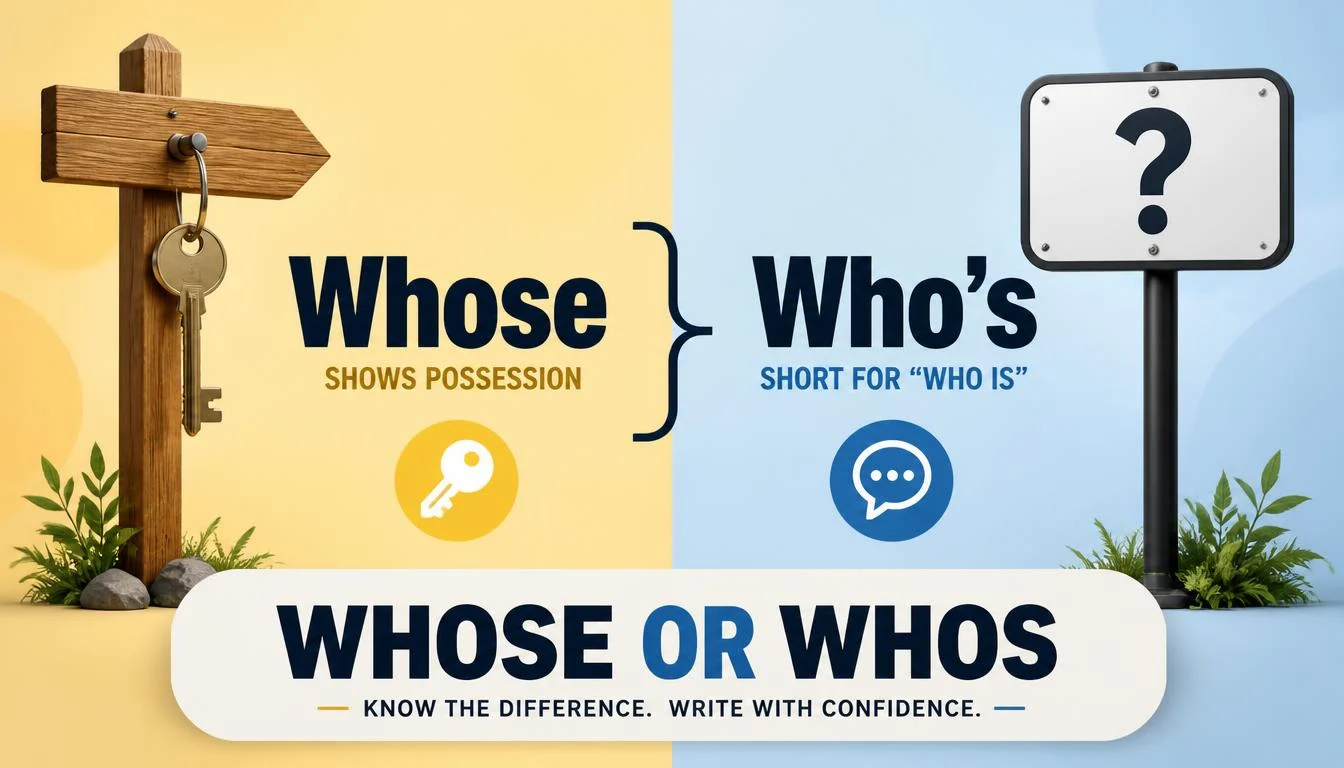
Use whose to show possession (belonging to someone). Use who’s as a contraction for who is or who has. If you can replace the word with “who is” or “who has,” choose who’s. If you need to show ownership, choose whose.
Whose or who’s can be confusing because the two words look and sound almost identical, but they have completely different meanings and grammatical functions. Whose is used to ask or tell us who something belongs to, while who’s is a contraction of “who is” or “who has.” For example, “Whose jacket is this?” asks about ownership, whereas “Who’s coming to the party?” means “Who is coming to the party?” Knowing this simple distinction can help you avoid one of the most common mistakes in everyday English writing.
The good news is that you do not need to memorize complicated grammar rules to understand whose vs. who’s. Once you know what each word stands for, choosing the correct form becomes much easier. In this guide, we’ll explain the meanings, grammatical uses, and differences between whose and who’s, along with clear examples to show how each word works in real sentences. Whether you are writing an email, school assignment, article, or casual message, this guide will help you use the right word with confidence.
Which One Is Correct?
Both whose and who’s are correct words, but they serve entirely different purposes. They are not interchangeable. “Whose” is a possessive pronoun, while “who’s” is a contraction. Choosing the right one depends entirely on the meaning you intend to convey.
Meaning of the Correct Word (Whose)
Definition
Whose is an interrogative and relative possessive pronoun. It is used to ask or indicate to whom something belongs. It functions like “his,” “her,” or “its” but specifically relates to a person or sometimes an animal or object.
Explanation
When you need to know who owns an item, idea, or trait, you ask “whose.” Think of it as the possessive form of “who.” For example, “Whose jacket is this?” shows you are asking who the jacket belongs to. In a relative clause, it connects an object to the person who owns it, as in “the woman whose car was stolen.”
Usage
Use whose in questions to ask about possession. Use it in statements to link a person to something they possess, whether tangible (book, house) or intangible (idea, opinion). It is always connected to a noun indicating the thing possessed.
Real-World Examples
- “Whose turn is it to wash the dishes?”
- “The author, whose latest novel topped the bestseller list, signed copies for fans.”
- “She is the student whose essay won the award.”
- “I met a man whose entire family runs a bakery.”
Meaning of the Alternative Word (Who’s)
Contraction
Who’s is strictly a contraction. It combines the pronoun “who” with either the verb “is” or the auxiliary verb “has.”
Explanation
Writers use contractions to make sentences shorter and more conversational. “Who’s” saves you a character or a breath when speaking. The apostrophe stands in for the missing letter: “i” from “is” or “ha” from “has.” If your sentence requires a verb, “who’s” is your answer.
Usage
Use “who’s” whenever you would say “who is” or “who has.” It is informal and common in everyday writing and speaking. In formal academic writing, you might spell out “who is” or “who has,” but “who’s” is still grammatically correct.
Real-World Examples
- “Who’s coming to the party tonight?” (Who is)
- “She is the only one who’s finished the project.” (Who has)
- “Who’s ready for an adventure?” (Who is)
- “Do you know who’s been taking my books?” (Who has)
Key Differences Between Whose and Who’s
| Feature | Whose | Who’s |
|---|---|---|
| Type | Possessive Pronoun | Contraction |
| Meaning | Of whom; belonging to whom | Who is / Who has |
| Replacement Test | Replaces “his,” “her,” “their” | Replaces “who is” or “who has” |
| Part of Speech | Determiner / Pronoun | Verb phrase |
| Apostrophe | No apostrophe | Apostrophe replaces missing letters |
| Examples | “Whose pen is this?” | “Who’s going?” / “Who’s done it?” |
Common Mistakes People Make
- Using who’s to show possession: Writing “Who’s jacket is this?” is incorrect because you are not asking “Who is jacket?” You are asking who owns the jacket.
- Using whose in place of who is: Writing “Whose coming to dinner?” is incorrect because you are not showing possession; you are asking who is coming.
- Overcorrecting: Some writers think all apostrophes show possession, so they add one to whose to be “safe.” This is the opposite of the rule, as “who’s” is the contraction, not the possessive.
- Confusing with its: This is a similar issue. “Its” shows possession (no apostrophe), while “it’s” means “it is” (with apostrophe). The same logic applies to whose and who’s.
Correct Usage Examples
Casual Examples
- “Who’s your favorite singer?” (Who is)
- “Whose idea was it to go camping in the rain?”
- “I wonder who’s going to show up.” (Who is)
- “Whose car is parked in my spot?”
Professional Examples
- “The board of directors, whose members include industry leaders, approved the merger.”
- “Can you confirm who’s scheduled for the next interview?” (Who is)
- “The marketing team, whose budget was recently increased, launched the new campaign.”
- “The client whose account I manage is looking for a refund.”
Educational Examples
- “The student whose paper was late will receive a one-point penalty.”
- “Who’s assigned to present their research next week?” (Who is)
- “The professor whose lectures I attend is a renowned historian.”
- “Whose textbook is on the podium?”
Literary/Metaphorical Examples
- “The night, whose darkness concealed his movements, was his ally.”
- “Whose heart can resist such a plea?”
- “Time, whose passage we cannot stop, flows on.”
- “Do you know who’s knocking on the door of opportunity?”
Word Origin / Etymology
Whose is a very old English word. It comes from the Old English word “hwæs,” which was the genitive (possessive) case of “hwa” (meaning “who”) and “hwæt” (meaning “what”). It has been used as a possessive pronoun for over a thousand years, making it one of the foundational parts of the English language. Its use is closely related to other possessive words like “his” and “hers.”
Who’s has a much shorter history. It is a relatively modern contraction that emerged alongside other -‘s contractions like “don’t” and “can’t” in the early modern English period. The purpose was to streamline speech and writing by combining common word pairs.
Why the Incorrect Version Became Popular
The confusion between whose and who’s is largely driven by the apostrophe rule. In most English words, an apostrophe followed by an “s” (‘s) indicates possession, as in “the cat’s toy” or “Sarah’s book.” Since this is a standard grammar rule children learn early, it creates a strong instinct to add an apostrophe to any word that might denote ownership. Consequently, writers apply the ‘s rule to “who” and produce “who’s” when they actually need the possessive form “whose.” The fact that “whose” is an exception to the typical ‘s rule makes it a common stumbling block.
Easy Memory Tricks
- The “Who Is” Test: This is the definitive way to check. If you can replace your word with “who is” or “who has,” then who’s (with the apostrophe) is correct. If you cannot, choose whose.
- “His” Trick: Try to replace the word with “his.” If “his” makes sense, use whose. Both “his” and “whose” show possession and do not have apostrophes.
- The Imposter Apostrophe: Remember the apostrophe in “who’s” is an imposter—it is hiding a letter. It is a trickster, not a sign of ownership.
FAQs
What is the difference between whose and who’s?
Whose is a possessive pronoun showing ownership (“Whose keys are these?”). Who’s is a contraction meaning “who is” or “who has” (“Who’s ready to go?”).
When should I use whose?
Use whose when you are asking or stating who owns something. It belongs to the same family as “his,” “her,” and “their.”
When should I use who’s?
Use who’s whenever you mean “who is” or “who has.” It is a contraction, not a possessive.
Is whose a real word?
Yes, whose is a real and essential word in English. It is the possessive form of the pronoun “who.”
How do you remember whose vs who’s?
Try replacing the word with “who is” or “who has.” If it works, use who’s. If it doesn’t, use whose. Alternatively, replace it with “his” to test for possession.
Is who’s a word?
Yes, who’s is a standard word in English. It is a contraction of “who” and “is” or “has” and is very common in both writing and speech.
Conclusion
The difference between whose and who’s is straightforward once you understand their distinct roles. Whose is all about possession, acting like a pronoun to answer the question “to whom?” Who’s is all about action, acting as a contraction for “who is” or “who has.” Remember the “who is” test to avoid the apostrophe trap, and your grammar will be flawless. Keep “whose” for ownership and “who’s” for the question of being.
Read More Articles
- Unorganized or Disorganized | Meaning, Usage and Examples In 2026
- Realest or Realist | Common Mistakes and Correct Examples In 2026

Jessica Morgan is a blogger and writer at GramScript.com, where she turns everyday ideas into engaging, relatable stories. Her writing blends a natural voice with fresh perspectives that keep readers coming back.