Quick Answer
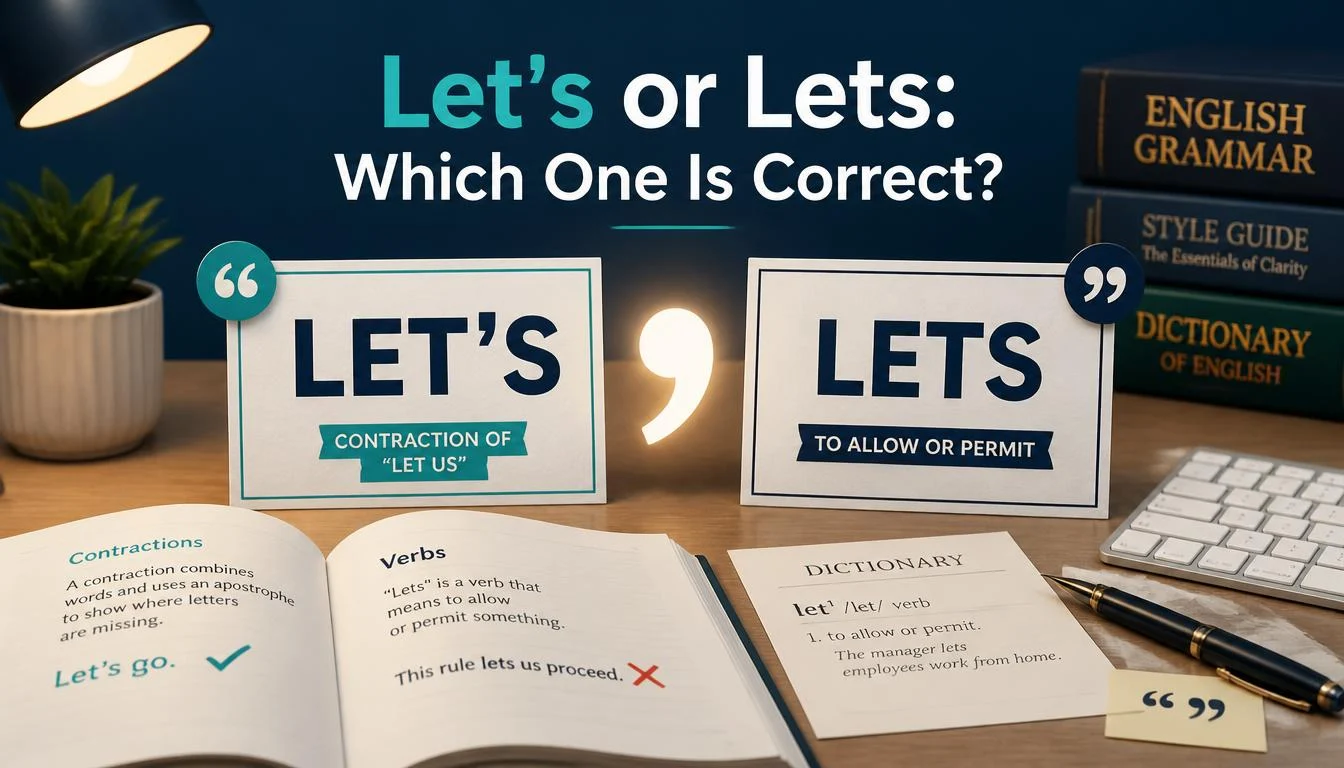
Let’s is correct when you mean “let us,” while lets is the third person singular form of the verb “let.”
The apostrophe changes the grammar and meaning, so let’s and lets are not interchangeable.
The words “let’s” and “lets” look almost identical, but the apostrophe changes their meaning and grammatical function. “Let’s” is a contraction of “let us” and is commonly used to make suggestions or propose an action, as in “Let’s go for a walk.” On the other hand, “lets” is the third-person singular form of the verb “let,” meaning to allow or permit something, as in “She lets her children play outside.” Because the only visible difference is an apostrophe, these two words are easy to confuse.
Knowing when to use let’s or lets can make your writing clearer and help you avoid a common grammar mistake. The easiest way to remember the difference is to think about whether you mean “let us” or “allows.” If “let us” makes sense, use “let’s.” If you mean that someone allows something, use “lets.” In this guide, we’ll explain the difference between let’s and lets, show clear examples, and give you simple rules for choosing the correct form every time.
Which One Is Correct?
Both let’s and lets are correct English words. The correct choice depends on what you want to say.
Use let’s when you mean let us:
- Let’s go home.
- Let’s try again.
- Let’s discuss the problem.
- Let’s take a break.
Use lets when the subject is he, she, it, or another singular noun:
- She lets her children play outside.
- The key lets you open the door.
- My schedule lets me leave early.
- This feature lets users save their work.
A quick test is to replace let’s with let us. If the sentence still makes sense, let’s is the right form.
For example:
Let’s start the meeting.
Becomes:
Let us start the meeting.
That works, so let’s is correct.
Now consider:
She lets me use her laptop.
Replacing it with “She let us me use her laptop” does not work. Here, lets means “allows,” so the apostrophe would be incorrect.
Meaning of the Correct Word: Let’s
Definition
Let’s is a contraction of let us. It is commonly used to suggest, propose, encourage, or invite someone to do something with the speaker.
The word is pronounced roughly as lets, with a short vowel sound.
Explanation
The apostrophe in let’s represents the missing letters in let us. It combines two words into one shorter form.
For example:
- Let us begin. → Let’s begin.
- Let us leave now. → Let’s leave now.
- Let us check the answer. → Let’s check the answer.
In modern English, let’s is especially common in conversation and informal writing. It can express cooperation because the speaker usually includes themselves in the proposed action.
When someone says, “Let’s go,” they normally mean that the speaker and the listener should go together.
Usage
Let’s usually comes before a base-form verb.
Common patterns include:
- Let’s go.
- Let’s eat.
- Let’s talk.
- Let’s start.
- Let’s find a solution.
- Let’s take a closer look.
It can also appear in longer sentences:
Let’s make sure everyone understands the instructions.
Let’s consider another option before making a decision.
The negative form is usually let’s not:
Let’s not rush the decision.
Let’s not forget to call her.
Real-World Examples
Here are some natural examples of let’s in everyday English:
- Let’s order pizza tonight.
- Let’s meet at the library after class.
- Let’s check the schedule before we leave.
- Let’s give him another chance.
- Let’s keep this conversation private.
- Let’s work together to solve the problem.
- Let’s see what happens next.
- Let’s not make a decision too quickly.
Notice that each sentence presents an action as a suggestion or shared plan.
Meaning of the Incorrect or Alternative Word: Lets
Incorrect
Lets is not incorrect by itself. It is a legitimate English word.
It becomes incorrect when writers use it where let’s is needed.
For example:
Lets go to the park.
This is incorrect if the intended meaning is “Let us go to the park.”
The correct sentence is:
Let’s go to the park.
Typo
A missing apostrophe can turn let’s into lets. This is especially common when people type quickly on phones or keyboards.
For example:
Lets meet tomorrow.
This is often simply a punctuation mistake. The intended sentence is:
Let’s meet tomorrow.
Although the missing apostrophe does not affect pronunciation, it changes the grammatical meaning.
Slang
Lets is not a slang version of let’s. Some informal writers may omit the apostrophe, but that does not make the spelling standard.
In casual digital communication, people sometimes leave out punctuation. However, standard written English still distinguishes let’s from lets.
Regional Variation
There is no major American versus British spelling difference between let’s and lets.
Both forms are used in standard English across English speaking regions. The distinction is grammatical rather than regional.
Rare but Valid Usage
Lets is completely valid when it functions as a verb meaning allows.
For example:
The new software lets employees work remotely.
Here, lets is not a misspelling. It is the third person singular present form of let.
This distinction is important because some writers assume every occurrence of “lets” should contain an apostrophe. That is not true.
Key Differences Between the Two Words
| Feature | Let’s | Lets |
|---|---|---|
| Spelling | Contains an apostrophe | No apostrophe |
| Meaning | Short for “let us” | Allows or permits |
| Pronunciation | Roughly “lets” | Roughly “lets” |
| Grammar | Contraction | Third-person singular verb |
| Typical use | Suggestions or proposals | Describing permission or ability |
| Subject | Usually includes “we” | He, she, it, or singular noun |
| Recognition | Common in everyday speech | Common as a regular verb |
| Example | Let’s go outside. | She lets me go outside. |
The biggest challenge is that let’s and lets sound the same in most contexts. You cannot always identify the correct form by listening.
Instead, look at the meaning and sentence structure.
If the sentence means “let us,” use let’s.
If it means “allows” or “permits,” use lets.
Consider these examples:
Let’s watch a movie.
This means:
Let us watch a movie.
Now compare:
My brother lets me choose the movie.
Here, lets means allows.
The two forms may sound alike, but they perform different grammatical jobs.
Common Mistakes People Make
Mistake 1: Writing “lets” Before a Verb
One of the most common errors is leaving out the apostrophe in suggestions.
Incorrect:
Lets go for a walk.
Correct:
Let’s go for a walk.
The sentence means “Let us go for a walk,” so the contraction needs an apostrophe.
Mistake 2: Adding an Apostrophe to “Lets” Meaning Allows
The opposite mistake is also common.
Incorrect:
My teacher let’s us leave early.
Correct:
My teacher lets us leave early.
Here, lets means “allows.” It is not a contraction.
Mistake 3: Assuming Every “Lets” Needs an Apostrophe
An apostrophe is not automatically required before a verb simply because the word resembles let’s.
Compare:
Let’s start now.
with:
This button lets you start the program.
The first means “let us.” The second means “allows.”
Mistake 4: Using “Let’s” as a Possessive
Let’s does not show possession.
For example:
Let’s plan our trip.
The apostrophe does not mean ownership. It indicates that let us has been shortened.
Mistake 5: Confusing Meaning Because the Words Sound Identical
Pronunciation does not help much here. Both forms are generally pronounced like lets.
That is why checking the sentence’s meaning is more reliable than sounding out the word.
Correct Usage Examples
Casual Examples
Let’s is extremely common in casual conversation.
- Let’s grab some coffee.
- Let’s watch something tonight.
- Let’s go before it gets crowded.
- Let’s call them later.
- Let’s take a short break.
- Let’s try that restaurant.
- Let’s figure this out together.
These examples all involve suggestions or shared actions.
Now compare them with lets:
- My dad lets me borrow his car.
- She lets her dog sleep inside.
- The app lets you customize the settings.
- This door lets in plenty of sunlight.
In each case, lets means “allows” or “permits.”
Professional Examples
Both forms can appear in professional communication.
Examples with let’s:
- Let’s review the proposal before the meeting.
- Let’s discuss the next steps.
- Let’s consider the available alternatives.
- Let’s confirm the deadline with the client.
- Let’s focus on the main issue.
Examples with lets:
- The platform lets employees track their progress.
- This system lets managers approve requests online.
- The updated policy lets staff work flexible hours.
- The new process lets customers receive faster support.
In professional writing, let’s can sound collaborative and direct, while lets describes what a person, system, rule, or tool permits.
Educational Examples
Teachers and students use let’s frequently when discussing activities:
- Let’s solve the problem together.
- Let’s read the next paragraph.
- Let’s compare these two examples.
- Let’s review what we learned.
- Let’s check our answers.
Lets appears when describing what something permits:
- This formula lets us calculate the total.
- The diagram lets students see the relationship clearly.
- The calculator lets users check their answers.
Literary/Metaphorical Examples
Writers can also use let’s to create an inviting or reflective tone:
- Let’s imagine a world without written language.
- Let’s return to the beginning of the story.
- Let’s consider what the character truly wants.
- Let’s follow the road until it disappears.
Lets can describe an object or circumstance that creates an opening or opportunity:
- The narrow window lets in a strip of morning light.
- The silence lets her thoughts become clearer.
- The old photograph lets us glimpse another era.
Word Origin / Etymology
Both let’s and lets come from the verb let, an old and highly established English word.
The verb let has Germanic roots and has been used in English for centuries. Its basic sense developed around allowing, permitting, or not preventing something.
The form let us eventually became commonly shortened to let’s. English frequently uses contractions to make speech and writing more natural and efficient.
The apostrophe in let’s signals this contraction. It tells the reader that letters have been omitted from the original phrase let us.
Meanwhile, lets developed as the ordinary third-person singular present form of let:
- I let
- You let
- We let
- They let
- He lets
- She lets
- It lets
The base verb let is unusual because most present-tense verbs take -s with “he,” “she,” or “it,” but its spelling remains recognizable:
He lets me decide.
Understanding this verb pattern makes the distinction easier to remember.
Why the Incorrect Version Became Popular
When lets appears where let’s should be used, the error is usually easy to explain. Apostrophes are small, easy to overlook, and often skipped in fast digital writing.
There is also a pronunciation issue. Let’s and lets are normally pronounced the same way. A writer may know the correct expression but type the wrong form because there is no audible difference to remind them.
Phones and keyboards can add to the problem. People often type quickly, rely on autocorrect, or leave out punctuation in informal messages. Over time, these habits can carry into emails, posts, and other forms of writing.
Another reason for the confusion is that lets is already a real English word. Unlike an obvious spelling error, it looks perfectly normal on the page.
The best solution is not to memorize which spelling “looks right.” Instead, identify the meaning.
Ask:
Does this mean “let us”?
If yes, write let’s.
Does this mean “allows”?
If yes, write lets.
Easy Memory Tricks
Trick 1: Expand the Contraction
When you see let’s, mentally expand it to let us.
Let’s leave.
→ Let us leave.
If the expanded version works, keep the apostrophe.
Trick 2: Think “Allows” for Lets
When lets means allows, there is no apostrophe.
The key lets me open the door.
Think:
The key allows me to open the door.
Trick 3: Look for a Shared Action
If someone is suggesting something for themselves and others, let’s is usually the answer.
Let’s eat.
Let’s travel.
Let’s begin.
Let’s talk.
These all suggest a shared action.
Trick 4: Check the Subject
If the subject is he, she, it, or a singular noun, and the verb means “allows,” choose lets.
She lets me borrow her notes.
The program lets users save files.
Trick 5: Remember the Apostrophe Means “Let Us”
The easiest rule is:
Let’s = let us
Lets = allows
Once you remember those two meanings, the spelling becomes much easier.
FAQs
Is “let’s” or “lets” correct?
Both are correct, but they have different meanings. Let’s means “let us,” while lets means “allows” or “permits.”
Is “lets go” correct?
The standard form is “Let’s go” when you mean “Let us go.”
What is the difference between let’s and lets?
Let’s is a contraction of “let us.” Lets is the third-person singular form of “let,” meaning “allows.”
Are let’s and lets pronounced the same?
Yes. In normal speech, both are generally pronounced like “lets.” Their grammar and meaning distinguish them.
Does “let’s” always mean “let us”?
In standard English, let’s is the contraction of let us. Its exact sense can vary slightly with context, but the underlying form is the same.
Should I write “lets us” or “let’s”?
Use “lets us” when a subject allows something: “The rule lets us enter.” Use “let’s” for a suggestion: “Let’s enter.”
Is “lets” a real word?
Yes. Lets is a standard verb form meaning “allows” or “permits,” as in “The app lets users edit photos.”
Why does “let’s” have an apostrophe?
The apostrophe shows that let us has been shortened to let’s. It marks the omitted letters in the contraction.
Conclusion
Understanding let’s or lets becomes easy when you focus on meaning rather than pronunciation.Use let’s for “let us,” especially when making a suggestion or proposing a shared action.Use lets when it means “allows” or “permits,” usually after he, she, it, or a singular noun.Remember: let’s means let us, while lets means allows and that simple rule will keep your writing correct.
Read More Articles
- Whiney or Whiny | A Quick Guide to the Right Spelling In 2026
- Artic or Arctic | The Definitive Answer to This Common Spelling Dilemma In 2026

Andrew Cooper is a blogger and writer at Gramscript.com, turning everyday ideas into clear, engaging stories. His writing blends curiosity, insight and a genuinely human perspective.
1 thought on “Let’s or Lets | Common Grammar Mistakes Explained In 2026”