Quick Answer
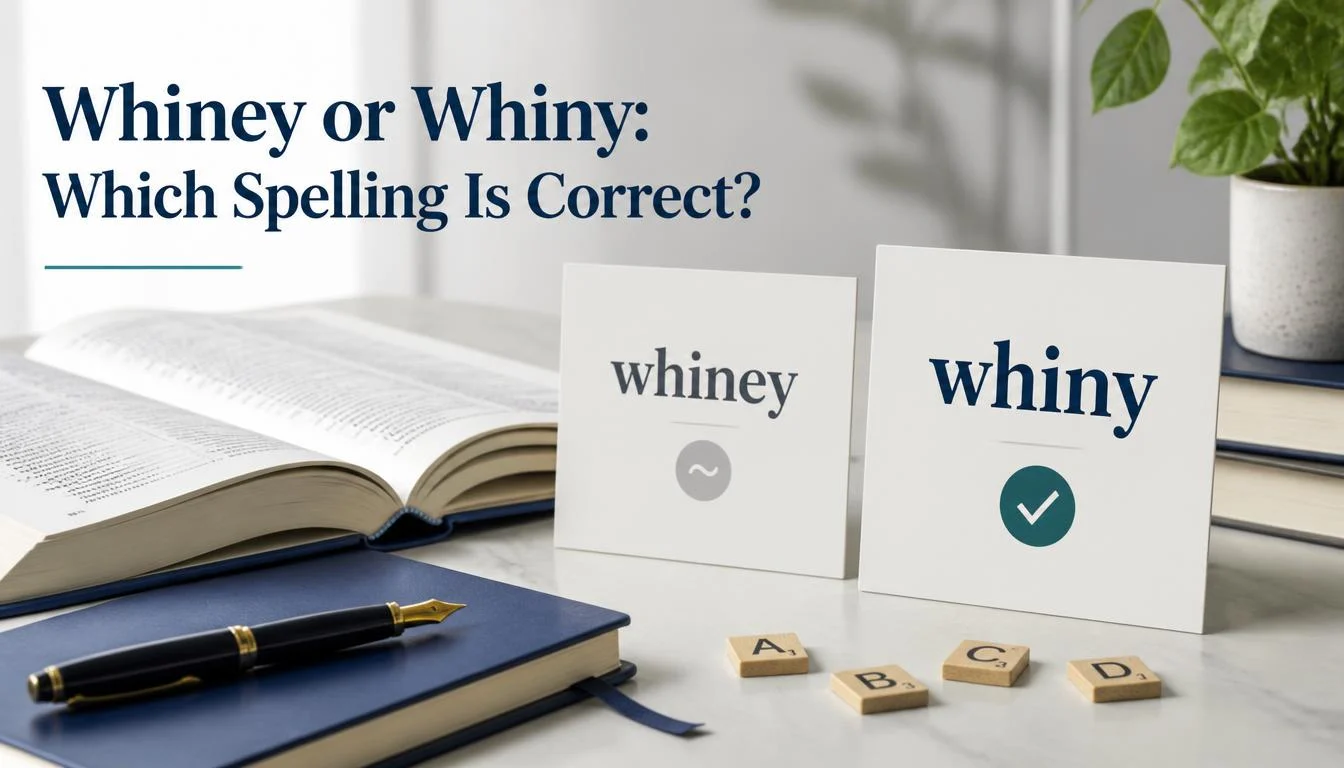
Whiny is the preferred and more common spelling in American English, meaning complaining, fretful, or speaking in an irritating high pitched way.Whiney is also a valid alternative spelling, but it is much less common and is usually not the best choice for standard writing.
If you have ever wondered whether the correct spelling is “whiney or whiny,” you are not alone. These two spellings look almost identical and are often used to describe someone who complains frequently, sounds dissatisfied, or speaks in an irritatingly complaining way. However, when you are writing an email, article, school assignment, or professional message, choosing the standard spelling matters. Knowing which form is preferred can help your writing sound clearer and more polished.
The good news is that the difference between whiney and whiny is fairly simple once you understand the spelling pattern. Whiny is the standard and more widely accepted spelling, while whiney is a less common variant. In this guide, we will explain the meaning of both forms, show you how they are used in real sentences, and clarify which spelling you should choose in different situations.
Which One Is Correct?
Whiny is the best spelling to use in most situations.
It is the established adjective formed from the verb whine. Major dictionaries recognize whiny as the primary spelling and define it as characterized by whining or given to complaining. Merriam Webster also records whiney as a less common variant.
So, if you are writing an email, school assignment, article, report, or other formal text, choose whiny.
That does not mean whiney is simply a spelling mistake. It is a legitimate alternative form. Dictionary.com, Collins, and Merriam-Webster all recognize it.
The practical rule is simple:
Use “whiny” as your default spelling.
You may encounter whiney in books, websites, informal messages, or other real-world writing, but it is less common.
Meaning of the Correct Word
Definition
Whiny is an adjective that describes someone or something that whines.
It can refer to a person who complains repeatedly or annoyingly. It can also describe a voice, sound, musical instrument, or other noise that has a high-pitched or plaintive quality.
For example:
- The child became whiny after missing his afternoon nap.
- She answered in a whiny voice.
- The old machine made a whiny sound.
Merriam-Webster gives both major senses: a high-pitched or plaintive quality and a tendency to complain.
Explanation
The adjective whiny comes from the verb whine.
To whine means to make a prolonged, high-pitched sound or to complain in an irritating, weak, or childish manner. The adjective whiny describes something that has that quality.
This means whiny does not always describe a person.
A voice can be whiny. A child can be whiny. A complaint can sound whiny. Even a guitar or electronic device can have a whiny sound.
The word often carries a negative tone. Calling someone whiny usually suggests that their complaining feels excessive, irritating, childish, or unnecessarily persistent.
Usage
Whiny works as a normal adjective.
It commonly appears before a noun:
- a whiny child
- a whiny customer
- a whiny voice
- a whiny complaint
- a whiny tone
- a whiny guitar
It can also appear after a linking verb:
- The customer sounded whiny.
- His voice became whiny.
- The puppy was unusually whiny.
Its comparative and superlative forms are whinier and whiniest.
For example:
- The baby became whinier as the evening continued.
- That was the whiniest complaint I heard all day.
Real-World Examples
Here are natural examples showing how whiny works in different contexts:
- The toddler was whiny because she was tired.
- His whiny tone made the conversation harder.
- The puppy gets whiny when everyone leaves the house.
- The singer’s voice sounded slightly whiny on that note.
- The manager rejected the proposal because the email sounded too whiny.
- The old fan produced a strange, whiny noise.
- Try to explain the problem without sounding whiny.
- Her character becomes less whiny as the story develops.
These examples show why context matters. Whiny can describe behavior, speech, tone, or sound.
Meaning of the Incorrect or Alternative Word
Incorrect
Whiney is not strictly incorrect.
This is an important distinction. Some spelling guides may mark whiney as incorrect because whiny is the preferred form. However, major dictionaries recognize whiney as an alternative spelling. Merriam-Webster specifically labels it a less common variant.
Therefore, calling whiney completely wrong is too strong.
For standard American English, though, whiny is the safer and more familiar choice.
Typo
Whiney can sometimes appear as an accidental spelling because writers naturally want to preserve the complete spelling of whine.
The reasoning looks logical:
whine + y = whiney
However, English spelling does not always work by simply attaching -y to the entire base word.
The established form is whiny, even though whiney is also recognized as a variant.
Slang
Whiney is not slang.
It does not have a separate slang meaning from whiny. When people use it, they generally mean exactly the same thing as whiny: complaining, fretful, or characterized by a whining sound.
The difference is primarily spelling and frequency, not meaning.
Regional Variation
There is no major American-versus-British meaning difference between whiny and whiney.
Both forms can be found in English varieties, although whiny is the dominant form. Collins lists whiney as an alternative spelling in its American English entry.
So this is not a case like color/colour or center/centre, where national spelling conventions clearly divide the forms.
Rare but Valid Usage
Whiney is best described as a less common but valid alternative spelling.
Dictionary sources support this distinction. Merriam-Webster gives whiny as the main entry and identifies whiney as a less common variant. Collins likewise lists whiney as an alternative spelling.
That makes the choice straightforward: whiny is preferred; whiney is acceptable but uncommon.
Key Differences Between the Two Words
| Feature | Whiny | Whiney |
|---|---|---|
| Spelling | Preferred | Alternative, less common |
| Meaning | Complaining or characterized by whining | Same meaning |
| Pronunciation | “WHY-nee” | “WHY-nee” |
| Grammar | Adjective | Adjective |
| Usage | Common and widely recognized | Less common |
| Recognition | Standard dictionary form | Recognized variant |
| Best for formal writing | Yes | Usually avoid if you can use whiny |
| Comparative | Whinier | Whinier |
| Superlative | Whiniest | Whiniest |
The most important difference is frequency and preference, not meaning.
- Both words are pronounced the same way.
- Both function as adjectives.
- Both describe someone or something connected with whining.
The spelling whiny is simply the form readers are more likely to expect.
Merriam Webster and Collins both recognize whiney, while presenting whiny as the main form.
Common Mistakes People Make
Assuming Whiney Is Always Wrong
One of the most common mistakes is saying that whiney can never be correct.
That is not accurate. Major dictionaries recognize it as an alternative spelling.
A better rule is to call it less common rather than completely incorrect.
Using Whinny Instead
Another common mistake is confusing whiny with whinny.
These words are related in sound but have different meanings.
Whiny describes complaining or a high-pitched, plaintive quality.
Whinny refers to the characteristic sound made by a horse.
Compare:
- The child became whiny after dinner.
- The horse gave a loud whinny.
This distinction is especially important because the three forms—whiny, whiney, and whinny—look remarkably similar.
Adding an Extra N
Some writers use whinny when they mean whiny.
The extra n changes the word.
- whiny = complaining or high-pitched
- whinny = a horse’s sound
Treating Whiny as a Noun
Whiny is an adjective, not a noun.
You would say:
- He sounds whiny.
- She has a whiny voice.
Do not normally use whiny by itself as the name of the behavior. For the noun, use whining or whininess, depending on the sentence.
For example:
- His constant whining became annoying.
- Her whininess frustrated the team.
Using Whiny for Every Complaint
Calling someone whiny is not the same as saying they are simply concerned.
A person can complain for a legitimate reason without being whiny. The adjective usually adds judgment about the manner, tone, or frequency of the complaint.
Compare:
- She complained about the broken heater.
- She sounded whiny while complaining about the heater.
The second sentence suggests an irritating or childish tone.
Correct Usage Examples
Casual Examples
- My little brother gets whiny when he’s hungry.
- Don’t get whiny just because we have to wait.
- The dog has been really whiny today.
- That sounded a little whiny.
- The kids were whiny after the long trip.
These examples fit everyday conversation.
Professional Examples
In professional settings, whiny can sound judgmental, so use it carefully.
- The response sounded somewhat whiny rather than solution-focused.
- The revised statement removes the whiny tone from the original draft.
- A professional complaint should explain the problem without sounding whiny.
- The customer was frustrated, but the message did not sound whiny.
In workplace writing, a more neutral word such as complaining, frustrated, or negative may sometimes be better.
Educational Examples
Teachers and students can use whiny when discussing tone or word choice:
- The character’s whiny behavior makes him less sympathetic.
- The author uses a whiny voice to show the character’s frustration.
- Rewrite the sentence so that it sounds confident instead of whiny.
- The narrator becomes less whiny as the story progresses.
These examples are useful because they show how adjectives can communicate attitude, not just factual description.
Literary/Metaphorical Examples
Whiny can also describe sounds that are not literally human complaints.
- A whiny guitar echoed through the room.
- The old motor produced a whiny hum.
- The wind made a thin, whiny sound through the window.
- The machine’s whiny buzz became impossible to ignore.
This broader use comes from the connection between whine and high-pitched sounds. Merriam-Webster includes both the sound-related and complaint-related senses of whiny.
Word Origin / Etymology
The history of whiny begins with whine.
The verb whine is much older than the adjective. Merriam-Webster traces whine to Middle English and Old English hwīnan, meaning “to whiz.” The word originally related to sharp or sustained sounds.
Over time, whine developed senses connected with plaintive human and animal sounds. It also came to mean complaining in a weak, childish, or irritating manner.
The adjective whiny developed from whine + -y. Etymological sources date the adjective to the mid-19th century, around 1854.
The suffix -y commonly forms adjectives that mean “characterized by” something.
For example:
- cloud → cloudy
- noise → noisy
- dirt → dirty
- whine → whiny
The alternative spelling whiney developed alongside the standard form. It preserves the complete spelling of whine, which may explain why it feels intuitive to many writers.
Why the Incorrect Version Became Popular
The word whiney became popular because its spelling follows a pattern that looks perfectly reasonable.
When people see the verb whine, they may instinctively add -y without removing the final e:
whine + y → whiney
That spelling is easy to understand and visually transparent.
English has many words where adding a suffix changes the spelling of the base word. For example, noise becomes noisy, not noisey. This kind of spelling pattern can make words like whiny less predictable for learners.
There is also a practical reason for the continued existence of whiney: people have used it in real writing for a long time. It is not a modern internet invention or a recent typo. Etymological references record whiney and whiny as forms dating to the same general period.
Modern dictionaries continue to recognize both spellings. However, whiny remains the preferred form in standard usage.
So, if you see whiney, you do not need to assume the writer has made an obvious spelling error. It is simply a less common form.
Easy Memory Tricks
Remember “Whiny” Without the E
Think of the adjective as:
WHINE → WHINY
The final e disappears before the -y ending.
This gives you the preferred spelling quickly.
Connect It With “Noisy”
A useful comparison is:
noise → noisy
whine → whiny
Both adjectives describe a sound or quality, and both use the shorter spelling.
Remember the Horse Rule
If you mean a horse’s sound, use:
whinny
If you mean complaining or an irritating high-pitched tone, use:
whiny
That single distinction can prevent one of the most common spelling mistakes.
Use Whiny as Your Default
When you are unsure whether to write whiney or whiny, choose whiny.
It is concise, familiar, widely recognized, and listed as the primary form by major dictionaries.
FAQs
Is whiny or whiney correct?
Whiny is the preferred spelling. Whiney is also a valid but less common alternative spelling.
Is whiney a misspelling of whiny?
Not necessarily. Major dictionaries recognize whiney as an alternative form of whiny.
How do you spell whiny correctly?
The preferred spelling is whiny, with no e between the n and y.
What does whiny mean?
Whiny describes someone who complains or sounds irritatingly high pitched, plaintive, or fretful.
How do you pronounce whiny?
Whiny is pronounced WHY-nee. The alternative whiney has the same pronunciation.
Is whiny a formal word?
Yes. Whiny is a standard English adjective, although its negative tone may make more neutral alternatives preferable in formal contexts.
What is the difference between whiny and whinny?
Whiny means complaining or high pitched. Whinny refers to the sound made by a horse.
What is the plural or comparative form of whiny?
The comparative is whinier, and the superlative is whiniest.
Conclusion
When choosing between whiney or whiny, use whiny as the standard and preferred spelling.Whiney is not meaningless or entirely wrong, but it is a less common alternative recognized by major dictionaries.Remember that whiny describes complaining or a high-pitched quality, while whinny refers to a horse’s sound.When in doubt, drop the final e from whine and choose whiny the simpler spelling is the safer choice.
Read More Articles
- Innie vs Outie | Meaning, Differences, and Common Usage In 2026
- Dependent or Dependant | Meaning, Spelling, and Usage Explained In 2026

Jessica Morgan is a blogger and writer at GramScript.com, where she turns everyday ideas into engaging, relatable stories. Her writing blends a natural voice with fresh perspectives that keep readers coming back.
4 thoughts on “Whiney or Whiny | A Quick Guide to the Right Spelling In 2026”