Quick Answer
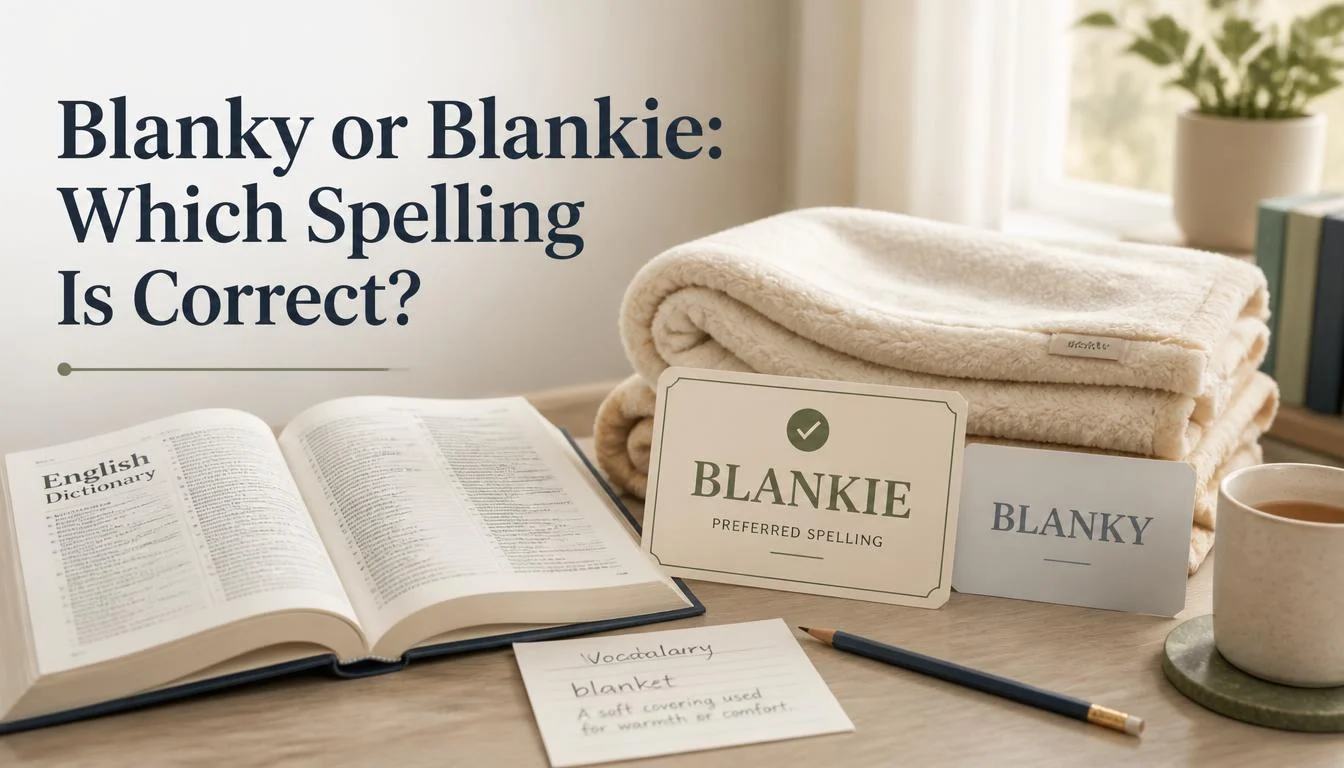
Blankie is the more common spelling for the informal word meaning a favorite blanket, especially a child’s comfort blanket.Blanky is also used, but it is a less common alternative spelling rather than a completely incorrect word.
When talking about a soft, comforting blanket, you may come across both blanky or blankie in casual English. These spellings are especially common when people use affectionate or childlike language for a favorite blanket. Although they look slightly different, both forms are informal and are generally understood to refer to the same cozy object.
The main difference comes down to spelling preference and usage rather than meaning. Blankie is a familiar affectionate spelling, while blanky is another informal variant that appears in everyday speech and writing. If you’re unsure which one to use, understanding their tone, pronunciation, and common contexts can help you choose the version that fits your sentence naturally.
Which One Is Correct?
Both blankie and blanky can be found as informal spellings, but blankie is the more established and widely recognizable form.
The key point is that this is not a standard-versus-completely-wrong spelling pair like definitely and definately. Instead, it is a comparison between two informal variants of the same affectionate word.
Blankie is especially common when referring to a child’s treasured blanket or a familiar comfort object. Parents may say things such as, “Where is your blankie?” or “Don’t forget your blankie.”
Blanky can communicate the same meaning. Some families and speakers prefer it because the spelling resembles the pronunciation more closely. However, readers are generally more likely to recognize blankie immediately.
For general writing, blankie is the better choice. For a family nickname, character name, or deliberately informal voice, blanky can still work.
Meaning of the Correct Word
Definition
Blankie is an informal, affectionate word for a blanket, especially one that a child uses for comfort or security.
It often refers to a particular blanket rather than blankets in general. A child might have one favorite blanket that they carry everywhere, sleep with, or hold when they feel tired or upset.
The word can also be used affectionately by adults when talking about a child’s belongings. For example:
“Mia can’t fall asleep without her blankie.”
Here, blankie does not describe a special type of fabric. It describes the blanket through its emotional or familiar role.
Explanation
The word blankie comes from blanket with an affectionate ending. English speakers often create informal words this way, particularly when talking to or about children.
The ending makes the word sound softer and more personal. Compare these ordinary and affectionate forms:
| Standard word | Informal or affectionate form |
|---|---|
| blanket | blankie |
| dog | doggie |
| aunt | auntie |
| cookie | cookie |
| kitty | kitty |
The pattern is not perfectly mechanical, so English speakers do not always agree on spelling. That helps explain why blanky exists alongside blankie.
Usage
Blankie is mainly used in informal situations. It works well in family conversations, parenting discussions, children’s stories, casual messages, and dialogue.
It is less suitable for formal reports or technical descriptions. In professional writing, simply use blanket unless the affectionate meaning is important.
For example:
- “The child reached for her blankie.” natural and informal
- “The patient was provided with a warm blanket.” professional and neutral
- “The toddler brought his favorite blankie to daycare.” natural
- “The laboratory blanket was sterilized before use.” blankie would sound inappropriate
The context determines whether the affectionate form feels natural.
Real-World Examples
Here are several natural examples:
- “Leo refuses to sleep without his blankie.”
- “She packed her favorite blankie for the overnight trip.”
- “The baby calmed down as soon as Dad handed her the blankie.”
- “We washed the blankie before bedtime.”
- “Her old blankie has become a treasured childhood keepsake.”
- “The puppy curled up beside the child’s blankie.”
In each example, the word has an affectionate, personal tone.
Meaning of the Incorrect or Alternative Word
Incorrect
Blanky is not best described as completely incorrect. It is an informal alternative spelling of blankie.
Still, if you want the spelling that most readers will recognize as the conventional informal form, blankie is usually the stronger choice.
Calling blanky “wrong” can therefore be misleading. The distinction is mainly one of frequency, familiarity, and stylistic preference.
Typo
In some contexts, blanky may simply be a spelling variation or an accidental substitution of y for ie.
Writers sometimes produce blanky because the pronunciation can naturally suggest that ending. However, not every occurrence is a typo. Some speakers intentionally use blanky as their preferred spelling.
That makes context important.
Slang
Neither form is serious formal English. Both belong to informal, affectionate vocabulary.
However, blankie is better described as a childish or affectionate informal word than as slang. Slang often carries a strong social or cultural identity, while blankie is simply a cute variation of blanket.
Regional Variation
There is no strict American-versus-British rule that makes one spelling universally correct.
English speakers in different families and communities may choose different spellings. Online writing also allows personal variants to spread quickly.
For American English readers, blankie is generally the clearest choice when you want this affectionate meaning.
Rare but Valid Usage
Blanky can be valid in deliberately informal writing. It may appear in family speech, children’s dialogue, usernames, product names, or creative writing.
For example:
“Where’s my blanky?”
That sentence sounds perfectly understandable in a child’s voice.
The important distinction is between recognizable informal usage and preferred general usage. Blanky can work, but blankie is usually easier for a broad audience to recognize.
Key Differences Between the Two Words
The two spellings have almost the same meaning. Their main difference is how familiar and conventional each spelling feels.
| Feature | Blankie | Blanky |
|---|---|---|
| Spelling | More common informal spelling | Less common alternative |
| Meaning | An affectionate word for a blanket | Same basic meaning |
| Pronunciation | Commonly pronounced “BLANG-kee” | Commonly pronounced “BLANG-kee” |
| Grammar | Informal noun | Informal noun |
| Usage | Family speech, children’s language, casual writing | Family speech, casual writing, creative usage |
| Recognition | More widely recognized | Recognizable but less conventional |
| Tone | Cute, affectionate, familiar | Cute, playful, highly informal |
| Formality | Informal | Informal |
| Best general choice | Yes | Usually no |
Spelling Is the Main Difference
The biggest difference is simply the final spelling.
Blankie uses -ie, while blanky uses -y.
This resembles other affectionate English forms where the ending can vary. English does not have one universal rule for creating these forms, so usage develops through habit.
Pronunciation Is Usually the Same
Most speakers pronounce both words approximately like “BLANG-kee.”
The spelling does not normally create a major pronunciation difference. If someone says blanky and another person says blankie, listeners will usually understand the same word.
Grammar Is Also the Same
Both words function primarily as nouns.
For example:
- “Her blankie is on the bed.”
- “Her blanky is on the bed.”
The grammatical role is identical. The difference lies in spelling and stylistic preference, not sentence structure.
Recognition Favors Blankie
When a word is highly informal, familiarity matters. Blankie immediately signals an affectionate form of blanket to many readers.
Blanky may still be understood, but some readers could pause and wonder whether it is a personal spelling, a nickname, or a typo.
That is why blankie is generally the safer choice for broad informal writing.
Common Mistakes People Make
Treating Blanky as Completely Wrong
One common mistake is assuming that blanky can never be used.
That is too strict. It is an informal spelling that people do use. The better explanation is that blankie is more conventional, while blanky is an alternative.
Using Blankie in Formal Writing
Another mistake is using blankie when the context requires neutral language.
For example:
“The hospital provided the patient with a clean blankie.”
If the writing is a formal medical report, blanket is more appropriate.
However, if a parent is telling a story about a child in the hospital, blankie may be exactly the right word.
Assuming Every Informal Word Has One Correct Spelling
Affectionate vocabulary often develops naturally in speech. People may spell the sounds in different ways.
Words such as doggie, doggy, mommy, and mummy show how English spelling can vary according to usage, dialect, and context.
Therefore, informal words should not always be judged by the same standard as formal vocabulary.
Confusing a Comfort Blanket With Any Blanket
The word blankie often carries an emotional meaning.
A blanket on a hotel bed is normally just a blanket. A child’s treasured blanket that they carry from room to room may be called a blankie.
The distinction comes from tone and context rather than from the object’s physical construction.
Overusing the Cute Form
Even in casual writing, blankie can sound too childish in some situations.
For example, an adult discussing bedding with a store employee would probably say:
“I’m looking for a lightweight blanket.”
They would rarely say:
“I’m looking for a lightweight blankie.”
The second sentence sounds deliberately cute or playful.
Correct Usage Examples
Casual Examples
Casual conversation is where blankie feels most natural.
- “Did you bring your blankie?”
- “Her blankie is still in the car.”
- “He won’t sleep unless he has his blankie.”
- “I need to wash the baby’s blankie.”
- “Where did you put the little one’s blankie?”
These examples use the word naturally because the situations are personal and informal.
Professional Examples
Professional writing usually calls for blanket, not blankie.
Consider these examples:
- “The nurse placed a warm blanket over the patient.”
- “The hotel provides an extra blanket upon request.”
- “The manufacturer tested the blanket for durability.”
- “The shelter distributed blankets to families.”
If a professional text specifically discusses a child’s comfort object, blankie may appear in a quotation or informal description.
For example:
“The child repeatedly asked for her ‘blankie’ during the interview.”
Here, the informal word has a purpose because it reflects the child’s language.
Educational Examples
Teachers and children’s authors may use blankie to create a friendly, age-appropriate tone.
Examples include:
- “Emma hugged her blankie before going to sleep.”
- “Bring your favorite blankie to story time.”
- “The puppy found a soft blankie in the basket.”
- “Sam learned to fold his blankie after bedtime.”
The word helps create warmth and familiarity.
Literary/Metaphorical Examples
Writers can also use blankie to evoke childhood memories or emotional comfort.
For example:
“The faded blankie reminded her of quiet nights at her grandmother’s house.”
Here, the word does more than identify fabric. It creates a nostalgic feeling.
A writer could also use the term metaphorically in playful prose:
“After a difficult day, the old blanket felt like a blankie for the soul.”
This is creative language rather than a literal definition.
Word Origin / Etymology
The history of blankie begins with the ordinary English noun blanket.
The word blanket has a long history in English and is associated with a heavy or warm covering. Its history is connected to Old French blanc, meaning “white,” because early blankets were associated with undyed or naturally light-colored woolen cloth.
Over time, blanket became the ordinary English word for a covering used for warmth.
Blankie developed much later as an affectionate, informal formation. English speakers frequently modify familiar nouns when talking to children or expressing affection. A softer ending can make an ordinary object sound personal and comforting.
The exact point at which blankie became established is difficult to assign to one moment. Informal vocabulary often develops gradually through speech rather than through a single documented naming event.
The spelling blanky follows the same general idea but uses -y instead of -ie. Because informal English does not always follow fixed spelling rules, both forms can emerge naturally.
Why the Incorrect Version Became Popular
Calling blanky the “incorrect version” gives the spelling more of a grammatical problem than it actually has.
Its popularity is easy to understand. When people hear blankie, the final sound may be interpreted as a simple long-e sound. English speakers often represent that sound with y in informal words.
For example, English has familiar forms such as doggy, kitty, and mommy. These patterns may encourage a writer to choose blanky naturally.
There is also a practical reason: people often spell informal words according to how they sound. If a person hears “BLANG-kee,” they may reasonably write blanky without realizing that blankie is the more established spelling.
Personal and family vocabulary adds another layer. Parents may invent or settle on their own spelling for a child’s favorite object. Once a family uses one spelling for years, that version feels completely natural to them.
The internet has also made informal spellings more visible. A word does not need to appear in formal publications to circulate widely. Messages, social posts, parenting forums, product descriptions, and children’s content can all reinforce alternative spellings.
So, while blankie remains the better general choice, blanky is understandable because English naturally allows variation in affectionate speech.
Easy Memory Tricks
A simple way to remember the preferred spelling is to connect blankie with cookie, auntie, and similar affectionate forms.
Think:
blanket → blankie
The -ie ending makes the word look like a deliberately affectionate form.
Another useful trick is to remember:
Blankie = blanket + a cute ending
If you are writing for a general audience and are unsure which spelling to choose, pick blankie.
You can also use the context test:
Formal or neutral? Use blanket.
Affectionate and informal? Use blankie.
Personal family spelling? Blanky can work.
This approach avoids treating the choice as a strict grammatical rule when it is really a matter of informal usage.
FAQs
Is blankie a real word?
Yes. Blankie is an informal word for a blanket, especially a child’s favorite comfort blanket.
Is blanky spelled correctly?
Blanky is an informal alternative spelling, but blankie is generally the more recognizable choice.
What does blankie mean?
Blankie usually means a favorite or comfort blanket, often one associated with a young child.
How do you pronounce blankie?
Blankie is commonly pronounced “BLANG-kee.”
Is blankie a slang word?
It is informal and affectionate rather than typical slang. It is commonly associated with children and family speech.
Should I use blankie or blanket?
Use blanket for neutral or formal writing and blankie when you want an affectionate, informal tone.
Is blankie only for children?
No. The word is strongly associated with children, but adults can use it affectionately when discussing a treasured blanket or childhood comfort object.
Why do people spell it blanky?
People may choose blanky because the spelling reflects the sound they hear or because it is a personal family spelling. Blankie is generally more conventional.
Conclusion
When choosing between blanky or blankie, blankie is usually the clearest and more familiar informal spelling for a comfort blanket.Blanky is not necessarily wrong, but it is a less common alternative that can feel more personal or playful.Use blanket in formal or neutral contexts, and choose blankie when the affectionate meaning matters.Remember the simple rule: blanket for neutral writing, blankie for comfort and affection.
Read More Articles
- Whiney or Whiny | A Quick Guide to the Right Spelling In 2026
- Grandad or Granddad | Meaning, Spelling and Usage Explained In 2026

Andrew Cooper is a blogger and writer at Gramscript.com, turning everyday ideas into clear, engaging stories. His writing blends curiosity, insight and a genuinely human perspective.
1 thought on “Blanky or Blankie | The Difference Between These Two Spellings In 2026”