Quick Answer
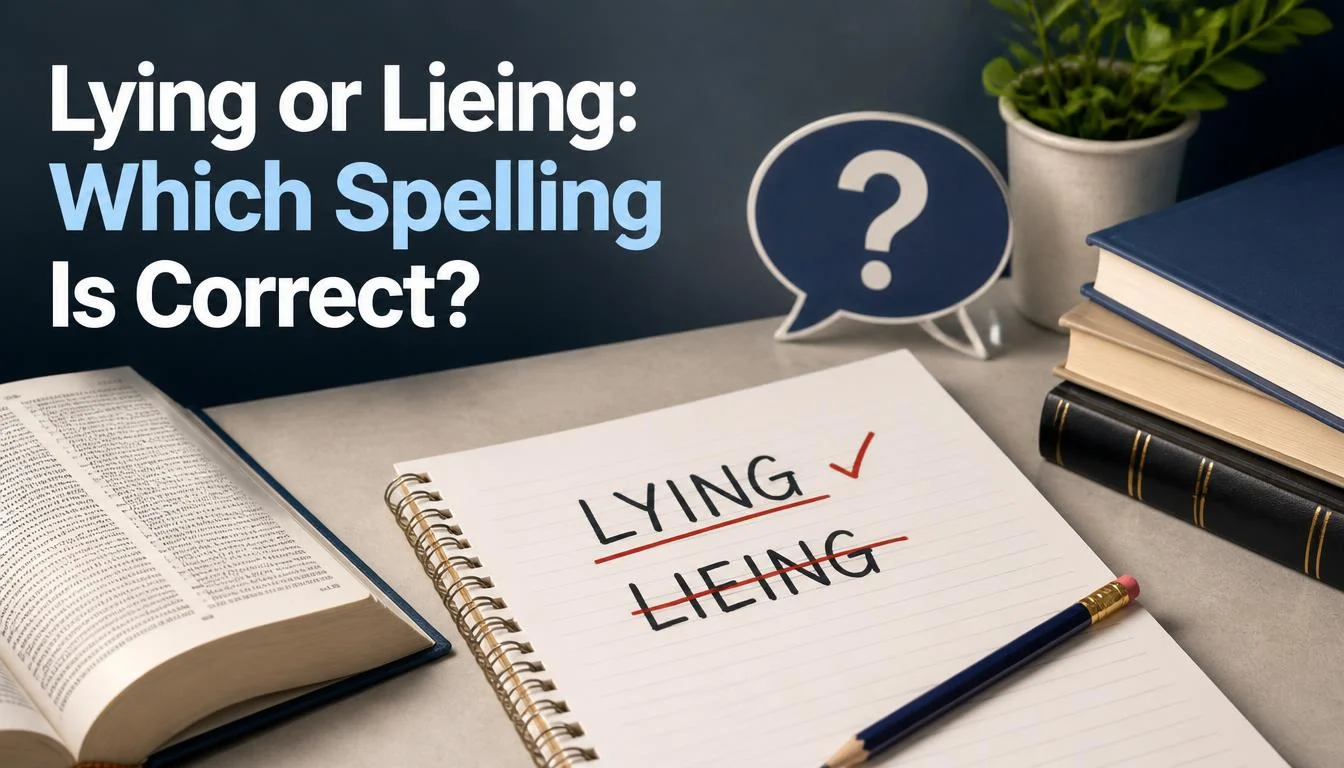
Lying is the correct spelling. Lieing is incorrect because the verb lie drops its final e before adding ing.
If you have ever wondered whether lying or lieing is the correct spelling, you are not alone. The confusion usually comes from adding -ing to the verb lie. At first glance, lieing may seem logical, but English spelling rules change the form of the word when the suffix is added. The correct spelling is lying, while lieing is considered incorrect.
Understanding why lying is correct can make this spelling easier to remember. The word lying can refer to telling something untrue or being in a reclining position, depending on the context. In this guide, we’ll explain the spelling rule, clarify the meaning of lying, and provide simple examples so you can confidently use the correct form in your writing.
Which One Is Correct?
Lying is the correct spelling in standard American English.
The word lying comes from the verb lie. When lie takes the present participle ending -ing, its final e is removed and the y remains:
lie → lying
The form lieing is incorrect in standard English. You should not use it in school assignments, professional writing, formal messages, or edited content.
The same spelling applies to both major meanings of lie:
- To lie down: “I am lying on the couch.”
- To tell an untruth: “He is lying about what happened.”
The pronunciation also stays straightforward. Lying is pronounced approximately LYE-ing, with two clear syllables.
Meaning of the Correct Word
Definition
Lying is the present participle of the verb lie. It can describe someone being in a horizontal position or someone making a false statement.
For example:
- “The cat is lying under the table.”
- “She is lying about her age.”
The context tells you which meaning applies.
Explanation
English has two common verbs spelled lie, and they have different meanings.
The first means to be in or move into a horizontal or resting position. Its forms include:
| Verb form | Example |
|---|---|
| Base form | lie |
| Past tense | lay |
| Past participle | lain |
| Present participle | lying |
The second lie means to make a false statement deliberately. Its forms are:
| Verb form | Example |
|---|---|
| Base form | lie |
| Past tense | lied |
| Past participle | lied |
| Present participle | lying |
Notice something important: both verbs produce lying in the present participle.
That means you do not need to decide between lying and lieing based on meaning. Lying is correct in both cases.
Usage
Use lying when lie functions as a present participle or gerund.
As a present participle, it commonly appears with forms of be:
- “She is lying on the bed.”
- “They were lying in the grass.”
- “He has been lying to everyone.”
As a gerund, lying can function like a noun:
- “Lying to your friends can damage trust.”
- “He dislikes lying about his feelings.”
The word may describe physical position or dishonesty.
Real-World Examples
Here are examples showing both meanings clearly:
- “I found my phone lying beside the sofa.”
- “The children were lying on the floor.”
- “He is lying about where he went.”
- “She admitted to lying during the interview.”
- “The book was lying open on the desk.”
- “Why are you lying to me?”
- “The dog is lying quietly in the shade.”
- “The witness was accused of lying.”
These examples show why context matters, but the spelling never changes to lieing.
Meaning of the Incorrect or Alternative Word
Incorrect
Lieing is not the standard spelling of the present participle of lie.
Although it may seem logical to write lie + ing = lieing, English spelling rules do not allow that form here. The final e is dropped before -ing is added.
Therefore:
lie + ing → lying
Not:
lie + ing → lieing
Typo
Lieing most often appears as a spelling mistake.
People may write it because they remember the general idea that verbs can take -ing without changing their spelling. They may also compare it with words such as seeing, where the spelling behaves differently.
Because lieing resembles the base word lie, the error can look convincing at first glance.
Modern spell-checkers usually identify it as incorrect, but knowing the rule is more useful than relying on automatic correction.
Slang
Lieing is not a recognized standard slang form of lying.
You may occasionally encounter it in informal online writing, comments, usernames, or social media posts. Such examples do not make the spelling grammatically correct.
Informal writing often contains intentional misspellings, but those forms should not be copied into formal English.
Regional Variation
Lieing is not a standard American or British spelling variation.
The correct form is lying in both American and British English. The difference is not regional.
So if you are writing for a U.S., Canadian, British, Australian, or other English-speaking audience, lying is the safe standard form.
Rare but Valid Usage
There is no standard English verb form lieing that serves as the ordinary present participle of lie.
If you see the spelling in a historical text, specialized source, personal writing, or an online post, it should not be treated as the modern standard form simply because it exists somewhere.
For everyday English, the rule is simple: use lying.
Key Differences Between the Two Words
The most important difference is that one form is standard and the other is a spelling error.
| Feature | Lying | Lieing |
|---|---|---|
| Spelling | Correct | Incorrect |
| Meaning | Present participle of lie | No standard modern meaning |
| Pronunciation | LYE-ing | Not a standard pronunciation |
| Grammar | Standard grammatical form | Nonstandard spelling |
| Usage | Formal and informal English | Usually a spelling mistake |
| Recognition | Accepted in dictionaries and edited writing | Not accepted as the standard form |
| Formation | lie → lying | lie → lieing is incorrect |
The spelling difference comes from a common English rule involving final e.
Many verbs ending in silent e drop that letter before -ing:
- make → making
- take → taking
- write → writing
- use → using
- move → moving
- hope → hoping
The same principle applies to lie, but the result also involves the letter y:
lie → lying
The spelling does not become lieing.
Why Does “Lie” Become “Lying”?
The change can seem unusual because the word already contains ie.
English spelling uses y in the form lying to preserve the pronunciation and established spelling pattern of the word. The final e disappears, while the y remains.
This gives us:
L I E → L Y I N G
The result looks different from the base verb, but it is completely standard.
Common Mistakes People Make
Writing “lieing” Instead of “lying”
This is the most common mistake.
Incorrect:
“He is lieing on the couch.”
Correct:
“He is lying on the couch.”
The easiest solution is to remember the complete word rather than trying to build it letter by letter.
Confusing “Lying” With “Laying”
Another common problem involves lying and laying.
Lying comes from lie, meaning to recline or rest.
Laying comes from lay, meaning to put or place something somewhere.
Compare:
- “I am lying on the bed.”
- “I am laying the blanket on the bed.”
You lie yourself down, but you lay something down.
Confusing “Lying” With “Lied”
The words lying and lied also come from the verb lie, but they have different grammatical roles.
- Present participle: “He is lying.”
- Simple past: “He lied yesterday.”
- Past participle: “He has lied before.”
If you are describing an action happening now, lying is often the correct form.
Confusing the Two Meanings of “Lie”
The verb lie has two important meanings.
One refers to physical position:
“She is lying on the floor.”
The other refers to dishonesty:
“She is lying about the money.”
Both use lying.
Assuming Every “-ing” Form Keeps the Base Spelling
English spelling does not always work by simply attaching -ing.
For example:
- write → writing
- dance → dancing
- hope → hoping
- come → coming
The final e disappears in these forms.
However, some verbs behave differently, which is why spelling patterns must be learned individually.
Correct Usage Examples
Casual Examples
These sentences reflect everyday conversation:
- “I’m lying on the couch.”
- “Why are you lying to me?”
- “The baby is lying in her crib.”
- “I just want to lie down.”
- “He’s lying about what he did.”
- “The dog was lying by the door.”
These forms sound natural in ordinary speech.
Professional Examples
The word also appears frequently in workplace and formal contexts:
- “The employee denied lying during the investigation.”
- “The documents were lying on the conference table.”
- “The witness was accused of lying under oath.”
- “Several files were lying unopened in the office.”
- “The report addressed concerns about misleading statements.”
The correct spelling remains lying regardless of the level of formality.
Educational Examples
Teachers and students may encounter the word in grammar lessons:
- “The student is lying on the reading mat.”
- “Lying is used as the present participle of lie.”
- “Remember that lie becomes lying, not lieing.”
- “The sentence uses lying as a gerund.”
- “The teacher explained the difference between lying and laying.”
These examples demonstrate both spelling and grammatical function.
Literary/Metaphorical Examples
Lying can also create vivid descriptions:
- “The old house was lying silent beneath the snow.”
- “A forgotten letter was lying between the pages.”
- “He was lying to himself about what he wanted.”
- “The village lay beyond the hills, sleeping beneath the evening sky.”
In literary writing, the physical meaning of lying can create a sense of stillness, while the figurative meaning can suggest denial or deception.
Word Origin / Etymology
The two major verbs spelled lie have different historical backgrounds.
The verb lie, meaning to recline or rest, comes from Old English licgan. It is related to older Germanic words associated with remaining in a horizontal or resting position.
The verb lie, meaning to tell an untruth, has a different history. It comes from Old English leogan, meaning to lie or tell a falsehood.
Over time, English developed the modern forms lie, lay, lain, and lying for the physical-position verb, while the dishonesty verb developed forms such as lie, lied, and lying.
This history helps explain why the two verbs share the spelling lie today even though their origins differ.
The present participle lying became the established English form. The spelling reflects the language’s historical development rather than a simple modern formula of attaching letters to the base verb.
Why the Incorrect Version Became Popular
The spelling lieing is easy to produce because it appears to follow a logical pattern.
A learner sees:
lie + ing
It seems natural to combine the two parts directly:
lieing
But English spelling does not always preserve every letter of the base form when suffixes are added.
The final e in many verbs disappears before -ing:
- bake → baking
- smile → smiling
- drive → driving
- save → saving
- close → closing
The same idea applies to lie, although the resulting form is visually less predictable:
lie → lying
Another reason for the confusion is that ie appears in many English words. Learners may expect those letters to remain together.
There is also the separate word lying, which can mean telling an untruth. Because both verbs share the same present participle spelling, learners may assume there should be different forms for different meanings. There are not.
The spelling is determined by the verb form, not by whether the person is reclining or being dishonest.
Easy Memory Tricks
Remember “Drop the E”
Use this simple pattern:
lie + ing → drop e → lying
Think of the final e as a letter that leaves before -ing arrives.
Remember “Lie Down, Then Drop E”
When you want to describe someone resting, think:
lie down → lying down
The phrase lying down is especially useful because it reinforces the correct spelling.
Use the “LY” Reminder
Look at the beginning of the correct form:
LY-ing
The word starts with ly, not lie.
You can remember:
Lie loses E and becomes LYING.
Compare It With Similar Verbs
A useful spelling family is:
- write → writing
- drive → driving
- make → making
- take → taking
- lie → lying
These examples reinforce the idea that the final e can disappear before -ing.
Test the Sentence
If you are unsure, replace lying with another -ing verb.
For example:
“She is ___ on the bed.”
The sentence needs a present participle. The correct form is:
“She is lying on the bed.”
Never choose lieing.
FAQs
Is “lying” or “lieing” correct?
Lying is correct. Lieing is a misspelling in standard English.
Why is “lieing” wrong?
The final e in lie is removed before -ing is added, producing lying.
How do you spell lying down?
The correct spelling is lying down. For example, “I am lying down on the sofa.”
Is “lying” a real word?
Yes. Lying is the present participle and gerund form of lie.
Is “lieing” ever correct?
Not in standard modern English. It is generally a spelling mistake rather than an accepted variant.
What is the difference between lying and laying?
Lying means reclining or being dishonest, while laying means putting or placing something somewhere.
Is lying American or British English?
Lying is standard in both American and British English. It is not a regional spelling difference.
What is the past tense of lie?
It depends on the meaning. For reclining, the past tense is lay; for telling an untruth, it is lied.
Conclusion
When choosing between lying or lieing, always use lying in standard English.The final e in lie drops before -ing, giving us the correct form lying.The word can describe resting in a position or telling something untrue, depending on context.Remember the simple rule: lie loses the e, and lying gets the win.
Read More Articles
- Behaviour or Behavior | Everything You Need to Know About the Spelling In 2026
- Whose or Who’s | Understanding Possession and Contractions In 2026

Jessica Morgan is a blogger and writer at GramScript.com, where she turns everyday ideas into engaging, relatable stories. Her writing blends a natural voice with fresh perspectives that keep readers coming back.